In brief
Water connects every part of the Earth system.
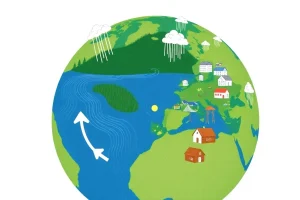
It evaporates from oceans, forms clouds, falls as rain or snow, flows through rivers, infiltrates soils, feeds groundwater, nourishes forests, supports agriculture, and eventually returns to the atmosphere through evaporation and plant transpiration.
This continuous circulation—known as the global water cycle or hydrological cycle—links the atmosphere, oceans, land, ice, ecosystems, and human societies into one interconnected system.
For centuries, this cycle remained relatively stable. Rainfall patterns shifted naturally from year to year, rivers experienced seasonal floods, and droughts periodically occurred. These variations were part of Earth’s normal climate system.
Today, however, human activities are altering the freshwater cycle on a planetary scale.
Climate change is changing when, where, and how precipitation falls. Deforestation is reducing moisture recycling. Groundwater is being depleted faster than it can recharge in many regions. Rivers are fragmented by dams and diversions. Urbanization replaces permeable soils with concrete. Agriculture consumes around 70% of global freshwater withdrawals, fundamentally reshaping water availability for both people and ecosystems. (Planetary Health Check)
Because freshwater is essential for ecosystems, food production, biodiversity, climate regulation, and human well-being, the Planetary Boundaries framework identifies Freshwater Change as one of the nine critical Earth-system processes that define Earth’s safe operating space.
Modern assessments show that this boundary has already been exceeded. Human activities now cause anomalously wet or dry streamflow and soil-moisture conditions across roughly twice as much land area as under pre-industrial-like conditions, placing Earth’s freshwater systems in an increasing-risk zone. (Planetary Health Check)
Quick Answer
Freshwater change refers to large-scale human alteration of Earth’s freshwater cycle, including rivers, lakes, groundwater, wetlands, and soil moisture.
Unlike earlier approaches that focused mainly on water withdrawals, the modern planetary-boundary framework evaluates both blue water and green water:
- Blue water — rivers, lakes, reservoirs, wetlands, and groundwater
- Green water — soil moisture available to plants
According to the Planetary Health Check 2025, both control variables exceed their safe boundaries:
| Control Variable | Planetary Boundary | 2025 Value | Status |
|---|---|---|---|
| Blue water disturbance | 12.9% of ice-free land | 22.6% | Breached |
| Green water disturbance | 12.4% of ice-free land | 22.0% | Breached |
These disruptions increase risks for ecosystems, agriculture, climate regulation, biodiversity, and human water security. (Planetary Health Check)
Why Freshwater Is More Than Drinking Water
Many people think freshwater simply means water people use.
Earth System Science views freshwater differently.
Freshwater is an active regulator of the Earth system.
It influences:
- Climate
- Ecosystems
- Carbon cycling
- Soil formation
- Agriculture
- Atmospheric circulation
- Biodiversity
- Human civilization
Water moves continuously among Earth’s major spheres:
- Atmosphere
- Hydrosphere
- Cryosphere
- Geosphere
- Biosphere
Every one of these exchanges affects the others.
The Global Water Cycle
The hydrological cycle begins with solar energy.
Sunlight causes water to evaporate from:
- Oceans
- Lakes
- Rivers
- Wetlands
- Soils
- Vegetation
Plants also release water through transpiration.
Together these processes are known as evapotranspiration.
Water vapor enters the atmosphere where it:
- Condenses
- Forms clouds
- Produces precipitation
Rain and snow then:
- Flow into rivers
- Recharge groundwater
- Enter lakes
- Replenish soil moisture
- Support ecosystems
Eventually, the water returns to oceans and the cycle repeats.
The remarkable feature of this cycle is not simply that water moves.
It links nearly every Earth-system process.
Blue Water and Green Water
Modern freshwater science distinguishes between two complementary forms of water.
Blue Water
Blue water includes visible freshwater stored in:
- Rivers
- Lakes
- Reservoirs
- Wetlands
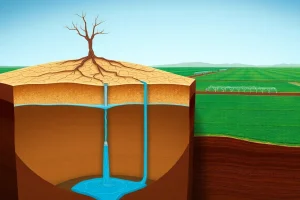
- Groundwater aquifers
This is the water most commonly used for:
- Drinking
- Irrigation
- Industry
- Hydropower
Blue water also supports freshwater ecosystems and transports nutrients and sediments.
Green Water
Green water is the water stored within soils and available to plants.
Although invisible compared with rivers, green water is equally important.
It supports:
- Forests
- Grasslands
- Agriculture
- Soil organisms
- Carbon uptake
- Evapotranspiration
Green water strongly influences regional rainfall because vegetation returns large quantities of moisture to the atmosphere.
The latest Planetary Health Check emphasizes that understanding only rivers and groundwater is insufficient. Soil moisture must also remain within safe limits because it links ecosystems, climate, and food production. (Planetary Health Check)
Why Soil Moisture Matters
Green water may be one of the least appreciated parts of the Earth system.
Healthy soils:
- Store rainfall
- Reduce floods
- Support crops
- Sustain forests
- Recharge groundwater
- Moderate drought
When soils dry excessively:
- Plant productivity declines.
- Carbon uptake decreases.
- Wildfire risk increases.
- Regional rainfall may weaken.
- Biodiversity suffers.
When soils become unusually wet:
- Oxygen declines.
- Root systems weaken.
- Nutrient loss increases.
- Agriculture becomes more difficult.
Maintaining stable soil moisture is therefore essential for both ecosystems and climate.
The Freshwater Planetary Boundary
The original 2009 planetary-boundary framework focused mainly on freshwater withdrawals.
Research over the following decade demonstrated that this approach overlooked critical aspects of Earth’s water cycle.
Freshwater assessments now examine human-induced deviations in:
- Streamflow (blue water)
- Root-zone soil moisture (green water)
Instead of asking:
“How much water do humans withdraw?”
Scientists increasingly ask:
“How much has humanity altered the natural functioning of Earth’s water cycle?”
This systems perspective better reflects how freshwater influences ecosystems and climate. (Planetary Health Check)
Current State of the Freshwater Boundary
The Planetary Health Check 2025 reports:
Blue Water
- Current disturbance: 22.6%
- Safe boundary: 12.9%
Green Water
- Current disturbance: 22.0%
- Safe boundary: 12.4%
Both variables have exceeded their boundaries since approximately the 1940s and have continued increasing. Large areas of the world now experience much greater deviations from pre-industrial-like streamflow and soil-moisture conditions. (Planetary Health Check)
What Drives Freshwater Change?
Freshwater change results from multiple interacting pressures rather than a single cause.
Climate Change
Climate change has become the dominant global driver.
A warmer atmosphere holds more water vapor.
This alters:
- Rainfall intensity
- Storm frequency
- Snowfall
- Evaporation
- Drought
- Floods
Some regions become wetter.
Others become drier.
Hydrological variability increases almost everywhere. (Planetary Health Check)
Water Withdrawals
Agriculture is the largest user of freshwater worldwide.
Large-scale withdrawals reduce:
- River flow
- Lake levels
- Wetland extent
- Groundwater storage
Groundwater pumping can exceed natural recharge for decades, lowering aquifers and affecting rivers connected to them. (Planetary Health Check)
Dams and River Regulation
Reservoirs provide:
- Water supply
- Flood control
- Electricity
- Irrigation
However, they also modify:
- Natural flood cycles
- Sediment transport
- Fish migration
- Downstream ecosystems
River regulation changes ecological conditions even when total water volume remains similar.
Land-Use Change
Deforestation, agriculture, and urbanization alter how landscapes store and release water.
Clearing forests:
- Reduces evapotranspiration
- Weakens rainfall recycling
- Increases runoff
- Lowers soil moisture
Urban surfaces prevent infiltration and accelerate storm runoff.
Groundwater Depletion
Aquifers accumulated water over centuries or millennia.
Excessive pumping may lower groundwater faster than natural recharge.
Consequences include:
- Land subsidence
- Reduced river flow
- Saltwater intrusion
- Increased drought vulnerability
Freshwater and Climate
Freshwater and climate influence one another continuously.
Climate affects:
- Evaporation
- Rainfall
- Snow
- Ice melt
- Soil moisture
Freshwater influences:
- Cloud formation
- Atmospheric humidity
- Surface temperature
- Carbon uptake
- Vegetation
Forests illustrate this relationship.
Trees transport enormous quantities of water from soils into the atmosphere.
Some rainfall falling hundreds of kilometers away originated as water released by forests.
Destroying forests therefore affects climate partly by disrupting the water cycle.
Freshwater and Biodiversity
Freshwater ecosystems contain extraordinary biodiversity despite covering only a small fraction of Earth’s surface.
Examples include:
- Rivers
- Lakes
- Wetlands
- Floodplains
- Peatlands
- Springs
These habitats support:
- Fish
- Amphibians
- Aquatic plants
- Insects
- Birds
- Mammals
- Microorganisms
Changing streamflow or soil moisture alters habitat conditions, often reducing biodiversity.
Freshwater and Food Security
Agriculture depends heavily on reliable freshwater.
Water supports:
- Crop growth
- Livestock
- Soil fertility
- Pollination
- Nutrient transport
Changes in rainfall and soil moisture influence:
- Crop yields
- Irrigation demand
- Food prices
- Rural livelihoods
Maintaining freshwater integrity is therefore fundamental to global food security.
Freshwater and Carbon Cycling
Water influences Earth’s carbon balance in several ways.
Healthy vegetation removes carbon dioxide.
Wetlands store organic carbon.
Peatlands accumulate carbon over thousands of years.
When water systems are altered:
- Peatlands may dry.
- Carbon storage declines.
- Vegetation productivity changes.
- Greenhouse-gas emissions may increase.
Freshwater management therefore affects climate indirectly through ecosystem carbon cycling.
Regional Differences
Freshwater is inherently local.
Some regions receive abundant rainfall.
Others are naturally arid.
For this reason, the planetary boundary evaluates global risk while recognizing that water management must occur largely at:
- River basins
- Watersheds
- Aquifers
- Local ecosystems
A globally safe average cannot guarantee local sustainability.
Likewise, local success does not necessarily restore global freshwater stability.
Freshwater and the Other Planetary Boundaries
Freshwater interacts strongly with every major Earth-system process.
Climate Change
Changing rainfall patterns alter rivers, groundwater, and soils.
At the same time, vegetation and soil moisture influence climate.
Biosphere Integrity
Freshwater supports ecosystems.
Healthy ecosystems help regulate freshwater.
Land-System Change
Deforestation alters infiltration, runoff, evaporation, and rainfall recycling.
Biogeochemical Flows
Nutrients move through rivers into lakes and coastal waters.
Altered freshwater systems influence nutrient transport.
Ocean Acidification
River discharge affects coastal ecosystems, although ocean acidification is primarily driven by atmospheric carbon dioxide.
Freshwater therefore acts as a connecting mechanism linking many planetary boundaries.
Solutions
Freshwater sustainability requires more than increasing water supply.
Earth System Science increasingly emphasizes restoring the water cycle itself.
Protect Forests
Healthy forests:
- Increase infiltration
- Recycle rainfall
- Stabilize soils
- Reduce floods
Restore Wetlands
Wetlands:
- Filter water
- Store floods
- Support biodiversity
- Store carbon
Improve Irrigation
More efficient irrigation can reduce unnecessary withdrawals while maintaining agricultural productivity.
Sustainable Groundwater Management
Withdrawals should remain closer to long-term recharge rates wherever possible.
Basin-Scale Water Governance
Managing entire watersheds helps balance upstream and downstream needs.
Climate Mitigation
Reducing greenhouse-gas emissions lowers long-term disruption of the global water cycle.
Common Misunderstandings
“Freshwater only means rivers.”
No.
Freshwater includes groundwater, lakes, wetlands, soil moisture, and atmospheric water.
“Water shortages are only caused by drought.”
Many shortages result from overuse, pollution, infrastructure, governance, and land-use change.
“Green water isn’t important.”
Green water supports vegetation, agriculture, climate regulation, and rainfall recycling.
It is one of the two control variables used in the planetary-boundary framework. (Planetary Health Check)
“Building more reservoirs solves freshwater problems.”
Reservoirs can provide benefits but also alter river ecosystems, sediment transport, and downstream flows.
Effective water management requires considering entire river systems.
Frequently Asked Questions
What is freshwater change?
Freshwater change refers to human disruption of Earth’s water cycle, including rivers, groundwater, wetlands, and soil moisture. (Planetary Health Check)
What is the difference between blue water and green water?
Blue water is water in rivers, lakes, reservoirs, wetlands, and aquifers.
Green water is soil moisture available to plants. (Planetary Health Check)
Why is green water important?
Green water supports vegetation, agriculture, carbon uptake, and rainfall recycling, making it essential for climate and ecosystem stability. (Planetary Health Check)
Has the freshwater planetary boundary been crossed?
Yes. According to the Planetary Health Check 2025, both blue-water and green-water control variables exceed their safe boundaries. (Planetary Health Check)
What causes freshwater change?
The principal drivers include climate change, irrigation, groundwater extraction, dams, river regulation, deforestation, agricultural expansion, and urbanization. (Planetary Health Check)
Why does freshwater matter for climate?
Water regulates evaporation, cloud formation, rainfall, vegetation, and carbon cycling. Climate and freshwater continuously influence one another through feedbacks.
Conclusion
Freshwater is often viewed as a resource that humans consume.
Earth System Science reveals a broader reality.
Freshwater is one of the planet’s fundamental regulatory systems, linking the atmosphere, land, vegetation, climate, biodiversity, and human societies through the continuous movement of water.
The distinction between blue water and green water has transformed our understanding of freshwater change. Rivers and groundwater remain essential, but so too does the invisible moisture stored in soils that sustains forests, agriculture, ecosystems, and atmospheric moisture recycling.
The latest Planetary Health Check shows that both components of Earth’s freshwater system have moved beyond their safe operating boundaries. Human activities—including climate change, land-use change, groundwater depletion, irrigation, and river regulation—have doubled the extent of abnormal streamflow and soil-moisture conditions compared with pre-industrial-like states. (Planetary Health Check)
Protecting freshwater therefore means far more than conserving rivers or building reservoirs. It requires safeguarding forests, restoring wetlands, improving agricultural water use, managing groundwater sustainably, reducing greenhouse-gas emissions, and treating the water cycle as an interconnected Earth-system process rather than a collection of isolated water resources.
Maintaining a stable freshwater cycle is not only essential for ecosystems—it is fundamental to climate stability, food security, biodiversity, and the long-term resilience of human civilization.