In brief
Every breath you take, every drop of rain that falls, every forest that grows, every ocean current that moves, and every glacier that melts are connected.
For centuries, scientists studied these processes separately. Meteorologists focused on the atmosphere. Oceanographers investigated the oceans. Geologists examined rocks and tectonic plates. Ecologists explored living organisms. Hydrologists studied rivers and groundwater.
Each discipline produced remarkable discoveries.
Yet one increasingly important realization emerged during the late twentieth century:
Earth cannot be fully understood by studying its parts in isolation.
The atmosphere influences the oceans. Oceans regulate climate. Climate shapes ecosystems. Living organisms modify atmospheric chemistry. Mountains influence rainfall. Ice sheets affect sea level. Human societies alter every one of these systems simultaneously.
This realization gave rise to Earth System Science (ESS)—an interdisciplinary field that studies Earth as a single, integrated, dynamic system composed of interacting physical, chemical, biological, and increasingly human components. Rather than treating Earth’s spheres as independent, ESS focuses on the exchanges of energy, matter, and information that connect them across local, regional, and global scales. (Nature)
Today, Earth System Science underpins much of modern climate research, sustainability science, biodiversity conservation, natural hazard assessment, Earth observation, and global environmental policy. It provides the scientific foundation for concepts such as the Anthropocene, Planetary Boundaries, Earth System Models, and safe operating spaces for humanity. (Nature)
Quick Answer
Earth System Science (ESS) is the study of Earth as a complex, interconnected system in which the atmosphere, hydrosphere, cryosphere, geosphere (or lithosphere), biosphere, and human societies continuously exchange energy and matter.
Instead of examining Earth’s components separately, ESS investigates how they interact through processes such as:
- Climate regulation
- Water cycling
- Carbon cycling
- Nutrient cycling
- Ocean circulation
- Ecosystem dynamics
- Geological processes
- Human activities
The goal is to understand how Earth functions as an integrated whole and how changes in one part of the system influence the others. (SERC)
What Is a System?
Before understanding Earth System Science, it helps to understand what scientists mean by a system.
A system consists of components that interact with one another.
These interactions produce behaviors that cannot be explained by studying each component independently.
Examples include:
- The human body
- A rainforest
- An economy
- The internet
- Earth’s climate
A system contains:
- Components
- Connections
- Inputs
- Outputs
- Feedbacks
- Storage
- Flows
- Dynamic behavior
Earth exhibits all of these characteristics.
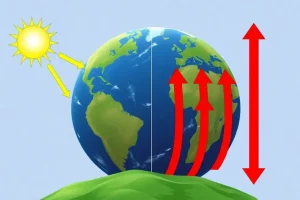
Solar energy enters the system.
Heat leaves the planet.
Water circulates continuously.
Carbon moves among the atmosphere, oceans, soils and living organisms.
Energy drives atmospheric circulation.
Life modifies chemical cycles.
Human societies increasingly reshape nearly every Earth-system process.
Earth therefore behaves as a complex adaptive system, not as a collection of isolated parts. (Nature)
The Evolution of Earth System Science
Earth System Science did not replace traditional disciplines.
Instead, it connected them.
The field emerged through advances in:
- Geology
- Oceanography
- Atmospheric science
- Ecology
- Hydrology
- Geochemistry
- Systems science
- Satellite observations
- Climate modeling
NASA’s Earth System Sciences Committee played a major role in defining the modern concept during the 1980s by promoting a holistic approach to understanding the interactions among Earth’s components and the role of biogeochemical cycles. (ScienceDirect)
The development of global satellite observations further transformed the field by allowing scientists to monitor Earth’s atmosphere, oceans, land surfaces, ice sheets, vegetation, fires, clouds and energy balance as parts of one integrated system.
The Five Major Earth System Spheres
Although different classifications exist, Earth System Science commonly describes Earth using five primary interacting spheres.
Atmosphere
The atmosphere is Earth’s envelope of gases.
It contains:
- Nitrogen
- Oxygen
- Carbon dioxide
- Water vapor
- Argon
- Trace gases
- Aerosols
The atmosphere regulates:
- Weather
- Climate
- Heat transport
- Radiation balance
- Water vapor
- Cloud formation
Atmospheric chemistry is continuously modified by volcanoes, oceans, ecosystems and human activities. (My NASA Data)
Hydrosphere
The hydrosphere includes:
- Oceans
- Rivers
- Lakes
- Groundwater
- Water vapor
- Surface water
Approximately 97% of Earth’s water resides in the oceans.
Water continuously moves through evaporation, condensation, precipitation, runoff, infiltration and groundwater flow.
Ocean circulation redistributes enormous amounts of heat around the planet, helping regulate global climate. (GPM Mission)
Cryosphere
The cryosphere consists of frozen water:
- Glaciers
- Ice sheets
- Sea ice
- Snow cover
- Permafrost
Although often considered part of the hydrosphere, it plays such a distinctive role that Earth System Science usually treats it separately.
The cryosphere influences:
- Planetary albedo
- Sea level
- Ocean circulation
- Freshwater storage
- Climate feedbacks
Melting ice alters Earth’s reflectivity and exposes darker surfaces that absorb more solar energy, amplifying warming. (Nature)
Geosphere (Lithosphere)
The geosphere includes:
- Rocks
- Minerals
- Soils
- Mountains
- Volcanoes
- Plate tectonics
- Earth’s crust
- Upper mantle
Geological processes operate across timescales ranging from seconds during earthquakes to millions of years during mountain building.
The geosphere stores vast amounts of carbon and nutrients while providing the physical foundation for ecosystems and human societies. (Berkeley Geography)
Biosphere
The biosphere includes all living organisms:
- Plants
- Animals
- Microorganisms
- Fungi
- Marine life
Life influences Earth far beyond biology.
Photosynthesis removes carbon dioxide.
Plants recycle water.
Microbes regulate nutrient cycles.
Marine plankton help influence atmospheric chemistry.
Living organisms therefore function as active components of the Earth system rather than passive inhabitants. (Nature)
The Human Sphere
Modern Earth System Science increasingly recognizes human societies as an integral component of the Earth system.
Sometimes called the anthroposphere, it includes:
- Cities
- Agriculture
- Industry
- Energy systems
- Transportation
- Economics
- Technology
- Governance
Human activities now modify atmospheric composition, freshwater systems, biodiversity, nutrient cycles and land cover on a planetary scale.
This recognition links Earth System Science closely with Anthropocene research and sustainability science. (Nature)
Energy: The Engine of the Earth System
Every Earth-system process requires energy.
Solar Energy
The Sun provides almost all energy driving Earth’s surface systems.
Solar radiation powers:
- Photosynthesis
- Atmospheric circulation
- Ocean circulation
- Evaporation
- Weather
- Climate
Internal Heat
Earth’s interior supplies geothermal energy.
This drives:
- Plate tectonics
- Volcanoes
- Earthquakes
- Mountain building
Although much smaller than incoming solar energy, internal heat shapes Earth’s long-term evolution.
Earth’s Energy Balance
Earth continually exchanges energy with space.
Incoming solar radiation is:
- Reflected
- Absorbed
- Re-emitted as infrared radiation
Greenhouse gases partially absorb outgoing infrared radiation, warming the lower atmosphere.
Changes in this balance drive climate change. (GPM Mission)
Matter Cycles Through the Earth System
Unlike energy, most matter continuously cycles.
Water Cycle
Water moves among:
- Oceans
- Atmosphere
- Land
- Rivers
- Groundwater
- Ice
- Living organisms
The hydrological cycle links nearly every Earth-system component.
Carbon Cycle
Carbon circulates among:
- Atmosphere
- Oceans
- Plants
- Soils
- Rocks
- Fossil fuels
The carbon cycle regulates climate over timescales from seasons to millions of years.
Nitrogen Cycle
Nitrogen cycles through:
- Atmosphere
- Soil
- Microorganisms
- Plants
- Animals
- Oceans
Human fertilizer production has dramatically altered this cycle.
Phosphorus Cycle
Unlike nitrogen, phosphorus lacks a significant atmospheric phase.
Its movement depends largely on weathering, erosion, rivers and biological activity.
These biogeochemical cycles connect Earth’s physical and biological systems and are central to Earth System Science. (Elsevier Educate)
Feedbacks: Why Earth Behaves Like a System
Feedbacks are among the most important ideas in Earth System Science.
A feedback occurs when a change influences itself through a chain of interactions.
Negative Feedback
Negative feedbacks stabilize systems.
Example:
Higher atmospheric carbon dioxide can stimulate additional plant growth in some ecosystems, increasing carbon uptake under suitable conditions.
Negative feedbacks resist change.
Positive Feedback
Positive feedbacks amplify change.
Example:
Warming melts sea ice.
Less sea ice exposes darker ocean water.
The darker ocean absorbs more sunlight.
Additional warming melts more sea ice.
Positive feedbacks accelerate change.
Earth contains both kinds of feedback simultaneously. (Nature)
Nonlinearity and Tipping Points
Earth does not always respond gradually.
Small changes can sometimes produce disproportionately large consequences.
Examples include:
- Ice-sheet instability
- Coral reef collapse
- Forest dieback
- Ocean circulation changes
- Permafrost thaw
These are examples of nonlinear behavior.
Earth System Science investigates where such thresholds may exist and how interacting feedbacks influence their likelihood.
Earth Operates Across Multiple Timescales
Different Earth-system processes operate at very different speeds.
| Timescale | Example |
|---|---|
| Seconds | Earthquakes |
| Hours | Storms |
| Days | Weather |
| Years | El Niño |
| Decades | Climate change |
| Centuries | Ice-sheet response |
| Millennia | Carbon cycle adjustment |
| Millions of years | Plate tectonics |
One challenge of ESS is connecting these vastly different timescales within a coherent framework. (Nature)
Earth System Models
Understanding such complexity requires advanced computer models.
Earth System Models (ESMs) couple multiple components of the Earth system into one numerical framework.
Modern ESMs simulate interactions among:
- Atmosphere
- Oceans
- Sea ice
- Land surface
- Vegetation
- Carbon cycle
- Biogeochemistry
- Human emissions
Unlike earlier climate models, ESMs explicitly represent biological and chemical processes in addition to physical climate dynamics. They are essential tools for projecting future climate, testing scenarios and understanding long-term Earth-system change. (arXiv)
Why Earth System Science Matters
ESS provides the scientific basis for understanding many of today’s global challenges.
It helps explain:
- Climate change
- Biodiversity loss
- Water scarcity
- Ocean acidification
- Deforestation
- Desertification
- Air pollution
- Food security
- Natural hazards
By viewing these issues as interconnected rather than isolated, Earth System Science supports more effective environmental management and policy. (Berkeley Geography)
Earth System Science and the Anthropocene
The Anthropocene concept argues that humans have become an Earth-system force.
Earth System Science provides the evidence and analytical framework for evaluating that claim.
Through satellites, observations, models and long-term datasets, ESS shows how human activities alter:
- Atmospheric composition
- Climate
- Hydrology
- Biogeochemical cycles
- Land cover
- Ecosystems
- Ocean chemistry
This integration explains why climate change cannot be separated from biodiversity, water, soils or human development.
Earth System Science and Planetary Boundaries
The Planetary Boundaries framework is built directly upon Earth System Science.
It identifies critical Earth-system processes—including climate change, biosphere integrity, freshwater change and biogeochemical flows—and proposes boundaries that help maintain a safe operating space for humanity.
Earth System Science explains how these processes interact, while Planetary Boundaries translate that understanding into a framework for assessing planetary risk. (Nature)
Common Misunderstandings
“Earth System Science is just climate science.”
Climate is one component. ESS also studies geology, oceans, ecosystems, freshwater, soils, ice, chemistry and human activities.
“Earth’s spheres operate independently.”
They are deeply interconnected through flows of energy, matter and feedbacks.
“Humans are outside the Earth system.”
Modern ESS treats human societies as integral components of the Earth system because they increasingly influence planetary processes.
“Earth behaves like a machine.”
Earth is better understood as a complex adaptive system with nonlinear interactions, feedbacks and emergent behavior rather than a simple mechanical system. (Nature)
Frequently Asked Questions
What is the main goal of Earth System Science?
To understand how Earth’s physical, biological, chemical and human components interact as one integrated system. (SERC)
What are the five major Earth spheres?
Atmosphere, hydrosphere, cryosphere, geosphere (or lithosphere), and biosphere. Many researchers also include the anthroposphere to represent human societies. (My NASA Data)
Why is Earth System Science interdisciplinary?
Because no single scientific discipline can fully explain Earth’s interconnected processes. ESS integrates geology, ecology, meteorology, oceanography, hydrology, chemistry, biology, mathematics and increasingly the social sciences. (SERC)
What is the difference between Earth Science and Earth System Science?
Traditional Earth science often studies individual components, such as rocks, weather or oceans. Earth System Science emphasizes the interactions and feedbacks among all of Earth’s components.
What role do satellites play?
Satellite observations provide continuous global measurements of clouds, oceans, vegetation, ice sheets, atmospheric gases, land cover and energy flows, allowing scientists to observe Earth as an integrated system. (Nature)
How does Earth System Science help society?
ESS improves climate projections, water-resource management, disaster preparedness, ecosystem conservation, sustainable development and environmental policy by revealing how interconnected Earth processes respond to natural and human-driven change. (Berkeley Geography)
Conclusion
Earth System Science represents one of the most significant advances in modern scientific thinking.
Rather than viewing Earth as separate domains of air, water, land and life, it reveals a dynamic planet whose components are inseparably linked through energy flows, matter cycles and feedbacks.
From solar radiation to plate tectonics, from photosynthesis to ocean circulation, from carbon cycling to human industry, every process participates in a larger network that shapes the past, present and future of our planet.
This systems perspective has transformed how scientists understand climate change, biodiversity loss, freshwater security, natural hazards and sustainability. It also underpins influential frameworks such as the Anthropocene and Planetary Boundaries, demonstrating that environmental challenges cannot be solved in isolation.
Ultimately, Earth System Science offers more than a new scientific discipline. It provides a new way of seeing our planet—one in which humanity is not separate from Earth’s life-support systems but an increasingly powerful participant within them. Understanding those connections is essential for protecting the stability and resilience of the only known world capable of sustaining human civilization.
FAQ
What are the main spheres considered in Earth System Science?
The five primary spheres are the Atmosphere, Hydrosphere, Cryosphere, Geosphere (Lithosphere), and Biosphere, with the Human (Anthroposphere) increasingly recognized as an integral component.
How does Earth System Science differ from traditional Earth science disciplines?
Traditional disciplines study individual components (e.g., atmosphere, oceans) in isolation, whereas Earth System Science examines the interactions, feedbacks, and energy/matter exchanges among all components as a single integrated system.
What role does energy play in Earth System Science?
Energy, primarily from solar radiation, drives atmospheric and oceanic circulation, the water cycle, and biological processes, while internal geothermal heat influences tectonics and long‑term planetary evolution.
Why is the human sphere now considered part of the Earth system?
Human activities modify atmospheric composition, land cover, freshwater resources, and biogeochemical cycles on a planetary scale, making societies an active component of Earth system dynamics.
How does Earth System Science support the concept of planetary boundaries?
By quantifying how interconnected Earth system processes operate and identifying thresholds beyond which human impacts could destabilize the system, Earth System Science provides the scientific basis for defining and monitoring planetary boundaries.