In brief
Earth is not merely a collection of separate habitats, resources and weather systems. It is an interconnected system in which the atmosphere, oceans, freshwater, soils, climate and living organisms continually influence one another.
Forests help regulate rainfall and store carbon. Ocean organisms participate in nutrient and carbon cycles. Rivers transport water, sediment and nutrients across landscapes. Atmospheric particles alter clouds, precipitation and temperature. Changes in one part of this system can therefore spread into others.
The planetary boundaries framework identifies nine Earth-system processes that are critical to maintaining the relatively stable conditions under which human civilization developed. For each process, scientists attempt to define a boundary beyond which human interference creates an increasing risk of large-scale, persistent or irreversible environmental change.
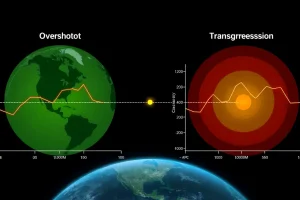
According to the latest annual assessment available as of July 2026, the Planetary Health Check 2025, seven of the nine planetary boundaries have been crossed. Climate change, biosphere integrity, land-system change, freshwater change, biogeochemical flows, ocean acidification and novel entities are outside the safe operating space. Atmospheric aerosol loading and stratospheric ozone depletion remain within their global boundaries. All seven transgressed boundaries are moving in an unfavorable direction. (Planetary Health Check)
This does not mean that Earth will suddenly become uninhabitable. It means that the safety margins surrounding several planetary life-support systems have been reduced—and that the boundaries cannot be understood independently.
Current Status of the Nine Planetary Boundaries
| Planetary boundary | Primary control variable | Planetary boundary | High-risk line | 2025 assessment | Status |
|---|---|---|---|---|---|
| Climate change | Atmospheric CO₂ | 350 ppm | 450 ppm | 423 ppm | Breached |
| Climate change | Anthropogenic radiative forcing | +1 W/m² | +1.5 W/m² | +2.97 W/m² | Beyond high-risk line |
| Biosphere integrity | Human appropriation of net primary production | 10% | 20% | 30% | Beyond high-risk line |
| Biosphere integrity | Extinction rate | 10 E/MSY | 100 E/MSY | 100–1,000 E/MSY | At or beyond high-risk line |
| Land-system change | Remaining forest cover | 75% | 54% | About 59% | Breached |
| Freshwater change | Land with streamflow disturbance | 12.9% | 50% | 22.6% | Breached |
| Freshwater change | Land with soil-moisture disturbance | 12.4% | 50% | 22% | Breached |
| Biogeochemical flows | Phosphorus applied to cropland | 6.2 Tg/year | 11.2 Tg/year | 18.2 Tg/year | Beyond high-risk line |
| Biogeochemical flows | Agricultural nitrogen fixation | 62 Tg/year | 82 Tg/year | 165 Tg/year | Beyond high-risk line |
| Ocean acidification | Surface aragonite saturation | 2.86 | 2.75 | 2.84 | Breached |
| Aerosol loading | Interhemispheric difference in aerosol optical depth | 0.10 | 0.25 | 0.063 | Within boundary |
| Ozone depletion | Global stratospheric ozone concentration | 277 DU | 263 DU | 285.7 DU | Within boundary |
| Novel entities | Share released without adequate safety testing | 0% | Not established | Breached; not precisely quantified | Breached |
The direction of risk differs among control variables. For carbon dioxide, fertilizer flows and disturbed freshwater systems, higher values indicate greater pressure. For remaining forest cover, ozone concentration and ocean aragonite saturation, lower values indicate deterioration. The figures above come from the Planetary Health Check 2025 and represent the latest framework values, not immutable natural constants. Control variables and boundaries may be refined as observations and Earth-system science improve.
Boundary, Threshold and Tipping Point: What Is the Difference?
These terms are related, but they do not mean the same thing.
Planetary boundary
A planetary boundary is a scientifically informed limit intended to keep human pressure within a comparatively safe range. Crossing it moves an Earth-system process into a zone of increasing risk.
The boundary is generally positioned before the most dangerous conditions because the precise location of ecological thresholds is uncertain.
Control variable
A control variable is a measurable indicator used to evaluate a planetary boundary.
Atmospheric carbon dioxide concentration is one control variable for climate change. Forest cover is used for land-system change, while streamflow and soil-moisture disturbances are used for freshwater change.
The nine planetary boundaries are currently evaluated using 13 control variables. (Planetary Health Check)
Zone of increasing risk
The zone of increasing risk begins after a planetary boundary has been crossed. The farther a control variable moves from the boundary, the greater the estimated risk of damaging Earth-system functions.
Risk does not rise identically for every boundary. Some systems may change gradually, while others may exhibit nonlinear responses.
High-risk line
Several boundaries include a high-risk reference line. Moving beyond this line indicates that the probability of severe or irreversible change has become substantially greater.
Climate radiative forcing, nitrogen and phosphorus flows, and both components of biosphere integrity are already at or beyond their respective high-risk lines in the 2025 assessment.
Tipping point
A tipping point is a critical threshold at which a relatively small additional disturbance can cause a major change in a system. Feedback mechanisms may then reinforce the change even if the original pressure stops increasing.
A planetary boundary is not necessarily the tipping point itself. Boundaries are intended to provide a safety margin before tipping behavior becomes likely.
Why the Boundaries Use Holocene-Like Conditions
For roughly 10,000 years, human societies developed under the relatively stable climatic conditions of the Holocene.
The Holocene was not free from droughts, floods, volcanic eruptions or regional ecological change. Its global climate and major biogeochemical cycles, however, remained within a comparatively narrow range. These conditions supported the emergence of agriculture, permanent settlements, cities and complex civilizations.
Since the middle of the twentieth century, population, energy consumption, industrial production, fertilizer use, resource extraction and land conversion have accelerated rapidly. This period is often described as the Great Acceleration.
The planetary boundaries framework uses Holocene-like Earth-system conditions as a reference because they represent the only known global environmental state in which modern civilization has developed and prospered. (Planetary Health Check)
The Nine Boundaries in Detail
1. Climate Change
Climate change concerns disruption of Earth’s energy balance by greenhouse gases, land alteration, aerosols and other human influences.
The framework uses two control variables:
- Atmospheric carbon dioxide concentration
- Total anthropogenic radiative forcing at the top of the atmosphere
The planetary boundary for carbon dioxide is 350 parts per million, while the 2025 value was approximately 423 ppm. The high-risk line is 450 ppm.
Radiative forcing measures the change in Earth’s energy balance produced by human activities. Its planetary boundary is +1 watt per square metre, while the high-risk line is +1.5 W/m². The 2025 assessment placed anthropogenic forcing at approximately +2.97 W/m², far beyond the high-risk reference.
Why the climate boundary matters
Climate regulates temperature, rainfall, ice cover, sea level, ocean circulation and the frequency or intensity of many extreme events. It also influences nearly every other planetary boundary.
A warmer climate can:
- Dry soils and alter river flows
- Increase heat stress on organisms
- Intensify wildfire conditions
- Shift species distributions
- Accelerate ice loss
- Reduce ocean oxygen
- Increase coral bleaching
- Weaken some land and ocean carbon sinks
Climate change is therefore both a boundary and a powerful driver of changes in other boundaries.
Important interactions
The most consequential climate interaction may be with the biosphere. Forests, soils, wetlands and oceans absorb carbon dioxide, reducing the amount remaining in the atmosphere. When these systems are degraded or warmed, their carbon-storage capacity can weaken.
Deforestation releases stored carbon, reduces biological uptake and may alter regional rainfall. Further warming can then increase drought, fire and tree mortality, creating a reinforcing climate–forest feedback.
Climate change and biosphere integrity are described as core boundaries because large changes in either could independently influence the overall state of the Earth system. Research mapping boundary interactions found that these two processes contributed more than half of the combined interaction strength in the assessed network. (Potsdam Institute)
2. Change in Biosphere Integrity
Biosphere integrity refers to the diversity, functioning and resilience of life on Earth.
It includes more than the number of species. It also concerns genetic variation, populations, ecological communities, food webs and the capacity of living systems to perform functions such as pollination, nutrient cycling, soil formation, water regulation and carbon storage.
The framework assesses two dimensions.
Genetic diversity
Genetic diversity is represented by the extinction rate, measured in extinctions per million species-years, or E/MSY.
The planetary boundary is 10 E/MSY. The current rate is estimated at approximately 100 to 1,000 E/MSY, placing it at or beyond the high-risk line of 100 E/MSY.
Functional integrity
Functional integrity is currently represented by the human appropriation of net primary production, or HANPP.
Net primary production is the plant biomass energy created through photosynthesis after plants have used the energy needed for their own respiration. It forms the energetic foundation of most terrestrial food webs.
The boundary allows human appropriation of 10% of preindustrial net primary production. The current value is approximately 30%, exceeding the high-risk line of 20%.
Why the biosphere boundary matters
A biologically diverse ecosystem usually contains multiple species capable of performing overlapping ecological roles. This functional redundancy can help ecosystems continue operating when drought, disease or other disturbances reduce particular populations.
As diversity declines, ecosystems may become more fragile. A system can appear intact while gradually losing its capacity to recover from shocks.
Important interactions
Biosphere integrity is influenced by almost every other boundary:
- Land conversion removes and fragments habitats.
- Climate change shifts temperature and rainfall conditions.
- Freshwater alteration damages rivers, wetlands and soil ecosystems.
- Nutrient pollution creates algal blooms and oxygen-depleted waters.
- Ocean acidification stresses marine food webs.
- Novel entities expose organisms to toxic or persistent substances.
- Aerosols can alter light, temperature, rainfall and plant productivity.
In return, biosphere decline affects climate, water, nutrient cycles and land stability. This two-way influence makes biosphere integrity a central node within the planetary-boundary network.
3. Land-System Change
Land-system change primarily measures the conversion and degradation of forests and other natural ecosystems.
Agriculture, grazing, logging, mining, roads, reservoirs and urban development can replace or fragment natural land cover. The effects extend beyond the physical area converted.
Land-cover change can alter:
- Carbon storage
- Surface temperature
- Evaporation and rainfall recycling
- Soil moisture
- Runoff and flood behavior
- Fire regimes
- Habitat connectivity
- Nutrient retention
The current global control variable measures remaining forested land as a share of estimated original forest cover. The planetary boundary is 75%, while the 2025 value was approximately 59%. The high-risk reference is 54%. Major forest biomes are already below their respective safety thresholds.
Forest quantity versus forest quality
A forest-cover measurement cannot capture every aspect of ecological condition.
A fragmented, selectively logged, frequently burned or biologically simplified forest may still appear as forest on a map while losing carbon, wildlife and hydrological functions. Future assessments may therefore place greater emphasis on forest integrity, connectivity and ecological quality.
Important interactions
Land conversion can simultaneously increase pressure on multiple boundaries.
Clearing a forest for agriculture may:
- Release carbon and reduce future carbon uptake.
- Remove habitat and reduce biosphere integrity.
- Change local evaporation and rainfall.
- Increase runoff and soil erosion.
- Carry phosphorus and nitrogen into waterways.
- Require additional irrigation and chemical inputs.
- Create conditions favorable to invasive species or pollutants.
Land-system change is consequently a major mediator between the food system and the climate, water, biodiversity and nutrient boundaries.
4. Freshwater Change
The freshwater boundary covers human disturbance of the global water cycle.
Earlier versions focused mainly on water withdrawals. More recent assessments distinguish between two components:
- Blue water: water in rivers, lakes, reservoirs and groundwater
- Green water: moisture stored in soil and available to plants
The blue-water control variable measures the proportion of global land experiencing human-induced streamflow disturbance. Its planetary boundary is 12.9%, compared with a 2025 value of 22.6%.
The green-water variable measures the proportion of land experiencing human-induced soil-moisture disturbance. Its boundary is 12.4%, compared with a current value of approximately 22%.
Why green water matters
Soil moisture connects the climate, vegetation and freshwater systems.
Plants draw water from soils and release it into the atmosphere through transpiration. This water can contribute to clouds and rainfall elsewhere. Deforestation, irrigation, soil degradation and climate change can interrupt these moisture flows.
The newer freshwater framework recognizes that measuring withdrawals alone cannot adequately represent the role of atmospheric water, soil moisture, surface water, groundwater and frozen water in Earth-system stability. (ScienceDirect)
Important interactions
Freshwater change affects agriculture, biodiversity, land cover and climate resilience.
Reduced river flow can concentrate pollutants and nutrients. Dry soils reduce plant productivity and carbon uptake. Wetland drainage releases carbon and removes natural flood regulation. Irrigation may support food production but deplete aquifers or alter downstream ecosystems.
Climate change is now a dominant driver of freshwater instability, while freshwater and land management can either intensify or reduce climate-related drought and flood risks.
5. Modification of Biogeochemical Flows
Biogeochemical flows describe the movement of chemical elements through organisms, soils, freshwater, oceans and the atmosphere.
The planetary boundaries framework focuses particularly on nitrogen and phosphorus. Both are essential nutrients for crops and ecosystems, but excessive inputs can overwhelm the systems that naturally absorb and recycle them.
Phosphorus
The current phosphorus variable measures mined phosphorus applied to cropland.
- Planetary boundary: 6.2 teragrams per year
- High-risk line: 11.2 teragrams per year
- 2025 value: 18.2 teragrams per year
Nitrogen
The nitrogen variable measures intentional nitrogen fixation for agriculture.
- Planetary boundary: 62 teragrams per year
- High-risk line: 82 teragrams per year
- 2025 value: 165 teragrams per year
Both nutrient flows are far beyond their high-risk reference lines.
Why nutrient flows matter
Crops absorb only part of the fertilizer applied to agricultural land. The remainder may accumulate in soils or move into groundwater, rivers, lakes, coastal waters and the atmosphere.
Excess nitrogen and phosphorus can cause:
- Harmful algal blooms
- Oxygen-depleted dead zones
- Drinking-water contamination
- Soil acidification
- Nitrous oxide emissions
- Loss of freshwater and marine biodiversity
- Changes in species composition
At the same time, some farming regions lack adequate nutrient access. The challenge is therefore not merely reducing global totals. It involves using nutrients more efficiently and distributing them more appropriately.
Important interactions
Nutrient flows are strongly connected to freshwater and biosphere integrity.
Runoff transports nitrogen and phosphorus into aquatic ecosystems. Algal growth can increase rapidly, followed by decomposition that consumes dissolved oxygen. Fish, shellfish and other organisms may then decline.
Nitrous oxide links agricultural nitrogen to climate change. Land degradation can increase erosion and phosphorus loss, while damaged wetlands lose some of their capacity to capture excess nutrients.
6. Ocean Acidification
Ocean acidification occurs when seawater absorbs carbon dioxide from the atmosphere.
Dissolved carbon dioxide changes ocean chemistry and reduces the availability of carbonate ions. These ions are used by corals, shellfish, plankton and other organisms to build calcium carbonate shells and skeletons.
The planetary-boundary control variable is the global mean surface saturation state of aragonite, a form of calcium carbonate.
- Planetary boundary: 2.86
- High-risk line: 2.75
- 2025 value: 2.84
Because lower values represent greater acidification, the current value is just beyond the boundary. Ocean acidification became the seventh planetary boundary formally assessed as transgressed in the 2025 Planetary Health Check.
Why a small numerical change matters
The global average may appear only slightly beyond the boundary, but it conceals substantial regional variation.
Polar waters naturally contain less carbonate and can approach corrosive conditions sooner. Coastal ecosystems may also be exposed to acidification from carbon dioxide, nutrient pollution, freshwater inflows and local biological processes.
Marine organisms face several simultaneous pressures, including:
- Acidification
- Ocean warming
- Deoxygenation
- Overfishing
- Habitat loss
- Nutrient pollution
- Plastics and chemical contamination
Important interactions
Ocean acidification is directly connected to climate change because both are driven primarily by carbon dioxide emissions.
The ocean absorbs large amounts of heat and carbon, buffering atmospheric climate change. That buffering service comes at a cost: warmer, more acidic and less oxygenated waters can weaken marine ecosystems and alter the biological processes that store carbon.
Damage to plankton, shell-forming organisms, seagrasses, mangroves and food webs may therefore affect both biosphere integrity and climate regulation.
7. Increase in Atmospheric Aerosol Loading
Atmospheric aerosols are small particles or droplets suspended in the air.
They include:
- Sulfates
- Black carbon
- Organic particles
- Mineral dust
- Sea salt
- Smoke
- Industrial particulates
Aerosols influence climate by reflecting or absorbing solar energy and by altering cloud formation. They can also affect rainfall patterns and cause serious respiratory and cardiovascular harm.
The global control variable measures the difference in aerosol optical depth between the Northern and Southern hemispheres.
- Planetary boundary: 0.10
- High-risk line: 0.25
- 2025 value: 0.063
The global aerosol boundary remains within the safe operating space and its overall trend is improving.
Global safety does not mean clean local air
The planetary indicator captures a global Earth-system effect. It does not measure every regional pollution hotspot or health risk.
A city can experience extremely hazardous particulate pollution even while the global interhemispheric aerosol boundary remains unbreached. Global and local assessments are therefore both necessary.
Important interactions
Some aerosols, particularly sulfates, temporarily cool the climate by reflecting sunlight. Black carbon absorbs heat and can accelerate snow and ice melt when deposited on bright surfaces.
Reducing harmful air pollution may remove some aerosol cooling and reveal warming previously masked by particles. This is not an argument for retaining polluted air. It demonstrates why aerosol reductions must be accompanied by rapid greenhouse-gas reductions.
Aerosols also influence clouds and monsoon systems, linking this boundary with climate, freshwater availability, agriculture and biosphere integrity.
8. Stratospheric Ozone Depletion
The stratospheric ozone layer absorbs much of the Sun’s harmful ultraviolet radiation.
During the twentieth century, chlorofluorocarbons and other ozone-depleting substances released chlorine and bromine into the stratosphere. These chemicals destroyed ozone, particularly over Antarctica.
The global control variable is average stratospheric ozone concentration.
- Planetary boundary: 277 Dobson Units
- High-risk line: 263 Dobson Units
- 2025 value: 285.7 Dobson Units
The boundary remains within the safe operating space. Ozone concentrations are stable and showing signs of gradual recovery, although the Antarctic ozone hole persists.
A planetary recovery story
International controls under the Montreal Protocol substantially reduced the production and consumption of many ozone-depleting substances.
Recovery remains slow because some chemicals persist in the atmosphere for decades. Continued monitoring and enforcement are essential, but ozone protection demonstrates that coordinated global action can reverse pressure on a planetary boundary.
Important interactions
Ozone-depleting chemicals and many replacement substances also influence climate. Changes in atmospheric circulation and temperature can, in turn, affect ozone chemistry.
The ozone boundary is therefore not completely isolated, even though it is often treated as the clearest example of successful planetary governance.
9. Introduction of Novel Entities
Novel entities include substances, materials and biological interventions that are new to the Earth system or introduced in unprecedented quantities.
Examples include:
- Synthetic chemicals
- Plastics and microplastics
- Persistent industrial compounds
- Pesticides
- Pharmaceuticals
- Radioactive materials
- Industrially mobilized heavy metals
- Some genetically modified organisms
- Chemical mixtures and degradation products
The current control variable is the fraction of synthetic chemicals released without adequate safety testing. The proposed boundary is effectively zero release of inadequately tested entities.
A reliable single global value has not yet been established, but the boundary is classified as transgressed because production and environmental release greatly exceed society’s capacity to assess and monitor potential effects.
Why this boundary is difficult to quantify
Chemical risks depend on more than production volume.
Important characteristics include:
- Toxicity
- Persistence
- Bioaccumulation
- Mobility
- Exposure
- Breakdown products
- Mixture effects
- Geographic distribution
- Effects on ecological functions
Thousands of substances may interact, while monitoring and regulation frequently occur chemical by chemical. The 2025 assessment recommends moving toward impact-linked indicators that track production, release, environmental fate and Earth-system effects.
Important interactions
Novel entities can affect almost every other boundary.
Pesticides can reduce insects and other non-target organisms. Plastics transport chemicals and alter marine habitats. Persistent substances contaminate water and soils. Some compounds affect reproduction, immunity or photosynthesis.
Chemical pollution can therefore weaken biodiversity, freshwater systems, soils and ocean ecosystems already under pressure from climate change and land conversion.
How the Planetary Boundaries Interact
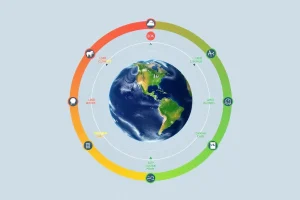
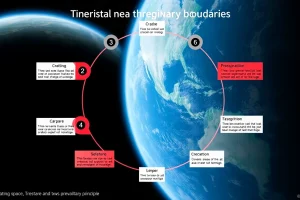
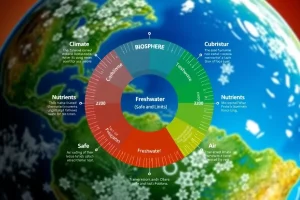
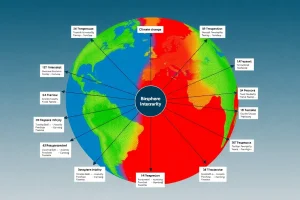
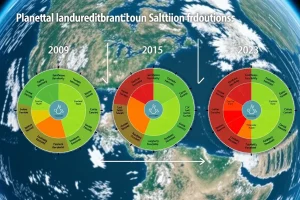
The planetary boundaries are frequently illustrated as nine wedges in a circular diagram. That image is useful for communication, but it can also create the false impression that the boundaries are separate compartments.
In reality, they form a dense network of feedbacks.
A major study of Earth-system interactions concluded that cascades and feedbacks predominantly amplify direct human pressure. Its provisional quantification suggested that interactions had almost doubled the combined effects of direct human impacts across the planetary boundaries. (Potsdam Institute)
Amplifying interactions
An amplifying interaction occurs when deterioration in one boundary increases pressure on another.
Example: forest–climate feedback
- Forest clearing releases carbon.
- Higher atmospheric carbon increases warming.
- Warming and altered rainfall stress remaining forests.
- Drought and fire cause additional tree mortality.
- Further carbon is released and less is absorbed.
Example: nutrient–water–biosphere cascade
- Excess fertilizer is applied to cropland.
- Rain carries nitrogen and phosphorus into waterways.
- Algal blooms increase.
- Decomposition reduces oxygen.
- Aquatic biodiversity declines.
- Damaged ecosystems become less capable of processing future pollution.
Example: climate–water–land interaction
- Rising temperatures increase evaporation.
- Soils dry more quickly.
- Vegetation becomes stressed.
- Fire risk and erosion increase.
- Land retains less moisture and carbon.
- Local and regional climate resilience declines.
Synergistic improvements
Interactions can also work in a beneficial direction.
Reducing pressure on one boundary may improve several others. Protecting and restoring a wetland, for example, can:
- Preserve habitat
- Store carbon
- Retain nutrients
- Improve water quality
- Reduce flooding
- Support soil moisture
- Increase resilience to drought
Research on food-related Earth-system processes found that land-system change and green water strongly affect other processes, while freshwater and marine biodiversity receive substantial pressure from blue-water change and nutrient flows. The study identified 37 direct interactions among 54 possible connections and concluded that most assessed interactions were amplifying. (Nature)
The climate–biosphere core
Climate change and biosphere integrity occupy a particularly influential position.
A stable climate supports ecosystems, while functioning ecosystems regulate climate by storing carbon, recycling moisture and influencing surface energy flows. Destabilizing either can weaken the other.
This does not make the remaining seven boundaries optional. It means that climate and biosphere interventions can create exceptionally large systemic benefits—or exceptionally damaging cascades.
The food-system nexus
Food production sits at the intersection of several planetary boundaries.
Agriculture requires land, freshwater and nutrients. It influences greenhouse-gas emissions, habitat conversion, soil moisture, river flows, chemical use and coastal pollution.
Because of these connections, an intervention designed to solve one problem can create another.
Large-scale bioenergy crops, for example, may remove carbon from the atmosphere but require extensive land, water and fertilizer. A 2025 assessment found that enforcing boundaries for nitrogen, freshwater, land-system change and biosphere integrity reduced the sustainable potential of dedicated bioenergy crops for carbon capture to almost zero outside existing agricultural areas. (Nature)
This illustrates a central principle: a climate solution is not automatically an Earth-system solution.
The ocean nexus
The ocean connects at least five boundaries:
- Climate change
- Ocean acidification
- Biosphere integrity
- Biogeochemical flows
- Novel entities
It absorbs heat and carbon dioxide, supports marine food webs, redistributes energy through currents and receives pollution transported from land.
Warming, acidification, oxygen loss, nutrient runoff and plastics may affect the same organisms simultaneously. Evaluating one pressure in isolation can therefore underestimate the total risk.
Thresholds Are Scientific Guardrails, Not Exact Cliff Edges
Planetary-boundary values should not be interpreted as perfectly precise natural laws.
Earth-system science contains unavoidable uncertainty because:
- Many processes vary across regions and seasons.
- Ecological responses may be delayed.
- Monitoring records can be incomplete.
- Interactions alter the response of individual systems.
- Tipping points may only be identified confidently after they have been crossed.
- Control variables simplify complex processes.
- Baselines and measurements improve over time.
The ocean acidification boundary, for example, was revised in 2025 as understanding of preindustrial aragonite conditions improved. The freshwater assessment also updated reference data and incorporated a more comprehensive view of blue and green water.
Scientific revision does not mean that boundaries are arbitrary. It means that the framework is designed to evolve with evidence.
Why precaution is necessary
Waiting for complete certainty may allow irreversible damage to occur.
A boundary therefore incorporates a safety margin. The relevant question is not, “Can scientists identify the precise moment the system will collapse?” It is, “How much risk should civilization accept when the consequences may be global and difficult to reverse?”
Global Boundaries and Local Reality
Planetary boundaries are globally aggregated. Environmental decisions, however, are usually implemented by nations, provinces, cities, businesses, farms and communities.
Translating a global boundary into local limits is challenging.
Water provides an obvious example. A global water indicator cannot determine whether a specific river basin is being managed sustainably. Conditions depend on rainfall, ecology, seasonality, groundwater recharge, upstream use and downstream needs.
The same issue applies to forests, nutrients, biodiversity and air pollution.
A global boundary does not replace local limits
Regional ecosystems may become severely degraded before the global control variable reaches its boundary.
A local improvement may not change the global status
A restored watershed can produce important benefits while worldwide freshwater disturbance continues to increase.
Allocation involves ethics and politics
The planetary-boundary framework does not automatically decide how the remaining safe operating space should be divided among countries, sectors or people.
Downscaling requires choices concerning historical responsibility, basic needs, equality, economic capacity and development rights. A 2026 study noted that numerous allocation principles have been proposed, reflecting different theories of distributive justice. (Nature)
What the Current Status Means for Humanity
Having seven boundaries outside the safe operating space does not establish a countdown to planetary collapse. It does indicate that Earth’s resilience is being weakened across several connected systems.
The implications include:
- Less capacity to absorb future shocks
- Greater risk of interacting environmental crises
- Higher probability of nonlinear change
- Increasing difficulty and cost of restoration
- Greater exposure of food, water and infrastructure systems
- Wider risks to human health and livelihoods
- Greater potential for unequal impacts
The most serious danger may not come from any single boundary. It may emerge from several pressures occurring together.
A drought becomes more damaging when forests are degraded, soils retain less moisture, rivers are overused and ecosystems have already lost diversity. A coastal ecosystem becomes more vulnerable when warming, acidification, nutrient pollution, overfishing and plastics act simultaneously.
Returning Toward the Safe Operating Space
Because the boundaries interact, solutions must be evaluated across the whole Earth system.
A 2025 modelling study found that current trends and policies would worsen almost every assessed boundary through 2050, except ozone depletion. Stronger climate policy, healthier diets and improved food, water and nutrient efficiency substantially reduced transgression, although several boundaries remained outside the safe space because of system inertia and the scale of existing damage. (Nature)
Transform energy systems
Reducing fossil-fuel combustion directly benefits climate and ocean acidification. It can also reduce many forms of air and chemical pollution.
Priorities include:
- Low-carbon electricity
- Efficient buildings and industry
- Electrification where appropriate
- Reduced methane emissions
- Lower material and energy waste
- Responsible management of residual emissions
Transform food and land systems
Food-system reform can simultaneously address land, biodiversity, freshwater, climate and nutrient boundaries.
Important measures include:
- Ending conversion of intact ecosystems
- Restoring degraded landscapes
- Improving fertilizer efficiency
- Protecting soil moisture
- Reducing food loss and waste
- Recycling nutrients
- Supporting sustainable diets
- Protecting Indigenous and community land rights
Protect freshwater as a living system
Water policy must extend beyond maximizing supply.
Effective management should maintain environmental flows, protect aquifer recharge, restore wetlands, control pollution and account for soil moisture and atmospheric moisture recycling.
Apply precaution to novel entities
Chemical and material governance should shift from reacting after contamination toward preventing unsafe release.
This includes:
- Stronger safety testing
- Transparent production data
- Assessment of mixtures
- Restrictions on highly persistent substances
- Safer material design
- Producer responsibility
- Monitoring across product life cycles
Design solutions for multiple boundaries
A strong intervention should be assessed for benefits and risks across all nine boundaries.
For example:
- Reforestation should not replace diverse ecosystems with monoculture plantations.
- Hydropower should account for river connectivity and aquatic biodiversity.
- Biofuels should not displace food production or intact habitats.
- Mineral extraction for energy technologies should address water, land and chemical pollution.
- Agricultural efficiency should not encourage unlimited expansion.
Common Misunderstandings
“Crossed” means Earth has already collapsed
No. Crossing a boundary means entering a zone of increasing risk. Environmental functions continue, but their resilience may be declining.
The boundaries predict an exact date of disaster
They do not. The framework identifies risk ranges rather than precise deadlines.
Every boundary has one unquestionable threshold
No. Boundaries are based on the best available evidence and precautionary reasoning. Indicators and values can be updated.
Staying below one boundary makes an activity sustainable
Not necessarily. An activity may reduce climate pressure while increasing land, freshwater, nutrient or biodiversity pressure.
Global safety means every region is safe
No. Local and regional ecosystems can cross critical thresholds even when a global boundary remains within its safe range.
Individuals are equally responsible
Environmental pressures are highly uneven. Governments, industries, wealthy consumers and communities have different historical contributions, needs and capacities. Fair allocation cannot be determined from biophysical boundaries alone.
Frequently Asked Questions
How many planetary boundaries are currently breached?
Seven of nine are breached: climate change, biosphere integrity, land-system change, freshwater change, biogeochemical flows, ocean acidification and novel entities. (Stockholm Resilience Centre)
Which two boundaries remain within the safe operating space?
Stratospheric ozone depletion and global atmospheric aerosol loading remain within their boundaries. Aerosol pollution can still be extremely dangerous at regional and local scales.
Which boundary was crossed most recently?
Ocean acidification was formally classified as breached in the 2025 Planetary Health Check, making it the seventh transgressed boundary. (Stockholm Resilience Centre)
Are planetary boundaries the same as tipping points?
No. A boundary is a precautionary guardrail. A tipping point is a critical threshold beyond which a system may shift rapidly or become self-reinforcing.
Can a planetary boundary be restored?
Pressure on a boundary can be reduced, although recovery times vary. Ozone protection demonstrates that coordinated global action can reverse a harmful trend. Some ecological and climatic changes, however, may persist for centuries or become irreversible on human timescales.
Why are there 13 control variables for nine boundaries?
Some Earth-system processes cannot be adequately represented by one indicator. Climate change, biosphere integrity, freshwater change and biogeochemical flows each use two control variables.
Which boundaries are most interconnected?
All nine interact, but climate change and biosphere integrity have particularly strong systemic influence. Land change, freshwater and nutrient flows also form a dense interaction network, especially through food production. (Potsdam Institute)
Are the planetary boundaries legally binding?
No. They are scientific risk thresholds rather than international laws. Governments, businesses and institutions may use them to inform targets, policy and risk management.
Can technology solve planetary-boundary transgression?
Technology is necessary but insufficient. Some technologies reduce pressure on one boundary while increasing pressure on others. Effective solutions also require governance, regulation, ecological protection, infrastructure change and more efficient or equitable patterns of production and consumption.
Conclusion
The nine planetary boundaries provide a dashboard of Earth-system stability.
That dashboard now shows seven boundaries outside the safe operating space. Several control variables—including climate radiative forcing, biodiversity loss and nutrient flows—are at or beyond their high-risk reference lines.
The individual thresholds matter, but the interactions matter just as much.
Climate change can weaken forests and freshwater systems. Land conversion can intensify climate change, biodiversity loss and nutrient pollution. Excess fertilizer can damage rivers and oceans. Chemical pollution can reduce the resilience of organisms already stressed by warming and habitat loss.
These interactions can amplify deterioration. They can also amplify recovery.
Protecting a forest may conserve species, store carbon, recycle moisture and stabilize soils. Restoring wetlands can improve biodiversity, water quality, flood control and carbon storage. Improving agricultural nutrient efficiency can reduce pollution, emissions and ecosystem damage at the same time.
The goal is therefore not to solve nine unrelated environmental problems. It is to manage one interconnected Earth system.
Planetary boundaries do not prohibit human development. They identify the conditions necessary for development to remain durable. A stable climate, functioning biosphere, healthy water cycle and resilient ocean are not optional environmental amenities. They are the physical foundation of food security, health, economies and civilization itself.