In brief
Climate change is often described as a gradual process. Temperatures rise year by year, glaciers retreat meter by meter, and sea level inches upward over decades.
But Earth does not always change gradually.
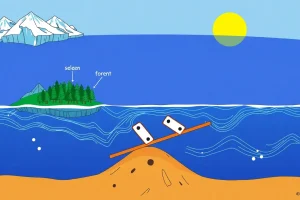
Many natural systems behave nonlinearly. They can absorb stress for years, decades, or even centuries with relatively modest visible change. Then, after crossing a critical threshold, they may shift rapidly into a fundamentally different state.
Scientists call these thresholds Earth system tipping points.
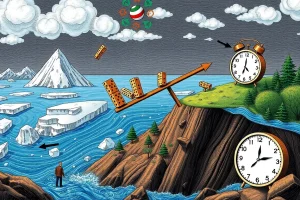
Crossing a tipping point does not necessarily mean immediate catastrophe. Instead, it means that a relatively small additional change can trigger self-reinforcing processes that continue even if the original pressure stops increasing. Some of these changes may unfold over centuries, while others could occur much more quickly. Many may be difficult—or impossible—to reverse on human timescales. (United Nations)
Because Earth’s major systems are interconnected, one tipping point can increase the likelihood of others. This possibility of tipping cascades has become one of the most important areas of Earth system research. (Global Tipping Points)
Understanding tipping points is therefore not about predicting a single moment when the planet suddenly “fails.” It is about understanding how complex systems lose resilience, why uncertainty does not eliminate risk, and how reducing warming lowers the probability of irreversible change.
Quick Answer
An Earth system tipping point is a critical threshold beyond which a small additional disturbance can trigger a large, self-sustaining change in part of the Earth system.
Potential tipping elements include:
- Greenland Ice Sheet
- West Antarctic Ice Sheet
- Atlantic Meridional Overturning Circulation (AMOC)
- Amazon rainforest
- Boreal forests
- Permafrost
- Warm-water coral reefs
- Monsoon systems
Scientists have strong evidence that several of these systems possess tipping behavior. However, the exact temperature thresholds, timing, speed, and interactions remain uncertain. What is well established is that the probability of crossing tipping points increases as global warming increases, making rapid emission reductions an important strategy for reducing long-term risk. (United Nations)
What Is a Tipping Point?
A tipping point is often misunderstood as a precise “line” beyond which disaster instantly occurs.
In reality, it is better understood as a critical transition in a complex system.
Before the threshold, the system can usually recover from disturbances.
After the threshold, internal feedbacks become strong enough that the system begins moving toward a new stable state, even if the original forcing no longer increases.
For example:
- An ice sheet may continue melting because lower elevation exposes it to warmer temperatures.
- A rainforest may generate less rainfall as forest cover declines, making further forest loss more likely.
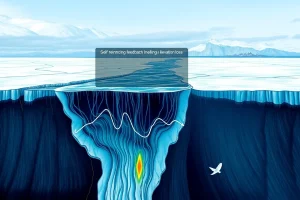
- Ocean circulation may weaken because freshwater reduces the density differences that normally drive deep-water formation.
The defining characteristic is self-reinforcement rather than the speed of change. Some tipping processes may unfold over decades, while others may take centuries or longer after the threshold has been crossed. (PMC)
Tipping Point vs. Threshold vs. Planetary Boundary
These terms are related but distinct.
| Concept | Meaning |
|---|---|
| Threshold | Any level at which system behavior changes |
| Tipping point | A threshold where self-reinforcing change becomes possible |
| Planetary boundary | A precautionary limit intended to keep Earth systems away from dangerous tipping risks |
Planetary boundaries are intentionally placed before known or suspected tipping regions whenever possible. They represent risk-management tools rather than predictions of exactly where tipping occurs.
Why Earth Systems Can Suddenly Change
Earth contains many feedback loops.
Some stabilize change.
Others amplify it.
Negative feedback
Negative feedback resists change.
Example:
Higher atmospheric carbon dioxide may increase plant growth in some ecosystems, allowing additional carbon uptake under suitable conditions.
Positive feedback
Positive feedback amplifies change.
Example:
- Arctic sea ice melts.
- Dark ocean water replaces bright ice.
- More sunlight is absorbed.
- Additional warming melts even more ice.
Positive feedbacks create the conditions for tipping behavior because the system increasingly drives its own change.
Characteristics of Earth System Tipping Points
Although every system differs, most proposed tipping elements share several characteristics.
They involve nonlinear change
Responses are not proportional to forcing.
Small changes may produce little visible response for decades before a much larger transition begins.
They contain internal feedbacks
The change becomes partly self-sustaining.
External forcing initiates the process, but internal dynamics increasingly control its evolution.
Recovery may be difficult
Simply reversing the original forcing may not restore the previous state.
This phenomenon is known as hysteresis.
For example, rebuilding an ice sheet after its collapse could require much cooler conditions than those at which melting originally began.
Timing differs from commitment
Crossing a tipping point does not necessarily mean the complete transition happens immediately.
Scientists distinguish between:
- Committed change — the long-term outcome becomes difficult to avoid.
- Realized change — the physical transformation that unfolds over time.
An ice sheet might become committed to long-term retreat while taking centuries to complete the process.
Major Earth System Tipping Elements
Research has identified more than 25 potential tipping elements across the cryosphere, biosphere, oceans, atmosphere, and regional climate systems. Confidence varies considerably among them. (Global Tipping Points)
Greenland Ice Sheet
The Greenland Ice Sheet stores enough frozen water to raise global sea level by approximately seven meters if completely lost.
Potential feedbacks include:
- Lower surface elevation
- Darkening from exposed ice
- Meltwater processes
- Reduced snowfall relative to melting
The exact threshold remains uncertain, but evidence suggests increasing risk as warming exceeds present-day levels. (Global Tipping Points)
Potential consequences
- Long-term sea-level rise
- Freshwater input to the North Atlantic
- Changes to ocean circulation
- Coastal impacts worldwide
West Antarctic Ice Sheet
Much of the West Antarctic Ice Sheet rests on bedrock below sea level.
This geometry creates the possibility of marine ice-sheet instability, in which retreating grounding lines expose thicker ice that becomes increasingly vulnerable to continued retreat.
Potential consequences include:
- Multi-meter long-term sea-level rise
- Increased coastal flooding
- Greater exposure of low-lying infrastructure
Evidence indicates that some sectors are already undergoing substantial retreat, although the pace and ultimate trajectory remain uncertain. (Global Tipping Points)
Atlantic Meridional Overturning Circulation (AMOC)
The AMOC transports warm surface water northward and returns colder, denser water southward at depth.
Freshwater from melting ice and increased precipitation may reduce seawater density, weakening deep-water formation.
A substantial weakening or collapse could alter:
- European climate
- Tropical rainfall
- Monsoon systems
- Marine ecosystems
- Storm tracks
Current observations suggest weakening relative to historical conditions, but scientists remain uncertain about how close the system is to a tipping threshold. (Global Tipping Points)
Amazon Rainforest
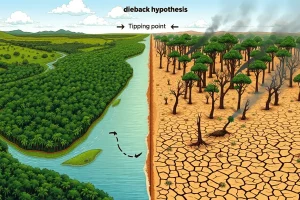
The Amazon generates much of its own rainfall through evapotranspiration.
Deforestation, warming, drought, and fire reduce this moisture recycling.
If forest cover declines sufficiently, parts of the Amazon could transition toward more open, savanna-like ecosystems.
Potential impacts include:
- Biodiversity loss
- Reduced carbon storage
- Regional rainfall decline
- Agricultural disruption
Land-use change and climate change interact, making this one of the clearest examples of multiple human pressures acting simultaneously. (Global Tipping Points)
Permafrost
Permafrost stores enormous quantities of frozen organic carbon.
As frozen soils thaw:
- Microorganisms decompose organic matter.
- Carbon dioxide and methane are released.
- Greenhouse warming increases.
- Additional thaw becomes more likely.
Unlike ice sheets, permafrost thaw may occur in numerous localized tipping processes rather than one single global threshold. (Global Tipping Points)
Warm-Water Coral Reefs
Coral reefs are highly sensitive to:
- Ocean warming
- Marine heatwaves
- Ocean acidification
Repeated bleaching events reduce coral recovery and may eventually transform reefs into algae-dominated ecosystems.
Although some reefs demonstrate adaptation and resilience, widespread reef loss remains one of the highest-confidence biological tipping risks under continued warming. (Global Tipping Points)
Boreal Forests
Northern forests may face increasing pressure from:
- Heat
- Drought
- Fire
- Insects
- Disease
If mortality exceeds regeneration over large regions, boreal forests could shift toward more open vegetation while releasing significant amounts of stored carbon.
Monsoon Systems
Monsoon rainfall depends on complex interactions among:
- Ocean temperatures
- Land heating
- Atmospheric circulation
- Vegetation
Research suggests that several monsoon systems may possess tipping behavior, although confidence varies between regions. (Global Tipping Points)
Tipping Cascades: When One Change Triggers Another
Perhaps the greatest concern is not any individual tipping element but their interactions.
Earth systems are connected through:
- Climate
- Ocean circulation
- Atmospheric circulation
- Water cycles
- Carbon cycles
- Ecosystems
A change in one system can increase stress elsewhere.
Examples include:
- Greenland melt adding freshwater that weakens the AMOC.
- AMOC changes influencing tropical rainfall.
- Reduced Amazon rainfall increasing forest dieback.
- Forest loss releasing carbon that increases warming.
- Additional warming accelerating ice-sheet loss.
These linked transitions are known as tipping cascades.
Evidence for such interactions is growing, although scientists continue refining their understanding of their strength, timing, and likelihood. (Global Tipping Points)
What Is the Evidence?
Scientists rely on several independent sources of evidence.
Paleoclimate records
Ice cores, sediments, fossil pollen, and marine deposits show that abrupt transitions occurred repeatedly throughout Earth’s history.
These records demonstrate that nonlinear Earth-system change is physically possible.
Modern observations
Satellite observations and long-term monitoring reveal declining resilience in several systems.
Observed changes include:
- Accelerating ice loss
- Coral bleaching
- Forest degradation
- Permafrost thaw
- Ocean warming
While observations alone rarely prove that a tipping point has been crossed, they help identify systems losing stability. (Global Tipping Points)
Physical theory
Scientists understand many of the mechanisms capable of generating tipping behavior through physics, ecology, and fluid dynamics.
Examples include:
- Ice-sheet instability
- Moisture recycling
- Ocean density feedbacks
- Vegetation–climate interactions
Computer models
Earth System Models explore how different warming scenarios affect tipping elements.
No model is perfect, but comparisons among multiple models improve confidence where independent results converge.
Early Warning Signals
Can scientists predict tipping points before they occur?
Possibly—but with important limitations.
One widely studied concept is critical slowing down.
As systems lose resilience:
- Recovery from disturbances becomes slower.
- Variability may increase.
- Successive observations become more strongly correlated.
Researchers investigate indicators such as:
- Increasing variance
- Rising autocorrelation
- Slower recovery after disturbances
These signals may provide useful information for some systems, but they are not universal, and they cannot yet determine exact tipping times. (arXiv)
Why Uncertainty Matters
One of the most common misconceptions is:
“Scientists aren’t certain, so tipping points may not exist.”
This misunderstands scientific uncertainty.
Researchers are uncertain about:
- Exact thresholds
- Timing
- Speed
- Interactions
- Regional responses
They are not uncertain that nonlinear Earth-system behavior exists.
In many cases, uncertainty increases rather than decreases the need for precaution because crossing an irreversible threshold before recognizing it could have lasting consequences. Recent assessments emphasize that uncertainty about tipping thresholds is not a reason for delaying action, but a reason to manage risk carefully. (United Nations)
Why Every Fraction of a Degree Matters
Tipping risks do not suddenly appear at one temperature.
Instead, they generally increase progressively with warming.
Research indicates that:
- Some tipping elements may become possible near today’s warming levels.
- Additional warming increases the number of systems at risk.
- Higher temperatures increase the likelihood of cascading interactions.
This is why climate assessments consistently conclude that limiting warming reduces—not eliminates—the probability of crossing tipping points. (United Nations)
Common Misunderstandings
“A tipping point means instant catastrophe.”
No.
Some transitions unfold rapidly, while others develop over centuries after commitment.
“Scientists know the exact temperature.”
They do not.
Most tipping thresholds are expressed as probability ranges rather than precise values.
“Crossing one tipping point guarantees all others.”
Not necessarily.
Interactions increase risk but do not determine inevitable cascades.
“Uncertainty means scientists are guessing.”
No.
Uncertainty reflects the complexity of Earth systems, not the absence of evidence.
“Nothing can be done.”
Reducing greenhouse-gas emissions, limiting land degradation, protecting ecosystems, and improving resilience all reduce the probability of crossing additional tipping points.
Frequently Asked Questions
Are tipping points the same as planetary boundaries?
No. Planetary boundaries are precautionary limits intended to reduce the risk of crossing tipping points.
How many Earth system tipping elements exist?
Recent assessments identify more than 25 potential tipping elements, although confidence varies considerably among them. (Global Tipping Points)
Which tipping elements have the strongest evidence?
Among the best-supported candidates are the Greenland and West Antarctic ice sheets, warm-water coral reefs, parts of the Amazon rainforest, permafrost, and large-scale ocean circulation systems, although confidence and uncertainty differ for each. (Global Tipping Points)
Can tipping points be reversed?
Some may be reversible over long periods, while others exhibit hysteresis, meaning that returning to previous conditions would require substantially greater changes than those that triggered the transition.
Can scientists predict exactly when tipping will occur?
Not at present. Current methods can sometimes identify declining resilience or increasing risk, but they cannot reliably forecast precise tipping times. (arXiv)
Does crossing a tipping point mean civilization will collapse?
No. Earth-system tipping points increase environmental risks and may have profound consequences, but their societal outcomes depend on exposure, vulnerability, adaptation, governance, and future emissions.
Conclusion
Earth system tipping points illustrate one of the most important lessons of complexity science: large changes do not always require large immediate causes.
Many Earth systems possess remarkable resilience, but that resilience is not unlimited. As warming, deforestation, pollution, and other pressures accumulate, some systems may approach critical thresholds where internal feedbacks begin driving further change on their own.
Scientists have strong evidence that tipping behavior exists in major components of the Earth system. They also have growing evidence that interactions among these components could amplify global risks through tipping cascades.
What remains uncertain are the precise thresholds, timelines, and interactions.
That uncertainty should not be mistaken for ignorance. Rather, it reflects the challenge of studying complex systems operating across decades to millennia and across the atmosphere, oceans, ice sheets, ecosystems, and human societies.
The practical implication is straightforward: every fraction of warming avoided reduces the probability of crossing tipping points, every ecosystem protected strengthens Earth-system resilience, and every action that limits cumulative environmental pressure helps preserve options for future generations. (United Nations)