In brief
At a glance
Quick Facts
- Verdict
- Mixed
- Problem addressed
- Atmospheric CO2 accumulation causing climate change
- Evidence strength
- Moderate
- Potential scale
- Global
- Relative cost
- High
- Time to impact
- Years to Decades
Quick verdict
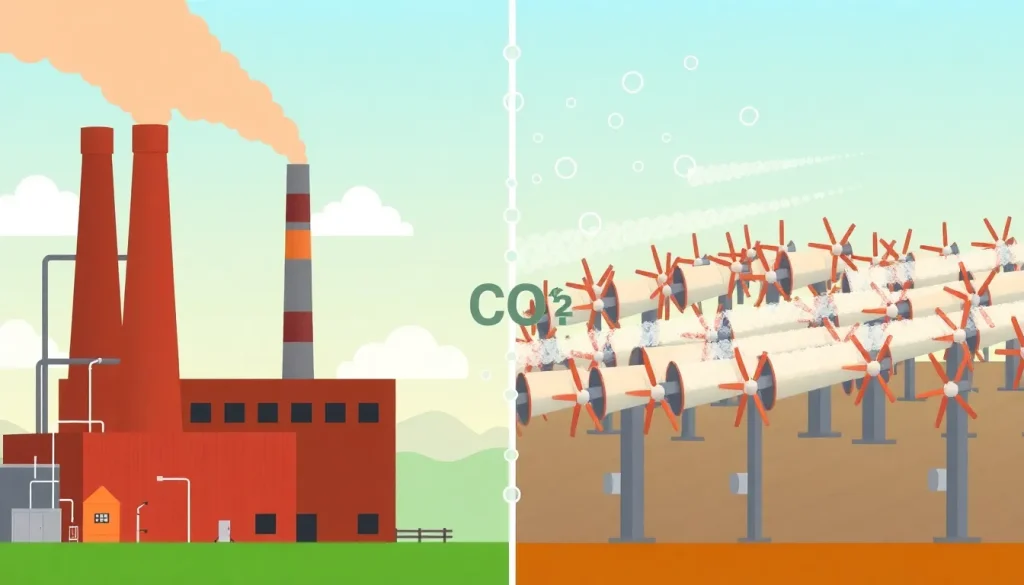
Point-source carbon capture (PSC) and direct air capture (DAC) are complementary rather than competing technologies. PSC is a proven, lower-cost method to abate emissions from large industrial and power plants, but it cannot address past emissions or diffuse sources. DAC can remove CO2 already in the atmosphere, offering a true negative emission, but it is currently expensive, energy-intensive, and at an early stage of deployment. Both face significant scaling challenges and should be viewed as part of a broader portfolio that prioritizes deep emissions cuts.
Problem addressed
Both technologies aim to mitigate climate change by reducing the concentration of carbon dioxide (CO2) in the atmosphere. Point-source capture targets emissions at their origin—such as fossil fuel power plants, cement kilns, and steel mills—preventing new CO2 from entering the air. Direct air capture, in contrast, removes CO2 that is already dispersed in the ambient atmosphere, addressing legacy emissions and hard-to-abate sectors like aviation and agriculture. The underlying problem is the accumulation of greenhouse gases, which drives global warming, ocean acidification, and associated environmental and societal risks.
How the solution works
Point-source carbon capture typically uses chemical absorption, adsorption, or membrane separation to isolate CO2 from flue gas streams where concentrations are relatively high (3–15% by volume for coal power plants, up to 30% for some industrial processes). The most common method is amine scrubbing: flue gas passes through a liquid solvent (often amine-based) that binds CO2; the solvent is then heated to release pure CO2 for compression and transport. The captured CO2 can be stored underground (carbon capture and storage, CCS) or utilized (CCU).

Direct air capture (DAC) works on ambient air with CO2 concentrations of about 0.04% (420 ppm). This requires moving large volumes of air through a capture medium. Two main approaches exist: liquid solvent systems (e.g., using a strong hydroxide solution to absorb CO2, then precipitating it as carbonate and heating to release pure CO2) and solid sorbent systems (e.g., using amine-functionalized materials that bind CO2 when cool and release it when heated). The captured CO2 is then compressed and stored or used. DAC is inherently more energy-intensive because of the low concentration of CO2 in air.
Evidence strength
Point-source capture is supported by decades of industrial experience. Amine-based CO2 scrubbing has been used since the 1970s in natural gas processing and, more recently, in power generation (e.g., Boundary Dam in Canada, Petra Nova in the US). The technology is well-characterized, with multiple commercial-scale plants operating, though many have faced reliability and cost issues. The evidence base includes peer-reviewed engineering studies, pilot projects, and operational data from facilities capturing 1–1.4 million tonnes of CO2 per year.
Direct air capture is less mature. As of 2024, only a handful of small commercial plants exist (e.g., Climeworks’ Orca in Iceland, Carbon Engineering’s pilot in Canada), collectively capturing a few thousand tonnes of CO2 per year—orders of magnitude below what is needed. Performance data is limited, and cost estimates vary widely. Research is active, with numerous pilot projects and government-funded initiatives, but the evidence base remains emerging, with few independent, long-term operational studies.
Potential scale
Point-source capture could theoretically be applied to thousands of large industrial and power facilities worldwide, potentially capturing several gigatonnes of CO2 per year. The IEA estimates that CCS could contribute up to 15% of cumulative emissions reductions needed by 2050. However, this depends on the continued operation of fossil fuel plants and the availability of storage sites. Retrofitting existing plants is technically feasible but often economically challenging.
Direct air capture has virtually unlimited physical potential because it can be sited anywhere with access to low-carbon energy and storage. Scenarios from the IPCC and IEA suggest DAC may need to capture 5–10 GtCO2 per year by mid-century to meet climate targets. Current capacity is less than 0.01 MtCO2/year, so scaling by a factor of a million is required. This would demand massive land, energy, and material resources, and the feasibility of such rapid scaling is highly uncertain.
Cost considerations
Point-source capture costs vary by industry and technology. For coal power, capture costs are estimated at $40–80 per tonne of CO2; for natural gas combined cycle, $50–100; for industrial processes like cement or steel, $40–120. These figures include capture, compression, and transport but exclude storage. Costs have not fallen as rapidly as once projected, and many early projects experienced overruns.
Direct air capture is significantly more expensive. Current estimates range from $250 to $600 per tonne of CO2 for solid sorbent systems, with some projections suggesting future costs could drop to $100–200 per tonne with technological learning and scale. Liquid solvent systems may be at the higher end. These costs are far above current carbon prices in most jurisdictions, making DAC economically unviable without subsidies or high carbon credit values.
Implementation time
Point-source capture can be deployed relatively quickly at existing facilities, with construction times of 2–4 years for retrofits. New plants with integrated capture can be built within standard power plant timelines (4–7 years). However, widespread deployment is constrained by the pace of investment, regulatory approvals, and CO2 transport and storage infrastructure development.
Direct air capture plants are modular and can be built in phases, with individual units deployable in 1–2 years. However, scaling to gigatonne levels would require building thousands of large facilities, which would take decades. The first million-tonne-per-year DAC plant is not expected until the late 2020s at the earliest. Thus, meaningful climate impact from DAC is likely a 2030s–2040s prospect.
Environmental benefits
Both technologies reduce net CO2 emissions. Point-source capture prevents new emissions from entering the atmosphere, while DAC removes existing CO2, enabling negative emissions when paired with permanent storage. DAC can also provide carbon-neutral synthetic fuels if the captured CO2 is used with renewable hydrogen. However, the environmental benefit depends on the energy source: if powered by fossil fuels without capture, the net reduction is diminished. Both require significant water and land, and the lifecycle emissions of construction and operation must be accounted for.
Social and economic co-benefits
Point-source capture can sustain jobs in fossil fuel-dependent regions during the energy transition, preserving industrial employment. It may also reduce local air pollutants (e.g., SOx, NOx, particulates) as a side effect of scrubbing. DAC offers fewer direct co-benefits but could create new industries and jobs in manufacturing, construction, and CO2 utilization. Both can contribute to energy security by enabling continued use of domestic fossil resources with lower emissions, though this may also delay the transition to renewables.
Risks and unintended consequences
Both technologies risk perpetuating fossil fuel dependence (moral hazard). Point-source capture may extend the life of coal and gas plants, locking in emissions if capture rates are less than 100% or if CO2 leaks from storage. DAC requires large amounts of energy and land; if powered by fossil fuels without capture, it could be net carbon positive. Sorbent production and disposal may involve toxic chemicals. Large-scale CO2 storage poses risks of leakage, groundwater contamination, and induced seismicity. There are also concerns about public acceptance and the diversion of investment from renewables and efficiency.
Where it works best
Point-source capture is most effective at large, stationary emission sources with high-purity CO2 streams, such as natural gas processing, ammonia production, and ethanol fermentation, where capture costs are lowest. It is also viable at coal and gas power plants, cement kilns, and steel mills, provided there is access to suitable CO2 storage or utilization infrastructure. Regions with strong policy support (e.g., tax credits like 45Q in the US, carbon pricing) and existing pipeline networks are most favorable.
Direct air capture works best in locations with abundant, cheap, low-carbon energy (e.g., geothermal, solar, wind) and access to permanent CO2 storage, such as basaltic rock formations or depleted oil and gas reservoirs. Iceland’s Hellisheiði plant, which uses geothermal heat and stores CO2 in basalt, is a prime example. DAC is also suited for producing synthetic fuels when combined with green hydrogen, though this does not result in net-negative emissions.
Where it may not work
Point-source capture is poorly suited for small, mobile, or intermittent emission sources (e.g., vehicles, residential heating). Retrofitting older plants can be technically challenging and uneconomical, especially if the remaining plant life is short. In regions without CO2 storage or utilization options, captured CO2 may need to be vented, defeating the purpose. High capture rates (>90%) are possible but increase energy penalties and costs significantly.
Direct air capture is ill-suited for regions with high energy costs, limited renewable resources, or lack of storage. It is not a cost-effective solution for offsetting emissions from point sources that could be captured more cheaply. DAC also requires large land areas for siting fans and contactors, which may conflict with other land uses. In humid or polluted environments, sorbent degradation can reduce efficiency.
Comparison with alternatives
Point-source capture and DAC are often compared to other mitigation options, including renewable energy, energy efficiency, and natural carbon sinks like afforestation. The table below summarizes key differences between PSC and DAC.
| Attribute | Point-Source Capture | Direct Air Capture |
|---|---|---|
| CO2 source | Concentrated flue gas (3–30% CO2) | Ambient air (~0.04% CO2) |
| Maturity | Commercial (decades of operation) | Early commercial / pilot stage |
| Current cost per tCO2 | $40–120 (varies by industry) | $250–600 (with future targets of $100–200) |
| Energy requirement | 2–4 GJ per tCO2 (thermal + electric) | 5–10 GJ per tCO2 (mostly thermal) |
| Land footprint | Small (integrated with plant) | Large (0.1–1 km2 per MtCO2/year) |
| Net emissions impact | Reduces new emissions (can be near-zero if high capture rate) | Negative emissions (removes legacy CO2) |
| Scalability constraints | Limited by number of large point sources | Limited by energy, materials, and investment |
Compared to natural climate solutions like reforestation, both technological approaches are more expensive and energy-intensive but offer permanent storage and do not compete for arable land in the same way. However, they should not be seen as replacements for rapid decarbonization of the energy system.
Case studies
Point-source capture: Boundary Dam, Canada. SaskPower’s Boundary Dam Unit 3, a 110 MW coal-fired power plant, was retrofitted with post-combustion amine capture in 2014. It captures about 1 million tonnes of CO2 per year, which is sold for enhanced oil recovery and stored in a deep saline aquifer. The project cost about CAD 1.5 billion and faced initial technical issues, achieving lower capture rates than designed. It remains one of the few operational large-scale CCS projects on a power plant.
Direct air capture: Orca, Iceland. Climeworks’ Orca plant, operational since 2021, uses solid sorbent DAC modules powered by geothermal energy. It captures about 4,000 tonnes of CO2 per year, which is mixed with water and injected into basalt rock where it mineralizes. The plant demonstrates the feasibility of DAC with permanent storage, but its small scale and high cost (estimated $600–800/tCO2) highlight the challenges of scaling.
Final assessment
Point-source carbon capture and direct air capture are both technically viable but face distinct economic and scalability hurdles. PSC is a more mature, lower-cost option for reducing emissions from existing industrial infrastructure, but it cannot deliver negative emissions and risks prolonging fossil fuel use. DAC offers a pathway to remove legacy CO2 and address hard-to-abate sectors, but it remains expensive and energy-intensive, with uncertain scaling potential. Neither is a silver bullet; they are best deployed as part of a comprehensive climate strategy that prioritizes rapid emissions reductions, energy efficiency, and renewable energy. Policymakers should support research, development, and demonstration for both, while implementing robust carbon pricing and storage regulations to ensure environmental integrity.
FAQ
What is the main difference between point-source capture and direct air capture?
Point-source capture removes CO2 from concentrated flue gas streams at industrial facilities, preventing new emissions. Direct air capture removes CO2 from ambient air, addressing legacy emissions and enabling negative emissions.
Which is cheaper: point-source capture or direct air capture?
Point-source capture is generally cheaper, with costs ranging from $40 to $120 per tonne of CO2, while direct air capture currently costs $250 to $600 per tonne, though future costs may fall.
Can these technologies solve climate change on their own?
No. Both are important but cannot replace the need for rapid and deep emissions reductions across all sectors. They are part of a broader portfolio that includes renewable energy, efficiency, and natural carbon sinks.
References
- IPCC Special Report on Carbon Dioxide Capture and Storage (2005)
- IEA Direct Air Capture 2022
- National Academies of Sciences, Engineering, and Medicine (2019). Negative Emissions Technologies and Reliable Sequestration: A Research Agenda.
- Global CCS Institute (2023). Global Status of CCS 2023.
- Climeworks (2021). Orca plant data.