In brief
At a glance
Quick Facts
- Abundance in Earth's crust
- Phosphorus is the 11th most abundant element, but only a small fraction is economically mineable.
- Primary use
- Approximately 90% of mined phosphate is used for fertilizer production.
- Natural cycle speed
- The natural phosphorus cycle takes millions of years, while human extraction depletes reserves in decades.
- Reserve concentration
- Morocco and Western Sahara control over 70% of the world's known phosphate rock reserves.
- Substitutability
- Phosphorus has no substitute in agriculture; it is essential for plant growth and cannot be replaced.
- Environmental impact
- Eutrophication caused by phosphorus runoff creates dead zones in water bodies, harming aquatic life.
Key Takeaways
- Phosphorus is a chemical element essential for all life, primarily used in fertilizers, and its economically mineable reserves are non-renewable and finite.
- The global phosphorus supply depends on phosphate rock deposits formed over millions of years, which are concentrated in a few countries, creating geopolitical vulnerabilities.
- Unlike water and carbon, phosphorus lacks a gaseous phase in its natural cycle, so it moves slowly from rocks to soil to oceans, where it becomes largely inaccessible.
- Mismanagement of phosphorus leads to both resource depletion and severe environmental pollution, such as eutrophication, making sustainable management critical for long-term food security.
What Is Why Phosphorus Is a Finite Resource?
Phosphorus is a finite resource because it is a chemical element that cannot be created or destroyed, but its accessible forms for human use are limited to concentrated deposits of phosphate rock that are being depleted far faster than they are naturally replenished. As a fundamental building block of life—forming the backbone of DNA, RNA, and ATP—phosphorus is irreplaceable in agriculture, where it is primarily used to produce fertilizers. The finiteness of phosphorus is not about the element disappearing from the Earth, but about the economic and energetic feasibility of extracting it from high-grade ores. Once these concentrated reserves are exhausted, obtaining phosphorus becomes increasingly costly and environmentally damaging, threatening global food production.
Phosphorus exists in nature almost exclusively as phosphate minerals, which are unevenly distributed across the planet. The natural phosphorus cycle is extremely slow: weathering of rocks releases phosphate into soils, where it is taken up by plants, consumed by animals, and eventually returned to the soil or washed into waterways. Over millions of years, some phosphate settles in ocean sediments and may be uplifted through tectonic activity to form new rock. However, human extraction for agriculture has accelerated this cycle dramatically, mining phosphate rock at rates that far exceed natural replenishment. This makes phosphorus a non-renewable resource on human timescales, similar to fossil fuels, but with the critical distinction that there is no substitute for phosphorus in food production.
Overview
Phosphorus is one of the three primary macronutrients required for plant growth, alongside nitrogen and potassium. It plays a vital role in photosynthesis, energy transfer, and root development. Without an adequate supply of phosphorus, crop yields decline sharply, and global food production would be insufficient to feed the human population. The modern agricultural system relies heavily on phosphate fertilizers derived from mined phosphate rock, a practice that began in the mid-19th century and intensified dramatically during the Green Revolution.

The finite nature of phosphate rock reserves has raised concerns about long-term food security. Unlike nitrogen, which can be synthesized from the atmosphere, or potassium, which has vast geological reserves, phosphorus is obtained from a limited number of high-grade deposits. The quality of remaining reserves is declining, with lower concentrations of phosphate and higher levels of contaminants such as cadmium. This means that extracting usable phosphorus will require more energy and produce more waste over time, increasing costs and environmental impacts. The issue is not immediate scarcity but the trajectory toward depletion and the lack of alternatives.
How It Works
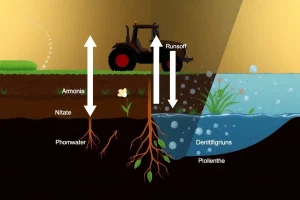
The phosphorus cycle on Earth is a slow, one-way flow from rocks to oceans. Phosphate minerals in the Earth’s crust are released through weathering and erosion, entering soils where they become available to plants. Animals obtain phosphorus by consuming plants or other animals. When organisms die, phosphorus returns to the soil or water, but a significant portion is carried by rivers to the ocean, where it eventually settles into sediments. Over geological time, these sediments may be uplifted to form new phosphate rock, but this process takes millions of years.
Human intervention has drastically altered this cycle. Phosphate rock is mined from sedimentary and igneous deposits, processed into fertilizers, and applied to agricultural fields. Much of this phosphorus is taken up by crops, but a substantial amount is lost through runoff, soil erosion, and inefficient use. Only about 20% of the phosphorus mined for food production actually reaches the human diet; the rest is lost at various stages, from mining waste to food waste. This linear flow from mine to ocean is unsustainable because it depletes finite reserves and causes environmental harm.
Importance and Impact
Phosphorus is indispensable for global food security. It is a limiting nutrient in many ecosystems, meaning that plant growth is constrained by its availability. In agriculture, phosphorus fertilizers have enabled the high crop yields necessary to support a growing global population. Without phosphorus, modern intensive farming would be impossible, and food production would plummet, leading to widespread hunger and social instability.
The impact of phosphorus extends beyond agriculture. It is also used in animal feed, food additives, detergents, and industrial processes. However, the overwhelming majority—around 90%—of mined phosphate goes to fertilizer production. The finite supply of high-quality phosphate rock thus directly threatens the foundation of the global food system. Moreover, the unequal distribution of reserves creates geopolitical dependencies, with a handful of countries controlling the majority of the world’s known phosphate resources.
Main Causes or Drivers
Several factors drive the finiteness of phosphorus as a resource. The primary driver is the ever-increasing demand for food, which requires more phosphorus fertilizers to maintain soil fertility and boost crop yields. Global population growth and dietary shifts toward more meat-intensive diets amplify this demand, as livestock production requires large amounts of feed crops that depend on phosphorus.
Inefficient use of phosphorus throughout the food system exacerbates the problem. Significant losses occur during mining and processing, where low-grade ores are discarded. In agriculture, over-application of fertilizers leads to runoff, and poor soil management causes erosion. Post-harvest, food waste and inadequate recycling of human and animal excreta mean that most phosphorus ends up in landfills or water bodies rather than being returned to farmland. These linear practices accelerate the depletion of finite reserves.
Environmental and Human Impacts
The mismanagement of phosphorus has severe environmental consequences. Excess phosphorus from agricultural runoff and untreated sewage enters rivers, lakes, and coastal waters, causing eutrophication—an overgrowth of algae that depletes oxygen and creates dead zones where aquatic life cannot survive. These dead zones disrupt fisheries, damage ecosystems, and release greenhouse gases. Eutrophication is a global problem affecting water bodies from the Gulf of Mexico to the Baltic Sea.
On the human side, phosphorus scarcity could lead to higher food prices and increased competition for resources, potentially fueling conflicts. The concentration of phosphate reserves in politically unstable regions adds a layer of risk. Additionally, phosphate mining and processing can cause local environmental degradation, including water pollution, habitat destruction, and exposure to heavy metals like cadmium, which can accumulate in soils and crops, posing health risks.
Solutions
Addressing the finite nature of phosphorus requires a shift toward a circular economy. Key strategies include improving phosphorus use efficiency in agriculture through precision farming, soil testing, and optimized fertilizer application. Developing crop varieties that require less phosphorus or are more efficient at uptake can also reduce demand. Recycling phosphorus from organic waste streams—such as animal manure, human sewage, and food waste—is critical. Technologies like struvite precipitation from wastewater can recover phosphorus in a reusable form.
Policy measures can promote sustainable phosphorus management. These include regulations to reduce nutrient runoff, incentives for recycling, and international cooperation to ensure equitable access to phosphate reserves. Reducing food waste across the supply chain and shifting dietary patterns toward less resource-intensive foods can also lower phosphorus demand. While no single solution is sufficient, a combination of these approaches can extend the lifespan of phosphorus reserves and mitigate environmental harm.
FAQ
What is phosphorus and why is it important?
Phosphorus is a chemical element essential for all life. It is a key component of DNA, RNA, and ATP, and is vital for plant growth. In agriculture, it is a primary nutrient in fertilizers, making it critical for global food production.
Why is phosphorus considered a finite resource?
Phosphorus is finite because it is obtained from phosphate rock deposits that formed over millions of years and are being mined much faster than they are naturally replenished. There is no synthetic substitute, and high-grade reserves are limited and concentrated in a few regions.
What are the consequences of phosphorus scarcity?
Scarcity could lead to higher fertilizer prices, reduced crop yields, and increased food insecurity. It may also exacerbate geopolitical tensions over remaining reserves and cause environmental damage from mining lower-grade ores.
References
- U.S. Geological Survey, Mineral Commodity Summaries, Phosphate Rock.
- Cordell, D., Drangert, J. O., & White, S. (2009). The story of phosphorus: Global food security and food for thought. Global Environmental Change.
- International Fertilizer Development Center (IFDC) reports on world phosphate rock reserves and resources.