In brief
At a glance
Quick Facts
- Verdict
- Mixed
- Problem addressed
- Global warming and climate change
- Evidence strength
- Emerging
- Potential scale
- Global
- Relative cost
- Varies (low to high)
- Time to impact
- Varies (years to decades)
Quick verdict
Climate geoengineering encompasses a set of proposed, largely unproven, techniques to deliberately intervene in the Earth’s climate system to counteract global warming. While some approaches, like carbon dioxide removal, are theoretically sound and have limited field trials, others, such as solar radiation management, remain highly speculative and carry significant risks. Geoengineering is not a substitute for deep emissions cuts; it is at best a potential supplement, with many methods still in early research stages and facing substantial governance, ethical, and technical challenges.
Problem addressed
Geoengineering targets the root cause and symptoms of anthropogenic climate change: the accumulation of greenhouse gases (GHGs) in the atmosphere, primarily from burning fossil fuels, deforestation, and industrial processes. The resulting enhanced greenhouse effect leads to global warming, sea-level rise, extreme weather events, and ecosystem disruption. Current mitigation efforts—reducing emissions and transitioning to clean energy—are insufficient to meet the Paris Agreement goals, and even with aggressive cuts, some warming is already locked in. Geoengineering is proposed as a set of additional tools to either remove GHGs from the atmosphere (carbon dioxide removal, CDR) or to reflect a fraction of incoming sunlight back to space (solar radiation management, SRM) to cool the planet.
How the solution works
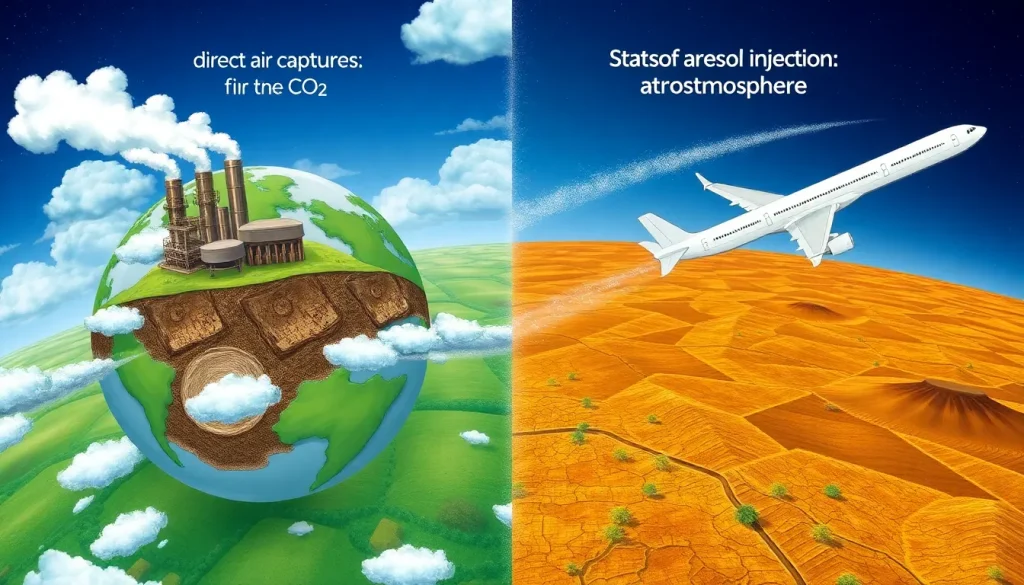
Geoengineering is broadly divided into two categories: Carbon Dioxide Removal (CDR) and Solar Radiation Management (SRM). CDR techniques aim to extract CO₂ from the atmosphere and store it in geological, terrestrial, or ocean reservoirs. Examples include afforestation/reforestation, bioenergy with carbon capture and storage (BECCS), direct air capture (DAC), enhanced weathering, and ocean fertilization. These methods address the root cause of warming but generally work slowly over decades to centuries. SRM techniques, by contrast, aim to increase the Earth’s albedo (reflectivity) to reduce the amount of solar energy absorbed. Proposed methods include stratospheric aerosol injection (mimicking volcanic eruptions), marine cloud brightening, and space-based reflectors. SRM could cool the planet rapidly but does not reduce CO₂ levels, thus failing to address other problems like ocean acidification. Both categories involve large-scale, intentional manipulation of natural systems.

Evidence strength
The evidence base for geoengineering varies widely by technique. For CDR, some methods like afforestation and soil carbon sequestration are well-understood and have been practiced at scale, though their climate impact is limited by land availability and permanence. Direct air capture has been demonstrated in pilot plants but remains energy-intensive and costly. Ocean fertilization has been tested in small-scale experiments, with mixed results and concerns about ecosystem disruption. Enhanced weathering is largely theoretical with limited field trials. For SRM, evidence comes almost entirely from climate models and natural analogues (e.g., volcanic eruptions). Stratospheric aerosol injection has not been field-tested; its effects are inferred from models and observations of volcanic events like Mount Pinatubo. Marine cloud brightening has seen very small-scale experiments. Overall, the evidence for CDR is stronger but still insufficient for deployment at climate-relevant scales; for SRM, it is almost entirely model-based with huge uncertainties.
Potential scale
The potential scale of geoengineering varies. CDR methods could, in theory, remove billions of tonnes of CO₂ per year, but current global emissions are around 40 GtCO₂/year. Afforestation could sequester perhaps 3–10 GtCO₂/year, but would compete with food production. BECCS could remove up to 10 GtCO₂/year but would require vast land areas. Direct air capture is limited by energy and cost, with theoretical potential in the tens of GtCO₂/year. SRM techniques could potentially offset all anthropogenic warming if deployed at sufficient scale, but they would not address CO₂ concentrations. Stratospheric aerosol injection could cool the planet within years, but would need continuous deployment; any abrupt stop would cause rapid warming. Marine cloud brightening would be regional. Overall, CDR could eventually remove a significant fraction of emissions, but scaling up is slow and resource-intensive. SRM could be scaled quickly but only masks warming temporarily.
Cost considerations
Cost estimates are highly uncertain and vary by technique. CDR methods range from relatively low-cost (afforestation, ~$10–100 per tonne CO₂) to very high (direct air capture, currently $600–1000 per tonne, with goals to reach $100–200). Enhanced weathering and ocean alkalinity enhancement are in the $50–200 range. SRM methods are generally considered cheap to deploy: stratospheric aerosol injection might cost $1–10 billion per year for a globally significant effect, making it orders of magnitude cheaper than the damages from unmitigated climate change. However, these cost estimates do not include monitoring, governance, or compensation for side effects. Moreover, the apparent low cost of SRM raises concerns about unilateral deployment and moral hazard. In contrast, CDR costs are more comparable to other mitigation options but still require substantial investment.
Implementation time
CDR methods require decades to centuries to significantly reduce atmospheric CO₂, depending on the technique. Afforestation takes years to decades to establish and sequester carbon. Direct air capture plants can be built in a few years but need massive scale-up. SRM could be implemented within a few years and would start cooling the planet almost immediately, but would need to be maintained indefinitely to offset ongoing emissions. The governance frameworks for any geoengineering deployment are currently lacking, which could delay implementation. Research and development for most techniques is still in early stages, so large-scale deployment is likely a decade or more away, even for the most advanced methods.
Environmental benefits
CDR methods can provide co-benefits: afforestation enhances biodiversity, improves soil and water quality, and provides ecosystem services. Enhanced weathering can improve soil fertility. However, the primary environmental benefit of CDR is the reduction of atmospheric CO₂, which mitigates ocean acidification and long-term warming. SRM could rapidly reduce global temperatures, potentially averting some climate tipping points and extreme weather, but it does not address ocean acidification and could disrupt regional weather patterns. The environmental benefits of SRM are thus partial and come with significant trade-offs.
Social and economic co-benefits
Some CDR methods, like reforestation and soil carbon sequestration, can provide rural employment, improve agricultural productivity, and support indigenous livelihoods. BECCS could generate energy. However, large-scale land-based CDR may compete with food production and displace communities. SRM offers no direct social co-benefits beyond avoided climate damages, but its low cost could reduce the economic burden of climate policy. Yet, the potential for unilateral deployment and the risk of termination shock could create geopolitical tensions and undermine trust in international cooperation.
Risks and unintended consequences
Geoengineering carries substantial risks. CDR methods: afforestation can reduce biodiversity if monocultures are used; BECCS requires vast land and water, threatening food security; ocean fertilization risks toxic algal blooms and disruption of marine ecosystems; direct air capture has high energy demand and may compete with renewable energy. SRM poses even greater risks: stratospheric aerosol injection could alter precipitation patterns, causing droughts in some regions; it could deplete stratospheric ozone; it does not address ocean acidification; and a sudden halt could cause rapid warming (termination shock). There is also the moral hazard that geoengineering research or deployment could reduce incentives for emissions cuts. Governance challenges are immense, as no international framework exists to regulate deployment, and unilateral action could trigger conflict.
Where it works best
CDR methods are location-dependent: afforestation works best in tropical and temperate regions with available land; direct air capture can be sited near geological storage or renewable energy; enhanced weathering is suited to agricultural lands with suitable soils. SRM would have global effects, but the regional impacts are uncertain; some models suggest stratospheric aerosol injection could reduce monsoon rainfall in parts of Asia and Africa. Thus, no single geoengineering technique is universally applicable, and deployment decisions would require careful regional analysis.
Where it may not work
CDR methods face limitations: afforestation in water-scarce regions or on land needed for food; BECCS in areas with low biomass productivity; ocean fertilization in nutrient-poor waters where it may be ineffective. SRM could fail to offset regional climate changes, potentially exacerbating droughts or floods in vulnerable regions. Moreover, geoengineering cannot substitute for emissions reductions in addressing ocean acidification or other CO₂-related impacts. In regions with weak governance, deployment could lead to conflict or unintended transboundary harm.
Comparison with alternatives
The primary alternative to geoengineering is aggressive emissions reduction through renewable energy, energy efficiency, electrification, and behavioral change. These address the root cause and have fewer risks, but they require global cooperation and time. Carbon capture and storage (CCS) at point sources is a related technology that prevents emissions rather than removing them from the atmosphere. Adaptation measures (e.g., sea walls, drought-resistant crops) are necessary regardless. Geoengineering, particularly SRM, is often compared to a “painkiller” that treats symptoms but not the disease, while mitigation is the cure. CDR is sometimes seen as a necessary complement to mitigation for hard-to-abate sectors, but it cannot replace rapid decarbonization.
Case studies
There are no full-scale geoengineering deployments, but several small-scale experiments and natural analogues provide insights. The 1991 eruption of Mount Pinatubo injected ~20 million tonnes of SO₂ into the stratosphere, cooling the planet by about 0.5°C for a year—a natural analogue for stratospheric aerosol injection. The 2009 LOHAFEX ocean fertilization experiment in the South Atlantic added iron to stimulate phytoplankton blooms; it showed limited carbon sequestration and raised ecological concerns. In CDR, the CarbFix project in Iceland has demonstrated that CO₂ can be mineralized in basalt formations. Climeworks operates direct air capture plants in Switzerland and Iceland, capturing thousands of tonnes of CO₂ per year. Afforestation projects like the Great Green Wall in Africa aim to restore degraded land and sequester carbon. These examples illustrate the early stage and varied outcomes of geoengineering approaches.
Final assessment
Climate geoengineering is a set of speculative, high-stakes proposals that are not yet ready for deployment. Carbon dioxide removal methods are more mature and align with the need to reduce atmospheric CO₂, but they are slow, costly, and cannot replace emissions cuts. Solar radiation management could rapidly cool the planet but carries severe risks and ethical dilemmas. Research into both should continue with caution, transparency, and international cooperation, but the priority must remain on reducing greenhouse gas emissions and adapting to climate change. Geoengineering is not a solution to climate change; at best, it is a temporary supplement that might buy time, but it cannot be a substitute for the fundamental transformation of our energy and land-use systems.
FAQ
What is the difference between carbon dioxide removal and solar radiation management?
Carbon dioxide removal (CDR) aims to reduce atmospheric CO₂ concentrations, addressing the root cause of warming, while solar radiation management (SRM) aims to reflect sunlight to cool the planet without reducing CO₂, thus not addressing ocean acidification.
Is geoengineering a substitute for reducing emissions?
No. Geoengineering cannot replace emissions reductions because it does not address the root cause of climate change and carries significant risks and uncertainties. It is at best a potential supplement.
What are the main risks of solar geoengineering?
Risks include altered precipitation patterns, ozone depletion, termination shock if deployment stops abruptly, and the moral hazard of reducing mitigation efforts. It also does not address ocean acidification.
References
- IPCC, 2022: Climate Change 2022: Mitigation of Climate Change. Contribution of Working Group III to the Sixth Assessment Report.
- National Academies of Sciences, Engineering, and Medicine, 2021: Reflecting Sunlight: Recommendations for Solar Geoengineering Research and Research Governance.
- Royal Society, 2009: Geoengineering the climate: science, governance and uncertainty.
- Keith, D. W., 2013: A Case for Climate Engineering. MIT Press.
- Shepherd, J. G., 2009: Geoengineering the climate: an overview and update. Philosophical Transactions of the Royal Society A.