In brief
At a glance
Quick Facts
- Typical nitrogen use efficiency in cereals
- 30–50% of applied nitrogen is recovered by the crop in the year of application.
- Phosphorus use efficiency
- Often below 20% in the year of application, though residual benefits can last for years.
- Ammonia volatilization loss
- Up to 50% of surface-applied urea nitrogen can be lost as ammonia gas under warm, windy conditions.
- Nitrate leaching
- A primary cause of groundwater nitrate contamination, especially in sandy soils with high rainfall.
- Denitrification and N2O
- Denitrification converts nitrate to N2O, a greenhouse gas with ~300 times the warming potential of CO2.
- Economic cost
- Inefficient fertilizer use costs farmers billions of dollars globally each year in wasted inputs.
- 4R Nutrient Stewardship
- Right source, right rate, right time, right place—a framework to improve nutrient use efficiency.
- Soil immobilization
- Microbes can temporarily tie up nutrients, making them unavailable to plants until microbial turnover releases them.
Key Takeaways
- Crops typically recover only 30–50% of applied nitrogen and 10–30% of applied phosphorus in the year of application, with the remainder lost to the environment or immobilized in the soil.
- Nutrient losses occur through multiple pathways, including leaching, volatilization, denitrification, runoff, and erosion, each influenced by soil properties, climate, and management practices.
- Inefficient fertilizer use imposes significant economic costs on farmers and contributes to environmental problems such as water pollution, greenhouse gas emissions, and biodiversity loss.
- Adopting practices like the 4R Nutrient Stewardship framework (right source, right rate, right time, right place) can substantially improve nutrient uptake and reduce losses.
What Is Why Crops Do Not Absorb All Applied Fertilizer?
Why crops do not absorb all applied fertilizer is a fundamental question in agricultural science that addresses the gap between the amount of nutrients supplied to soil and the amount actually taken up by plants. This phenomenon is quantified by the concept of nutrient use efficiency (NUE), which measures the proportion of applied fertilizer that is recovered by the crop. In most farming systems, NUE is far below 100%, meaning that a substantial fraction of the nitrogen, phosphorus, potassium, and other nutrients applied to fields never reaches the plant roots or is not available in a form the crop can use. The reasons for this inefficiency are rooted in the complex interactions between soil chemistry, biology, physics, and environmental conditions.
Fertilizers are essential for modern agriculture, supplying the macronutrients (nitrogen, phosphorus, potassium) and micronutrients that crops need to grow and produce high yields. However, the soil is not a simple reservoir; it is a dynamic system where nutrients can be transformed, moved, or lost through a variety of pathways. Understanding why crops do not absorb all applied fertilizer is critical for improving farm profitability, reducing environmental damage, and ensuring long-term food security. The issue is not that fertilizers are ineffective, but that their fate in the environment is governed by processes that often operate beyond the control of a single application.
How It Works
To understand why crops do not absorb all applied fertilizer, it is necessary to examine how plants take up nutrients and what happens to the nutrients that are not taken up. Plants absorb nutrients primarily through their roots, which grow through the soil and intercept dissolved ions. The three main mechanisms of nutrient movement to the root surface are root interception, mass flow, and diffusion. Root interception occurs when roots grow into soil spaces where nutrients are already present. Mass flow is the movement of dissolved nutrients toward the root with the water that the plant transpires. Diffusion is the movement of nutrients from areas of higher concentration to lower concentration near the root surface. Even under optimal conditions, these mechanisms cannot capture all the nutrients in the soil because the root system occupies only a small fraction of the total soil volume, and nutrients may be located too far from roots or in forms that are not immediately available.

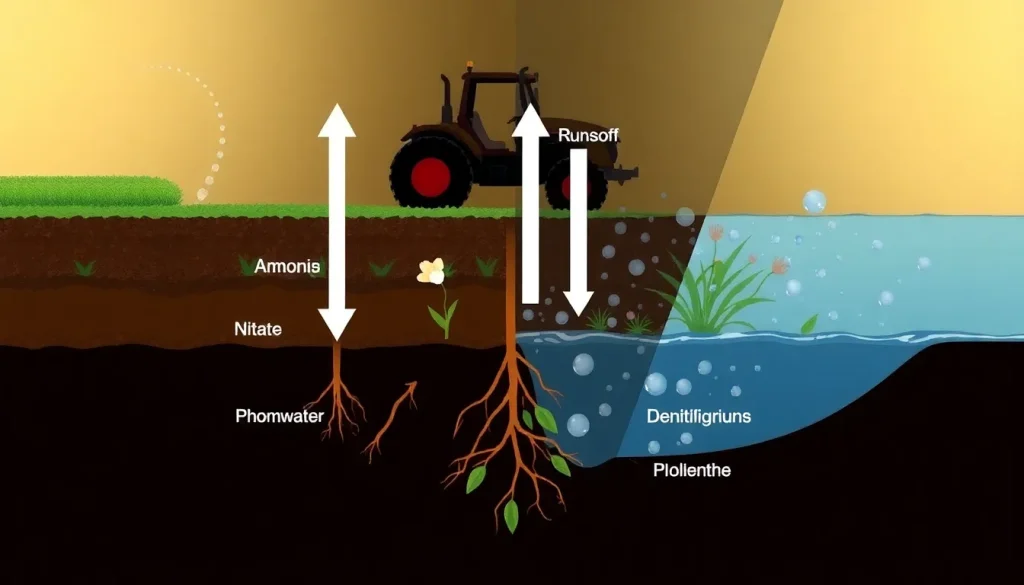
Once applied, fertilizer nutrients undergo a series of transformations and can be lost through several pathways. Nitrogen, for example, is highly mobile and subject to leaching (downward movement with water beyond the root zone), volatilization (loss as ammonia gas), denitrification (conversion to nitrogen gases by microbes under wet conditions), and runoff (surface loss with water). Phosphorus is less mobile but can be lost through erosion of soil particles and runoff, or it can become fixed in forms that plants cannot access, such as insoluble compounds with calcium, iron, or aluminum. Potassium, while generally less prone to gaseous losses, can be leached in sandy soils or held tightly by certain clay minerals. Additionally, soil microorganisms immobilize nutrients temporarily as they decompose organic matter, making them unavailable to plants until the microbes die and release them. These processes, combined with the fact that crops only take up nutrients during specific growth stages, explain why a significant portion of applied fertilizer is not absorbed by the crop in the season of application.
Main Causes or Drivers
The extent of fertilizer loss and inefficiency is driven by a combination of soil, climatic, and management factors. Soil texture plays a major role: sandy soils have low water- and nutrient-holding capacities, making them prone to leaching, while clay soils can fix phosphorus tightly, reducing its availability. Soil pH affects nutrient solubility; for example, phosphorus becomes less available in very acidic or alkaline soils. Organic matter content influences microbial activity and nutrient cycling, with high organic matter soils often having greater capacity to supply nutrients slowly but also to immobilize them temporarily.
Climate and weather conditions are equally important. Heavy rainfall can cause leaching and runoff, while high temperatures and wind can increase ammonia volatilization from surface-applied urea. In waterlogged soils, denitrification converts nitrate to nitrogen gases, including nitrous oxide, a potent greenhouse gas. Management practices, such as the type of fertilizer used, the timing and method of application, and the rate applied, directly affect losses. For instance, applying all fertilizer at once before planting can lead to high early-season losses when crop uptake is low. Over-application, often done as an insurance against poor yields, exacerbates inefficiency because the crop cannot use the excess nutrients. Finally, crop characteristics, including rooting depth, growth duration, and nutrient demand patterns, determine how effectively a plant can capture available nutrients.
Environmental and Human Impacts
The nutrients that crops do not absorb do not simply disappear; they enter the broader environment, often with harmful consequences. Nitrogen that leaches into groundwater can contaminate drinking water supplies with nitrate, posing health risks such as methemoglobinemia (blue baby syndrome) and potential links to certain cancers. Phosphorus and nitrogen that run off into surface waters fuel eutrophication, leading to algal blooms, oxygen depletion, and dead zones in lakes, rivers, and coastal areas. Ammonia volatilization contributes to air pollution and can form fine particulate matter that affects human respiratory health. Nitrous oxide emissions from denitrification are a significant contributor to climate change, as this gas has a global warming potential nearly 300 times that of carbon dioxide.
Beyond direct pollution, inefficient fertilizer use represents a waste of resources. The production of nitrogen fertilizers is energy-intensive, relying heavily on natural gas, and mining of phosphate rock is a finite resource. When large portions of these inputs are lost, the economic and environmental costs of their production are incurred without the benefit of increased crop production. This inefficiency also undermines efforts to achieve sustainable food systems, as it necessitates higher fertilizer application rates to meet crop demands, creating a cycle of loss and pollution.
Solutions
Improving the efficiency with which crops absorb applied fertilizer is a central goal of sustainable agriculture. The most widely adopted framework is the 4R Nutrient Stewardship concept, which emphasizes applying the right source of fertilizer at the right rate, at the right time, and in the right place. For example, using controlled-release fertilizers or nitrification inhibitors can slow nitrogen release to better match crop uptake. Split applications—applying fertilizer in multiple smaller doses during the growing season—reduce the risk of loss compared to a single large application. Placing fertilizer in bands near the root zone rather than broadcasting it on the surface can improve uptake and reduce volatilization and runoff.
Other solutions include adopting conservation practices such as cover cropping, which scavenges residual nutrients and prevents erosion; reduced tillage, which improves soil structure and organic matter; and precision agriculture technologies that use sensors, GPS, and variable-rate applicators to tailor fertilizer applications to specific field conditions. Integrated soil fertility management, which combines organic amendments like compost or manure with mineral fertilizers, can enhance nutrient retention and supply. At the policy level, regulations on fertilizer use, incentives for best management practices, and investment in agricultural extension services help promote wider adoption of efficient techniques.
Benefits, Limitations and Trade-offs
Increasing fertilizer use efficiency offers clear benefits: reduced input costs for farmers, lower environmental pollution, and conservation of finite resources. Higher NUE can also contribute to climate change mitigation by decreasing nitrous oxide emissions. However, there are limitations and trade-offs. Some efficiency-enhancing technologies, such as controlled-release fertilizers or precision equipment, require upfront investment that may be prohibitive for small-scale farmers. Implementing split applications or cover crops demands additional labor and management time. There can also be a yield penalty if nutrient supply is insufficient at critical growth stages, so farmers must balance the risk of under-fertilizing against the certainty of some loss.
Moreover, no single practice can eliminate all losses because natural processes like leaching and denitrification are inherent to the soil environment. Trade-offs exist between different loss pathways; for instance, incorporating urea into the soil reduces ammonia volatilization but may increase the risk of nitrate leaching if heavy rain follows. Thus, improving NUE requires a systems approach that considers local conditions and integrates multiple practices, rather than a one-size-fits-all solution.
Common Misconceptions
A common misconception is that if a crop does not absorb all applied fertilizer, the fertilizer is simply wasted or ineffective. In reality, some of the “lost” nutrients may remain in the soil and become available to subsequent crops, particularly phosphorus and potassium that are fixed but slowly released. Another misunderstanding is that organic fertilizers are always fully absorbed and do not cause pollution. While organic sources release nutrients more slowly, they can still contribute to leaching and runoff if applied in excess or at the wrong time. It is also incorrect to assume that fertilizer inefficiency is solely the fault of farmers; many losses are driven by uncontrollable factors like weather, and farmers often lack access to the tools or knowledge needed to optimize applications. Finally, the belief that applying more fertilizer always leads to higher yields ignores the law of diminishing returns, where beyond an optimum rate, additional fertilizer does not increase yield and may even harm the crop or the environment.
FAQ
What is fertilizer inefficiency?
Fertilizer inefficiency refers to the fact that crops do not take up all the nutrients applied through fertilizers. A significant portion is lost to the environment via leaching, volatilization, runoff, or becomes temporarily unavailable in the soil.
How does nutrient loss occur from fertilizers?
Nutrient loss occurs through several pathways: nitrogen can be lost as ammonia gas (volatilization), leached as nitrate into groundwater, or converted to nitrogen gases by microbes (denitrification). Phosphorus is mainly lost through soil erosion and runoff. Soil fixation and microbial immobilization also temporarily reduce availability.
Why does fertilizer inefficiency matter?
It matters because it represents an economic loss to farmers, wastes finite resources used to produce fertilizers, and causes environmental problems such as water pollution, greenhouse gas emissions, and harm to aquatic ecosystems. Improving efficiency is essential for sustainable agriculture.
References
- Food and Agriculture Organization of the United Nations (FAO). The State of Food and Agriculture. Various years.
- Intergovernmental Panel on Climate Change (IPCC). Guidelines for National Greenhouse Gas Inventories. Volume 4: Agriculture, Forestry and Other Land Use.
- The Fertilizer Institute. 4R Nutrient Stewardship Framework. Available at nutrientstewardship.org.