In brief
At a glance
Quick Facts
- Verdict
- Proven
- Problem addressed
- High resource consumption from low-density urban development
- Evidence strength
- Strong
- Potential scale
- Global
- Relative cost
- Moderate
- Time to impact
- Decades
Quick verdict
Urban sprawl—characterized by low-density, leapfrog, and automobile-dependent development—consistently increases per capita consumption of land, energy, water, and construction materials compared to compact urban forms. The evidence from comparative studies, lifecycle analyses, and transportation research is strong. While compact development policies can mitigate these impacts, they must be carefully designed to avoid unintended consequences such as housing affordability crises and loss of green space within cities.
Problem addressed
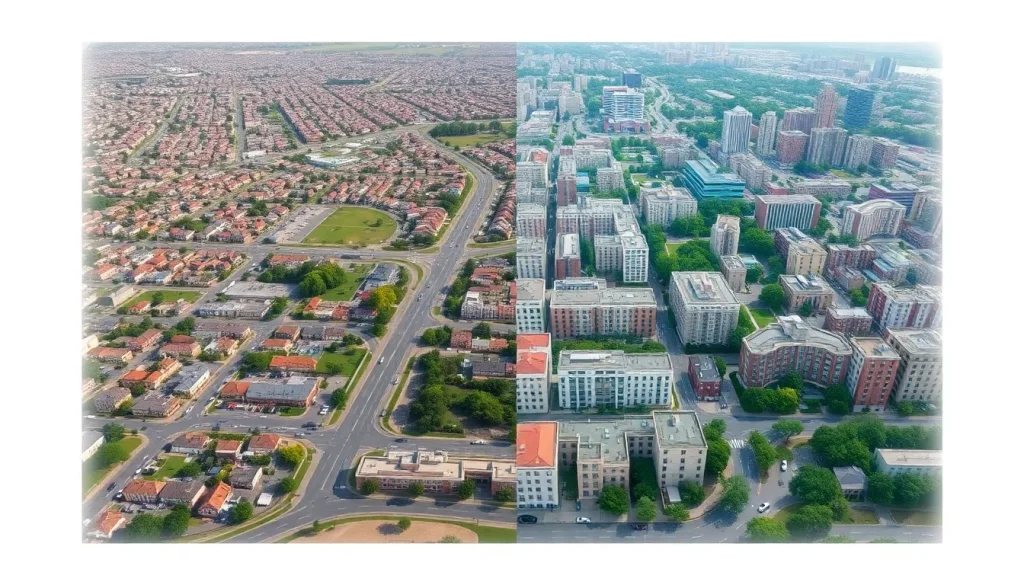
Urban sprawl is a pattern of urban growth that expands cities outward, consuming large areas of land for low-density residential and commercial development, often with segregated land uses and heavy reliance on private automobiles. This pattern is prevalent in North America, Australia, and increasingly in parts of Europe and rapidly urbanizing regions of Asia and Africa. The core problem is that sprawl dramatically increases per capita resource consumption—land, energy, water, and materials—compared to compact, mixed-use urban forms. This not only depletes finite resources but also exacerbates greenhouse gas emissions, infrastructure costs, and environmental degradation. Addressing sprawl is therefore critical for sustainable resource management and climate change mitigation.
How the solution works
The solution to sprawl-induced resource overconsumption is the adoption of compact, mixed-use, and transit-oriented urban development. This approach works by reducing the physical footprint of cities and shortening travel distances, which in turn lowers demand for land, transportation energy, and infrastructure materials. Key mechanisms include:
- Higher density: Concentrating housing and jobs reduces the per capita land area required for urban uses, preserving agricultural and natural land on the periphery.
- Mixed land uses: Integrating residential, commercial, and recreational spaces decreases the need for long trips, enabling walking, cycling, and efficient public transit.
- Transit-oriented development: Focusing growth around public transport nodes reduces car dependency, cutting fuel consumption and vehicle-related resource use.
- Infill and brownfield redevelopment: Using existing urban land and infrastructure avoids the resource costs of building new roads, utilities, and buildings on greenfield sites.
- Efficient building typologies: Multi-unit and attached housing consume less energy and materials per dwelling than detached single-family homes, and they reduce land consumption per capita.
By internalizing the true costs of sprawl through planning policies, pricing mechanisms, and infrastructure investment, cities can shift toward more resource-efficient forms.
Evidence strength
The relationship between urban form and resource consumption is well-documented. Numerous peer-reviewed studies have found that residents of compact cities consume less energy for transportation and housing, use less land per capita, and require less extensive infrastructure networks. For example, comparative analyses of cities in Europe and North America consistently show that sprawling U.S. cities have per capita transport energy consumption two to three times higher than compact European cities. Research using lifecycle assessment demonstrates that low-density, single-use developments have significantly higher embodied and operational energy and material footprints. The evidence is particularly strong for transportation energy and land consumption; for water and materials, the data are more context-dependent but still point to sprawl as a driver of higher per capita use. However, the magnitude of savings from compact development can vary based on local climate, building technology, and behavior. Overall, the evidence base is robust and has been incorporated into numerous policy frameworks, including the IPCC’s assessment of urban mitigation strategies.
Potential scale
The potential scale of resource savings through compact urban development is global. Urban areas are projected to house 68% of the world’s population by 2050, with most growth occurring in developing countries. If this growth follows sprawling patterns, resource consumption will escalate dramatically. Conversely, steering urbanization toward compact forms could reduce global energy demand for transport and buildings by 20–50% by 2050, according to scenario analyses. Land savings could be even more substantial: compact development can reduce urban land expansion by 50–80% compared to sprawl scenarios. However, the achievable scale depends on governance capacity, land availability, and cultural preferences. In already sprawling cities, retrofitting for density is a slow, incremental process, limiting near-term impact.
Cost considerations
Compact development often involves higher upfront land and construction costs per square meter in central areas, but lower per capita infrastructure costs over the long term. Sprawl imposes significant hidden costs: extending roads, water, and sewer networks to low-density areas is more expensive per household, and these costs are often subsidized by existing residents. Studies in the United States have estimated that compact growth could save billions in infrastructure costs over several decades. However, in cities with high land prices, anti-sprawl policies can increase housing costs and exacerbate affordability crises unless paired with inclusionary zoning and public investment in affordable housing. The cost-effectiveness of compact development is generally favorable when full lifecycle and societal costs are considered, but the distribution of costs and benefits can create political resistance.
Implementation time
Shifting from sprawl to compact development is a long-term process. Policy changes such as zoning reforms, urban growth boundaries, and transit investments can be enacted within a few years, but their effects on resource consumption unfold over decades as the building stock and travel patterns adjust. Infill development and densification in existing urban areas can yield measurable reductions in per capita resource use within 5–10 years if supported by strong incentives and public investment. In rapidly growing cities, directing new growth to compact forms can prevent resource-intensive sprawl from locking in, with benefits accruing over the 20–30 year horizon of infrastructure and building lifespans.
Environmental benefits
Compact urban development reduces direct and indirect environmental impacts. Key benefits include:
- Land conservation: Reduced urban footprint preserves farmland, forests, and natural habitats, maintaining ecosystem services and biodiversity.
- Lower greenhouse gas emissions: Shorter trips and higher transit use cut transport emissions; multi-unit buildings reduce heating and cooling energy per capita.
- Reduced material consumption: Denser housing types use less construction material per dwelling, and shared infrastructure lowers per capita material stocks.
- Water savings: Smaller lot sizes and shared landscaping can reduce outdoor water use, though indoor water use is less affected by density.
- Improved air quality: Reduced vehicle miles traveled decrease local air pollutants, though concentrated emissions may require careful management.
Social and economic co-benefits
Compact urban forms can enhance quality of life and economic efficiency. Benefits include improved public health through active transport (walking, cycling), greater access to jobs and services, reduced household transportation costs, and more vibrant public spaces. Economically, agglomeration benefits can boost productivity and innovation. Socially, mixed-use neighborhoods can foster stronger community ties and reduce social isolation. However, these benefits are not automatic; they require deliberate design to ensure equitable access and avoid displacement.
Risks and unintended consequences
Policies to curb sprawl and promote density carry risks. Restricting land supply can inflate property prices, exacerbating housing affordability and displacing lower-income residents. High-density development, if poorly designed, can lead to overcrowding, noise, loss of privacy, and reduced access to green space. There is also a risk of “green gentrification,” where new parks or transit investments raise property values and push out existing communities. Rebound effects are possible: efficiency gains from density might be offset by increased consumption in other areas (e.g., more air travel). Additionally, compact development in some contexts may increase urban heat island effects and concentrate pollution if not managed with green infrastructure.
Where it works best
Compact development is most effective in regions with strong governance, clear land-use planning frameworks, and public support for density. It works well in growing cities where new development can be directed to infill sites or transit corridors. Cities with existing public transit systems, walkable street networks, and a mix of uses are well-positioned to densify. Cultural preferences for urban living and smaller households also facilitate acceptance. Examples include many European cities, Portland (Oregon), Vancouver, and Tokyo.
Where it may not work
Compact development may face significant barriers in areas with deeply entrenched car culture, low population growth, or weak planning institutions. In shrinking cities, densification may be impractical or undesirable. In regions with extreme climates, high-density living can increase energy demand for heating or cooling if building design is not optimized. In some developing countries, rapid informal urbanization makes planned compact development difficult without substantial institutional capacity building. Moreover, in places where land is abundant and cheap, the economic incentives for sprawl remain strong, and anti-sprawl policies may be politically unfeasible.
Comparison with alternatives
Alternatives to compact development include continued sprawl with technological fixes (e.g., electric vehicles, smart grids) or decentralized, self-sufficient eco-villages. While technology can reduce the resource intensity of sprawl (e.g., electric cars lower tailpipe emissions), it does not address land consumption, infrastructure costs, or the embodied energy of low-density construction. Eco-villages can achieve low per capita resource use but are difficult to scale to urban populations. Compact development remains the most scalable and evidence-backed approach to reducing urban resource consumption, though it is often complemented by green building standards and renewable energy integration.
Case studies
Portland, Oregon, USA: The city’s urban growth boundary, established in the 1970s, has contained sprawl and directed growth inward. Studies show that Portland’s per capita vehicle miles traveled are lower than comparable U.S. cities, and its land consumption per new resident has decreased. However, housing affordability has become a major challenge, partly attributed to land supply constraints.
Freiburg, Germany: The Vauban district is a model of car-free, high-density, mixed-use development. It achieves very low per capita energy use and high quality of life, demonstrating that compact living can be attractive and resource-efficient.
Atlanta vs. Barcelona: A classic comparison: Atlanta’s sprawling metropolitan area has a similar population to Barcelona’s compact urban region, yet Atlanta consumes vastly more land and energy per capita, with transport emissions many times higher. This stark contrast underscores the resource implications of urban form.
Final assessment
The evidence is clear: urban sprawl significantly increases per capita resource consumption, and compact urban development is a proven strategy to mitigate this. However, the transition is complex and context-dependent. Success requires integrated policies that address affordability, equity, and quality of life. For rapidly urbanizing regions, avoiding sprawl from the outset is far more cost-effective than retrofitting later. In already sprawling cities, incremental densification around transit nodes offers a pragmatic path. While not a panacea, compact development is an essential component of sustainable resource management and climate action.
FAQ
Does compact development always reduce energy consumption?
Generally yes, but the magnitude depends on local factors. In very cold climates, detached housing can sometimes be more energy-efficient per square meter due to simpler shapes, but per capita energy use is still typically lower in compact forms because of smaller dwelling sizes and reduced transportation needs. The overall lifecycle energy savings from compact development are well-established.
Can technology solve the resource problems of sprawl without changing urban form?
Technology such as electric vehicles and smart grids can reduce some impacts (e.g., tailpipe emissions), but it does not address land consumption, infrastructure costs, or the embodied energy of low-density construction. Moreover, electric vehicles still require energy and materials, and sprawling patterns lock in car dependency. Technology is a complement, not a substitute, for compact urban form.
How do we prevent compact development from causing housing unaffordability?
Policies like inclusionary zoning, public investment in affordable housing, rent control, and community land trusts can help ensure that densification does not displace existing residents. It is also important to increase housing supply broadly, not just in a few neighborhoods, to avoid concentrating price pressures.
References
- IPCC, 2022: Climate Change 2022: Mitigation of Climate Change. Chapter 8: Urban Systems and Other Settlements.
- Newman, P., & Kenworthy, J. (1999). Sustainability and Cities: Overcoming Automobile Dependence. Island Press.
- Ewing, R., & Cervero, R. (2010). Travel and the Built Environment: A Meta-Analysis. Journal of the American Planning Association, 76(3), 265-294.
- Litman, T. (2023). Analysis of Public Policies that Unintentionally Encourage Sprawl. Victoria Transport Policy Institute.
- OECD (2018). Rethinking Urban Sprawl: Moving Towards Sustainable Cities. OECD Publishing.