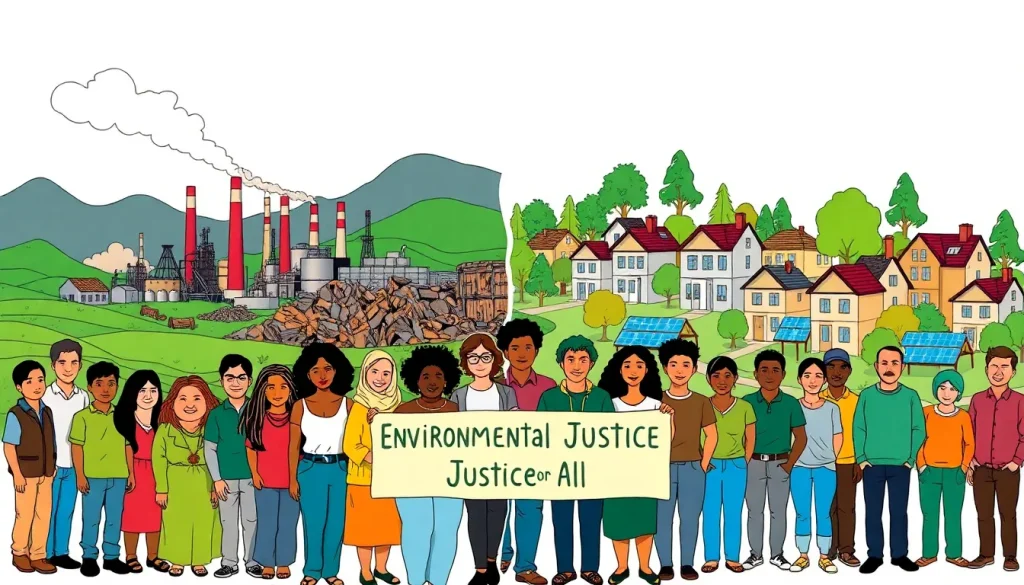
In brief
At a glance
Quick Facts
- Definition
- Environmental justice is the fair treatment and meaningful involvement of all people regardless of race, color, national origin, or income with respect to environmental laws, regulations, and policies.
- Founding Document
- The 17 Principles of Environmental Justice were adopted in 1991 at the First National People of Color Environmental Leadership Summit.
- Key Principle
- Environmental justice demands that public policy be based on mutual respect and justice for all peoples, free from any form of discrimination or bias.
- Health Disparities
- Low-income communities and communities of color often face higher exposure to air pollution, toxic waste, and lead contamination, leading to elevated rates of asthma and other illnesses.
- Legal Basis
- Title VI of the Civil Rights Act of 1964 prohibits discrimination in programs receiving federal funds, a tool used in environmental justice litigation.
- Global Reach
- Environmental justice principles have been adopted internationally, influencing climate negotiations and the rights of indigenous peoples.
- Procedural Equity
- Procedural justice ensures that all people have equal access to the decision-making processes that affect their environment and health.
- Distributive Equity
- Distributive justice addresses the fair distribution of environmental benefits (like parks and clean energy) and burdens (like pollution and waste facilities).
Key Takeaways
- Environmental justice is the fair treatment and meaningful involvement of all people in environmental decision-making, regardless of race, income, or national origin.
- The 17 Principles of Environmental Justice, drafted in 1991, form the foundational ethical framework of the movement, emphasizing human rights, self-determination, and ecological responsibility.
- Environmental injustices disproportionately affect marginalized communities, leading to higher exposure to pollution, health disparities, and limited access to green spaces.
- Applying environmental justice principles requires addressing both procedural inequities (who has a voice) and distributive inequities (who bears the burdens and who receives the benefits).
What Is Environmental Justice Principles Explained?
Environmental justice principles are a set of ethical and political guidelines that demand all people, regardless of race, color, national origin, or income, receive equal protection from environmental and health hazards and equal access to the decision-making processes that shape their environment. These principles emerged from grassroots activism in the United States during the 1980s, when communities of color and low-income groups began organizing against the disproportionate siting of toxic waste facilities, landfills, and polluting industries in their neighborhoods. The movement crystallized in 1991 at the First National People of Color Environmental Leadership Summit, where delegates adopted the landmark 17 Principles of Environmental Justice. These principles go beyond traditional environmentalism by linking ecological concerns with social justice, human rights, and economic equity.
At its core, environmental justice is both a concept and a movement. As a concept, it recognizes that environmental benefits (such as clean air, water, and access to nature) and environmental burdens (such as pollution, waste, and resource extraction) are not distributed equally across society. As a movement, it seeks to correct these imbalances through community organizing, legal action, policy reform, and public education. The principles serve as a moral compass, guiding efforts to ensure that no group of people bears a disproportionate share of negative environmental consequences, and that all people have a voice in decisions affecting their environment and health.
Overview
Environmental justice principles rest on three foundational pillars: distributive justice, procedural justice, and corrective justice. Distributive justice concerns the fair allocation of environmental benefits and burdens. It demands that no community, particularly those already disadvantaged by socioeconomic factors, should shoulder a disproportionate share of pollution, waste disposal, or industrial hazards. Procedural justice focuses on the fairness of decision-making processes, ensuring that all stakeholders have meaningful access to information, opportunities to participate, and the ability to influence outcomes. Corrective justice addresses past harms, calling for remediation, compensation, and policies that prevent recurrence of environmental injustices.

These principles are operationalized through a variety of tools, including environmental impact assessments that consider cumulative effects on vulnerable populations, community benefit agreements, and equitable enforcement of environmental laws. The U.S. Environmental Protection Agency defines environmental justice as “the fair treatment and meaningful involvement of all people regardless of race, color, national origin, or income with respect to the development, implementation, and enforcement of environmental laws, regulations, and policies.” Internationally, the concept has been expanded to include climate justice, food sovereignty, and the rights of indigenous peoples, reflecting a global recognition that environmental harms and benefits are unevenly distributed across nations and within societies.
History
The environmental justice movement has deep roots in the civil rights movement and the struggle against environmental racism. In the United States, the modern movement is often traced to the 1982 protests in Warren County, North Carolina, where a predominantly African American community opposed the siting of a hazardous waste landfill. Although the protests did not stop the landfill, they galvanized national attention and led to studies that documented the systemic placement of toxic facilities in communities of color. The 1987 United Church of Christ report, “Toxic Wastes and Race in the United States,” provided the first comprehensive evidence that race was the most significant factor in the location of hazardous waste sites, even more than income.
In 1991, the First National People of Color Environmental Leadership Summit brought together over 1,000 delegates from across the United States and other countries. The summit produced the 17 Principles of Environmental Justice, which remain a cornerstone of the movement. These principles affirm the sacredness of Mother Earth, the right to self-determination, the need for universal protection from nuclear testing and toxic waste, and the demand for full compensation and reparations for environmental damages. The summit also broadened the movement’s scope to include urban and rural issues, workers’ rights, and the rights of indigenous peoples. In 1994, President Bill Clinton signed Executive Order 12898, directing federal agencies to integrate environmental justice into their missions, marking a significant step in institutional recognition.
How It Works
Environmental justice principles are applied through a combination of legal frameworks, policy tools, and community-driven initiatives. At the governmental level, agencies are required to identify and address disproportionately high and adverse human health or environmental effects of their programs, policies, and activities on minority and low-income populations. This involves conducting environmental justice analyses, engaging with affected communities early in the decision-making process, and ensuring equitable distribution of resources for environmental protection and remediation.
Community-based organizations play a critical role by monitoring local environmental conditions, advocating for policy changes, and holding polluters accountable. Tools such as community mapping, participatory research, and citizen science enable residents to document environmental hazards and health impacts. Legal avenues include filing civil rights complaints under Title VI of the Civil Rights Act, which prohibits discrimination by recipients of federal funds, and using environmental laws to challenge permits for polluting facilities. The principles also guide corporate social responsibility efforts, encouraging businesses to adopt fair practices and engage transparently with affected communities.
Importance and Impact
Environmental justice principles are essential because environmental harms and benefits are not distributed equally across society. Numerous studies have shown that low-income communities and communities of color are more likely to live near hazardous waste sites, breathe polluted air, and lack access to clean water and green spaces. These disparities contribute to higher rates of asthma, cancer, and other health problems, as well as reduced quality of life and economic opportunities. By centering equity, environmental justice principles help to correct these systemic imbalances and ensure that environmental protection benefits all people, not just the privileged.
The impact of the environmental justice movement is evident in policy changes, legal victories, and increased public awareness. For example, the U.S. Environmental Protection Agency now has an Office of Environmental Justice and requires environmental justice considerations in rulemaking. Community-led campaigns have successfully blocked or relocated polluting facilities, secured cleanup of contaminated sites, and won compensation for affected residents. Internationally, environmental justice principles have influenced climate negotiations, highlighting the disproportionate impact of climate change on developing nations and indigenous communities. The movement has also fostered a broader understanding of sustainability that includes social equity as a core component.
Common Misconceptions
One common misconception is that environmental justice is solely about race. While race is a central factor, the principles also address income, national origin, and other forms of social disadvantage. Environmental injustices often intersect with multiple dimensions of inequality, including class, gender, and disability. Another misconception is that environmental justice is only concerned with pollution and toxic waste. In reality, it encompasses access to environmental benefits such as parks, clean energy, healthy food, and safe housing, as well as protection from climate change impacts and resource extraction.
Some people mistakenly believe that environmental justice is anti-development or opposed to economic growth. The movement does not reject development but advocates for equitable development that does not sacrifice the health and well-being of marginalized communities. It calls for a just transition to a sustainable economy that creates green jobs and revitalizes communities rather than perpetuating cycles of pollution and poverty. Finally, there is a misconception that environmental justice is a niche issue affecting only a few communities. In fact, environmental inequities are widespread, affecting urban, rural, and suburban areas across the globe, and addressing them is essential for achieving a truly sustainable and just society.
What Individuals Can Do
Individuals can support environmental justice by educating themselves about local environmental issues and the communities most affected. This includes learning about the history of environmental racism and the principles of the movement. Engaging with community organizations, attending public hearings, and participating in local planning processes are direct ways to amplify the voices of those impacted. Supporting policies and elected officials who prioritize environmental justice at the local, state, and national levels is also crucial.
On a personal level, individuals can reduce their own environmental footprint and advocate for sustainable practices, but it is equally important to recognize that individual actions alone cannot solve systemic problems. Donating to environmental justice organizations, volunteering time, and using social platforms to raise awareness can help build momentum. Consumers can support businesses that demonstrate a commitment to environmental justice and fair labor practices. Ultimately, being an ally means listening to and centering the leadership of frontline communities rather than speaking for them.
FAQ
What is environmental justice?
Environmental justice is the principle that all people have the right to equal protection from environmental hazards and equal access to environmental benefits, regardless of race, income, or national origin. It also includes the right to participate meaningfully in decisions that affect one's environment.
How do environmental justice principles work?
They work by guiding policies, laws, and community actions to identify and correct inequities. This includes requiring environmental impact assessments to consider effects on vulnerable groups, ensuring public participation in permitting processes, and enforcing anti-discrimination laws in environmental matters.
Why do environmental justice principles matter?
They matter because environmental harms and benefits are not distributed equally. Without these principles, marginalized communities continue to suffer higher rates of pollution-related illnesses, reduced quality of life, and limited economic opportunities. Addressing these inequities is essential for a just and sustainable society.
References
- U.S. Environmental Protection Agency, 'Environmental Justice', https://www.epa.gov/environmentaljustice
- First National People of Color Environmental Leadership Summit, 'The Principles of Environmental Justice', 1991
- Robert D. Bullard, 'Dumping in Dixie: Race, Class, and Environmental Quality', Westview Press, 1990