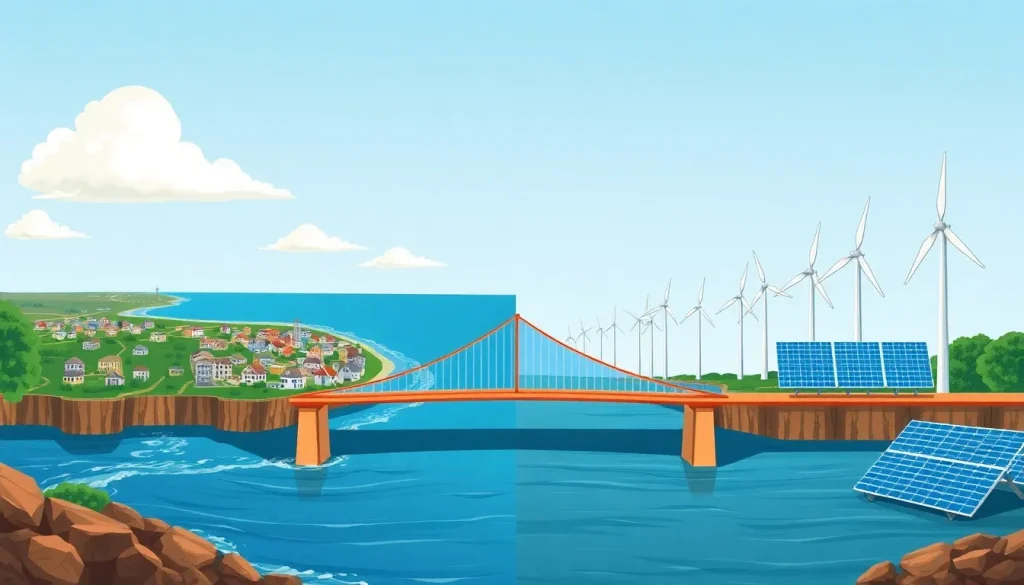
In brief
At a glance
Quick Facts
- Primary Goal of Mitigation Finance
- Reduce greenhouse gas emissions and enhance carbon sinks to limit future climate change.
- Primary Goal of Adaptation Finance
- Help communities and ecosystems adjust to the current and expected impacts of climate change.
- Main Sources
- Public funds (governments, multilateral banks), private investment, and blended finance.
- Typical Projects (Mitigation)
- Renewable energy, energy efficiency, sustainable transport, reforestation.
- Typical Projects (Adaptation)
- Flood defenses, drought-resistant agriculture, early warning systems, water management.
- Global Finance Flows
- Mitigation receives the majority of climate finance; adaptation accounts for a smaller share, often less than 25%.
- Paris Agreement Target
- Calls for a balance between adaptation and mitigation finance, with increased support for adaptation.
- Key Challenge
- Adaptation finance is underfunded relative to needs, especially in the most vulnerable countries.
Key Takeaways
- Adaptation finance and mitigation finance are two distinct but complementary pillars of climate finance, each addressing different aspects of the climate crisis.
- Mitigation finance targets the reduction of greenhouse gas emissions, while adaptation finance helps societies cope with the unavoidable impacts of climate change.
- Mitigation projects often attract more private investment due to revenue-generating potential, whereas adaptation finance relies heavily on public and concessional sources.
- A balanced approach to both is essential for sustainable development, yet global finance flows remain skewed toward mitigation.
What Is Adaptation Finance vs Mitigation Finance?
Adaptation finance and mitigation finance are the two main categories of climate finance, each serving a distinct purpose in the global response to climate change. Adaptation finance refers to the financial resources directed at helping communities, ecosystems, and economies adjust to the current and expected impacts of climate change. This includes funding for projects such as building flood defenses, developing drought-resistant crops, improving water management systems, and establishing early warning systems for extreme weather events. The primary goal is to reduce vulnerability and increase resilience to climate-related hazards.
Mitigation finance, on the other hand, supports activities that reduce greenhouse gas emissions or enhance carbon sinks. It flows into projects like renewable energy installations, energy efficiency improvements, sustainable transport, and reforestation. The aim is to limit the magnitude of future climate change by cutting emissions and removing carbon dioxide from the atmosphere. While both types of finance are critical, they address different time horizons: mitigation tackles the root cause of climate change over the long term, while adaptation deals with the immediate and near-term consequences that are already locked in due to past emissions.
How It Works
Climate finance flows through a complex network of sources, intermediaries, and instruments. Public sources include national governments, multilateral development banks (such as the World Bank), and dedicated climate funds like the Green Climate Fund (GCF) and the Global Environment Facility (GEF). Private sources encompass commercial banks, institutional investors, private equity, and corporations. Blended finance, which combines public and private capital to reduce risk and attract investment, is increasingly used to bridge funding gaps.

Mitigation finance often flows to large-scale, capital-intensive projects that generate revenue streams, such as wind farms or solar parks. This makes them attractive to private investors seeking returns. Instruments include project finance, green bonds, and equity investments. Adaptation finance, by contrast, frequently supports public goods like coastal protection, ecosystem restoration, or community-based resilience programs that do not produce direct financial returns. As a result, it relies more on grants, concessional loans, and public budgets. The Green Climate Fund, for example, aims to allocate its resources equally between adaptation and mitigation, but achieving this balance has been challenging due to the differing nature of the projects.
Importance and Impact
Both adaptation and mitigation finance are indispensable for achieving the goals of the Paris Agreement and the Sustainable Development Goals. Mitigation finance is crucial for limiting global temperature rise to well below 2°C, as it drives the transition to a low-carbon economy. It has already contributed to significant cost reductions in renewable energy technologies and accelerated their deployment worldwide. Without sustained mitigation investment, the physical risks of climate change would escalate dramatically, making adaptation far more costly and less effective.
Adaptation finance is equally vital because even with aggressive mitigation, some degree of climate change is unavoidable due to historical emissions. It protects lives, livelihoods, and infrastructure from climate impacts, particularly in vulnerable regions. Evidence shows that every dollar invested in adaptation can yield significant economic returns by avoiding disaster losses and safeguarding development gains. For instance, early warning systems and climate-resilient agriculture have demonstrably reduced mortality and economic disruption. The impact of adaptation finance extends beyond immediate protection; it fosters long-term resilience and social stability.
Benefits, Limitations and Trade-offs
Mitigation finance offers clear benefits: it reduces long-term climate risks, improves air quality, and can stimulate green jobs and innovation. However, it often favors large, centralized projects and may overlook small-scale or decentralized solutions, such as community energy or sustainable land management. There is also a risk that mitigation projects, if not carefully designed, can have negative social or environmental side effects, such as land-use conflicts from bioenergy or hydropower.
Adaptation finance provides direct, local benefits by protecting communities and ecosystems. Yet it faces significant limitations: funding is chronically insufficient, and it is often reactive rather than proactive, flowing after disasters rather than building resilience beforehand. Some adaptation measures can be maladaptive if they inadvertently increase vulnerability elsewhere or in the future—for example, building a sea wall that destroys coastal habitats and increases erosion downstream. A key trade-off is that resources allocated to one type of finance may reduce availability for the other, though in practice the two can be synergistic. Integrated projects, such as mangrove restoration that sequesters carbon (mitigation) and protects coastlines (adaptation), demonstrate how trade-offs can be minimized.
Regional Differences
The distribution of adaptation and mitigation finance varies significantly by region. Mitigation finance tends to flow toward large emerging economies with high emissions and strong renewable energy potential, such as China, India, and Brazil, as well as developed countries. These regions offer attractive investment environments for private capital. Adaptation finance, however, is disproportionately needed in the most climate-vulnerable countries, including small island developing states (SIDS), least developed countries (LDCs), and many African nations. These countries have contributed least to global emissions but face the severest impacts, such as sea-level rise, droughts, and extreme weather.
Despite this need, adaptation finance remains a small fraction of total climate finance in many vulnerable regions. Sub-Saharan Africa, for example, receives a relatively high share of adaptation funding compared to other regions, but the absolute amounts are far below estimated requirements. Developed countries also require adaptation finance to address their own vulnerabilities, such as wildfires, heatwaves, and coastal flooding, but their domestic resources are generally larger. The mismatch between where mitigation finance is invested and where adaptation finance is most needed underscores the equity dimensions of climate finance.
Common Misconceptions
One common misconception is that adaptation and mitigation are interchangeable or that focusing on one eliminates the need for the other. In reality, they are complementary: mitigation reduces the severity of future climate change, while adaptation manages the impacts that cannot be avoided. Another misunderstanding is that adaptation is only a concern for developing countries. Developed nations also face significant climate risks and must invest in adaptation, as seen in the increasing frequency of floods, heatwaves, and wildfires in Europe and North America.
Some believe that mitigation alone is sufficient if done aggressively enough. However, even if emissions were halted immediately, the climate would continue to change for decades due to the inertia of the Earth system, making adaptation unavoidable. There is also a misconception that adaptation finance is merely charity; it is a strategic investment in global stability, as climate impacts can trigger migration, conflict, and supply chain disruptions that affect all countries. Finally, the idea that adaptation projects are always small-scale and low-tech is false—large infrastructure projects like the Delta Works in the Netherlands are major adaptation investments.
What Businesses and Governments Can Do
Governments play a central role in scaling up both adaptation and mitigation finance. They can establish clear policy frameworks, such as carbon pricing and renewable energy targets, to incentivize private investment in mitigation. For adaptation, they can integrate climate risk into national planning, allocate dedicated budget lines, and strengthen regulatory environments to encourage resilient infrastructure. International cooperation through the UNFCCC and multilateral development banks is essential to mobilize and channel funds to where they are most needed, particularly for vulnerable countries with limited fiscal capacity.
Businesses and financial institutions also have critical roles. Corporations can invest in low-carbon technologies, improve energy efficiency, and assess climate risks across their supply chains. The financial sector can develop innovative instruments like green bonds, sustainability-linked loans, and resilience bonds. Blended finance structures can help de-risk adaptation projects and attract private capital. By aligning their strategies with the Paris Agreement, businesses not only contribute to climate goals but also manage their own long-term risks and seize new market opportunities in the growing green economy.
FAQ
What is the difference between adaptation finance and mitigation finance?
Adaptation finance funds projects that help communities adjust to climate impacts, such as sea walls or drought-resistant crops. Mitigation finance supports efforts to reduce greenhouse gas emissions, like renewable energy or reforestation.
Why is adaptation finance often less than mitigation finance?
Mitigation projects often generate revenue (e.g., selling electricity), attracting private investors. Adaptation projects typically provide public goods without direct financial returns, so they rely more on public and concessional funding, which is scarcer.
How can adaptation and mitigation finance be balanced?
Balancing requires policy commitments, such as the Paris Agreement's goal of equal funding, increased public finance for adaptation, innovative financial instruments to de-risk adaptation projects, and integrating adaptation into development planning.
References
- UNFCCC Standing Committee on Finance, Biennial Assessment and Overview of Climate Finance Flows
- IPCC Sixth Assessment Report, Working Group II: Impacts, Adaptation and Vulnerability
- Climate Policy Initiative, Global Landscape of Climate Finance
- World Bank, Climate Change Adaptation and Mitigation
- OECD, Climate Finance Provided and Mobilised by Developed Countries