In brief
At a glance
Quick Facts
- Definition
- The capacity of an ecosystem to absorb disturbance and reorganize while retaining essentially the same function, structure, and feedbacks.
- Key Concept
- Introduced by C.S. Holling in 1973, distinguishing it from engineering resilience.
- Biodiversity Role
- Higher biodiversity often enhances resilience through functional redundancy.
- Regime Shift
- When resilience is exceeded, an ecosystem may shift to a fundamentally different state, such as a clear lake becoming turbid.
- Disturbance
- Natural disturbances like fire and floods can maintain resilience by preventing any single species from dominating.
- Climate Change
- Climate change increases disturbance frequency and intensity, testing ecosystem resilience globally.
- Management
- Adaptive management and reducing non-climate stressors are key strategies for building resilience.
Key Takeaways
- Ecological resilience is the ability of an ecosystem to absorb disturbance and reorganize while maintaining its essential functions, structure, and feedbacks.
- It differs from engineering resilience, which focuses on the speed of return to a single equilibrium state after a disturbance.
- High biodiversity, functional redundancy, and connectivity within and across scales can enhance resilience.
- Understanding resilience is crucial for managing ecosystems sustainably in the face of climate change and other anthropogenic pressures.
What Is Ecological Resilience?
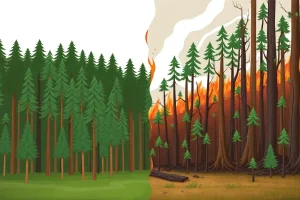
Ecological resilience is the capacity of an ecosystem to absorb disturbance and reorganize while undergoing change so as to still retain essentially the same function, structure, identity, and feedbacks. This concept, introduced by ecologist C.S. Holling in 1973, contrasts with the earlier notion of “engineering resilience,” which measures how quickly a system returns to a single equilibrium state after a perturbation. In ecological resilience, the focus is on the existence of multiple stable states and the ability of the system to persist within a given “regime” rather than returning to a precise original condition. For example, a resilient forest may experience fire, pest outbreaks, or drought, yet continue to function as a forest ecosystem—maintaining nutrient cycling, species interactions, and overall productivity—even if its species composition shifts.
Resilience is thus a property of complex adaptive systems, where feedback loops, diversity, and redundancy allow the system to absorb shocks and avoid crossing critical thresholds that would lead to a fundamentally different state, such as a forest turning into a grassland or a clear lake becoming a turbid, algae-dominated one. The concept is closely tied to the idea of regime shifts—abrupt, persistent changes in ecosystem structure and function. A resilient ecosystem can experience disturbance and still remain within its current regime, while a system with low resilience may be pushed past a tipping point into an alternative state that is often less desirable from a human perspective. Understanding resilience therefore involves recognizing the processes that maintain a system’s identity and the thresholds that, if crossed, can lead to irreversible change.
How It Works
Ecological resilience operates through a set of interconnected mechanisms that allow ecosystems to cope with change. These mechanisms work across different scales, from genetic diversity within populations to landscape-level connectivity. Key mechanisms include:
- Functional redundancy: Multiple species perform similar ecological roles, so if one species is lost to disease or disturbance, others can compensate, maintaining processes like pollination, decomposition, or nutrient cycling.
- Response diversity: Within a functional group, species may respond differently to the same disturbance. For example, some plant species may be fire-resistant while others resprout quickly after fire, ensuring that the plant community as a whole recovers.
- Connectivity: The flow of organisms, energy, and materials across the landscape enables recolonization after local extinctions and allows species to track suitable conditions as the environment changes. However, excessive connectivity can also spread disturbances like invasive species or disease.
- Feedback loops: Negative feedbacks dampen fluctuations and stabilize the system (e.g., predators controlling herbivore populations), while positive feedbacks can amplify change and potentially push the system past a threshold (e.g., melting permafrost releasing methane, which accelerates warming).
- Adaptive capacity: The ability of species and ecosystems to adjust to changing conditions through behavioral, physiological, or evolutionary changes. This includes phenotypic plasticity and genetic diversity that provide the raw material for natural selection.
These mechanisms are often described through the adaptive cycle, a model that depicts ecosystems moving through phases of growth, conservation, release (disturbance), and reorganization. Resilience is typically highest during the reorganization phase, when the system has the opportunity to shift to a new trajectory, and lowest during the conservation phase, when resources are tightly held and the system is rigid. Disturbances such as fire, floods, or pest outbreaks are natural parts of many ecosystems and can enhance resilience by preventing any single species from dominating and by creating opportunities for renewal.
Importance and Impact
Ecological resilience is critical for sustaining the ecosystem services upon which human societies depend. These services include provisioning services like food, fresh water, and timber; regulating services such as climate regulation, flood control, and water purification; and cultural services like recreation and spiritual values. Resilient ecosystems are better able to withstand and recover from disturbances like hurricanes, droughts, and wildfires, reducing the risk of catastrophic shifts that could compromise these services. For instance, resilient coastal wetlands can buffer storm surges and adapt to sea-level rise, protecting inland communities and infrastructure.
In a world facing rapid climate change, habitat fragmentation, and biodiversity loss, maintaining and enhancing resilience is a central goal of conservation and natural resource management. Loss of resilience can lead to regime shifts—sudden, often irreversible changes—such as coral reefs becoming algae-dominated or forests turning into savannas, with severe consequences for biodiversity and human livelihoods. The economic costs of such shifts can be enormous, including lost fisheries, reduced agricultural productivity, and increased disaster recovery expenses. Moreover, resilience thinking encourages a shift from trying to control ecosystems to managing their capacity to adapt, which is essential in an era of uncertainty and rapid environmental change.
Main Causes or Drivers
Several factors influence the resilience of an ecosystem, and these can act as both enhancers and eroders depending on context. The primary drivers include:
- Biodiversity: Ecosystems with higher species richness and functional diversity tend to be more resilient because they have more “insurance” against the loss of any single component. Genetic diversity within species also provides adaptive potential.
- Connectivity: Landscape connectivity allows for migration and recolonization, but excessive connectivity can facilitate the spread of invasive species, diseases, or disturbances like fire.
- Disturbance regimes: The frequency, intensity, and type of natural disturbances shape resilience. Ecosystems that have evolved with periodic fires, floods, or herbivory may depend on these disturbances for renewal and maintenance of diversity.
- Human activities: Land-use change, pollution, overexploitation of resources, and introduction of invasive species can erode resilience by simplifying ecosystems, breaking feedback loops, and pushing systems closer to critical thresholds.
- Climate change: Rising temperatures, altered precipitation patterns, and increased frequency of extreme events act as chronic stressors that can reduce resilience and trigger regime shifts, especially when combined with other pressures.
Interactions among these drivers are particularly important. For example, a forest stressed by drought (climate change) and fragmented by roads (land-use change) may have lower resilience to a pest outbreak, leading to widespread tree mortality and a shift to a non-forested state. Understanding these interactions is key to predicting and managing resilience.
Examples
Coral reefs provide a classic example of ecological resilience. Healthy reefs with diverse herbivorous fish populations can recover from bleaching events because the fish graze on algae, preventing a shift to an algae-dominated state. However, overfishing of herbivores and nutrient pollution from land can reduce resilience, making reefs vulnerable to regime shifts where corals are replaced by macroalgae. Once such a shift occurs, it is difficult to reverse because the algae inhibit coral recruitment, creating a self-reinforcing feedback loop.
In boreal forests, fire is a natural disturbance that releases nutrients and triggers seed germination in species like jack pine. The ecosystem is resilient if fire frequency remains within historical bounds. But climate change-induced increases in fire severity and frequency, combined with logging and insect outbreaks, can overwhelm resilience, leading to conversion to grassland or shrubland. Similarly, shallow lakes can exist in two alternative stable states: a clear-water state with submerged vegetation, or a turbid state dominated by phytoplankton. Resilience depends on nutrient levels; beyond a threshold of phosphorus loading, the lake may abruptly shift to the turbid state. Restoring resilience often requires reducing nutrient inputs and sometimes biomanipulation, such as removing planktivorous fish to allow zooplankton to graze on algae.
Common Misconceptions
A common misconception is that resilience means an ecosystem returns to its exact original state after a disturbance. In reality, ecological resilience emphasizes persistence of function and identity, not a static composition. The species mix may change, but the ecosystem remains a forest, a wetland, or a coral reef. Another misunderstanding is that resilience is always desirable; some ecosystems, such as those dominated by invasive species, can be highly resilient but undesirable from a conservation or human perspective. For example, a grassland invaded by cheatgrass may be very resilient to fire but provides poor habitat and forage.
Additionally, resilience is not the same as resistance—the ability to withstand disturbance without change. A resistant system may show little immediate effect from a disturbance, while a resilient system may change markedly in structure but still maintain its core processes. Finally, resilience is not a fixed property; it can change over time due to internal dynamics and external pressures. An ecosystem that is resilient today may become vulnerable if key species are lost or if chronic stress accumulates.
Solutions
Enhancing ecological resilience involves a range of strategies that address both the drivers of resilience loss and the mechanisms that underpin it. Key approaches include:
- Protecting and restoring biodiversity: Conserving species and genetic diversity provides the functional redundancy and adaptive capacity needed for resilience. Restoration efforts should focus on re-establishing native species and ecological processes.
- Maintaining natural disturbance regimes: In fire-adapted ecosystems, prescribed burns can reduce fuel loads and prevent catastrophic wildfires. Allowing rivers to flood naturally can maintain wetland resilience.
- Reducing non-climate stressors: Minimizing pollution, habitat fragmentation, and overharvesting gives ecosystems a better chance to cope with climate change. Integrated management of multiple stressors is essential.
- Establishing ecological networks: Protected areas connected by corridors allow species to move and adapt to shifting conditions, supporting landscape-scale resilience.
- Adaptive management: A structured process of learning by doing, where management actions are treated as experiments, and policies are adjusted based on monitoring and new knowledge. This is particularly important given uncertainties about future conditions.
- Assisted migration and genetic rescue: In some cases, actively moving species or introducing genetic diversity may be necessary to bolster the adaptive capacity of populations facing rapid environmental change.
Ultimately, building resilience requires a holistic approach that integrates ecological, social, and economic considerations. It involves not only managing ecosystems but also transforming the human systems that depend on them to be more flexible and forward-looking.
FAQ
What is ecological resilience?
Ecological resilience is the ability of an ecosystem to absorb disturbance and reorganize while maintaining its essential functions, structure, and feedbacks, without shifting to a fundamentally different state.
How does ecological resilience differ from resistance?
Resistance is the ability to withstand disturbance without change, while resilience involves absorbing change and reorganizing. A resistant system may not change at all, whereas a resilient system may change in composition but retain its core processes.
Why does ecological resilience matter?
It matters because it underpins the stability of ecosystem services that humans rely on, such as clean water, food, and climate regulation. Loss of resilience can lead to abrupt, often irreversible, ecosystem degradation.
References
- Holling, C.S. (1973). Resilience and stability of ecological systems. Annual Review of Ecology and Systematics, 4, 1-23.
- Walker, B., Holling, C.S., Carpenter, S.R., & Kinzig, A. (2004). Resilience, adaptability and transformability in social–ecological systems. Ecology and Society, 9(2), 5.
- Gunderson, L.H. (2000). Ecological resilience—in theory and application. Annual Review of Ecology and Systematics, 31, 425-439.