In brief
At a glance
Quick Facts
- Definition of passive restoration
- Removing disturbances and allowing natural ecological processes to restore an ecosystem without direct human intervention.
- Definition of active restoration
- Deliberate human actions such as planting, engineering, or species reintroduction to repair a degraded ecosystem.
- Cost comparison
- Passive restoration is generally less expensive than active restoration, sometimes by orders of magnitude.
- Timeframe
- Passive restoration can take decades to centuries; active restoration can accelerate recovery to years or a few decades.
- Key barrier to passive recovery
- Crossing ecological thresholds, such as soil loss, seed bank depletion, or invasive species dominance, may prevent natural recovery.
- Common active techniques
- Planting native species, removing invasives, soil amendment, hydrological repair, and reintroducing keystone species.
- Hybrid approach
- Assisted natural regeneration combines passive recovery with targeted active interventions to overcome specific barriers.
- Global relevance
- Both approaches are used worldwide in forests, grasslands, wetlands, and marine systems to combat degradation and biodiversity loss.
Key Takeaways
- Passive restoration removes or reduces disturbances to allow natural recovery, while active restoration involves direct human actions like planting, soil amendment, or hydrological repair.
- Passive restoration is generally less expensive and can produce more natural species composition, but it may be slow or fail if degradation thresholds have been crossed.
- Active restoration accelerates recovery and can overcome barriers, but it is costlier, riskier, and may result in less diverse or less resilient ecosystems.
- Choosing between passive and active restoration depends on site conditions, degradation severity, available resources, and desired outcomes; often a combination of both is most effective.
- Both approaches are critical tools for reversing ecosystem degradation, conserving biodiversity, and restoring ecosystem services such as carbon sequestration and water purification.
What Is Passive Restoration vs Active Restoration?
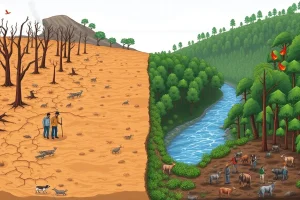
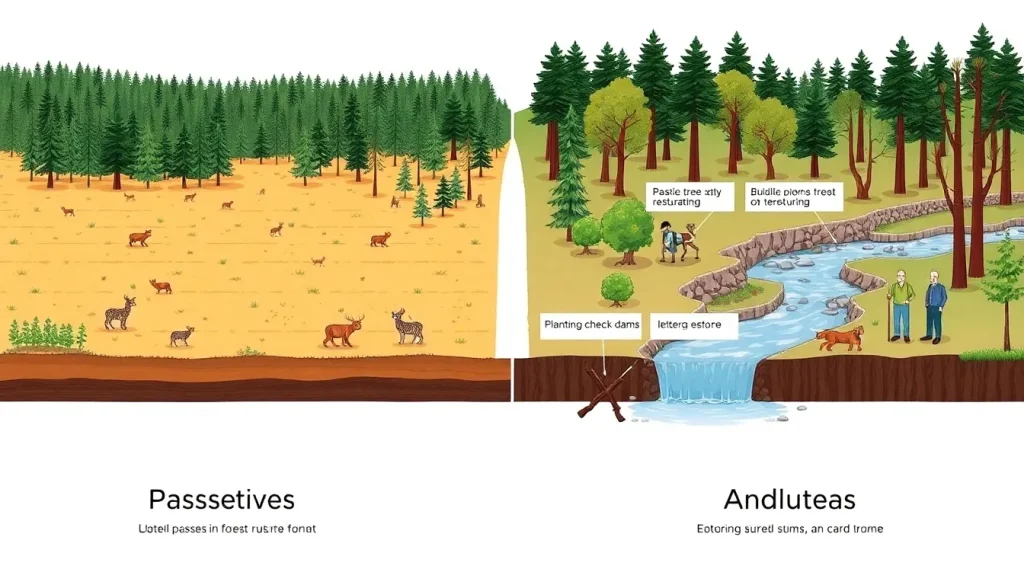
Passive restoration and active restoration are two fundamental strategies in ecological restoration, the process of assisting the recovery of an ecosystem that has been degraded, damaged, or destroyed. Passive restoration, also called natural regeneration, involves removing or reducing the sources of degradation and then allowing natural ecological processes to drive recovery without direct human intervention. Active restoration, in contrast, requires deliberate human actions to repair ecosystem structure and function, such as planting native species, removing invasive species, reshaping landforms, or reintroducing keystone organisms.
These approaches exist on a continuum. At one extreme, a site may recover entirely on its own once a stressor—like overgrazing or pollution—is eliminated. At the other extreme, a severely degraded landscape, such as a mine site, may need complete reconstruction of soils and vegetation. Most restoration projects blend elements of both strategies, using passive recovery where possible and active interventions where necessary. The choice between them depends on the resilience of the ecosystem, the degree of degradation, the availability of propagules (seeds, spores, or colonists), and the goals of the restoration effort.
Overview
Ecological restoration is the practice of returning a degraded ecosystem to a state that resembles its pre-disturbance condition in terms of composition, structure, and function. The two primary approaches—passive and active restoration—represent different philosophies and resource commitments. Passive restoration assumes that once the cause of degradation is removed, natural successional processes will eventually restore the ecosystem. This approach is often used in forests, grasslands, and wetlands where soil seed banks, nearby source populations, and natural dispersal mechanisms remain intact.
Active restoration is employed when natural recovery is unlikely or unacceptably slow. It involves direct human manipulation of the environment, which can range from simple actions like sowing seeds or planting seedlings to complex engineering projects such as regrading topography, restoring hydrological flows, or reintroducing extirpated species. The distinction is not always sharp; many projects use a hybrid approach, such as removing invasive species (an active intervention) and then allowing native vegetation to recolonize on its own (passive recovery).
How It Works
Passive restoration works by removing or reducing the pressures that caused degradation, then relying on natural ecological processes—dispersal, germination, competition, succession—to reassemble the community. Key steps include:
- Ceasing harmful activities: Stopping logging, grazing, mining, or pollution inputs.
- Protecting the site: Fencing to exclude herbivores, legal protection, or fire management.
- Allowing natural recolonization: Seeds from adjacent intact ecosystems, resprouting from remnant root systems, and animal dispersal gradually restore vegetation and habitat.
Active restoration, by contrast, directly manipulates the environment to overcome barriers to recovery. Common techniques include:
- Planting: Sowing seeds or transplanting nursery-grown seedlings of native species.
- Invasive species control: Manual, chemical, or biological removal of non-native plants and animals.
- Soil remediation: Adding organic matter, nutrients, or microorganisms; removing contaminants.
- Hydrological restoration: Restoring natural water flows by removing drains, plugging ditches, or re-meandering streams.
- Reintroductions: Bringing back keystone species, such as beavers or apex predators, to restore ecological processes.
Active restoration often requires ongoing management, such as watering, weeding, and protection from herbivores, until the ecosystem becomes self-sustaining.
Benefits, Limitations and Trade-offs
Passive restoration offers several advantages. It is typically less expensive because it requires minimal labor and materials. It can also produce ecosystems that are more self-organizing and better adapted to local conditions, as natural selection operates on the species that establish. However, passive restoration can be slow, taking decades or centuries to reach a desired state, and it may fail if degradation has crossed critical thresholds—for example, if soil has eroded, seed banks are depleted, or invasive species dominate. There is also a risk that the ecosystem will recover to an alternative stable state that is less desirable than the original.
Active restoration can accelerate recovery and direct the trajectory toward a specific target. It is often necessary when the ecosystem has lost its capacity for self-repair. Yet active restoration is more expensive, labor-intensive, and can inadvertently cause harm—such as introducing non-native genotypes, compacting soil, or creating overly simplified communities. The choice of species and methods may also reflect human preferences rather than ecological suitability, leading to low diversity or poor long-term resilience. A hybrid approach, sometimes called “assisted natural regeneration,” seeks to combine the cost-effectiveness of passive restoration with the targeted interventions of active restoration.
Examples
Passive restoration: In many temperate regions, abandoned agricultural fields undergo natural succession. Without plowing or grazing, grasses and herbs are replaced by shrubs, then by pioneer trees, and eventually by forest. In the eastern United States, large areas of farmland that were abandoned in the 19th and early 20th centuries have reverted to forest through passive processes. Similarly, in some marine protected areas, simply prohibiting fishing and other extractive activities has allowed fish populations and coral reef communities to recover over time.
Active restoration: The restoration of mined lands often requires active intervention. For example, after bauxite mining in Australia, companies reshape the landscape, replace topsoil, and plant a diverse mix of native species to re-establish jarrah forest. In wetland restoration, projects frequently involve removing drainage tiles, plugging ditches, and planting native vegetation to recreate hydrological conditions. In tropical dry forests, active planting of native tree species has been used to overcome dispersal limitations and competition from invasive grasses.
Hybrid approach: In the Atlantic Forest of Brazil, restoration practitioners often use “assisted natural regeneration” by controlling invasive grasses, installing perches to attract seed-dispersing birds, and planting clusters of native trees to accelerate forest recovery on degraded pastures.
Why It Matters
Understanding the distinction between passive and active restoration is crucial for effective environmental management. Globally, ecosystems are under unprecedented pressure from land-use change, climate change, and pollution. Restoration is increasingly recognized as a key strategy for addressing biodiversity loss, mitigating climate change, and sustaining ecosystem services that support human well-being. Choosing the wrong approach can waste resources, delay recovery, or even cause further degradation.
Passive restoration, when feasible, can be a cost-effective way to restore large areas, particularly in regions with low population density and intact source ecosystems. Active restoration is essential for highly degraded sites where natural recovery is blocked. By matching the approach to the ecological and social context, restoration practitioners can maximize the benefits for biodiversity, carbon storage, water quality, and local communities. The growing field of restoration ecology continues to refine guidelines for selecting and combining these strategies to achieve durable, self-sustaining ecosystems.
FAQ
What is passive restoration?
Passive restoration is the process of allowing an ecosystem to recover on its own after removing or reducing the sources of degradation, such as stopping grazing or pollution, without direct human intervention.
How does active restoration differ from passive restoration?
Active restoration involves direct human actions like planting native species, reshaping land, or controlling invasives, whereas passive restoration relies on natural processes once disturbances are removed.
When is passive restoration preferred over active restoration?
Passive restoration is preferred when the ecosystem is resilient, degradation is not severe, seed sources are nearby, and time is not a critical constraint. It is also chosen when budgets are limited and large areas need restoration.
References
- Society for Ecological Restoration (SER) International Standards for the Practice of Ecological Restoration
- Holl, K. D., & Aide, T. M. (2011). When and where to actively restore ecosystems? Forest Ecology and Management, 261(10), 1558-1563.
- Chazdon, R. L. (2008). Beyond deforestation: restoring forests and ecosystem services on degraded lands. Science, 320(5882), 1458-1460.