In brief
At a glance
Quick Facts
- Definition
- The accelerated removal of the uppermost fertile soil layer, primarily by water and wind erosion, driven by human land use.
- Global extent
- About 33% of the Earth's land surface is moderately to highly degraded, with soil erosion as the dominant cause.
- Formation rate
- It can take 200–1,000 years to form 2.5 cm (1 inch) of topsoil under natural conditions.
- Erosion rate in conventional agriculture
- 10–40 tons per hectare per year, far exceeding soil production rates.
- Primary human drivers
- Intensive tillage, deforestation, overgrazing, and unsustainable land management.
- Carbon impact
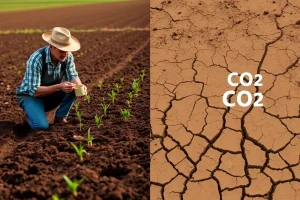
- Soil erosion releases stored organic carbon into the atmosphere, contributing to climate change.
- Economic cost
- Global soil erosion is estimated to cost hundreds of billions of dollars annually in lost productivity and environmental damage.
- Key solution
- Conservation agriculture (no-till, cover crops, crop rotation) can reduce erosion by up to 90% compared to conventional tillage.
Key Takeaways
- Topsoil loss is the accelerated removal of the nutrient-rich upper layer of soil, primarily driven by water and wind erosion, and intensified by human land use.
- Conventional agriculture, deforestation, and overgrazing are the leading causes, stripping the land of protective vegetation and organic matter.
- Scientific evidence shows that topsoil is being lost at rates far exceeding natural formation, with severe consequences for crop yields, water quality, and carbon storage.
- Addressing topsoil loss requires a combination of conservation practices, policy support, and sustainable land management to protect this finite resource for future generations.
What Is Topsoil Loss: Causes, Evidence and Consequences?
Topsoil loss refers to the removal or degradation of the uppermost layer of soil, known as topsoil, which is the most biologically active and fertile portion of the Earth’s surface. This layer, typically only a few inches to a foot thick, contains the highest concentration of organic matter, microorganisms, and nutrients essential for plant growth. While soil erosion is a natural geological process that shapes landscapes over millennia, topsoil loss in the modern context describes the accelerated rate at which this vital resource is being stripped away by human activities, far outpacing the slow natural processes of soil formation.
Topsoil loss is a central component of land degradation and is closely linked to desertification, reduced agricultural productivity, and environmental decline. The causes are multifaceted, including unsustainable farming practices, deforestation, overgrazing, and climate change, which exacerbate erosion. The evidence is gathered through field measurements, satellite imagery, and sediment analysis, revealing that large portions of the world’s arable land are losing topsoil at alarming rates. The consequences extend beyond the farm, affecting water quality through sedimentation, releasing stored carbon into the atmosphere, and undermining the resilience of ecosystems and human communities that depend on the land.
Overview
Topsoil is the foundation of terrestrial life, supporting 95% of the world’s food production and playing a critical role in water filtration, carbon cycling, and biodiversity. It forms over centuries through the weathering of parent rock and the accumulation of organic material from decaying plants and animals. Under natural conditions, soil formation roughly balances erosion, but human intervention has tipped this balance dramatically. The United Nations Food and Agriculture Organization (FAO) has warned that the equivalent of one soccer pitch of soil is eroded every five seconds, and it can take up to 1,000 years to form just a few centimeters of topsoil. This makes topsoil a non-renewable resource on a human timescale.
The problem is global but varies in severity. Regions with steep slopes, intense rainfall, or strong winds are naturally more vulnerable, but the primary driver is land use. When protective vegetation is removed, soil particles are exposed to the direct impact of raindrops and wind, leading to sheet, rill, and gully erosion. Tillage practices in agriculture can also directly move soil downhill. The loss of topsoil reduces the land’s ability to retain water and nutrients, creating a vicious cycle of declining fertility and further erosion. Understanding the scale and mechanisms of topsoil loss is essential for developing effective conservation strategies.
Main Causes or Drivers
The accelerated loss of topsoil is overwhelmingly driven by human activities that disturb the soil surface and remove protective cover. The primary causes include:
- Conventional Agriculture: Intensive tillage (plowing) breaks up soil structure, buries crop residues, and leaves soil bare for extended periods. Monoculture cropping depletes organic matter, weakening soil aggregates. Heavy machinery compacts subsoil, reducing infiltration and increasing runoff. The use of synthetic fertilizers can mask short-term nutrient loss but does not replace lost organic matter, leading to long-term degradation.
- Deforestation: Clearing forests for timber, agriculture, or urban expansion removes tree canopies and root systems that anchor soil. On steep slopes, this can trigger massive erosion events, especially in tropical regions with heavy rainfall. Logging roads and skid trails further concentrate runoff and sediment transport.
- Overgrazing: Livestock grazing beyond the land’s carrying capacity removes vegetation cover, compacts soil with hooves, and breaks down soil structure. This is a major driver in arid and semi-arid rangelands, contributing to desertification.
- Climate Change: More frequent and intense rainfall events increase the erosive power of water. Droughts kill vegetation, leaving soil exposed to wind erosion. Shifts in temperature and precipitation patterns can alter growing seasons, making it harder to maintain soil cover.
- Urbanization and Infrastructure: Construction sites, roads, and mining operations expose large areas of bare soil, often with inadequate erosion controls, leading to high sediment loads in nearby waterways.
What the Evidence Shows
Scientific evidence for topsoil loss comes from multiple independent lines of research. Field plot studies, such as those conducted by the US Department of Agriculture over decades, measure soil loss under different management practices using standardized erosion plots. These show that conventional tillage can result in soil loss rates of 10–40 tons per hectare per year, while no-till systems reduce losses to near natural levels. Sediment cores from lakes and reservoirs provide a historical record of erosion, revealing spikes in sedimentation coinciding with agricultural expansion and deforestation.
Remote sensing and geographic information systems (GIS) allow scientists to model soil erosion risk at regional and global scales. The Universal Soil Loss Equation (USLE) and its revised versions integrate rainfall erosivity, soil erodibility, slope length and steepness, cover management, and support practices to estimate average annual soil loss. Global assessments, such as the Global Land Degradation Information System (GLADIS), indicate that about 33% of the Earth’s land surface is moderately to highly degraded, with erosion as the dominant process. In key agricultural regions like the US Corn Belt, studies using satellite-derived carbon measurements have documented that topsoil has thinned by about 1.9 mm per year over the past 150 years, far exceeding the soil production rate. Similarly, in China’s Loess Plateau, historical erosion rates reached 50–100 tons per hectare per year before large-scale conservation efforts. The evidence consistently points to human land use as the primary accelerator of topsoil loss.
Environmental and Human Impacts
The consequences of topsoil loss ripple through ecosystems and societies. Environmentally, the removal of topsoil reduces the land’s capacity to support plant life, leading to loss of biodiversity both above and below ground. Soil organisms, from earthworms to mycorrhizal fungi, decline, disrupting nutrient cycling. Eroded sediment often ends up in rivers, lakes, and coastal waters, where it degrades water quality, smothers aquatic habitats, and carries attached pollutants such as phosphorus and pesticides. This sedimentation can also reduce reservoir capacity, affecting water supply and hydroelectric power generation.
For humans, the most direct impact is on food production. Topsoil loss reduces crop yields and increases the need for costly inputs like fertilizers and irrigation. Over time, it can render land unsuitable for agriculture, forcing farmers to abandon fields or clear new land, often forests, perpetuating the cycle. Economically, the global cost of soil erosion is estimated at hundreds of billions of dollars annually in lost productivity and environmental damage. Socially, it contributes to food insecurity, poverty, and migration, particularly in developing regions where livelihoods depend directly on the land. The loss of soil organic carbon also exacerbates climate change, as carbon stored in topsoil is released into the atmosphere as CO₂ when soil is eroded and disturbed.
Solutions
Addressing topsoil loss requires a shift toward sustainable land management practices that protect and rebuild soil health. Key solutions include:
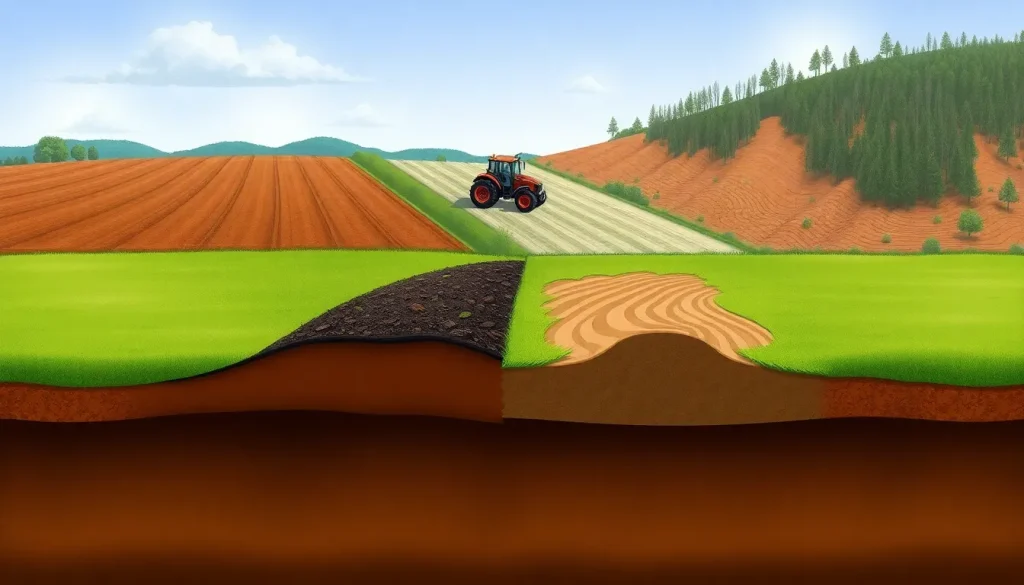
- Conservation Agriculture: This approach combines minimum tillage (no-till or reduced till), permanent soil cover with crop residues or cover crops, and diverse crop rotations. It reduces erosion, improves soil structure, and increases organic matter.
- Agroforestry and Windbreaks: Integrating trees and shrubs into agricultural landscapes provides wind protection, stabilizes soil with roots, and adds organic matter through leaf litter.
- Terracing and Contour Farming: On sloping land, building terraces or planting along contour lines slows water runoff and traps sediment, significantly reducing erosion.
- Cover Cropping and Green Manures: Planting non-cash crops during fallow periods protects soil from rain and wind, fixes nitrogen, and adds biomass when incorporated.
- Managed Grazing: Rotational grazing systems prevent overgrazing, allow vegetation recovery, and improve soil health through controlled animal impact.
- Reforestation and Afforestation: Restoring tree cover on degraded lands stabilizes soil, enhances water infiltration, and rebuilds organic matter.
- Policy and Economic Incentives: Governments can support soil conservation through subsidies for cover cropping, conservation easements, and regulations that require erosion control on construction sites. Payment for ecosystem services can reward farmers for practices that sequester carbon and reduce erosion.
While these solutions are effective, their adoption often faces barriers such as upfront costs, lack of technical knowledge, and short-term economic pressures. Integrated approaches that combine multiple practices and are tailored to local conditions offer the best chance of reversing topsoil loss.
Data Limitations and Uncertainties
Despite extensive research, quantifying topsoil loss globally remains challenging due to data limitations and methodological uncertainties. Soil erosion rates vary widely across space and time, and direct measurements are sparse, especially in developing countries. Most global estimates rely on models that extrapolate from limited field data, introducing significant uncertainty. The rate of natural soil formation is also poorly constrained, making it difficult to determine tolerable soil loss thresholds for different environments.
Additionally, the impacts of topsoil loss on long-term agricultural productivity are complex and influenced by management practices, crop genetics, and climate variability. Some studies suggest that yield declines may be partially offset by increased fertilizer use, but this masks the underlying degradation of soil health and the loss of ecosystem services. Sediment delivery ratios—the proportion of eroded soil that reaches water bodies—are also uncertain, complicating assessments of off-site impacts. Ongoing research using advanced remote sensing, soil mapping, and long-term field experiments aims to reduce these uncertainties and improve global monitoring of soil resources.
FAQ
What is topsoil loss?
Topsoil loss is the removal of the uppermost fertile layer of soil, primarily through accelerated erosion by water and wind, often caused by human activities like intensive farming, deforestation, and overgrazing.
How does topsoil loss affect food production?
It reduces soil fertility, water-holding capacity, and nutrient availability, leading to lower crop yields and increased reliance on fertilizers. Over time, it can make land unsuitable for agriculture, threatening food security.
Why does topsoil loss matter for climate change?
Topsoil stores large amounts of organic carbon. When soil is eroded, this carbon is released into the atmosphere as carbon dioxide, contributing to global warming. Healthy soils also help mitigate climate change by sequestering carbon.
References
- Food and Agriculture Organization of the United Nations (FAO). Status of the World's Soil Resources. 2015.
- Montgomery, D. R. Dirt: The Erosion of Civilizations. University of California Press, 2007.
- Pimentel, D., et al. Environmental and Economic Costs of Soil Erosion and Conservation Benefits. Science, 1995.
- United Nations Convention to Combat Desertification (UNCCD). Global Land Outlook.