In brief
At a glance
Quick Facts
- Primary storage mechanism
- Electrochemical (batteries) vs. gravitational potential (pumped hydro)
- Typical storage duration
- Minutes to hours (batteries); hours to days (pumped hydro)
- Round-trip efficiency
- 85–95% for batteries; 70–85% for pumped hydro
- Global installed capacity
- Pumped hydro dominates with over 160 GW; battery storage is growing rapidly but smaller in total capacity
- Response time
- Milliseconds (batteries); seconds to minutes (pumped hydro)
- Lifespan
- 5–15 years (batteries); 50–100 years (pumped hydro)
- Land footprint
- Compact for batteries; large area and specific topography for pumped hydro
- Main applications
- Frequency regulation, peak shaving (batteries); bulk energy storage, load shifting (pumped hydro)
Key Takeaways
- Battery storage uses electrochemical cells for fast, modular energy storage, while pumped hydropower stores energy as gravitational potential by pumping water uphill.
- Pumped hydropower is the most established grid-scale storage technology, accounting for the vast majority of global energy storage capacity.
- Battery storage, particularly lithium-ion, has seen significant cost reductions and is ideal for short-duration, high-response applications.
- The choice between them depends on storage duration needs, geographic constraints, environmental considerations, and economic factors.
What Is Battery Storage vs Pumped Hydropower?
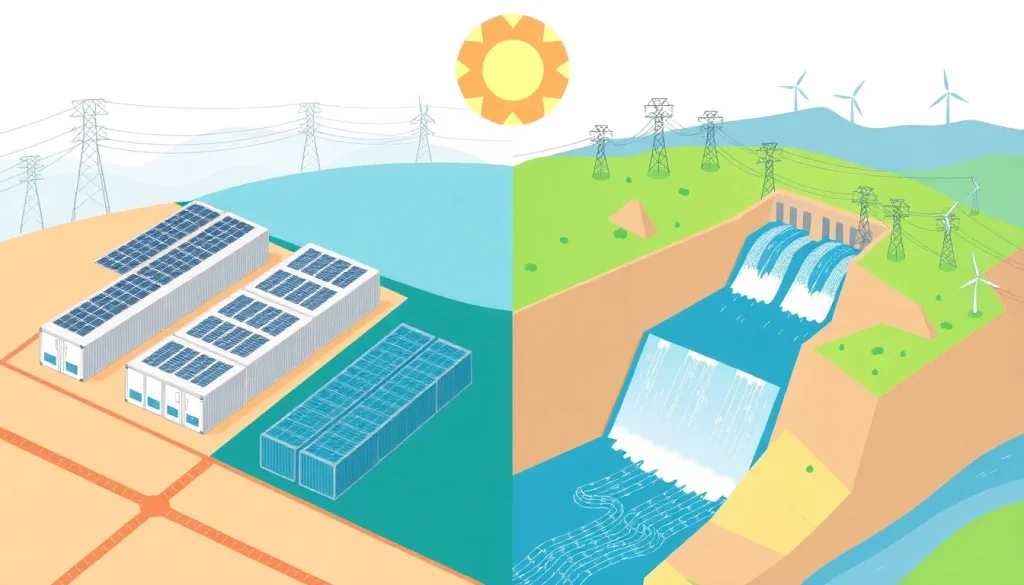
Battery storage and pumped hydropower are two distinct technologies used to store electrical energy for later use, playing a critical role in balancing electricity supply and demand. Battery storage systems, often referred to as battery energy storage systems (BESS), use rechargeable batteries—most commonly lithium-ion—to store energy chemically and release it as electricity when needed. Pumped hydropower storage (PHS), also known as pumped-storage hydroelectricity, stores energy by pumping water from a lower reservoir to an upper reservoir during periods of low electricity demand, then releasing it through turbines to generate power when demand is high.
Both technologies fall under the broader category of grid energy storage, which is essential for modernizing electrical grids, integrating variable renewable energy sources like solar and wind, and enhancing grid reliability. While pumped hydropower has been used for over a century and represents the bulk of installed storage capacity worldwide, battery storage has gained prominence in recent years due to its flexibility, declining costs, and suitability for decentralized applications.
How It Works
Battery storage systems convert electrical energy into chemical energy during charging and reverse the process during discharging. In a lithium-ion battery, for example, lithium ions move from the cathode to the anode through an electrolyte when charging; during discharge, the ions flow back, generating an electric current. Power electronics manage the flow of electricity, allowing rapid response—often within milliseconds—to grid signals. Battery systems can be scaled from small residential units to large utility-scale installations, making them highly versatile.
Pumped hydropower storage operates on a different principle. It requires two water reservoirs at different elevations. During off-peak hours, when electricity is cheap and abundant, water is pumped from the lower to the upper reservoir. When demand rises, the stored water is released back down through turbines, generating electricity. The amount of energy stored depends on the volume of water and the height difference (head) between the reservoirs. Pumped hydro plants typically have a slower response time than batteries—seconds to minutes—but can store vast amounts of energy for extended periods, from hours to days.
Benefits, Limitations and Trade-offs
Both technologies offer distinct advantages and face inherent constraints. The following comparison highlights key trade-offs:
- Round-trip efficiency: Battery systems generally achieve 85–95% efficiency, meaning most of the input energy is recovered. Pumped hydropower typically operates at 70–85% efficiency, with losses mainly from pumping and generation.
- Storage duration: Batteries are best suited for short-duration storage (minutes to a few hours), while pumped hydro can store energy for hours to days, making it ideal for bulk energy shifting.
- Response time: Batteries can respond within milliseconds, providing essential grid services like frequency regulation. Pumped hydro has a slower ramp-up but can sustain output for longer periods.
- Lifespan: Battery systems have a limited cycle life, typically 5–15 years depending on chemistry and usage. Pumped hydro facilities can operate for 50–100 years with proper maintenance.
- Scalability and siting: Batteries are modular and can be installed almost anywhere, from urban substations to remote microgrids. Pumped hydro requires specific topography (elevation difference and water availability) and large land areas, limiting suitable sites.
- Capital costs: Battery storage has seen dramatic cost declines, but per-unit energy capacity costs remain higher than pumped hydro for long-duration storage. Pumped hydro involves high upfront civil engineering costs but very low operational expenses over its long life.
- Environmental impact: Battery production involves mining of lithium, cobalt, and other minerals, with associated ecological and social concerns. Pumped hydro can disrupt river ecosystems, require large land areas, and involve water consumption, though closed-loop systems mitigate some impacts.
Environmental and Human Impacts
The environmental footprint of battery storage is largely tied to raw material extraction and end-of-life disposal. Mining for lithium, cobalt, and nickel can lead to habitat destruction, water pollution, and social issues in mining regions. However, battery recycling is advancing, and second-life applications (e.g., using retired EV batteries for grid storage) can extend useful life. Operational impacts are minimal, as batteries produce no direct emissions and have a small physical footprint.
Pumped hydropower projects, especially open-loop systems connected to natural water bodies, can alter river flows, affect aquatic ecosystems, and require significant land. Reservoir creation may displace communities and wildlife. Closed-loop systems, which use artificial reservoirs and recycle water, reduce some ecological impacts but still require substantial land and initial water fill. Both technologies face challenges related to material sourcing: batteries need critical minerals, while pumped hydro requires large amounts of concrete and steel for construction.
Importance and Impact
Energy storage is a cornerstone of the transition to a low-carbon electricity system. As variable renewable energy sources like wind and solar become more prevalent, storage helps match supply with demand, reducing the need for fossil-fuel peaker plants. Battery storage excels in providing fast frequency response and short-term balancing, enhancing grid stability. Pumped hydropower offers bulk energy storage, enabling load shifting over longer periods and supporting seasonal storage needs.
Both technologies contribute to energy security by reducing dependence on imported fuels and increasing the resilience of power systems against disruptions. They also enable greater penetration of renewables, which is essential for meeting climate targets. The complementary nature of batteries and pumped hydro means that a mix of both is often optimal for a robust, flexible grid.
Examples
Notable battery storage installations include the Hornsdale Power Reserve in South Australia, a 150 MW/194 MWh lithium-ion system that provides grid stability and has demonstrated rapid response capabilities. Utility-scale battery projects are now common worldwide, often co-located with solar or wind farms.
Pumped hydropower examples include the Bath County Pumped Storage Station in Virginia, USA, with a capacity of over 3,000 MW, and the Fengning Pumped Storage Power Station in China, one of the world’s largest. These facilities have operated for decades, showcasing the longevity and reliability of pumped hydro. Many countries with mountainous terrain, such as Switzerland and Japan, rely heavily on pumped storage for grid balancing.
Common Misconceptions
A common misconception is that battery storage is always more environmentally friendly than pumped hydropower. While batteries have no direct emissions during operation, their lifecycle impacts from mining and manufacturing can be significant. Conversely, pumped hydro is sometimes seen as inherently green, but large reservoirs can have substantial ecological footprints. Another misconception is that battery storage can fully replace pumped hydro; in reality, they serve different roles on the grid, with batteries better for short-duration, high-power applications and pumped hydro for long-duration, bulk energy storage. Finally, some believe that energy storage is only needed with renewables, but it also provides critical services like black start capability and voltage support to conventional grids.
FAQ
What is battery storage?
Battery storage uses rechargeable batteries to store electrical energy chemically and release it when needed. It is fast, modular, and suitable for short-duration applications like frequency regulation and peak shaving.
How does pumped hydropower work?
Pumped hydropower stores energy by pumping water from a lower reservoir to an upper reservoir when electricity is cheap, then releasing it through turbines to generate power during high demand. It provides large-scale, long-duration storage.
Why does energy storage matter?
Energy storage is critical for integrating variable renewable energy sources, improving grid reliability, reducing the need for fossil-fuel peaker plants, and enabling a more resilient and decarbonized electricity system.
References
- U.S. Energy Information Administration (EIA) – Energy Storage Reports
- International Energy Agency (IEA) – Technology Roadmap: Energy Storage
- National Renewable Energy Laboratory (NREL) – Energy Storage Publications