In brief
At a glance
Quick Facts
- Definition of land degradation
- The reduction or loss of the biological or economic productivity of land.
- Definition of desertification
- Land degradation in arid, semi-arid, and dry sub-humid areas resulting from climatic variations and human activities.
- Global dryland coverage
- Drylands cover about 40% of Earth's land surface and are home to over 2 billion people.
- Primary driver
- Unsustainable agricultural practices, deforestation, and overgrazing are leading causes of both processes.
- People affected
- Land degradation negatively impacts the well-being of at least 3.2 billion people worldwide.
- Soil loss
- An estimated 24 billion tonnes of fertile soil are lost each year due to erosion.
- Climate connection
- Land degradation releases stored carbon, contributing to climate change, while climate change exacerbates degradation.
- Economic cost
- Land degradation is estimated to cost about 10% of annual global gross product in lost ecosystem services.
- Key international agreement
- The United Nations Convention to Combat Desertification (UNCCD) is the main global framework for addressing desertification.
- Reversibility
- Many forms of land degradation are reversible through sustainable land management and restoration, though costs increase over time.
Key Takeaways
- Land degradation is the reduction or loss of biological or economic productivity of land, while desertification is a specific type of land degradation that occurs in drylands.
- Desertification is land degradation in arid, semi-arid, and dry sub-humid areas resulting from various factors, including climatic variations and human activities.
- Land degradation can occur in any climate, but desertification is confined to dryland ecosystems, making it a subset of the broader land degradation problem.
- Both processes threaten food security, biodiversity, and livelihoods, and are exacerbated by climate change and unsustainable land management.
What Is Land Degradation vs Desertification?
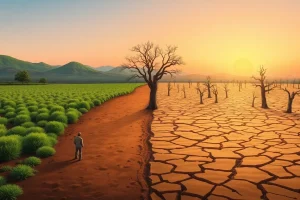
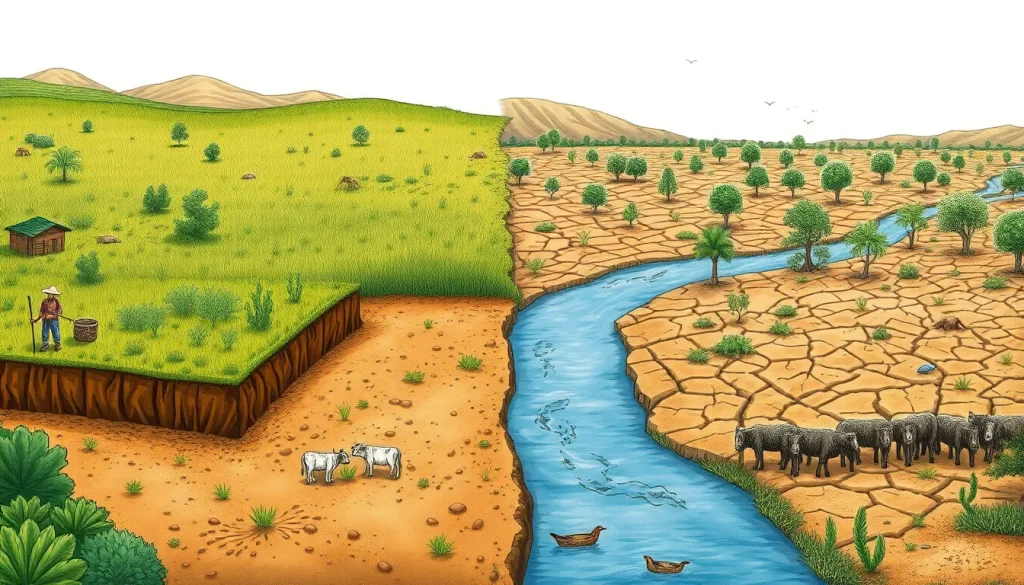
Land degradation is the long-term decline in the capacity of land to provide ecosystem services, such as food production, water filtration, and carbon storage. It encompasses a range of processes—including soil erosion, nutrient depletion, salinization, acidification, and loss of vegetation—that reduce the biological or economic productivity of land. This phenomenon can affect all types of land, from croplands and pastures to forests and wetlands, and is driven by both natural forces and human activities. In contrast, desertification is a specific form of land degradation that occurs exclusively in drylands: arid, semi-arid, and dry sub-humid areas. The United Nations Convention to Combat Desertification (UNCCD) defines it as “land degradation in arid, semi-arid and dry sub-humid areas resulting from various factors, including climatic variations and human activities.” Thus, while all desertification is land degradation, not all land degradation is desertification.
The distinction is important because drylands have unique ecological characteristics and vulnerabilities. They cover about 40% of Earth’s land surface and are home to over two billion people, many of whom depend on subsistence agriculture. Desertification does not mean the expansion of existing deserts, but rather the persistent degradation of dryland ecosystems, which can lead to desert-like conditions. Land degradation, on the other hand, is a global issue that also affects humid and temperate regions through processes like soil compaction, pollution, and deforestation. Both concepts are central to international environmental policy, as they directly impact food security, climate resilience, and sustainable development.
Overview
Land degradation and desertification are among the most pressing environmental challenges of the modern era. The Intergovernmental Science-Policy Platform on Biodiversity and Ecosystem Services (IPBES) has found that land degradation negatively affects the well-being of at least 3.2 billion people worldwide. It is a major driver of biodiversity loss and contributes to climate change by releasing stored soil carbon into the atmosphere. Desertification, as a subset, disproportionately affects some of the world’s poorest and most vulnerable populations, particularly in Africa and Asia. The two processes are often interconnected: land degradation in drylands can accelerate desertification, while desertification can exacerbate land degradation in adjacent areas through dust storms and altered hydrological cycles.
International efforts to combat these issues are coordinated through the UNCCD, which promotes sustainable land management and restoration. The convention emphasizes that addressing land degradation and desertification is essential for achieving the Sustainable Development Goals, including zero hunger, clean water, and climate action. Despite their severity, both processes are largely reversible with appropriate interventions, though the time and cost required increase as degradation progresses.
How It Works
Land degradation operates through a variety of physical, chemical, and biological mechanisms. Soil erosion by wind and water is the most visible form, removing the nutrient-rich topsoil and reducing the land’s ability to support plant growth. Chemical degradation includes salinization (the buildup of salts in soil, often from improper irrigation), acidification, and pollution by heavy metals or agrochemicals. Biological degradation involves the loss of soil organic matter, reduced microbial activity, and the decline of vegetation cover, which in turn diminishes the land’s capacity to cycle nutrients and retain water. These processes often reinforce one another: for example, deforestation exposes soil to erosion, which depletes nutrients and further inhibits plant regrowth.
Desertification follows similar pathways but is shaped by the unique conditions of drylands. In these regions, low and variable rainfall, high evaporation rates, and fragile soils make ecosystems particularly susceptible to disturbance. Overgrazing, deforestation, and unsustainable farming practices strip away protective vegetation, exposing soil to wind and water erosion. As vegetation cover declines, the land’s albedo (reflectivity) can change, altering local climate patterns and potentially reducing rainfall. This creates a feedback loop: less rain leads to sparser vegetation, which leads to more erosion and even less rain. The result is a downward spiral of productivity loss that can eventually create desert-like conditions, even if the area does not become a true desert.
Main Causes or Drivers
The drivers of land degradation and desertification are a mix of human activities and natural factors, often interacting in complex ways. Key human causes include:
- Deforestation: Clearing forests for agriculture, timber, or fuelwood removes the protective canopy and root systems that stabilize soil.
- Overgrazing: Excessive livestock numbers compact soil, reduce vegetation cover, and accelerate erosion.
- Unsustainable agriculture: Monocropping, excessive tillage, and overuse of chemical fertilizers deplete soil nutrients and organic matter.
- Urbanization and infrastructure: Construction and mining disturb soil and can lead to contamination and sealing of land.
- Poor water management: Inefficient irrigation causes waterlogging and salinization, while over-extraction of groundwater lowers water tables.
Natural factors include climate variability, such as prolonged droughts, which can trigger or worsen degradation, especially in drylands. Steep slopes and erodible soils make some areas naturally prone to erosion. However, human activities are the dominant cause of accelerated land degradation. In the case of desertification, the combination of climatic stress (low and erratic rainfall) and human pressure on fragile dryland ecosystems is particularly destructive. Climate change is intensifying these pressures by increasing the frequency and severity of droughts and extreme weather events.
Environmental and Human Impacts
The consequences of land degradation and desertification are far-reaching. Environmentally, they lead to loss of soil fertility, reduced water retention, and diminished biodiversity. Degraded lands are less able to sequester carbon, contributing to climate change. Desertification can increase the frequency and intensity of dust storms, which transport fine particles over long distances, affecting air quality, human health, and even ocean productivity. The loss of vegetation also disrupts local water cycles, potentially reducing rainfall and exacerbating water scarcity.
For human populations, the impacts are severe. Reduced agricultural productivity threatens food security and livelihoods, particularly in rural areas where people depend directly on the land. This can lead to malnutrition, poverty, and forced migration. The UNCCD estimates that land degradation could reduce global food production by 12% over the next 25 years, leading to higher food prices. Desertification in sub-Saharan Africa and Asia has been linked to social unrest and conflict over dwindling resources. Additionally, the economic cost of land degradation is enormous, with some estimates placing it at 10% of annual global gross product, through lost ecosystem services and decreased agricultural output.
Regional Differences
Land degradation is a global phenomenon, but its severity and form vary by region. In humid tropical areas, deforestation and intensive agriculture drive soil erosion and nutrient loss. In temperate zones, industrial farming and urbanization are major contributors. Drylands, however, face the unique threat of desertification. The Sahel region of Africa is one of the most cited examples, where a combination of drought, overgrazing, and population pressure has led to widespread land degradation and recurring food crises. Similarly, large parts of Central Asia, including the Aral Sea basin, have suffered severe desertification due to unsustainable irrigation and water diversion. In China, the Gobi Desert’s expansion is driven by overgrazing and deforestation, prompting large-scale afforestation projects like the Great Green Wall.
In contrast, land degradation in Europe and North America often takes the form of soil contamination, compaction, and loss of organic matter from intensive agriculture. The Dust Bowl of the 1930s in the United States was a dramatic example of land degradation in a semi-arid region, caused by drought and poor farming practices. Today, Australia faces significant land degradation challenges, including salinization and erosion, in both its dry and temperate agricultural zones. These regional differences underscore the need for locally tailored solutions.
Solutions
Addressing land degradation and desertification requires a combination of sustainable land management practices, policy interventions, and community engagement. Key solutions include:
- Agroforestry and reforestation: Integrating trees into farming systems and restoring degraded forests help stabilize soil, improve water retention, and enhance biodiversity.
- Conservation agriculture: Practices such as no-till farming, crop rotation, and cover cropping reduce erosion and build soil organic matter.
- Improved grazing management: Rotational grazing and controlling livestock numbers prevent overgrazing and allow vegetation to recover.
- Water management: Efficient irrigation techniques, rainwater harvesting, and the construction of small dams can combat salinization and water scarcity.
- Soil conservation measures: Terracing, contour plowing, and windbreaks reduce erosion on slopes and in windy areas.
- Policy and governance: The UNCCD provides a framework for national action programs, while land tenure reforms and incentives for sustainable practices encourage long-term stewardship.
For desertification specifically, additional measures include sand dune stabilization using vegetation or mechanical barriers, and the planting of drought-resistant native species. Large-scale restoration initiatives, such as Africa’s Great Green Wall, aim to halt desertification by creating a mosaic of green and productive landscapes across the Sahel. Success depends on integrating scientific knowledge with local and indigenous practices, and on securing adequate funding and political will.
FAQ
What is the difference between land degradation and desertification?
Land degradation is the general decline in land quality and productivity, affecting all climate zones. Desertification is a specific type of land degradation that occurs only in drylands (arid, semi-arid, and dry sub-humid areas) and results from climatic variations and human activities.
How does desertification affect people?
Desertification reduces agricultural yields, leading to food insecurity and loss of livelihoods. It can force migration, increase poverty, and contribute to conflicts over scarce resources. Dust storms from desertified areas also harm human health.
Can land degradation be reversed?
Yes, many forms of land degradation are reversible through practices like reforestation, conservation agriculture, and improved water management. However, the longer degradation continues, the more difficult and costly restoration becomes. Prevention is more effective than cure.
References
- United Nations Convention to Combat Desertification (UNCCD). "Desertification." https://www.unccd.int/land-and-life/desertification/overview
- Food and Agriculture Organization of the United Nations (FAO). "Land Degradation." http://www.fao.org/land-water/land/land-degradation/en/
- Intergovernmental Science-Policy Platform on Biodiversity and Ecosystem Services (IPBES). "Land Degradation and Restoration Assessment." https://ipbes.net/assessment-reports/ldr