In brief
At a glance
Quick Facts
- Definition
- The capacity of the Earth system to absorb disturbances and reorganize while retaining essentially the same function, structure, and feedbacks.
- Key concept
- Resilience is not about stability but about the ability to persist within critical thresholds and adapt to change.
- Planetary boundaries
- Nine Earth system processes that regulate the stability and resilience of the planet; exceeding them increases the risk of abrupt changes.
- Tipping points
- Critical thresholds beyond which a system reorganizes, often abruptly and irreversibly, such as Amazon dieback or ice sheet collapse.
- Holocene stability
- The past 11,700 years of relatively stable climate enabled human civilization; resilience maintains this state.
- Main drivers of decline
- Climate change, biodiversity loss, land-use change, pollution, and freshwater overuse.
- Feedback loops
- Negative feedbacks dampen change; positive feedbacks amplify it, potentially reducing resilience.
- Social-ecological link
- Human systems are part of Earth system resilience; social and economic factors influence and are influenced by environmental resilience.
Key Takeaways
- Earth system resilience is the capacity of the planet’s interconnected physical, chemical, and biological components to absorb disturbances and reorganize while retaining the same fundamental functions, structures, and feedbacks.
- Resilience does not mean stability or lack of change; it involves the ability to persist within critical thresholds and to adapt to gradual and abrupt changes.
- Human activities such as deforestation, greenhouse gas emissions, and biodiversity loss are eroding Earth system resilience, increasing the risk of crossing planetary boundaries and triggering irreversible tipping points.
- Maintaining Earth system resilience is essential for preserving the Holocene-like conditions that have allowed human civilization to develop and thrive over the past 10,000 years.
What Is Earth System Resilience?
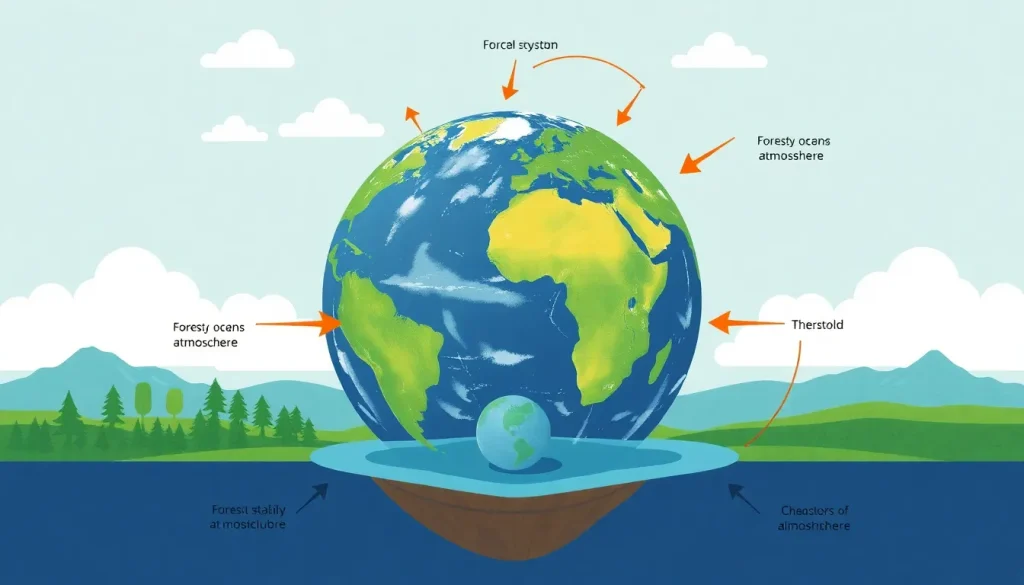
Earth system resilience is the capacity of the Earth’s integrated system—encompassing the atmosphere, hydrosphere, geosphere, biosphere, and anthroposphere—to absorb disturbances and reorganize while retaining essentially the same function, structure, identity, and feedbacks. The concept extends ecological resilience to the planetary scale, recognizing that the Earth operates as a single, complex, self-regulating system. Resilience in this context is not about preventing change altogether; rather, it is about the system’s ability to persist within a given state or regime, such as the relatively stable Holocene epoch that has allowed human civilizations to develop and flourish over the past 11,700 years.
Earth system resilience is closely tied to the idea of planetary boundaries and tipping points. When resilience is high, the system can absorb shocks—such as volcanic eruptions, solar variations, or human pressures—and return to its original state. When resilience is low, even a small disturbance can push the system across a threshold into a new state with fundamentally different properties, often less hospitable to human life. Understanding and monitoring Earth system resilience is therefore critical for navigating the Anthropocene, the proposed geological epoch defined by human dominance over planetary processes.
How It Works
Earth system resilience arises from the interplay of feedback mechanisms, diversity, and modularity across scales. Negative feedback loops tend to dampen disturbances and stabilize the system. For example, increased atmospheric carbon dioxide stimulates plant growth, which in turn absorbs more CO₂, partially offsetting the initial increase. Positive feedback loops, on the other hand, amplify changes and can reduce resilience. The melting of Arctic sea ice is a classic positive feedback: ice reflects sunlight, but as it melts, darker ocean water absorbs more heat, accelerating further melting.
Resilience also depends on the existence of multiple stable states and thresholds. The Earth system can exist in different configurations—such as an ice-free or ice-covered planet—and transitions between them can be abrupt. A system with high resilience has a deep “basin of attraction,” meaning it can withstand large perturbations without flipping to an alternative state. However, if a threshold is crossed, the system may undergo a regime shift. Examples of potential regime shifts include the dieback of the Amazon rainforest (from forest to savanna), the collapse of the Atlantic Meridional Overturning Circulation, or the irreversible melting of the Greenland ice sheet.
The concept of panarchy, developed by resilience thinkers, describes how systems operate across multiple scales in adaptive cycles of growth, conservation, release, and reorganization. At the planetary level, slow variables—such as ice sheet mass, ocean heat content, and biodiversity—interact with faster variables like weather patterns and human economic activity. Resilience is maintained when these cycles are connected in ways that allow for adaptation and learning without triggering cascading failures.
Importance and Impact
Earth system resilience is directly linked to the stability of the environmental conditions that support human life. The Holocene epoch has provided a remarkably stable climate, reliable freshwater resources, productive soils, and predictable seasons. This stability has enabled agriculture, urbanization, and technological progress. If resilience is lost and the Earth system shifts into a new state, these life-supporting conditions could be severely disrupted, with consequences including food and water insecurity, increased frequency of extreme weather events, sea-level rise, and mass displacement of populations.
The planetary boundaries framework identifies nine key Earth system processes that regulate the stability and resilience of the planet. Exceeding these boundaries—such as those for climate change, biosphere integrity, land-system change, and biogeochemical flows—increases the risk of triggering nonlinear, abrupt environmental changes. Maintaining resilience within these boundaries is essential for keeping the Earth in a “safe operating space” for humanity. The impact of declining resilience is not evenly distributed; vulnerable communities, particularly in low-income countries and small island states, often face the most severe consequences despite contributing least to the pressures.
Main Causes or Drivers
Human activities are the primary drivers of declining Earth system resilience. The scale and pace of anthropogenic change since the Industrial Revolution have pushed many Earth system processes beyond their natural variability. Key drivers include:
- Climate change: Rising greenhouse gas concentrations alter energy balance, increase global temperatures, and intensify feedback loops such as permafrost thaw and reduced albedo.
- Biodiversity loss: The decline in genetic, species, and ecosystem diversity reduces the functional redundancy and adaptive capacity of the biosphere, making ecosystems more vulnerable to collapse.
- Land-use change: Deforestation, urbanization, and agricultural expansion fragment habitats, disrupt water cycles, and release stored carbon, weakening the Earth’s ability to regulate climate and hydrological flows.
- Pollution: Excessive nitrogen and phosphorus from fertilizers disrupt nutrient cycles, while plastic and chemical pollutants harm marine and terrestrial life.
- Freshwater overuse: Depletion of aquifers and alteration of river flows reduce the resilience of freshwater systems and the services they provide.
These drivers often interact, creating compounding effects that further erode resilience. For instance, deforestation in the Amazon reduces regional rainfall, which in turn stresses remaining forests and increases fire risk, potentially pushing the ecosystem toward a savanna state.
Common Misconceptions
One common misconception is that resilience means stability or resistance to change. In reality, resilient systems can undergo significant change while maintaining core functions. A resilient Earth system is not static; it can adapt and reorganize in response to disturbances. Another misunderstanding is that resilience is always desirable. Some states, such as a degraded ecosystem or a poverty trap, can be highly resilient but undesirable. The goal is to foster resilience of the Earth system in a state that supports human well-being.
It is also often assumed that resilience is solely an environmental concept. However, Earth system resilience is deeply intertwined with social and economic systems. Human societies are part of the Earth system, and their capacity to adapt and transform is a key component of overall resilience. Finally, some believe that technological solutions alone can restore resilience, but without addressing the underlying drivers of environmental change, such interventions may only provide temporary relief or create new vulnerabilities.
Connections to Other Systems
Earth system resilience is inseparable from social-ecological resilience. Human systems—including economies, governance structures, and cultural practices—both influence and are influenced by the Earth system. For example, global food production depends on stable climate conditions, fertile soils, and pollination services, all of which are products of a resilient Earth system. Conversely, economic shocks or political instability can lead to resource overexploitation, further degrading environmental resilience.
The concept also connects to the global climate system, the water cycle, and biogeochemical cycles. Changes in one component can cascade through others. The melting of Arctic ice not only affects climate but also alters ocean circulation patterns, which in turn impact marine ecosystems and fisheries. Understanding these interconnections is crucial for developing integrated strategies to enhance resilience at multiple scales, from local communities to the planetary level.
Solutions
Enhancing Earth system resilience requires a combination of reducing pressures, protecting critical ecosystems, and fostering adaptive capacity. Key approaches include:
- Mitigating climate change: Rapidly reducing greenhouse gas emissions to limit global warming and avoid crossing critical thresholds.
- Conserving biodiversity: Protecting and restoring habitats, establishing protected areas, and promoting sustainable land and ocean management to maintain functional diversity.
- Sustainable resource use: Shifting to circular economies, reducing waste, and managing freshwater, forests, and fisheries within regenerative limits.
- Strengthening governance: Building institutions that can respond flexibly to environmental change, integrating Earth system science into policy, and fostering international cooperation.
- Promoting social resilience: Reducing inequality, supporting community-based adaptation, and ensuring that vulnerable populations have the resources to cope with environmental changes.
These solutions are interconnected and require transformative change across sectors. By recognizing humanity’s role as part of the Earth system, societies can work toward a resilient and sustainable future.
FAQ
What is Earth system resilience?
Earth system resilience is the ability of the planet’s interconnected physical, chemical, and biological components to absorb shocks and disturbances while maintaining the same basic functions, structures, and feedbacks that have characterized the Holocene epoch.
How does Earth system resilience differ from climate resilience?
Climate resilience focuses specifically on the capacity of social, economic, and environmental systems to cope with climate change impacts. Earth system resilience is broader, encompassing the entire planetary system—including climate, biodiversity, nutrient cycles, and land use—and their interactions.
Why is Earth system resilience declining?
Human activities such as greenhouse gas emissions, deforestation, pollution, and biodiversity loss are pushing Earth system processes beyond their natural variability, weakening the negative feedbacks that maintain stability and increasing the risk of crossing critical thresholds.
References
- Stockholm Resilience Centre, 'Planetary Boundaries' research.
- IPCC, 'Special Report on Global Warming of 1.5°C' (2018).
- Rockström, J. et al. (2009) 'A safe operating space for humanity'. Nature, 461, 472–475.