In brief
At a glance
Quick Facts
- Planetary boundaries framework introduced
- 2009 by Rockström et al.
- Number of planetary boundaries
- Nine
- Boundaries already transgressed
- At least four: climate change, biosphere integrity, land-system change, biogeochemical flows
- Food systems share of global greenhouse gas emissions
- Approximately 25%
- Agriculture's share of global freshwater use
- About 70%
- Land used for agriculture
- Half of all habitable land
- Main driver of deforestation
- Agricultural expansion
- Global food loss and waste
- Roughly one-third of all food produced
Key Takeaways
- Food systems are a primary driver of transgression for multiple planetary boundaries, including climate change, biodiversity loss, land-system change, freshwater use, and disruption of nitrogen and phosphorus cycles.
- The global food system, from production to waste, exerts pressure on Earth’s life-support systems, threatening the stability of the Holocene-like state that has allowed human civilization to flourish.
- Agriculture alone occupies about half of the world’s habitable land and is responsible for the majority of deforestation, habitat fragmentation, and species extinction risks.
- Transforming food systems through sustainable practices, dietary shifts, and reduced waste is essential to bring human activities back within a safe operating space.
What Is How Food Systems Cross Multiple Planetary Boundaries?
How food systems cross multiple planetary boundaries refers to the ways in which the global network of activities involved in producing, processing, distributing, consuming, and disposing of food drives the transgression of Earth’s environmental limits. The planetary boundaries framework, introduced in 2009 and refined in subsequent years, identifies nine critical Earth-system processes that regulate the stability and resilience of the planet. Crossing these boundaries increases the risk of abrupt or irreversible environmental changes that could undermine human well-being. Food systems are now recognized as a central force pushing several of these boundaries beyond their safe operating space.
This concept highlights the interconnectedness of food production and planetary health. Agriculture, livestock, fisheries, and associated supply chains are not merely passive users of natural resources; they actively alter the Earth’s climate, ecosystems, and biogeochemical cycles. Because food is a universal human need, the scale of its production is immense, making it one of the largest drivers of global environmental change. Understanding how food systems interact with planetary boundaries is crucial for developing strategies that can feed a growing population while maintaining the Earth’s life-support systems.
Overview
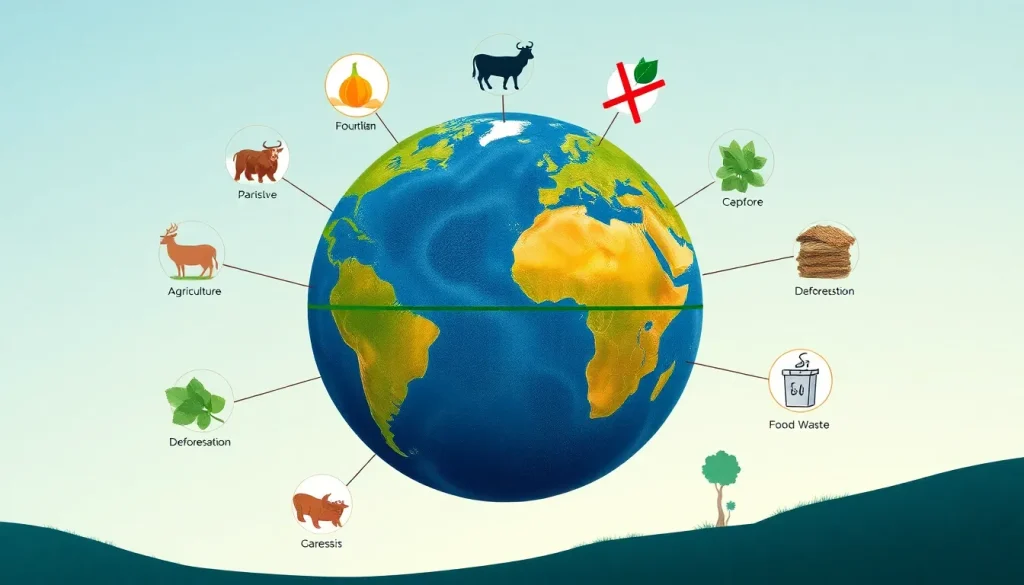
The planetary boundaries framework defines a safe operating space for humanity with respect to nine key processes: climate change, biosphere integrity (biodiversity loss), land-system change, freshwater use, biogeochemical flows (nitrogen and phosphorus cycles), ocean acidification, atmospheric aerosol loading, stratospheric ozone depletion, and the introduction of novel entities (such as synthetic chemicals and plastics). As of the most recent assessments, at least four of these boundaries have already been transgressed: climate change, biosphere integrity, land-system change, and biogeochemical flows. Food systems are a major contributor to each of these four, and they also exert significant pressure on freshwater use and, indirectly, on other boundaries.
Food production accounts for approximately 25% of global greenhouse gas emissions, making it a leading cause of climate change. It is the primary driver of deforestation and habitat conversion, which erodes biosphere integrity and alters land systems. Agriculture is responsible for about 70% of global freshwater withdrawals and is the largest source of nutrient pollution from nitrogen and phosphorus fertilizers, which disrupt aquatic ecosystems and contribute to dead zones in coastal waters. The sheer scale of the food system means that even incremental changes in how food is produced and consumed can have profound implications for planetary stability.
How It Works
Food systems cross planetary boundaries through a variety of interconnected mechanisms that operate at every stage of the food supply chain. These mechanisms can be grouped into several key pathways:
- Land-use change: The expansion of cropland and pasture is the single largest driver of deforestation and habitat loss. Converting forests, grasslands, and wetlands into agricultural land releases stored carbon, reduces biodiversity, and disrupts water cycles. This directly affects the land-system change and biosphere integrity boundaries.
- Greenhouse gas emissions: Agriculture emits carbon dioxide (from land clearing and soil degradation), methane (from livestock and rice paddies), and nitrous oxide (from fertilizer use). These emissions contribute to climate change and, through carbon absorption by oceans, to ocean acidification.
- Freshwater consumption: Irrigation for crops accounts for the majority of global water use. In many regions, water withdrawals exceed renewable supplies, depleting rivers, lakes, and aquifers. This directly pressures the freshwater use boundary.
- Nutrient pollution: The application of synthetic nitrogen and phosphorus fertilizers, as well as manure from livestock, leads to runoff into waterways. This causes eutrophication, harmful algal blooms, and oxygen-depleted dead zones, disrupting aquatic ecosystems and crossing the biogeochemical flows boundary.
- Biodiversity loss: Beyond habitat destruction, food systems contribute to biodiversity decline through pesticide use, overfishing, and the homogenization of landscapes. The loss of genetic diversity in crops and livestock further reduces resilience.
- Waste and pollution: Food loss and waste account for roughly one-third of all food produced. When wasted food decomposes in landfills, it generates methane. Plastic packaging and other materials introduce novel entities into the environment.
Main Causes or Drivers
Several underlying factors drive the food system’s pressure on planetary boundaries. These drivers are deeply embedded in economic, social, and demographic trends:
- Population growth and rising affluence: A larger and wealthier global population increases demand for food, especially resource-intensive products like meat and dairy. This intensifies land use, water consumption, and emissions.
- Dietary shifts: As incomes rise, diets tend to include more animal-based foods, processed products, and empty calories. Livestock production requires significantly more land, water, and feed per calorie than plant-based foods, amplifying environmental impacts.
- Inefficient agricultural practices: In many regions, farming methods rely on heavy inputs of synthetic fertilizers and pesticides, monoculture cropping, and intensive irrigation, which degrade soils, pollute water, and reduce biodiversity.
- Food loss and waste: A substantial portion of food is lost during harvest, storage, and transport, or wasted at retail and consumer levels. This represents a needless expenditure of resources and a major source of avoidable emissions.
- Globalized supply chains: Long-distance transport, refrigeration, and processing increase the carbon footprint of food. The disconnect between production and consumption also obscures environmental costs and makes regulation more difficult.
- Policy and economic incentives: Subsidies for certain commodities (such as corn, soy, and beef), weak land-use regulations, and a lack of pricing for environmental externalities encourage practices that push food systems beyond planetary boundaries.
What the Evidence Shows
A robust body of scientific research quantifies the food system’s role in transgressing planetary boundaries. The EAT-Lancet Commission on Food, Planet, Health synthesized global evidence and concluded that food production is the largest cause of global environmental change. It found that agriculture occupies about 40% of global land, is responsible for up to 30% of greenhouse gas emissions, and uses 70% of freshwater. The commission warned that without transformation, food systems will exceed planetary boundaries for climate, land, water, nitrogen, and phosphorus by mid-century.
Studies consistently show that livestock production has a disproportionately high environmental footprint. Beef, for example, requires 20 times more land and generates 20 times more greenhouse gases per gram of protein than plant-based proteins such as beans. The expansion of pasture and feed crops is the leading cause of deforestation in the Amazon and other tropical regions. Meanwhile, overfishing has pushed many marine fish stocks beyond sustainable limits, threatening ocean biodiversity. The evidence also indicates that food loss and waste contribute about 8–10% of global greenhouse gas emissions, making reduction a critical lever for staying within planetary boundaries.
Importance and Impact
Crossing planetary boundaries poses systemic risks to human societies. Climate change driven in part by food systems leads to more frequent extreme weather events, sea-level rise, and disruptions to agricultural productivity. Biodiversity loss undermines pollination, pest control, and soil fertility—services on which food production itself depends. Freshwater depletion threatens drinking water supplies and irrigation capacity, while nutrient pollution creates dead zones that collapse fisheries and harm coastal economies.
The impacts are not only environmental but also social and economic. Food insecurity, malnutrition, and diet-related diseases are exacerbated by environmental degradation. The economic costs of boundary transgression—through disaster recovery, health care, and lost ecosystem services—are enormous and often fall disproportionately on vulnerable populations. Maintaining food systems within planetary boundaries is therefore not just an ecological imperative but a prerequisite for long-term human health, equity, and prosperity.
Solutions
Bringing food systems back within planetary boundaries requires a combination of technological, behavioral, and policy changes across all stages of the food chain. No single intervention is sufficient; a portfolio of solutions is needed:
- Sustainable agricultural practices: Agroecology, regenerative farming, conservation agriculture, and precision farming can reduce inputs, restore soils, and enhance biodiversity while maintaining yields.
- Dietary shifts: Moving toward plant-rich diets, particularly in high-income countries, can dramatically reduce land, water, and greenhouse gas footprints. The EAT-Lancet Commission recommends a “planetary health diet” that is largely plant-based with modest amounts of animal products.
- Reducing food loss and waste: Improving harvest techniques, storage, and supply chain infrastructure, along with consumer education, can cut the roughly one-third of food that is lost or wasted.
- Technological innovation: Alternative proteins (such as plant-based meats and cultured meat), improved crop varieties, and digital agriculture tools can help decouple food production from environmental harm.
- Policy and governance: Reforming agricultural subsidies, implementing carbon pricing, strengthening land-use regulations, and setting science-based targets for food companies can align incentives with planetary boundaries.
- International cooperation: Because food systems are global, coordinated action through agreements on climate, biodiversity, and trade is essential to prevent leakage and ensure equitable transitions.
FAQ
What is the planetary boundaries framework?
The planetary boundaries framework identifies nine critical Earth-system processes that regulate the stability of the planet. It proposes quantitative boundaries for each process, beyond which the risk of destabilizing the Earth system increases. The framework is used to assess whether human activities are operating within a safe space.
How does food production affect planetary boundaries?
Food production affects planetary boundaries through land clearing, greenhouse gas emissions, water use, and nutrient pollution. Agriculture is the main driver of deforestation, a major source of methane and nitrous oxide, the largest consumer of freshwater, and the primary cause of nitrogen and phosphorus runoff, which leads to dead zones in water bodies.
Why is it important to keep food systems within planetary boundaries?
Staying within planetary boundaries is essential to maintain the stable environmental conditions that have allowed human civilization to thrive. Exceeding these boundaries increases the risk of irreversible changes such as climate destabilization, biodiversity collapse, and water scarcity, which in turn threaten food security, human health, and economic stability.
References
- Rockström, J., et al. (2009). A safe operating space for humanity. Nature, 461, 472–475.
- Steffen, W., et al. (2015). Planetary boundaries: Guiding human development on a changing planet. Science, 347(6223), 1259855.
- Willett, W., et al. (2019). Food in the Anthropocene: the EAT–Lancet Commission on healthy diets from sustainable food systems. The Lancet, 393(10170), 447–492.