In brief
At a glance
Quick Facts
- Definition of long-chain PFAS
- Perfluoroalkyl carboxylic acids with 8 or more carbons (e.g., PFOA) and perfluoroalkane sulfonic acids with 6 or more carbons (e.g., PFOS).
- Definition of short-chain PFAS
- Perfluoroalkyl carboxylic acids with 7 or fewer carbons and perfluoroalkane sulfonic acids with 5 or fewer carbons.
- Persistence
- All PFAS are highly persistent due to strong carbon-fluorine bonds; they do not naturally degrade and are called 'forever chemicals'.
- Bioaccumulation
- Long-chain PFAS bind to proteins and accumulate in blood and organs; short-chain PFAS are less bioaccumulative and are excreted faster.
- Health effects of long-chain PFAS
- Linked to liver damage, thyroid disease, decreased fertility, high cholesterol, and certain cancers.
- Mobility of short-chain PFAS
- Short-chain PFAS are more water-soluble and mobile, leading to widespread groundwater contamination.
- Regulatory status
- Long-chain PFAS like PFOA and PFOS are largely phased out globally; short-chain PFAS are still in use but face increasing scrutiny.
- Examples of short-chain replacements
- GenX (HFPO-DA), PFBS, and PFHxA are common short-chain PFAS used as alternatives.
Key Takeaways
- Long-chain PFAS, such as PFOA and PFOS, have 8 or more fluorinated carbons and are known for their high bioaccumulation and toxicity, leading to global phase-outs.
- Short-chain PFAS, with fewer fluorinated carbons, were introduced as replacements but are still extremely persistent and more mobile in water and soil.
- The shift to short-chain PFAS reduces bioaccumulation potential but may increase the risk of widespread environmental contamination and long-term exposure.
- All PFAS, regardless of chain length, share a carbon-fluorine backbone that makes them virtually indestructible in the environment, earning the label “forever chemicals.”
What Is PFAS Short-Chain vs Long-Chain Compounds?
PFAS short-chain and long-chain compounds are two subcategories of per- and polyfluoroalkyl substances (PFAS), a large family of synthetic chemicals defined by the length of their fully or partially fluorinated carbon chain. The distinction is based on the number of carbon atoms in the perfluoroalkyl chain: long-chain PFAS typically refer to perfluoroalkyl carboxylic acids (PFCAs) with 8 or more carbons (e.g., perfluorooctanoic acid, PFOA) and perfluoroalkane sulfonic acids (PFSAs) with 6 or more carbons (e.g., perfluorooctane sulfonate, PFOS). Short-chain PFAS have fewer carbons—PFCAs with 7 or fewer and PFSAs with 5 or fewer—and include compounds like perfluorobutanoic acid (PFBA) and perfluorobutane sulfonate (PFBS). This classification emerged as a regulatory and scientific framework to differentiate between PFAS that are highly bioaccumulative and those that are less so, though both types share the same fundamental chemical stability.
The carbon-fluorine bond is one of the strongest in organic chemistry, making all PFAS resistant to heat, oil, water, and degradation. This durability is why they have been used since the mid-20th century in products ranging from non-stick cookware and stain-resistant fabrics to firefighting foams and industrial surfactants. However, the same properties that make them useful also cause them to persist indefinitely in the environment and in living organisms. The chain-length distinction became critical when studies revealed that long-chain PFAS accumulate in the human body over years, while short-chain PFAS are eliminated more rapidly but can still contaminate water sources and pose potential health risks.
Overview
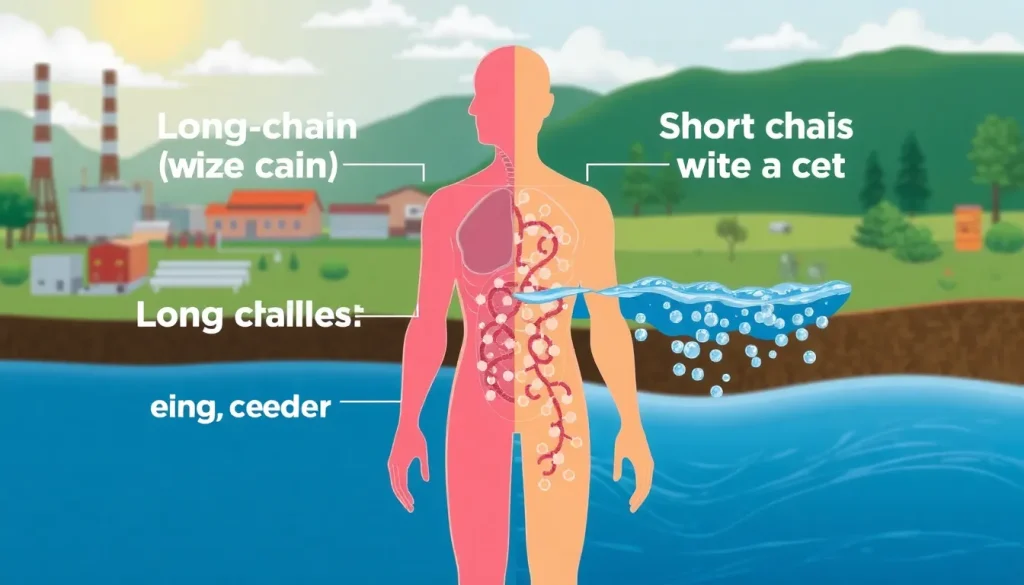
PFAS are a group of thousands of synthetic chemicals characterized by a chain of carbon atoms bonded to fluorine atoms. The length of this fluorinated carbon chain determines many of the compound’s physical, chemical, and biological properties. Long-chain PFAS, historically the most widely produced and studied, are known for their ability to bind to proteins and accumulate in blood, liver, and other organs. Their half-lives in humans can range from several years to decades. In contrast, short-chain PFAS have lower bioaccumulation potential and are more rapidly excreted, but they are equally persistent in the environment and can travel long distances through groundwater and air.
The shift from long-chain to short-chain PFAS began in the early 2000s after major manufacturers voluntarily phased out PFOA and PFOS under regulatory pressure. Short-chain alternatives were designed to provide similar oil- and water-repellent properties while reducing the risk of accumulation in living organisms. However, these replacements are not without concerns: they are still highly persistent, and their mobility makes them difficult to remove from drinking water using conventional treatment methods. The debate over short-chain vs long-chain PFAS thus centers on a trade-off between bioaccumulation and environmental mobility.
History
The commercial use of PFAS began in the 1940s with the discovery of polytetrafluoroethylene (PTFE) by DuPont, which later led to the development of PFOA as a processing aid. PFOS was a key ingredient in 3M’s Scotchgard fabric protector. For decades, these long-chain compounds were used without full understanding of their environmental and health impacts. In the late 1990s and early 2000s, studies began to detect PFAS in wildlife and human blood globally, revealing their widespread distribution and persistence.
In 2000, 3M announced it would phase out production of PFOS, and by 2006, the U.S. EPA launched the PFOA Stewardship Program, in which eight major companies committed to eliminating PFOA and related long-chain chemicals by 2015. Similar actions followed in Europe and under the Stockholm Convention on Persistent Organic Pollutants, which listed PFOS in 2009 and PFOA in 2019. In response, the chemical industry developed short-chain PFAS and other fluorinated alternatives, such as GenX (a replacement for PFOA) and PFBS (a replacement for PFOS). These newer compounds were marketed as safer because they do not bioaccumulate to the same extent, but their long-term effects are still under investigation.
How It Works
The behavior of PFAS in the environment and in organisms is largely governed by the length of the fluorinated carbon chain. Long-chain PFAS are both hydrophobic and lipophobic, meaning they repel water and oil, but their chain length allows them to interact with proteins and cell membranes. This leads to strong binding to blood proteins and accumulation in tissues. The longer the chain, the higher the bioaccumulation potential, as measured by bioconcentration factors and half-lives. For example, the human half-life of PFOA is estimated at 2–4 years, while PFOS is around 5 years.
Short-chain PFAS, with fewer fluorinated carbons, are less likely to bind to proteins and are more water-soluble. This results in lower bioaccumulation but higher mobility in aqueous environments. They can travel rapidly through soil and groundwater, contaminating drinking water supplies far from the original source. Their persistence means they do not break down naturally, and they can cycle through the environment for centuries. The same carbon-fluorine bond strength that makes all PFAS durable also makes them resistant to conventional water treatment, though short-chain compounds are particularly challenging to remove with activated carbon due to their smaller size and higher polarity.
Environmental and Human Impacts
Long-chain PFAS have been linked to a range of adverse health effects in epidemiological studies. These include increased cholesterol levels, liver enzyme changes, decreased birth weight, immune system suppression, thyroid disruption, and an elevated risk of kidney and testicular cancer. Because of their long half-lives, even low-level chronic exposure can lead to significant body burdens over time. Environmental contamination from long-chain PFAS is widespread near industrial sites, military bases, and airports where firefighting foams were used.
Short-chain PFAS are generally considered less toxic based on current data, but they are not harmless. Animal studies have shown liver and thyroid effects at high doses, and some short-chain compounds have been found to cause developmental toxicity. The primary concern with short-chain PFAS is their extreme mobility and persistence, leading to ubiquitous low-level exposure through drinking water. Once in groundwater, they are difficult and costly to remediate. The full extent of their health impacts is still being studied, but their environmental footprint may be even larger than that of long-chain PFAS due to their ability to spread widely.
Benefits, Limitations and Trade-offs
The functional benefits of PFAS are significant: they provide unmatched oil and water repellency, thermal stability, and surfactant properties that are critical in many industrial and consumer applications. Long-chain PFAS were particularly effective because their longer chains created more durable and effective barriers. However, their toxicity and bioaccumulation made them unacceptable from a public health perspective.
Short-chain PFAS were introduced as a compromise, offering similar performance with reduced bioaccumulation. The trade-off is that they are more mobile in the environment, potentially contaminating water resources over vast areas. They are also more difficult to filter out of water, requiring advanced treatment technologies like reverse osmosis or specialized adsorbents. This creates a dilemma: while short-chain PFAS may pose a lower direct health risk to individuals, their widespread presence could lead to chronic, low-level exposure for entire populations. The search for truly safe and sustainable alternatives continues, with some manufacturers moving toward non-fluorinated options.
Common Misconceptions
FAQ
What is the difference between short-chain and long-chain PFAS?
The difference lies in the number of carbon atoms in the fluorinated chain. Long-chain PFAS have more carbons (e.g., 8 for PFOA) and are more bioaccumulative and toxic. Short-chain PFAS have fewer carbons and are less bioaccumulative but more mobile in water.
Are short-chain PFAS safer than long-chain PFAS?
Short-chain PFAS are less bioaccumulative and may have lower acute toxicity, but they are not proven safe. They remain highly persistent and can contaminate water supplies widely, and some have shown health effects in animal studies.
Why were short-chain PFAS introduced?
They were developed as replacements for long-chain PFAS like PFOA and PFOS after those were found to be toxic and bioaccumulative. Short-chain versions aim to provide similar industrial performance with reduced risk of accumulation in living organisms.
References
- OECD (2018). Toward a new comprehensive global database of per- and polyfluoroalkyl substances (PFASs).
- U.S. Environmental Protection Agency. Basic Information on PFAS.
- Buck, R. C., et al. (2011). Perfluoroalkyl and polyfluoroalkyl substances in the environment: terminology, classification, and origins. Integrated Environmental Assessment and Management.