In brief
At a glance
Quick Facts
- Typical land use for utility-scale PV
- 5-10 acres per megawatt
- Global solar potential land area
- Less than 1% of total land area could meet world electricity demand
- Comparison to coal mining
- Solar uses less land than coal when factoring in mining and waste disposal
- Agrivoltaics potential
- Combining solar with agriculture can increase land productivity by up to 60%
- Rooftop solar land use
- Rooftop solar requires no additional land
- CSP land use
- Concentrating solar power uses 4-10 acres per MW
- Land use efficiency improvement
- Solar panel efficiency has doubled since 2000, reducing land per watt
- Dual use with grazing
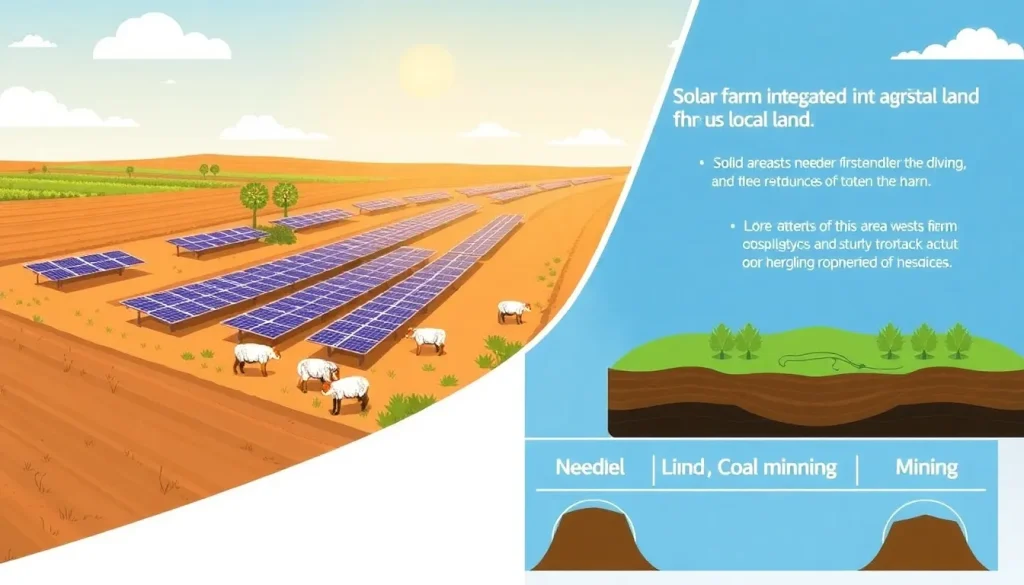
- Sheep grazing on solar farms is a common practice to manage vegetation
Key Takeaways
- Utility-scale solar photovoltaic (PV) farms typically require 5 to 10 acres per megawatt of capacity, while concentrating solar power (CSP) plants need 4 to 10 acres per megawatt.
- Solar land use is often overstated; meeting global electricity demand with solar would require less than 1% of the world’s land area, and rooftop solar uses no additional land.
- Solar installations can be co-located with agriculture (agrivoltaics) or placed on marginal lands, reducing competition for productive farmland and providing dual land-use benefits.
- Careful siting, technological improvements, and policy frameworks are essential to minimize environmental impacts and maximize the land-use efficiency of solar power.
What Is Solar Power Land Use: How Much Land Is Required?
Solar power land use refers to the amount of land area needed to install and operate solar energy systems, including photovoltaic (PV) panels, concentrating solar power (CSP) plants, and associated infrastructure such as access roads, inverters, and transmission lines. The land requirement is typically expressed in acres per megawatt (MW) of installed capacity or acres per gigawatt-hour (GWh) of annual electricity generation. For utility-scale PV systems, the direct land use ranges from about 5 to 10 acres per MW, while CSP facilities generally require 4 to 10 acres per MW. These figures vary based on technology type, panel efficiency, tracking systems, latitude, and local site conditions.
Understanding solar land use is critical because land is a finite resource, and the expansion of solar energy must be balanced with other land needs such as agriculture, conservation, and urban development. However, solar power’s land footprint is often misunderstood. When compared to the land used for fossil fuel extraction, processing, and waste disposal over a plant’s lifetime, solar energy is far more land-efficient. Moreover, solar panels can be installed on rooftops, over parking lots, on reservoirs, and on degraded lands, significantly reducing the need for greenfield development. The question of how much land is required is not just about physical area but also about how that land is used, managed, and integrated into existing landscapes.
Overview
Solar power is the most abundant energy source on Earth, but it is diffuse, meaning that large collection areas are needed to capture significant amounts of energy. The land required for solar installations depends on several key factors. First, the type of solar technology matters: PV panels directly convert sunlight to electricity and can be packed more densely than CSP mirrors, which need spacing to focus sunlight onto a central receiver. Second, panel efficiency—the percentage of sunlight converted to electricity—directly affects land use; higher efficiency panels produce more power per unit area. Third, whether the system uses fixed-tilt or tracking mounts influences spacing; single-axis trackers increase energy output but require more land to avoid shading between rows. Fourth, geographic location determines the amount of sunlight (insolation) available, so a solar farm in a sunnier region needs less land to produce the same amount of energy.

Globally, solar power capacity has grown exponentially, and with it, the total land area dedicated to solar farms has increased. However, the land footprint remains a small fraction of total land use. For example, the U.S. Department of Energy’s Solar Futures Study estimates that achieving a decarbonized grid with significant solar contribution would require about 0.5% of the contiguous U.S. land area. This is comparable to the land currently used for golf courses or less than the area dedicated to corn ethanol production. In many regions, solar farms are sited on low-productivity agricultural land, brownfields, or in deserts, minimizing competition with high-value cropland. The overview of solar land use reveals that while the absolute numbers can appear large, the relative impact is manageable with thoughtful planning.
How It Works
Solar power generation relies on capturing photons from sunlight and converting them into electricity. In PV systems, semiconductor materials in solar cells absorb photons and release electrons, creating an electric current. To generate utility-scale power, thousands of these panels are arranged in arrays over a large area. The land must be relatively flat, cleared of obstructions, and oriented to maximize sun exposure. Panels are spaced apart to prevent shading, which would reduce output. The spacing depends on the panel tilt angle and whether tracking systems are used. Single-axis trackers, which rotate panels from east to west, require more land than fixed-tilt systems because the rows must be farther apart to avoid shading as the sun moves. Dual-axis trackers, which also adjust for seasonal sun angle, need even more space.
Concentrating solar power (CSP) works differently: mirrors (heliostats) reflect and concentrate sunlight onto a receiver, where a fluid is heated to drive a turbine. CSP plants require larger land areas per MW than PV because the mirrors need clear lines of sight to the receiver and must be spaced to avoid blocking each other. Additionally, CSP often includes thermal energy storage, which increases the overall plant footprint. The land is not just for the solar field; it also includes substations, maintenance buildings, and buffer zones. Understanding how these systems work clarifies why land requirements vary and why technological advances that increase efficiency or enable dual use can significantly reduce the effective land footprint.
What the Evidence Shows
Multiple studies and data sets provide a consistent picture of solar land use. The National Renewable Energy Laboratory (NREL) has compiled land-use estimates for operating solar plants in the United States. For utility-scale PV, the median total land use is about 7.5 acres per MW, with a range of 5 to 10 acres per MW depending on configuration. CSP plants show a median of about 7 acres per MW, with a range of 4 to 10 acres. When expressed in terms of annual energy generation, PV requires about 3 to 4 acres per GWh per year, while CSP requires 2.5 to 3.5 acres per GWh per year. These figures account for the entire facility area, not just the panel footprint.
Comparative analyses show that solar’s land use is often less than that of other energy sources when the full lifecycle is considered. Coal mining, for instance, disturbs large areas for extraction and waste disposal; over a 30-year period, a coal plant can require more land per unit of energy than a solar farm. Nuclear power has a small direct footprint but requires land for uranium mining and long-term waste storage. Wind farms use land more extensively, with turbines spaced far apart, though the land between turbines can often be used for farming. Evidence also indicates that solar can be deployed on already disturbed lands: a study by the U.S. Environmental Protection Agency identified over 43 million acres of brownfields, landfills, and mine sites suitable for renewable energy. The data consistently show that solar land use is manageable and can be optimized through technology and siting strategies.
Environmental and Human Impacts
The environmental impacts of solar land use are multifaceted. On one hand, solar farms can lead to habitat loss and fragmentation, especially when sited on undeveloped land. Large-scale installations may disrupt local ecosystems, affect wildlife corridors, and alter soil properties. In desert environments, the clearing of vegetation and soil compaction can have long-lasting effects. Water use is another concern: while PV panels require minimal water for cleaning, CSP plants with wet cooling can consume significant amounts of water, which is problematic in arid regions where many solar resources are located. Visual impacts and glare can also affect nearby communities, leading to opposition.
On the other hand, solar power offers substantial environmental benefits that often outweigh the local land-use impacts. Solar energy produces no air pollution or greenhouse gas emissions during operation, helping to mitigate climate change. Compared to fossil fuel extraction, solar’s land disturbance is temporary and reversible; panels can be removed, and the land can be restored. Moreover, innovative practices such as agrivoltaics—where crops are grown or livestock grazed beneath elevated solar panels—can enhance land productivity, improve soil moisture retention, and provide shade for animals. Pollinator-friendly solar farms, planted with native wildflowers, support biodiversity and agricultural pollination. Human impacts include job creation in construction and maintenance, though these are often temporary. Community engagement and equitable siting processes are crucial to address local concerns and ensure that the benefits of solar energy are shared.
Benefits, Limitations and Trade-offs
The primary benefit of solar power regarding land use is its potential for dual use and siting flexibility. Unlike fossil fuel extraction, which permanently alters land and often renders it unusable, solar panels can be installed on rooftops, over parking lots, on canals, and on marginal lands without competing with food production. Agrivoltaic systems can increase land-use efficiency by 30% to 60% compared to separate solar and agricultural operations. Solar farms can also provide a stable income for landowners, helping to preserve family farms. Additionally, solar’s land footprint is small relative to its energy output over a 25- to 30-year lifespan, and the land can be returned to its original state after decommissioning.
However, limitations exist. Solar power is intermittent, requiring backup or storage, which may have its own land implications. The best solar resources are often in remote areas, necessitating long transmission lines that also require land and can face siting challenges. There are trade-offs between using high-efficiency panels that reduce land per watt and the higher cost or resource intensity of such panels. Land-use conflicts can arise when solar farms are proposed on prime farmland or in ecologically sensitive areas. Balancing these trade-offs requires integrated planning that considers energy, food, water, and ecosystem needs. Policies that incentivize rooftop solar, brownfield redevelopment, and agrivoltaics can help maximize benefits while minimizing land-use conflicts.
Common Misconceptions
Misconception: Solar power requires enormous amounts of land that could be better used for farming. In reality, solar farms often use less productive land, and agrivoltaics allow farming and solar to coexist. The total land needed to power a country with solar is a small fraction of its agricultural land. For example, meeting the entire U.S. electricity demand with solar would require about 0.6% of the land area, which is less than the land used for corn ethanol.
Misconception: Solar panels permanently destroy land. Solar installations are temporary and reversible. Panels can be removed, and the land can be restored to its previous state. Unlike mining or drilling, solar does not contaminate soil or water. In many cases, the land under panels can be used for grazing or pollinator habitat, improving soil health.
Misconception: Rooftop solar can meet all our energy needs, so we don’t need solar farms. While rooftop solar is valuable, it cannot supply all electricity due to space constraints, shading, and orientation limitations. Utility-scale solar is necessary to achieve the scale required for decarbonization and is more cost-effective per watt. A mix of both is optimal.
Misconception: Solar land use is worse than coal or nuclear when you consider the full lifecycle. Lifecycle assessments show that solar uses less land than coal when accounting for mining, waste disposal, and pollution. Nuclear has a small direct footprint but requires land for uranium mining and waste storage. Solar’s land impact is often overstated because its footprint is visible and concentrated, while the land impacts of fossil fuels are dispersed and hidden.
FAQ
How much land does a solar farm need?
A utility-scale solar farm typically requires 5 to 10 acres per megawatt of capacity. A 100 MW solar farm would need about 500 to 1,000 acres.
Does solar power use more land than coal or nuclear?
When considering the full lifecycle, including mining and waste disposal, solar power often uses less land than coal and is comparable to nuclear when sited on suitable land.
Can solar panels be installed without using land?
Yes, rooftop solar panels on residential, commercial, and industrial buildings use no additional land. Floating solar on reservoirs and canals also avoids land use.
References
- National Renewable Energy Laboratory (NREL), 'Land Use by System Technology'
- International Energy Agency (IEA), 'Solar PV Global Supply Chains'
- U.S. Department of Energy, 'Solar Futures Study'