In brief
At a glance
Quick Facts
- Core concept
- Two contrasting strategies for balancing food production and biodiversity conservation on a landscape scale.
- Land sparing
- Intensifies agriculture on existing farmland to free up other land for conservation, maximizing yields and setting aside natural habitats.
- Land sharing
- Integrates conservation into farmland through wildlife-friendly practices, supporting biodiversity within agricultural areas.
- Key trade-off
- Higher yields per hectare in sparing vs. greater on-farm biodiversity in sharing; the optimal mix depends on species and context.
- Scale
- Sparing is often considered at regional or global scales; sharing is typically implemented at farm or landscape scales.
- Evidence
- Studies show mixed results: sparing benefits specialist species, while sharing supports generalists and ecosystem services.
- Policy relevance
- Informs debates on sustainable intensification, land-use zoning, and agri-environmental schemes worldwide.
Key Takeaways
- Land sparing and land sharing are two contrasting strategies for reconciling food production with biodiversity conservation on a landscape scale.
- Land sparing separates intensive agriculture from natural habitats, aiming to maximize yields on farmed land while setting aside other areas for conservation.
- Land sharing integrates conservation into farmland through wildlife-friendly practices, supporting biodiversity across the entire agricultural landscape but often at lower yields.
- The choice between sparing and sharing depends on local ecological, economic, and social contexts, and neither approach is universally superior.
What Is Land Sparing vs Land Sharing?
Land sparing and land sharing are two conceptual models for how to allocate land between agricultural production and biodiversity conservation. The debate originated in conservation biology and land-use planning as a response to the growing need to feed a rising human population while halting the loss of species and ecosystems. At its core, the question is whether it is better to separate intensive farming from natural habitats (sparing) or to integrate conservation-friendly practices into agricultural landscapes (sharing).
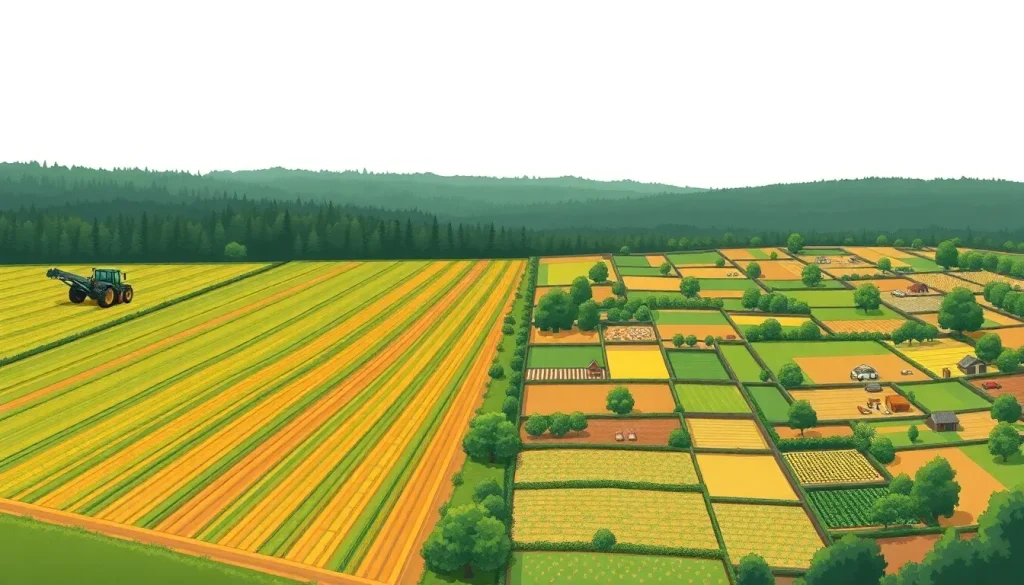
Land sparing advocates argue that high-yield farming on existing agricultural land can meet food demand while leaving more land untouched for nature. This approach typically involves intensive, industrial-style agriculture that maximizes output per unit area, coupled with strict protection of remaining natural habitats. In contrast, land sharing promotes lower-intensity, wildlife-friendly farming that maintains habitat features within agricultural areas—such as hedgerows, trees, and fallow fields—but often produces less food per hectare. The two strategies represent endpoints on a continuum, and real-world landscapes often combine elements of both.
Overview
The land sparing vs land sharing framework emerged in the early 2000s as ecologists and agricultural scientists sought to address the apparent conflict between food security and biodiversity loss. The concept gained prominence through a 2005 paper by Green et al. that compared the two strategies using a simple model of species density versus yield. Since then, it has become a central organizing principle in conservation science, influencing policy discussions on sustainable intensification, land-use zoning, and agri-environment schemes.
At its heart, the debate is about trade-offs. Land sparing prioritizes high agricultural efficiency to minimize the total area needed for farming, theoretically allowing more land to be set aside exclusively for conservation. This approach often relies on technological advances, such as genetically modified crops, precision agriculture, and synthetic inputs, to boost yields. Land sharing, by contrast, accepts lower yields in exchange for maintaining semi-natural habitats within farmland, supporting species that can coexist with agricultural activities. The two strategies also differ in their spatial scale: sparing is typically conceived at regional or global scales, while sharing is often implemented at farm or landscape scales.
How It Works
In a land sparing scenario, agricultural production is concentrated on the most fertile or accessible lands using high-input, high-output methods. The goal is to achieve the maximum possible yield per unit area, thereby reducing the need to convert additional natural habitats into farmland. The spared land is then designated for strict conservation, such as national parks or reserves, where human activity is limited. This model assumes that most species cannot persist in intensively farmed areas and that biodiversity is best protected in large, contiguous natural habitats.
Land sharing, on the other hand, involves managing farmland in ways that make it more hospitable to wildlife. Practices include maintaining hedgerows, field margins, and trees; reducing pesticide and fertilizer use; rotating crops; and preserving patches of natural vegetation within the agricultural matrix. The aim is to create a landscape where both food production and biodiversity can coexist. This approach often aligns with traditional, small-scale farming systems and is supported by agri-environmental schemes that compensate farmers for adopting biodiversity-friendly practices.
What the Evidence Shows
Research comparing land sparing and land sharing has produced mixed results, with outcomes depending heavily on the species, region, and farming systems studied. A landmark 2011 study by Phalan et al. in Ghana and India found that land sparing—combining high-yield farming with forest protection—supported more bird and tree species than land sharing, which required more land to produce the same amount of food. However, other studies in Europe and Latin America have shown that wildlife-friendly farming can sustain high levels of biodiversity, particularly for species that depend on agricultural habitats.
Evidence suggests that the effectiveness of each strategy varies by taxonomic group. Specialist species with narrow habitat requirements often benefit most from land sparing, as they cannot survive in modified agricultural landscapes. Generalist species, on the other hand, may thrive in shared landscapes. Additionally, the scale of analysis matters: at a global level, land sparing may be necessary to protect intact ecosystems, while at local scales, land sharing can provide important habitat connectivity and ecosystem services. There is no one-size-fits-all answer, and many scientists advocate for a mixed approach that applies different strategies in different contexts.
Benefits
Land sparing offers several potential advantages. By intensifying production on existing farmland, it can reduce pressure to clear new land for agriculture, thereby protecting large, contiguous natural habitats that are critical for many species. High-yield farming can also increase food supply, potentially lowering food prices and improving food security. Additionally, spared areas can serve as carbon sinks, helping to mitigate climate change, and can preserve ecosystem services such as water regulation and pollination that benefit adjacent agricultural lands.
Land sharing provides its own set of benefits. It maintains biodiversity within agricultural landscapes, supporting species that cannot survive in isolated reserves. This approach can enhance ecosystem services directly on farms, such as pest control by natural predators, soil fertility through organic matter, and pollination by wild insects. Land sharing also often preserves cultural landscapes and traditional farming practices, and it can be more politically and socially acceptable in regions where smallholder farming dominates and land-use zoning is difficult to enforce.
Limitations and Trade-offs
Both strategies have significant limitations. Land sparing requires high yields, which often depend on intensive inputs like synthetic fertilizers and pesticides that can cause pollution and degrade soil health. If spared land is not effectively protected, it may be converted later, undermining conservation goals. Moreover, the model can marginalize smallholder farmers who lack access to the technology and capital needed for intensification, potentially leading to social inequity.
Land sharing, while more inclusive, typically produces lower yields per hectare, meaning more land is needed to meet the same food demand. This can increase pressure to convert natural habitats elsewhere, a phenomenon known as leakage. Wildlife-friendly farming may also fail to support species that require large, undisturbed areas. Additionally, the economic viability of land sharing often depends on subsidies or premium prices for eco-labeled products, which may not be sustainable at scale.
Common Misconceptions
One common misconception is that land sparing always means industrial, chemical-intensive farming. In reality, sparing can involve a range of high-yield methods, including agroecological approaches that achieve high productivity through ecological intensification rather than heavy reliance on synthetic inputs. Similarly, land sharing is not synonymous with low productivity; some shared landscapes can achieve relatively high yields while maintaining biodiversity.
Another misconception is that the two strategies are mutually exclusive. In practice, many landscapes employ a mix of both, with some areas managed intensively and others under wildlife-friendly practices. The debate is not about choosing one over the other universally, but about determining the optimal allocation of land uses in a given context to meet multiple objectives, including food production, biodiversity conservation, and human well-being.
FAQ
What is the difference between land sparing and land sharing?
Land sparing separates intensive agriculture from natural habitats, using high-yield farming on some land to leave other areas untouched for conservation. Land sharing integrates conservation into farmland through wildlife-friendly practices, allowing biodiversity and agriculture to coexist on the same land.
Which is better: land sparing or land sharing?
There is no universally better approach. The effectiveness depends on the species, landscape, and socio-economic context. Land sparing often benefits specialist species and large-scale conservation, while land sharing can support generalist species and provide ecosystem services. Many real-world landscapes use a combination of both.
How does land sparing affect food production?
Land sparing aims to increase food production per unit area through intensification, which can boost overall output and potentially reduce pressure to convert new land. However, it may rely on high inputs and technology, and if not managed well, can lead to environmental degradation.
References
- Phalan, B., Onial, M., Balmford, A., & Green, R. E. (2011). Reconciling food production and biodiversity conservation: land sharing and land sparing compared. Science, 333(6047), 1289-1291.
- Green, R. E., Cornell, S. J., Scharlemann, J. P. W., & Balmford, A. (2005). Farming and the fate of wild nature. Science, 307(5709), 550-555.
- Fischer, J., Brosi, B., Daily, G. C., Ehrlich, P. R., Goldman, R., Goldstein, J., ... & Tallis, H. (2008). Land sparing versus land sharing: moving forward. Conservation Letters, 1(3), 149-157.