In brief
At a glance
Quick Facts
- Definition
- The unavoidable future sea-level increase resulting from past and ongoing greenhouse gas emissions, even if emissions stop immediately.
- Primary drivers
- Thermal expansion of the ocean and mass loss from ice sheets and glaciers.
- Timescale
- Centuries to millennia; the deep ocean and ice sheets respond very slowly to warming.
- Committed rise from recent emissions
- Approximately 0.7–1.1 meters by 2300 for emissions from 2000–2019, according to IPCC AR6.
- Long-term potential
- If warming reaches 2°C, multi-meter rise over thousands of years is expected, consistent with past warm periods.
- Regional variation
- Gravitational effects and land motion cause some regions to experience higher-than-average committed rise.
- Policy relevance
- Defines the minimum adaptation needs for coastal planning and infrastructure design.
- Irreversibility
- Some ice sheet changes may be irreversible on human timescales once critical thresholds are crossed.
Key Takeaways
- Sea-level rise commitment is the unavoidable future sea-level increase locked in by past and ongoing greenhouse gas emissions, persisting even if emissions stop immediately.
- Thermal expansion of the ocean and the slow response of ice sheets are the primary mechanisms that drive this long-term commitment.
- Current emissions have already committed the planet to at least 1–2 meters of sea-level rise over the next 2,000 years, with much higher potential if ice sheet tipping points are crossed.
- Understanding this commitment is essential for long-term coastal planning, as it defines the minimum adaptation measures required regardless of future emission pathways.
What Is Sea-Level Rise Commitment?
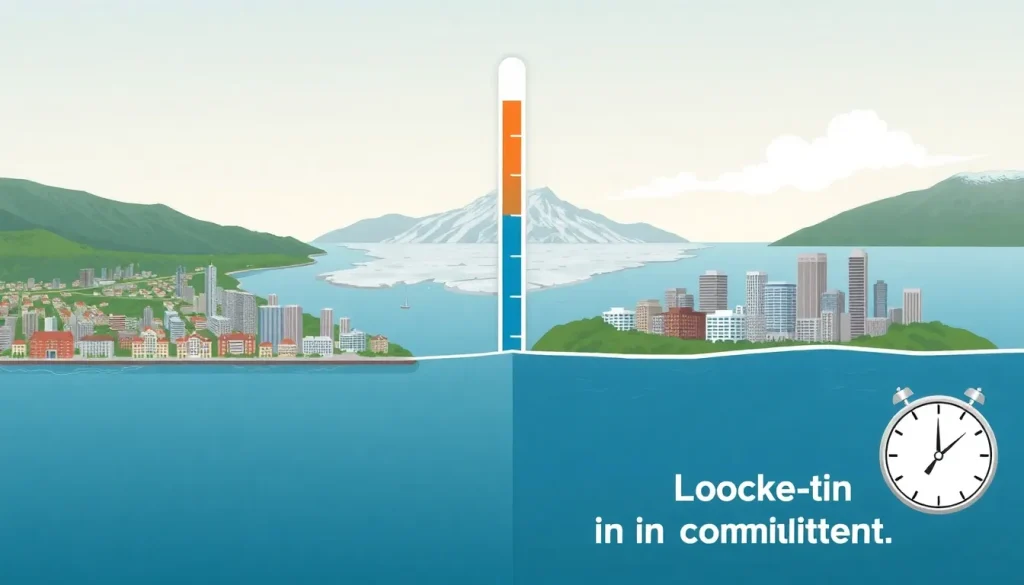
Sea-level rise commitment is the future increase in global mean sea level that is already inevitable due to the cumulative effects of past and present greenhouse gas emissions. It represents the sea-level response that would occur even if atmospheric greenhouse gas concentrations were stabilized immediately or emissions were reduced to zero. This commitment arises because the climate system—particularly the oceans and ice sheets—responds slowly to changes in radiative forcing, meaning that the full consequences of today’s emissions will unfold over centuries to millennia.
The concept is a subset of the broader idea of climate commitment, which also includes committed warming. While surface temperatures would stop rising relatively quickly if emissions ceased, sea level continues to rise because the deep ocean takes centuries to warm and expand, and ice sheets take even longer to reach equilibrium with a warmer climate. Sea-level rise commitment thus quantifies the legacy of past actions and underscores the long-term responsibility embedded in current emission choices. It is a central metric in climate science for distinguishing between avoidable and unavoidable impacts, and it informs the minimum adaptation requirements for coastal communities worldwide.
How It Works
The commitment operates through two main physical processes with very different timescales. The first is thermal expansion: as the ocean absorbs excess heat from the atmosphere, the water expands. Because heat penetrates slowly into the deep ocean, this expansion continues for centuries after surface temperatures stabilize. Even if atmospheric warming halts, the ocean will keep taking up heat until it reaches a new thermal equilibrium, adding to sea-level rise.

The second process is the mass loss from ice sheets and glaciers. Ice sheets on Greenland and Antarctica are so massive that they respond to warming over millennia. They are currently out of balance with the present climate, meaning they are losing more ice than they gain each year. This imbalance will persist until the ice sheets shrink to a size that matches the warmer conditions. Additionally, some ice sheet changes may be irreversible on human timescales once critical thresholds are crossed, such as the collapse of marine-based sectors in West Antarctica. Mountain glaciers, though smaller, also contribute and have a shorter response time of decades to centuries. Together, these mechanisms lock in a long-term sea-level trajectory that is largely determined by the peak warming and cumulative carbon emissions achieved.
Main Causes or Drivers
The primary drivers of sea-level rise commitment are the same processes that cause observed sea-level rise, but their inertia creates the commitment:
- Ocean thermal expansion: The ocean absorbs more than 90% of the excess heat trapped by greenhouse gases. As this heat diffuses downward, the water expands, contributing the largest share of committed rise on centennial timescales.
- Ice sheet mass loss: The Greenland and Antarctic ice sheets hold enough water to raise global sea level by about 7 meters and 58 meters, respectively. Their response to warming includes surface melt, increased iceberg calving, and the retreat of grounding lines. Once destabilized, these ice sheets can continue losing mass for thousands of years.
- Mountain glacier retreat: Glaciers outside the ice sheets are already committed to further loss because they are out of equilibrium with current temperatures. Their contribution is smaller but significant over the next few centuries.
- Land water storage changes: Human activities such as groundwater extraction and reservoir construction can also affect sea level, but these are minor compared to the other drivers and are not a major component of the long-term commitment.
What the Evidence Shows
Scientific assessments, including the Intergovernmental Panel on Climate Change (IPCC) Sixth Assessment Report, provide robust estimates of committed sea-level rise. For emissions from 2000 to 2019 alone, the committed rise by 2300 is approximately 0.7 to 1.1 meters under a scenario where temperatures stabilize. If global warming reaches 2°C above pre-industrial levels, multi-meter rise over the following millennia is expected, consistent with paleoclimate records from past warm periods when sea levels were 6 to 9 meters higher than today.
Observations confirm that ice loss from Greenland and Antarctica is accelerating, and this trend is consistent with model projections of committed future loss. Satellite measurements show that the rate of global mean sea-level rise has increased from about 1.4 mm per year over the 20th century to over 3.5 mm per year in recent decades. This acceleration is driven by growing contributions from ice sheet melt, indicating that the commitment is already being realized. Paleoclimate evidence further reinforces the long-term sensitivity of sea level to even modest warming, providing a natural analogue for the multi-millennial commitment we are now locking in.
Regional Differences
Sea-level rise commitment is not uniform across the globe. Regional variations arise from several geophysical processes. As ice sheets lose mass, their gravitational attraction weakens, causing sea levels to fall near the shrinking ice sheet but rise more than the global average at great distances. This fingerprint effect means that regions far from Greenland and Antarctica—such as the tropics and mid-latitudes—will experience a disproportionately large share of the committed rise.
Other factors include ocean dynamics, which can shift currents and redistribute heat, and vertical land motion due to glacial isostatic adjustment (the slow rebound of the Earth’s crust after the last ice age) or local subsidence from groundwater extraction and sediment compaction. For example, the U.S. East Coast and many low-lying delta regions in Asia face higher-than-average committed sea-level rise, compounding their vulnerability. These regional patterns are an integral part of the commitment and must be considered in local adaptation planning.
Why It Matters
Sea-level rise commitment matters because it defines the minimum amount of change that coastal communities must prepare for, regardless of future emission reductions. It shifts the policy focus from solely preventing sea-level rise to also adapting to its inevitable consequences. Infrastructure with long design lifetimes—such as ports, coastal defenses, and urban developments—must account for this locked-in rise to avoid costly retrofits or abandonment.
Moreover, the concept highlights the long-term benefits of early and aggressive mitigation. While some rise is already committed, every additional ton of CO2 emitted increases the ultimate commitment, especially by raising the risk of crossing ice sheet tipping points that could lead to meters of additional rise over centuries. Understanding the commitment thus provides a powerful incentive to reduce emissions now to limit the severity of future impacts and to buy time for adaptation.
Common Misconceptions
FAQ
What is sea-level rise commitment?
Sea-level rise commitment is the future increase in global mean sea level that is already inevitable due to past and ongoing greenhouse gas emissions. It represents the rise that would occur even if all emissions were stopped immediately, driven by the slow response of the ocean and ice sheets.
How does sea-level rise commitment work?
It works through two main mechanisms: thermal expansion of the ocean as it continues to absorb heat, and the ongoing mass loss from ice sheets and glaciers that are out of equilibrium with the current climate. Both processes operate over centuries to millennia, locking in future rise.
Why does sea-level rise commitment matter?
It matters because it defines the minimum sea-level rise that coastal communities must adapt to, regardless of future emission cuts. Understanding the commitment helps planners design long-lived infrastructure and motivates early emission reductions to limit the ultimate rise and avoid crossing dangerous ice sheet tipping points.
References
- IPCC Sixth Assessment Report (AR6), Working Group I: The Physical Science Basis, Chapter 9 (Ocean, Cryosphere and Sea Level Change)
- NASA Sea Level Change Portal (https://sealevel.nasa.gov)
- National Oceanic and Atmospheric Administration (NOAA) Climate.gov (https://www.climate.gov)