In brief
At a glance
Quick Facts
- Verdict
- Promising but context-dependent
- Problem addressed
- Urban flooding and stormwater management
- Evidence strength
- Moderate
- Potential scale
- Regional (urban areas)
- Relative cost
- Moderate to High
- Time to impact
- Years to decades
Quick verdict
Sponge cities are a promising but not yet fully proven approach to urban flood management. By integrating green infrastructure such as permeable pavements, green roofs, rain gardens, and constructed wetlands, they aim to absorb, store, and purify stormwater, reducing runoff and easing pressure on drainage systems. Evidence from pilot projects shows they can effectively manage moderate rainfall and provide multiple co-benefits, but their performance during extreme events is less certain. Implementation is costly and requires long-term maintenance, and success depends heavily on local climate, soil conditions, and governance. Sponge cities are best viewed as one component of a broader, integrated water management strategy.
Problem addressed
Rapid urbanization has replaced natural, permeable landscapes with impervious surfaces such as roads, rooftops, and pavements. This prevents rainwater from infiltrating into the ground, leading to increased surface runoff, overwhelmed drainage systems, and a higher risk of pluvial (rainfall-driven) flooding. Climate change is intensifying the problem by increasing the frequency and severity of heavy rainfall events in many regions. Traditional “gray” infrastructure—pipes, culverts, and concrete channels—often lacks the capacity to handle these new extremes, resulting in property damage, disruption, and in some cases loss of life. Sponge cities directly address this by restoring the natural water cycle within urban areas, aiming to absorb, store, and purify rainwater where it falls.
How the solution works
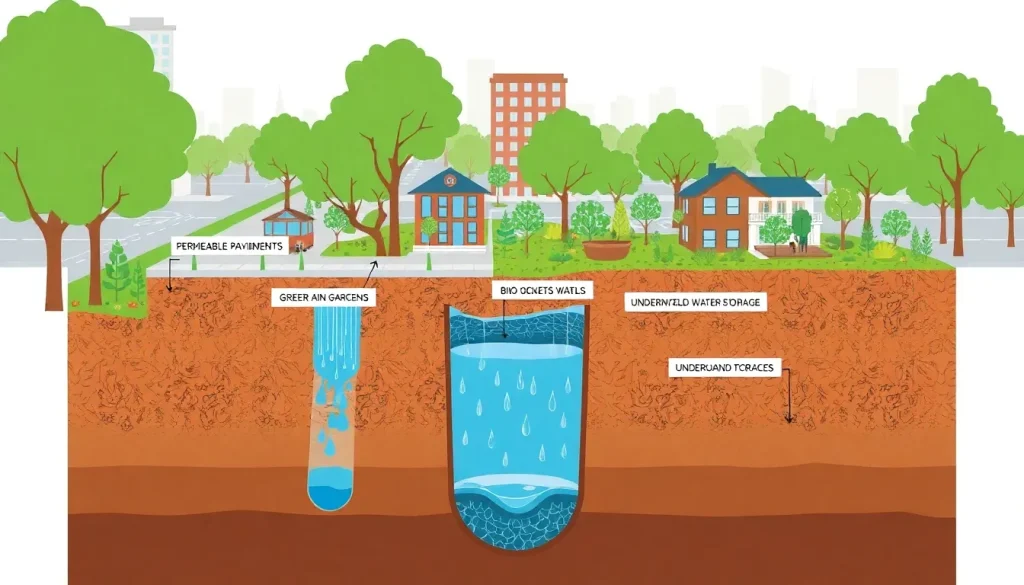
The sponge city concept mimics natural hydrological processes by deploying distributed, nature-based solutions across the urban landscape. Key techniques include: permeable pavements that allow water to infiltrate into underlying layers; green roofs that retain rainfall and reduce runoff; rain gardens and bioswales that capture and filter stormwater; constructed wetlands and ponds that store and treat larger volumes; and underground storage tanks or infiltration trenches for excess water. These elements work together to slow down, spread out, and soak up rainwater, reducing peak flows into drainage systems. Captured water can be reused for irrigation, toilet flushing, or other non-potable purposes. The approach is often combined with upgraded gray infrastructure for extreme events, creating a hybrid system.

Evidence strength
The evidence base for sponge cities is moderate and growing. Numerous pilot projects, particularly in China’s Sponge City Program (launched in 2015 with 30 pilot cities), have generated site-specific data showing reductions in runoff volumes and improvements in water quality. For example, monitoring in some Chinese pilot cities has demonstrated a 30–50% reduction in peak runoff for moderate rainfall events. However, city-wide, long-term performance data remain limited. Many studies rely on modeling rather than extensive field measurements. The effectiveness during extreme, high-intensity storms is less documented, and some evaluations indicate that sponge infrastructure can be overwhelmed, with runoff reductions dropping significantly. Maintenance issues and variability in design quality further complicate the evidence. International examples, such as Philadelphia’s Green City, Clean Waters program, provide additional data but also highlight the need for decades-long monitoring to fully assess impacts.
Potential scale
Sponge city principles can be applied in urban areas worldwide, from neighborhood retrofits to entire new developments. The concept is scalable in theory, but practical scaling faces significant barriers. Retrofitting existing dense cities is expensive, disruptive, and constrained by available space, underground utilities, and land ownership. New cities or districts can integrate sponge design from the outset at lower marginal cost. China’s national program aims to have 80% of urban areas in pilot cities meet sponge standards by 2030, but progress has been slower than planned. Globally, the potential scale is regional—concentrated in cities with the political will, financial resources, and suitable climatic and geological conditions. Full-city transformation is a multi-decade endeavor.
Cost considerations
Sponge city infrastructure generally has higher upfront capital costs than conventional drainage, though life-cycle cost comparisons are complex. Costs vary widely depending on the techniques used, local labor and material prices, and the scale of implementation. For instance, green roofs can cost two to three times more than conventional roofs, and permeable pavements are more expensive than standard asphalt. However, when co-benefits such as reduced flood damage, improved water quality, energy savings from cooling, and increased property values are factored in, the benefit-cost ratio can be favorable. Maintenance is an ongoing expense: permeable surfaces require regular vacuum sweeping to prevent clogging, and vegetation needs care. Underfunded maintenance is a common cause of performance decline. In some Chinese pilots, cost overruns and unclear funding mechanisms have been reported.
Implementation time
Small-scale sponge interventions, such as a single rain garden or green roof, can be installed in weeks to months and begin providing benefits immediately. Neighborhood-scale retrofits typically take several years of planning and construction. Achieving city-wide transformation is a long-term process, often projected over 20–30 years. The time to see measurable flood reduction at a catchment scale depends on the density of interventions; benefits accumulate gradually as more green infrastructure is added. In new developments, sponge features can be incorporated from the start, shortening the timeline to impact.
Environmental benefits
Beyond flood mitigation, sponge cities offer multiple environmental gains. They improve water quality by filtering pollutants from stormwater, reducing the load on receiving water bodies. Groundwater recharge is enhanced where infiltration is feasible. Vegetation provides urban cooling, mitigating the heat island effect, and can sequester carbon, though amounts are modest. Green spaces create habitats for birds, insects, and other wildlife, supporting urban biodiversity. Quantified benefits vary: a study of Philadelphia’s program estimated that green infrastructure reduces stormwater pollutant loads by 50–80% for certain contaminants, while cooling effects can lower local air temperatures by 1–3°C.
Social and economic co-benefits
Sponge city projects often create attractive public spaces that improve quality of life. Parks, green corridors, and water features offer recreational opportunities and can increase adjacent property values. Improved air quality and reduced heat stress have public health benefits. The design, construction, and maintenance of green infrastructure can generate local jobs. In some cases, harvested stormwater reduces demand on municipal water supplies, lowering water bills. However, these co-benefits are not automatic; they depend on good design, equitable access, and ongoing upkeep.
Risks and unintended consequences
Poorly maintained sponge infrastructure can become a source of problems. Clogged permeable pavements lose infiltration capacity, and stagnant water in poorly designed features can breed mosquitoes. Over-reliance on green infrastructure without adequate gray backup for extreme events may increase flood risk if the green elements fail. There is also a risk of “green gentrification,” where new amenities raise property values and displace lower-income residents. In areas with contaminated soils or high groundwater, infiltration can mobilize pollutants or cause waterlogging. Finally, if sponge city projects are implemented as isolated, piecemeal efforts without catchment-level planning, their flood reduction benefits may be negligible.
Where it works best
Sponge cities are most effective in urban areas with moderate to high rainfall, especially those with combined sewer systems that overflow during storms. They are well-suited to temperate and subtropical climates where vegetation can thrive year-round. Cities with available open space—such as wide streets, vacant lots, or parks—have more opportunities for retrofitting. Strong governance, clear regulations, and dedicated funding streams are critical enablers. Examples of favorable contexts include older industrial cities with combined sewers (e.g., in the northeastern United States or northwestern Europe) and rapidly urbanizing areas in Asia where new development can be planned with sponge principles.
Where it may not work
Sponge city approaches face major challenges in arid regions where rainfall is infrequent but intense; the long dry spells can stress vegetation and lead to high maintenance costs, while the rare heavy storms may overwhelm green infrastructure. Areas with high groundwater tables or impermeable clay soils limit infiltration and can cause waterlogging. Dense urban cores with little surface space and extensive underground utilities may find retrofitting prohibitively expensive. Cities with weak institutional capacity or insufficient funding for long-term maintenance are likely to see performance degrade over time. In such contexts, conventional drainage upgrades or alternative strategies may be more reliable.
Comparison with alternatives
Traditional gray infrastructure (pipes, tunnels, detention tanks) provides predictable, high-capacity conveyance but offers few co-benefits and can be overwhelmed by events exceeding design standards. Green-gray hybrid approaches combine the strengths of both: green infrastructure handles everyday rainfall and provides amenities, while gray infrastructure manages extreme events. This is increasingly seen as best practice. Other nature-based solutions, such as low-impact development (LID) and water-sensitive urban design (WSUD), share similar principles with sponge cities but may differ in terminology and specific techniques. Compared to purely gray solutions, sponge cities generally have higher upfront costs but greater long-term value when co-benefits are monetized. The choice depends on local priorities, climate, and available space.
Case studies
China’s Sponge City Program: Launched in 2015, the program selected 30 pilot cities to implement sponge infrastructure, with a goal of retaining 70% of average annual rainfall on-site. Results have been mixed. Cities like Zhenjiang and Xiamen report reduced flooding and improved water quality in some districts, but others have struggled with cost overruns, maintenance, and limited effectiveness during extreme events. A 2019 review found that while runoff control targets were met in many pilot areas, city-wide impacts were less clear, and the program’s expansion has been slower than planned.
Rotterdam, Netherlands: The city has integrated water squares (public plazas that double as temporary water storage during heavy rain), green roofs, and permeable surfaces into its climate adaptation strategy. The Benthemplein water square can store up to 1.7 million liters of water, reducing strain on the drainage system. Monitoring shows these measures effectively manage moderate storms, though extreme events still require conventional pumps.
Philadelphia, USA: The Green City, Clean Waters program, started in 2011, uses green infrastructure to reduce combined sewer overflows. By 2023, over 2,800 green tools (rain gardens, tree trenches, etc.) had been installed, contributing to a documented reduction in overflow volumes. The program is considered a leading example of urban green stormwater management, though full compliance with regulatory targets remains a long-term effort.
Final assessment
Sponge cities represent a valuable, multi-benefit approach to urban flood management, but they are not a universal solution. The evidence shows they can reduce runoff and improve water quality for moderate rainfall, while also delivering environmental and social co-benefits. However, their performance during extreme events is uncertain, and success depends heavily on appropriate design, sustained maintenance, and integration with conventional drainage. They are most worth pursuing in cities with the financial and institutional capacity to support long-term green infrastructure programs, particularly where combined sewer overflows are a problem and where space for retrofitting exists. For cities facing severe flooding risks with limited resources, a more targeted hybrid approach may be more cost-effective. Overall, sponge cities should be viewed as an important component of a broader, integrated urban water resilience strategy rather than a standalone fix.
FAQ
What is a sponge city?
A sponge city is an urban area designed to absorb, store, and purify rainwater using green infrastructure such as permeable pavements, green roofs, rain gardens, and constructed wetlands. The concept aims to mimic the natural water cycle, reducing stormwater runoff, preventing floods, and improving water quality, while also providing recreational and ecological benefits.
How effective are sponge cities in preventing floods?
Sponge cities are generally effective at managing moderate, frequent rainfall events, reducing peak runoff by 30–50% in some monitored projects. However, their performance during extreme, high-intensity storms is less certain, and they may be overwhelmed. They work best as part of an integrated system that includes conventional drainage for rare, heavy events. Long-term, city-wide effectiveness data are still limited.
What are the main challenges of implementing sponge cities?
Key challenges include high upfront costs, the need for ongoing maintenance (e.g., cleaning permeable surfaces, caring for vegetation), space constraints in dense urban areas, and the risk of poor design leading to problems like mosquito breeding or waterlogging. Additionally, without strong governance and funding, projects may not be sustained, and there is a potential for green gentrification if new amenities raise property values and displace residents.
References
- Chinese Ministry of Housing and Urban-Rural Development, Sponge City Construction Technical Guide (2014)
- World Bank, Integrating Green and Gray: Creating Next Generation Infrastructure (2019)
- Philadelphia Water Department, Green City, Clean Waters program evaluation reports
- Copenhagen Climate Adaptation Plan (2011)
- Rotterdam Climate Adaptation Strategy (2013)