In brief
At a glance
Quick Facts
- Verdict
- Promising
- Problem addressed
- Car dependency and urban sprawl
- Evidence strength
- Emerging
- Potential scale
- Regional
- Relative cost
- Moderate
- Time to impact
- Years
Quick verdict
The 15-minute city is a promising but unproven urban planning model that seeks to reorganize neighborhoods so residents can meet most daily needs within a short walk or bike ride. It offers potential for reduced car dependency, lower carbon emissions, improved public health, and stronger local economies. However, evidence from real-world implementations is still emerging, and critics highlight risks of gentrification, limited applicability in low-density areas, and concerns about restricting mobility. The concept is best seen as a guiding principle for incremental urban retrofitting rather than a one-size-fits-all solution.
Problem addressed
The 15-minute city targets the spatial mismatch between where people live and where they access jobs, goods, services, education, and recreation. In many modern cities, especially those built around the automobile, daily activities are dispersed, forcing long commutes and car dependency. This contributes to traffic congestion, air pollution, greenhouse gas emissions, sedentary lifestyles, social isolation, and inefficient land use. The model also addresses the decline of local amenities and community cohesion in car-centric suburbs, where residents often lack nearby shops, parks, or healthcare. By reorganizing urban space, the concept aims to reduce travel demand, improve quality of life, and make cities more resilient.
How the solution works
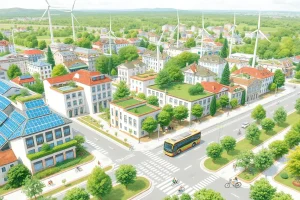
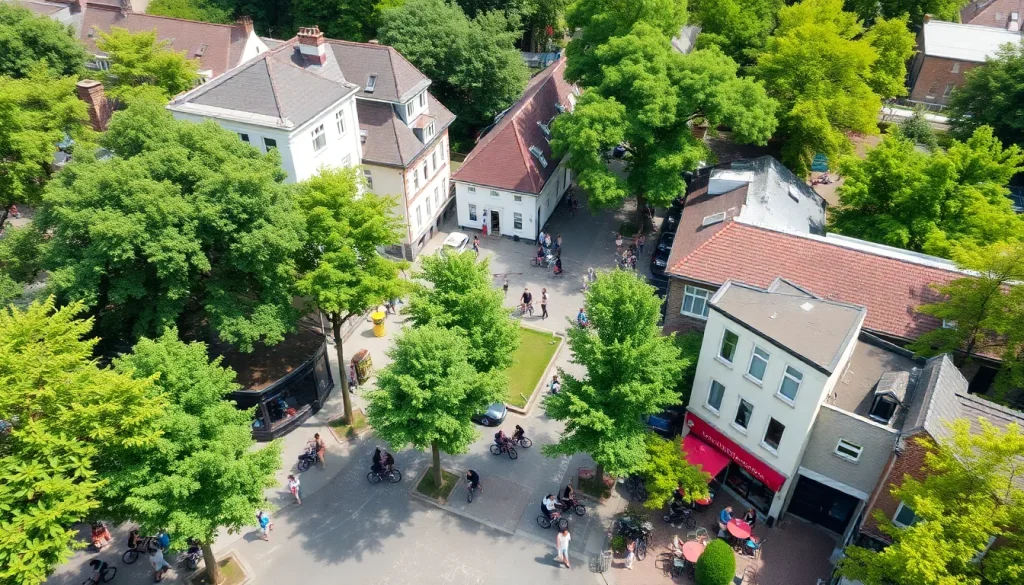
The 15-minute city reorganizes urban districts into complete neighborhoods where residents can access work, food, education, healthcare, leisure, and green space within a 15-minute walk or bike ride from home. This is achieved through a combination of land-use planning, transport policy, and infrastructure changes. Key mechanisms include: (1) Mixed-use zoning that allows residential, commercial, and light industrial uses in close proximity; (2) Densification to support local services and public transport; (3) Active transport infrastructure such as protected bike lanes, widened sidewalks, and pedestrianized streets; (4) Decentralization of public services into neighborhood hubs; (5) Traffic calming and car-restrictive measures like low-traffic neighborhoods, reduced speed limits, and limited parking; and (6) Digital tools to help residents locate nearby amenities. The idea is to reduce the need for long trips, thereby cutting vehicle miles traveled and promoting walking, cycling, and public transit for longer journeys.
Evidence strength
Evidence for the 15-minute city is largely theoretical and based on modeling studies, with limited empirical data from full-scale implementations. Research on related concepts—such as transit-oriented development, walkable neighborhoods, and mixed-use planning—provides indirect support. Studies show that residents in more walkable, mixed-use areas drive less, have lower carbon footprints, and report higher well-being. However, direct evidence that a 15-minute city configuration causes these outcomes is scarce. The concept gained prominence after Paris adopted it in 2020, but systematic evaluations of its impact are still underway. Pilot projects in cities like Melbourne, Barcelona, and Portland show increased walking and cycling, but long-term data on emissions, health, and economic effects are lacking. The evidence base is therefore best described as emerging, with strong theoretical grounding but limited rigorous empirical validation.
Potential scale
If widely adopted, the 15-minute city could transform urban living for a significant share of the global population—over half of whom already live in cities. The concept is scalable in principle, as it can be applied to new developments and retrofitted into existing urban areas. However, its maximum potential is constrained by existing urban form: low-density, car-dependent suburbs are difficult to convert without massive redevelopment. In dense, historic cities, the 15-minute city is often already partially realized. The model could influence urban planning globally, but its impact on total global emissions would be limited unless paired with broader decarbonization of transport and energy systems. Estimates suggest that if all urban trips under 5 km were walked or cycled, global CO2 emissions could be reduced by roughly 5–10%, but this is a rough approximation and depends on local conditions.
Cost considerations
Costs vary widely depending on the starting point. Retrofitting existing neighborhoods with bike lanes, wider sidewalks, and traffic calming measures is relatively low-cost compared to large-scale infrastructure projects like new metro lines. For example, Paris’s plan was budgeted at around €250 million over several years, a fraction of the cost of a single new highway. However, in car-dependent suburbs, the cost of densification and providing new services can be substantial. The economic benefits—reduced healthcare costs from active travel, increased local business revenue, and lower transport costs for households—may offset initial investments, but robust cost-benefit analyses are still limited. The concept is generally considered cost-effective for dense, existing urban cores but expensive for sprawling areas.
Implementation time
Implementation can begin quickly with low-cost interventions like pop-up bike lanes, parklets, and changes to traffic signal timing—these can be deployed in weeks or months. However, achieving a fully realized 15-minute city with a complete mix of uses and services typically takes years to decades, as it requires zoning changes, private investment, and cultural shifts. Early benefits in terms of increased walking and cycling can appear within months of infrastructure improvements. Long-term outcomes like reduced car ownership and improved public health may take 5–10 years to materialize. The timeline is highly dependent on political will, community acceptance, and existing urban fabric.
Environmental benefits
The primary environmental benefit is reduced greenhouse gas emissions from transportation, which accounts for roughly 15–25% of global CO2 emissions. By shortening trips and shifting modes to walking and cycling, the 15-minute city can lower per capita transport emissions. Additional benefits include reduced air pollution (NOx, particulate matter) from fewer car trips, less noise pollution, and decreased urban heat island effects through more green spaces and less asphalt. Some studies suggest that compact, mixed-use neighborhoods can reduce vehicle miles traveled by 20–40% compared to sprawled areas. However, these gains may be partially offset if residents still own cars and use them for longer trips, or if densification leads to increased energy use in buildings. The net environmental benefit depends on complementary policies like electrification of remaining vehicles and green building standards.
Social and economic co-benefits
Proponents argue the 15-minute city can improve public health by promoting active transport, reducing obesity, and lowering rates of chronic diseases linked to sedentary lifestyles. It may also enhance social equity by providing car-free access to jobs and services for those who cannot afford a car. Local economies can benefit from increased foot traffic to small businesses and reduced household spending on transportation. The model can foster stronger community ties and reduce social isolation, particularly among the elderly and those with limited mobility. Green spaces and quieter streets improve mental well-being. However, these benefits are not automatic; they depend on inclusive planning and affordable housing policies to prevent displacement.
Risks and unintended consequences
Critics raise several concerns. First, the concept may lead to gentrification and displacement if improved neighborhoods become more desirable and housing costs rise. Without strong affordability measures, the 15-minute city could exacerbate inequality. Second, restricting car access can be perceived as limiting personal freedom, sparking political backlash—as seen in conspiracy theories linking the concept to “climate lockdowns.” Third, the model may not suit people with disabilities or those whose jobs require travel across the city; careful design is needed to ensure accessibility and connectivity. Fourth, densification could increase local pollution and noise if not managed well. Fifth, there is a risk of creating isolated enclaves that lack diversity and economic opportunity. Finally, the focus on local living might reduce demand for public transit, undermining the viability of regional transit systems.
Where it works best
The 15-minute city is most feasible in dense, historic urban cores with existing mixed-use patterns, good public transit, and a legacy of walkable streets—such as central Paris, Barcelona, or many European city centers. It also works well in new developments planned from scratch with these principles, like some eco-districts in Northern Europe. Cities with strong political support, robust public services, and a culture of active transport are better positioned. The model is particularly effective in areas with high population density (above 5,000–8,000 people per square kilometer) and a diverse mix of land uses already in place.
Where it may not work
The concept faces significant challenges in low-density, car-dependent suburbs where distances between homes and services are large, and retrofitting would require massive investment and densification that may face community opposition. Rural areas are inherently unsuitable. Cities with weak planning institutions, fragmented governance, or high levels of inequality may struggle to implement the necessary changes equitably. In regions where car culture is deeply entrenched, political and public resistance can derail projects. Additionally, in cities with extreme climates, walking and cycling for 15 minutes may be impractical for much of the year without significant investment in weather-protected infrastructure.
Comparison with alternatives
The 15-minute city overlaps with several established planning concepts. Transit-oriented development (TOD) focuses on high-density, mixed-use nodes around public transport stations, enabling longer trips via transit while still promoting walkability locally. The 15-minute city is more decentralized, aiming to reduce the need for transit by bringing destinations closer. New Urbanism shares similar goals but often applies to greenfield developments and emphasizes traditional neighborhood design. Car-free or car-lite cities go further by banning or severely restricting cars. The 15-minute city is less prescriptive, allowing cars but making them unnecessary for daily needs. Compared to these alternatives, the 15-minute city is more flexible and adaptable to existing cities, but it may be less effective at reducing regional car travel than comprehensive transit investment or road pricing.
Case studies
Paris, France: Under Mayor Anne Hidalgo, Paris has implemented the “ville du quart d’heure” since 2020. Measures include pedestrianizing streets near schools, creating hundreds of kilometers of bike lanes, and converting parking spaces into green areas. Early data shows a significant increase in cycling and a decrease in car traffic in the city center. However, critics note that the benefits have been concentrated in wealthier central arrondissements, and suburban areas remain car-dependent.
Melbourne, Australia: The “20-minute neighborhood” pilot in areas like Croydon South aims to provide local access to services. Evaluations indicate increased walking and a sense of community, but the pilot is small-scale and long-term outcomes are not yet known.
Portland, USA: Portland’s “20-minute neighborhood” analysis found that many areas already meet the criteria, but lower-income neighborhoods often lack key services. The city has used the concept to guide investments in sidewalks, bike infrastructure, and affordable housing.
Barcelona, Spain: The “superblocks” (superilles) program restricts through traffic in 3×3 block areas, creating pedestrian-priority zones. Studies show reduced air pollution, noise, and increased physical activity. The model is being expanded citywide.
Final assessment
The 15-minute city is a compelling vision for more sustainable, livable urban environments. Its strength lies in integrating multiple policy goals—climate, health, equity, and economic vitality—into a coherent spatial framework. While the evidence base is still developing, the underlying principles are well-supported by research on walkability and mixed-use development. The concept is not a panacea; its success depends on careful implementation, complementary policies to ensure affordability and accessibility, and adaptation to local contexts. For dense, well-resourced cities with strong political leadership, it offers a practical pathway to reduce car dependence and improve quality of life. For sprawling, car-centric regions, it may serve as an aspirational guide rather than a near-term blueprint. Overall, the 15-minute city is a promising direction for urban planning, but its transformative potential will only be realized through sustained, equitable, and context-sensitive effort.
FAQ
What exactly is a 15-minute city?
A 15-minute city is an urban planning concept where all essential daily needs—work, shopping, education, healthcare, and leisure—are accessible within a 15-minute walk or bike ride from home. It aims to reduce car dependency and improve quality of life by creating self-sufficient neighborhoods.
Does the 15-minute city restrict people's movement?
No. The concept does not confine residents to their neighborhood; it simply ensures that most daily needs can be met locally, reducing the need for long trips. People remain free to travel anywhere, but the design encourages walking and cycling for short trips.
Is the 15-minute city only for dense urban areas?
It is most easily applied in dense, mixed-use urban areas. In low-density suburbs, achieving a 15-minute city would require significant densification and investment in local services, which may be challenging. However, the principles can still guide incremental improvements in many contexts.
References
- Moreno, C. (2020). The 15-minute city: A new urban model. TED Talk and associated publications.
- C40 Cities Climate Leadership Group. (2020). How to build back better with a 15-minute city.
- Portland Plan. (2012). 20-minute neighborhoods analysis. City of Portland, Oregon.
- Mueller, N., et al. (2020). Changing the urban design of cities for health: The superblock model. Environment International, 134, 105132.
- Ewing, R., & Cervero, R. (2010). Travel and the built environment: A meta-analysis. Journal of the American Planning Association, 76(3), 265-294.