In brief
When people think about global environmental problems, they often picture rising temperatures, melting glaciers, disappearing forests, or plastic pollution.
Few think about fertilizer.
Yet the movement of nitrogen and phosphorus through Earth’s ecosystems has become one of the largest human disruptions of the planet’s natural systems.
These two nutrients are essential for life.
Every plant needs nitrogen to build proteins and chlorophyll. Every animal requires phosphorus to build DNA, cell membranes, and bones. Without them, agriculture would be impossible and modern civilization could not feed nearly eight billion people.
The problem is not that humanity uses nitrogen and phosphorus.
The problem is how much, where, and how inefficiently they are used.
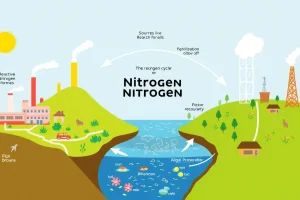
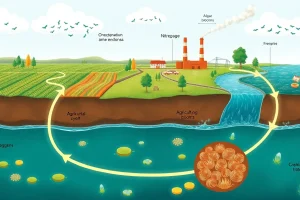
Over the past century, industrial fertilizer production, livestock farming, wastewater, fossil-fuel combustion, and expanding agriculture have dramatically accelerated the movement of reactive nitrogen and phosphorus through the biosphere. Large quantities escape fields into rivers, lakes, groundwater, coastal waters, and the atmosphere, where they contribute to algal blooms, oxygen-depleted “dead zones,” biodiversity loss, air pollution, greenhouse-gas emissions, and declining water quality.
Because these disruptions now operate on a planetary scale, the Planetary Boundaries framework identifies Modification of Biogeochemical Flows as one of Earth’s nine critical life-support processes.
According to the Planetary Health Check 2025, both the nitrogen and phosphorus boundaries remain well beyond their safe operating limits. Human activities intentionally fix about 165 teragrams (million metric tons) of nitrogen each year for agriculture—more than 2.5 times the planetary boundary of 62 Tg N/year. Likewise, mined phosphorus applied to cropland has reached approximately 18.2 Tg P/year, nearly three times the planetary boundary of 6.2 Tg P/year. Both indicators remain in the high-risk zone with worsening trends. (Planetary Health Check)
This is often called the hidden planetary crisis because nutrient pollution is less visible than climate change, yet it affects freshwater, oceans, biodiversity, agriculture, and even climate itself.
Quick Answer
The nitrogen cycle and phosphorus cycle describe how these two essential nutrients move through the atmosphere, soils, water, organisms, and rocks.
Human activities have dramatically accelerated both cycles through:
- Synthetic fertilizer production
- Livestock agriculture
- Fossil-fuel combustion
- Mining of phosphate rock
- Wastewater discharge
- Expansion of cropland
These changes have created one of the most severe planetary-boundary transgressions.
Current Planetary Boundary status:
| Indicator | Planetary Boundary | High-Risk Line | 2025 Value | Status |
|---|---|---|---|---|
| Nitrogen fixation for agriculture | 62 Tg N/year | 82 Tg N/year | 165 Tg N/year | Beyond high-risk |
| Phosphorus applied to cropland | 6.2 Tg P/year | 11.2 Tg P/year | 18.2 Tg P/year | Beyond high-risk |
Excess nutrients contribute to eutrophication, freshwater pollution, marine dead zones, biodiversity loss, nitrous oxide emissions, and declining ecosystem resilience. (Planetary Health Check)
What Are Biogeochemical Cycles?
The word biogeochemical combines three components:
- Bio — living organisms
- Geo — Earth’s rocks, soils, and sediments
- Chemical — movement of elements
Biogeochemical cycles describe how chemical elements move among:
- Atmosphere
- Oceans
- Rivers
- Soils
- Rocks
- Plants
- Animals
- Microorganisms
These cycles continually recycle Earth’s essential building blocks.
Among the most important are:
- Carbon
- Nitrogen
- Phosphorus
- Oxygen
- Water
- Sulfur
Without these cycles, nutrients would quickly become trapped in one part of the Earth system and life could not persist.
Why Nitrogen and Phosphorus Matter
Although they are often discussed together, nitrogen and phosphorus behave differently.
Nitrogen
Nitrogen is a major component of:
- Proteins
- Amino acids
- DNA
- RNA
- Chlorophyll
Earth’s atmosphere is about 78% nitrogen gas (N₂).
However, most organisms cannot use atmospheric nitrogen directly.
It must first be converted into reactive nitrogen through biological or industrial fixation.
Phosphorus
Phosphorus forms part of:
- DNA
- RNA
- ATP (cellular energy)
- Cell membranes
- Bones and teeth
Unlike nitrogen, phosphorus has no significant atmospheric phase.
Instead, it moves primarily through:
- Rocks
- Soils
- Rivers
- Lakes
- Oceans
- Living organisms
Because phosphorus is released mainly by weathering of rocks, it naturally cycles much more slowly than nitrogen.
The Natural Nitrogen Cycle
Before industrialization, nitrogen entered ecosystems mainly through:
Biological nitrogen fixation
Certain bacteria convert atmospheric nitrogen gas into biologically available forms.
These bacteria live:
- In soils
- In freshwater
- In oceans
- In root nodules of legumes
Lightning
Lightning provides a smaller natural source by converting atmospheric nitrogen into reactive compounds.
Decomposition
Microorganisms recycle nitrogen from dead plants and animals.
Denitrification
Other bacteria convert reactive nitrogen back into nitrogen gas, returning it to the atmosphere.
For thousands of years, these natural processes remained approximately balanced.
The Natural Phosphorus Cycle
Phosphorus follows a different pathway.
It begins with:
Rock weathering
Rain, temperature changes, and erosion gradually release phosphate from rocks.
Plants absorb phosphate from soils.
Animals obtain phosphorus by eating plants or other animals.
When organisms die, decomposers return phosphorus to soils.
Some phosphorus eventually enters rivers and oceans.
Over geological timescales, marine sediments become new phosphate-containing rocks.
Unlike nitrogen, this cycle operates slowly because it depends on geological processes.
How Humans Changed the Nitrogen Cycle
The twentieth century fundamentally transformed the nitrogen cycle.
The Haber–Bosch Process
Around the beginning of the twentieth century, scientists developed the Haber–Bosch process, which converts atmospheric nitrogen into ammonia using natural gas, heat, and pressure.
This innovation made synthetic fertilizers widely available and dramatically increased agricultural productivity.
It also greatly increased the amount of reactive nitrogen entering Earth’s ecosystems.
Today, industrial fixation combined with intentional biological fixation for agriculture reaches approximately 165 Tg N/year, compared with the planetary boundary of 62 Tg N/year. (Planetary Health Check)
Fossil-Fuel Combustion
Burning coal, oil, and natural gas produces nitrogen oxides (NOₓ).
These gases contribute to:
- Air pollution
- Smog
- Acid deposition
- Ozone formation
- Nitrogen deposition
Although the current planetary-boundary control variable focuses on agricultural nitrogen fixation, fossil-fuel emissions also modify the nitrogen cycle and are increasingly recognized in updated assessments. (Planetary Health Check)
Livestock Production
Large livestock operations contribute reactive nitrogen through:
- Manure
- Feed production
- Fertilizer use
Nitrogen can then escape into soils, waterways, and the atmosphere.
How Humans Changed the Phosphorus Cycle
Unlike nitrogen, phosphorus cannot be manufactured from atmospheric gases.
Instead, humans mine phosphate rock.
Most mined phosphorus becomes fertilizer.
Current global application to cropland reaches approximately 18.2 Tg P/year, compared with the planetary boundary of 6.2 Tg P/year. (Planetary Health Check)
Unlike nitrogen, phosphorus often accumulates in soils for decades before eventually reaching rivers and lakes.
This “legacy phosphorus” means that even if fertilizer use declines today, water-quality improvements may take years or decades.
Why Nutrient Pollution Happens
Plants never absorb all applied fertilizer.
Some nutrients:
- Wash into rivers
- Enter groundwater
- Blow away as dust
- Escape into the atmosphere
- Accumulate in soils
The result is nutrient pollution.
Modern agriculture therefore experiences two simultaneous problems:
- Too much fertilizer in some regions.
- Too little fertilizer in others.
The planetary challenge is not simply reducing nutrient use—it is using nutrients much more efficiently and equitably. (Planetary Health Check)
Eutrophication: Too Much of a Good Thing
One of the best-known consequences is eutrophication.
This occurs when excess nutrients stimulate rapid algal growth.
The sequence typically follows this pattern:
- Nitrogen and phosphorus enter water.
- Algae multiply rapidly.
- Algae die.
- Bacteria decompose them.
- Oxygen is consumed.
- Fish and aquatic organisms suffocate.
The result may be:
- Fish kills
- Harmful algal blooms
- Toxic drinking water
- Loss of biodiversity
- Coastal dead zones
Dead Zones
Some coastal waters become so depleted of oxygen that many organisms cannot survive.
These dead zones now occur in numerous estuaries and coastal regions around the world.
They result largely from nutrient runoff transported by rivers from agricultural landscapes.
The Planetary Health Check identifies nutrient pollution and oxygen depletion as among the clearest consequences of exceeding the nitrogen and phosphorus planetary boundaries. (Planetary Health Check)
Nitrous Oxide: The Hidden Greenhouse Gas
Nitrogen pollution also affects climate.
Microorganisms convert some reactive nitrogen into nitrous oxide (N₂O).
Nitrous oxide:
- Is a powerful greenhouse gas.
- Remains in the atmosphere for more than a century.
- Contributes to stratospheric ozone depletion.
This creates another important connection between nutrient management and climate mitigation.
Why Nitrogen and Phosphorus Are Planetary Boundaries
The Planetary Boundaries framework does not treat nutrient pollution as merely a local water-quality issue.
Instead, it recognizes that altering global nutrient cycles changes the functioning of the Earth system itself.
Key reasons include:
- Freshwater eutrophication
- Coastal oxygen depletion
- Biodiversity decline
- Greenhouse-gas emissions
- Soil degradation
- Ocean ecosystem disruption
- Reduced ecosystem resilience
Because nutrient cycles connect land, freshwater, oceans, atmosphere, and living organisms, their disruption affects multiple planetary boundaries simultaneously.
Interactions With Other Planetary Boundaries
Freshwater Change
Nutrients travel through rivers and groundwater.
Freshwater disruption influences nutrient transport.
Excess nutrients degrade freshwater ecosystems.
Biosphere Integrity
Algal blooms reduce biodiversity.
Nutrient pollution changes species composition.
Sensitive aquatic organisms often disappear.
Climate Change
Nitrous oxide contributes to warming.
Climate influences rainfall, runoff, and nutrient transport.
Land-System Change
Agricultural expansion increases fertilizer demand.
Deforestation alters nutrient cycling.
Ocean Acidification
Nutrient pollution does not directly cause ocean acidification.
However, both processes affect marine ecosystems simultaneously, increasing ecological stress.
Agriculture: Feeding Humanity Without Overloading the Planet
Modern fertilizers helped transform global agriculture.
Without them, feeding today’s population would be extraordinarily difficult.
The challenge is therefore optimization, not elimination.
Strategies include:
Precision Agriculture
Applying fertilizer:
- At the right time
- In the right place
- In the right quantity
Improved Crop Varieties
Plants with higher nutrient-use efficiency require less fertilizer.
Nutrient Recycling
Recovering phosphorus and nitrogen from:
- Wastewater
- Food waste
- Animal manure
Cover Crops
Cover crops reduce erosion and retain nutrients between growing seasons.
Buffer Strips
Vegetated strips beside waterways reduce nutrient runoff.
Improved Manure Management
Better storage and application reduce nutrient losses.
Reducing Food Waste
Food wasted also wastes the fertilizer used to produce it.
Why This Is a Hidden Crisis
Unlike melting glaciers or wildfires, nutrient pollution often remains invisible.
Reactive nitrogen and dissolved phosphorus cannot usually be seen.
Yet they silently alter:
- Rivers
- Lakes
- Groundwater
- Coastal ecosystems
- Atmospheric chemistry
- Climate
Many effects also occur slowly because nutrients accumulate over decades.
By the time large algal blooms or dead zones appear, the underlying nutrient imbalance may have been developing for years.
Common Misunderstandings
“Nitrogen and phosphorus are pollutants.”
No.
Both are essential nutrients.
Problems arise when they occur in excessive quantities or in the wrong places.
“Only agriculture contributes.”
Agriculture is the largest source, but fossil-fuel combustion, wastewater, and livestock also contribute.
“More fertilizer always means more food.”
Beyond a certain point, additional fertilizer often produces diminishing crop gains while greatly increasing pollution.
“Stopping fertilizer use would solve the problem.”
Global food production depends heavily on fertilizers.
The objective is more efficient nutrient management rather than eliminating their use.
Frequently Asked Questions
What are biogeochemical flows?
Biogeochemical flows describe how essential elements such as nitrogen and phosphorus move through organisms, soils, water, atmosphere, and rocks.
Why are nitrogen and phosphorus important?
Both nutrients are fundamental for DNA, proteins, plant growth, and all living organisms.
Has the planetary boundary been crossed?
Yes. Both nitrogen and phosphorus exceed their safe operating limits by a wide margin and remain in the high-risk zone. (Planetary Health Check)
Why is phosphorus different from nitrogen?
Nitrogen cycles through the atmosphere, while phosphorus primarily cycles through rocks, soils, rivers, and oceans.
What causes dead zones?
Excess nitrogen and phosphorus stimulate algal blooms whose decomposition removes oxygen from the water, creating conditions where many aquatic organisms cannot survive.
Can the nutrient crisis be reversed?
Yes, but recovery often takes time because nitrogen and phosphorus accumulate in soils and sediments. Improved fertilizer efficiency, nutrient recycling, wetland restoration, wastewater treatment, and sustainable agriculture can substantially reduce future pollution. (Planetary Health Check)
Conclusion
Nitrogen and phosphorus are among the most essential elements for life.
They support plant growth, food production, and the biological processes that sustain civilization. Yet humanity has transformed their natural cycles more rapidly and extensively than almost any other biogeochemical process.
The latest Planetary Health Check shows that intentional nitrogen fixation and phosphorus application remain far beyond Earth’s safe operating space, with values of approximately 165 Tg N/year and 18.2 Tg P/year, compared with planetary boundaries of 62 Tg N/year and 6.2 Tg P/year, respectively. These excessive nutrient flows continue to drive freshwater pollution, eutrophication, coastal dead zones, biodiversity loss, and greenhouse-gas emissions. (Planetary Health Check)
Unlike many environmental crises, nutrient pollution is largely invisible. It accumulates quietly in soils, rivers, lakes, and groundwater, often taking years before its consequences become obvious. This makes it easy to overlook, even as it reshapes ecosystems and weakens Earth’s resilience.
The solution is not to abandon modern agriculture. It is to redesign nutrient management so that nitrogen and phosphorus remain where they are needed—in crops rather than waterways. Precision agriculture, nutrient recycling, sustainable fertilizer practices, restored wetlands, improved wastewater treatment, and more efficient food systems can all reduce pressure on this planetary boundary while continuing to support global food security.
Ultimately, protecting the nitrogen and phosphorus cycles means protecting the invisible processes that sustain both the biosphere and human civilization.