In brief
At a glance
Quick Facts
- Primary source
- Agriculture (fertilizers and livestock manure) accounts for the majority of anthropogenic reactive nitrogen.
- Global impact
- Excess nitrogen affects air, water, soil, biodiversity, and climate simultaneously through the nitrogen cascade.
- Key compound
- Nitrous oxide (N₂O) is a greenhouse gas about 300 times more potent than CO₂ and depletes the ozone layer.
- Water pollution
- Nitrate contamination of groundwater is a widespread drinking water threat, especially in agricultural regions.
- Air pollution
- Nitrogen oxides contribute to smog and fine particulate matter, linked to respiratory and cardiovascular diseases.
- Ecosystem effect
- Eutrophication from nitrogen runoff creates coastal dead zones where oxygen levels are too low for most marine life.
- Historical trend
- Human activities have roughly doubled the global rate of reactive nitrogen creation since pre-industrial times.
- Economic cost
- Nitrogen pollution imposes significant costs through health impacts, environmental cleanup, and lost agricultural productivity.
Key Takeaways
- Nitrogen pollution is the overabundance of reactive nitrogen compounds in the environment, largely from human activities like agriculture and fossil fuel burning.
- It triggers a cascade of ecological problems, including eutrophication, acidification, and biodiversity loss, while also harming human health through air and water contamination.
- Reactive nitrogen contributes to climate change by forming nitrous oxide, a potent greenhouse gas, and by altering atmospheric chemistry.
- Addressing nitrogen pollution requires integrated management across sectors, including improved agricultural practices, emission controls, and wastewater treatment.
What Is Nitrogen Pollution Explained?
Nitrogen pollution refers to the accumulation of reactive nitrogen compounds in the environment at levels that cause adverse effects. While nitrogen gas (N₂) makes up 78% of the atmosphere and is chemically inert, human activities convert it into reactive forms—such as ammonia (NH₃), nitrogen oxides (NOₓ), nitrous oxide (N₂O), and nitrate (NO₃⁻)—at rates far exceeding natural processes. These reactive nitrogen species cascade through air, water, and soil, triggering a chain of environmental and health problems. The concept is often framed as the “nitrogen cascade,” where a single molecule of reactive nitrogen can sequentially cause multiple impacts, from smog formation to groundwater contamination to climate change.
Nitrogen pollution has intensified dramatically since the mid-20th century, driven by the widespread use of synthetic fertilizers, the expansion of intensive livestock farming, and the combustion of fossil fuels. Unlike carbon dioxide, which has a single dominant environmental consequence (global warming), nitrogen pollution manifests in many interconnected ways, making it a complex and persistent challenge. It is a primary driver of biodiversity loss, water quality degradation, and air pollution, yet it remains less recognized by the public than issues like climate change or plastic waste. Understanding nitrogen pollution is essential for achieving sustainable development and protecting planetary health.
Overview
Nitrogen is an essential element for life, a building block of proteins and DNA. In its inert atmospheric form (N₂), it is abundant but unavailable to most organisms. Natural processes such as lightning and biological nitrogen fixation by certain bacteria and legumes convert N₂ into reactive forms that plants can use. However, human activities have roughly doubled the global rate of reactive nitrogen creation since pre-industrial times, overwhelming the capacity of ecosystems to process it safely. This excess reactive nitrogen accumulates in the environment, where it causes a wide range of problems.
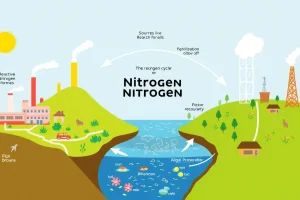
The nitrogen cycle describes how nitrogen moves through the atmosphere, soil, water, and living organisms. Human intervention has drastically altered this cycle by introducing large quantities of reactive nitrogen through the Haber-Bosch process (used to produce synthetic fertilizers), the cultivation of nitrogen-fixing crops, and the burning of fossil fuels. Once released, reactive nitrogen can travel long distances through air and water, affecting regions far from its source. The result is a global problem with local, regional, and planetary consequences.
How It Works
Nitrogen pollution operates through a series of transformations and movements of reactive nitrogen species in the environment. The key processes include:
- Fixation: Industrial processes (fertilizer production) and combustion convert inert N₂ into reactive forms like ammonia (NH₃) and nitrogen oxides (NOₓ).
- Emission and deposition: These reactive compounds are released into the air from agricultural fields, livestock operations, vehicles, and power plants. They can travel long distances before being deposited onto land or water surfaces through rain or dry deposition.
- Eutrophication: When nitrogen compounds enter water bodies, they act as nutrients, fueling excessive growth of algae and aquatic plants. This leads to oxygen depletion, fish kills, and loss of biodiversity.
- Acidification: Deposition of nitrogen compounds can acidify soils and freshwater ecosystems, leaching essential nutrients and mobilizing toxic metals like aluminum.
- Greenhouse gas formation: Nitrous oxide (N₂O) is a potent greenhouse gas with a global warming potential about 300 times that of carbon dioxide. It is produced during nitrification and denitrification processes in soils and water.
- Groundwater contamination: Nitrate (NO₃⁻) leaches into groundwater, posing health risks when consumed in drinking water, particularly for infants (methemoglobinemia, or “blue baby syndrome”).
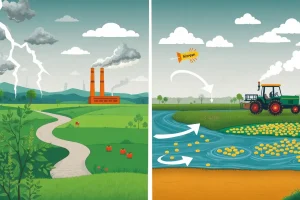
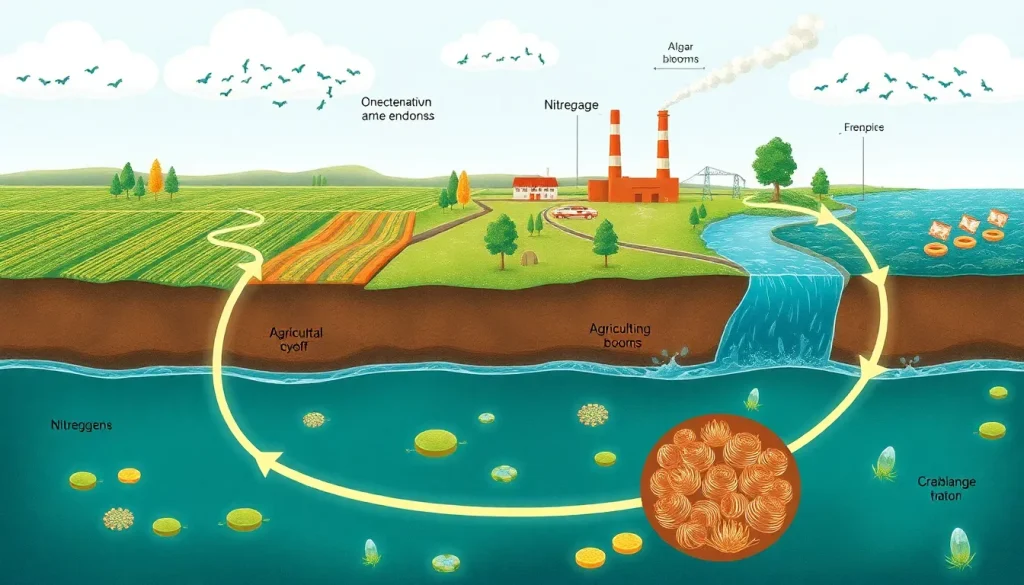
The nitrogen cascade means that a single molecule of reactive nitrogen can cause a sequence of environmental impacts. For example, ammonia emitted from a farm can be deposited downwind, causing eutrophication in a lake, then be converted to nitrate and leach into groundwater, and eventually be denitrified to N₂O, contributing to climate change and stratospheric ozone depletion.
Main Causes or Drivers
The primary sources of nitrogen pollution are human activities that introduce reactive nitrogen into the environment at rates faster than natural systems can absorb. The main drivers include:
- Agriculture: The largest contributor globally. Synthetic fertilizers and manure applied to croplands release ammonia and nitrate. Livestock operations generate large amounts of ammonia from animal waste. Nitrogen-fixing crops (e.g., soybeans, alfalfa) also add reactive nitrogen to soils.
- Fossil fuel combustion: Power plants, vehicles, and industrial processes emit nitrogen oxides (NOₓ) into the atmosphere, contributing to smog, acid rain, and particulate matter formation.
- Wastewater and sewage: Untreated or inadequately treated human waste releases nitrogen compounds into waterways, especially in areas without advanced wastewater treatment plants.
- Industrial processes: Production of chemicals, textiles, and other goods can release reactive nitrogen as byproducts.
- Biomass burning: Forest fires and agricultural burning release nitrogen oxides and other reactive nitrogen species.
While natural sources (lightning, biological fixation) also produce reactive nitrogen, the scale of human-driven inputs has overwhelmed the natural balance, leading to widespread pollution.
Environmental and Human Impacts
Nitrogen pollution has far-reaching consequences for ecosystems and human well-being. Key impacts include:
- Water quality degradation: Eutrophication creates “dead zones” in coastal areas and lakes, where oxygen levels are too low to support most marine life. Nitrate contamination of groundwater threatens drinking water supplies.
- Air pollution: Nitrogen oxides contribute to the formation of ground-level ozone (smog) and fine particulate matter (PM₂.₅), which are linked to respiratory diseases, cardiovascular problems, and premature death. Ammonia emissions also form secondary particulate matter.
- Climate change: Nitrous oxide is a long-lived greenhouse gas that also depletes the stratospheric ozone layer. Nitrogen deposition can alter carbon storage in ecosystems, sometimes increasing carbon sequestration but often reducing it in nitrogen-saturated systems.
- Biodiversity loss: Excess nitrogen favors fast-growing, nitrogen-loving plant species, which outcompete native species adapted to low-nitrogen conditions. This leads to declines in plant diversity and the animals that depend on them. In aquatic systems, eutrophication harms fish and other organisms.
- Soil acidification: Nitrogen deposition acidifies soils, leaching essential nutrients like calcium and magnesium and releasing toxic aluminum, which damages plant roots and reduces forest health.
- Human health: Beyond respiratory issues from air pollution, high nitrate levels in drinking water can cause methemoglobinemia in infants and have been linked to certain cancers and thyroid disorders. Algal blooms can produce toxins that contaminate drinking water and recreational waters.
Why It Matters
Nitrogen pollution is a critical environmental issue because it intersects with nearly every major global challenge: food security, climate change, biodiversity loss, water scarcity, and public health. The Haber-Bosch process, which enables the synthesis of nitrogen fertilizers, is credited with supporting roughly half of the world’s population, yet the inefficiency of nitrogen use means that a large fraction of applied fertilizer is lost to the environment. This inefficiency represents not only an environmental threat but also an economic waste and a missed opportunity to improve agricultural productivity.
Addressing nitrogen pollution is essential for achieving the United Nations Sustainable Development Goals (SDGs), particularly those related to clean water, climate action, life below water, and life on land. Because reactive nitrogen moves across boundaries, it requires international cooperation and integrated policies that consider the full nitrogen cycle. Failure to manage nitrogen pollution will undermine progress in many other areas, from mitigating climate change to ensuring safe drinking water.
Solutions
Reducing nitrogen pollution requires a combination of technological, policy, and behavioral changes across multiple sectors. Key solutions include:
- Improving nitrogen use efficiency in agriculture: Precision farming techniques, such as variable-rate fertilizer application, use of slow-release fertilizers, and better timing of applications, can reduce nitrogen losses. Incorporating nitrification inhibitors can slow the conversion of ammonium to nitrate, reducing leaching and N₂O emissions.
- Managing livestock waste: Improved manure storage, treatment, and application methods can minimize ammonia emissions. Anaerobic digesters can capture methane and reduce nitrogen losses.
- Reducing fossil fuel combustion: Transitioning to renewable energy sources, improving vehicle emission standards, and promoting public transportation can lower NOₓ emissions.
- Upgrading wastewater treatment: Advanced treatment technologies, such as biological nutrient removal, can significantly reduce nitrogen discharges from sewage plants.
- Restoring ecosystems: Wetlands, riparian buffers, and constructed wetlands can intercept and remove nitrogen from agricultural runoff before it reaches waterways.
- Dietary shifts: Reducing consumption of animal products, particularly from intensive livestock systems, can lower the demand for nitrogen-intensive feed crops and reduce manure-related emissions.
- Policy and regulation: Setting limits on nitrogen emissions, establishing nutrient management plans, and creating economic incentives (e.g., nitrogen taxes or tradable permits) can drive systemic change. International agreements, such as those targeting transboundary air pollution, have shown success in reducing nitrogen deposition.
- Public awareness and education: Increasing understanding of nitrogen pollution can encourage individual actions, such as reducing fertilizer use in gardens, supporting sustainable food choices, and advocating for stronger environmental policies.
No single solution is sufficient; an integrated approach that addresses the entire nitrogen cycle is necessary to mitigate the multiple impacts of nitrogen pollution effectively.
FAQ
What is nitrogen pollution?
Nitrogen pollution is the excessive release of reactive nitrogen compounds—such as ammonia, nitrogen oxides, and nitrate—into the environment from human activities like agriculture, industry, and transportation. It causes a cascade of harmful effects on ecosystems, human health, and the climate.
How does nitrogen pollution affect human health?
Nitrogen pollution harms human health primarily through air and water contamination. Nitrogen oxides and ammonia contribute to fine particulate matter and ground-level ozone, which can cause respiratory and cardiovascular diseases. High nitrate levels in drinking water can lead to methemoglobinemia (blue baby syndrome) and have been linked to certain cancers.
What can be done to reduce nitrogen pollution?
Solutions include improving nitrogen use efficiency in agriculture, managing livestock waste, reducing fossil fuel combustion, upgrading wastewater treatment, restoring wetlands, shifting diets toward less nitrogen-intensive foods, and implementing policies that limit nitrogen emissions and promote sustainable practices.
References
- United Nations Environment Programme (UNEP). (2019). Frontiers 2018/19: Emerging Issues of Environmental Concern. Chapter on Nitrogen: Strategies for resolving an urgent environmental problem.
- Galloway, J. N., et al. (2003). The Nitrogen Cascade. BioScience, 53(4), 341–356.
- Sutton, M. A., et al. (2011). The European Nitrogen Assessment. Cambridge University Press.
- Intergovernmental Panel on Climate Change (IPCC). (2021). Climate Change 2021: The Physical Science Basis. Contribution of Working Group I to the Sixth Assessment Report.
- U.S. Environmental Protection Agency. Nutrient Pollution: The Problem. https://www.epa.gov/nutrientpollution/problem