In brief
At a glance
Quick Facts
- Verdict
- Promising
- Problem addressed
- Climate change, biodiversity loss, land degradation
- Evidence strength
- Moderate
- Potential scale
- Global
- Relative cost
- Moderate
- Time to impact
- Years to Decades
Quick verdict
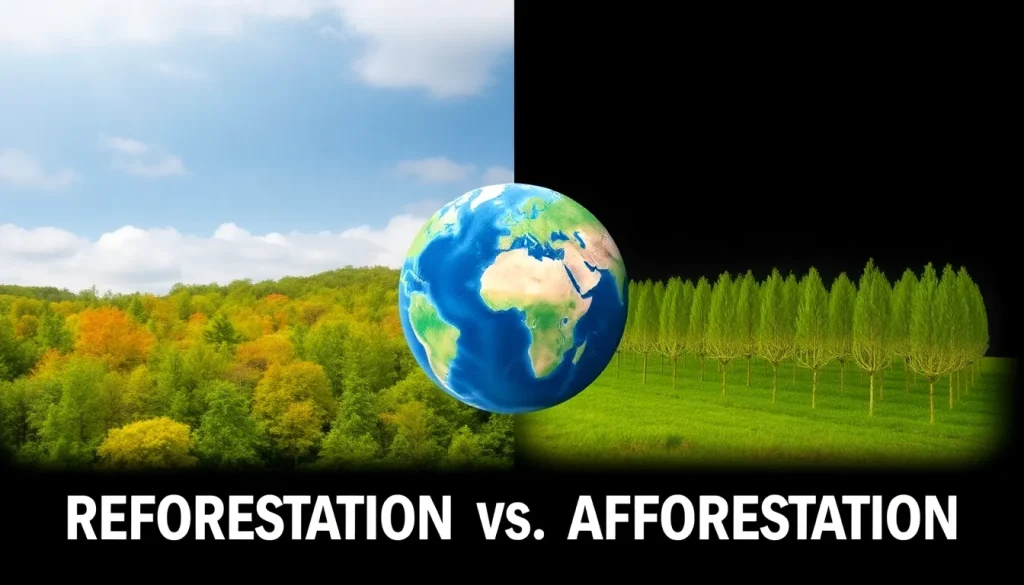
Reforestation and afforestation are both widely promoted nature-based solutions for carbon removal, biodiversity conservation, and land restoration. Reforestation—replanting trees in recently deforested areas—generally offers faster ecological recovery and lower risks of unintended harm, while afforestation—planting trees in historically unforested landscapes—can sequester additional carbon but often involves trade-offs with native grasslands, water resources, and local livelihoods. The evidence base is moderate to strong for reforestation, more mixed for afforestation. Both are promising when implemented with native species, community involvement, and careful site selection, but neither is a substitute for reducing fossil fuel emissions.
Problem addressed
Both practices aim to mitigate climate change by increasing carbon storage in biomass and soils, reverse biodiversity loss by restoring habitat, and combat land degradation. Deforestation and land-use change contribute roughly 10–15% of global greenhouse gas emissions, and forest loss continues at alarming rates, particularly in the tropics. Reforestation directly addresses the legacy of past deforestation, while afforestation seeks to expand forest cover beyond its historical extent, often on marginal agricultural or degraded lands. The problem is urgent: the world has lost about a third of its forest area since the last ice age, and current pledges to halt deforestation and restore forests are insufficient to meet climate targets.
How the solution works
Both reforestation and afforestation involve establishing trees on land. Reforestation typically occurs on sites that were forested within the past 50 years (definitions vary) and may involve natural regeneration—allowing forests to regrow spontaneously—or active planting. Afforestation plants trees on land that has not been forested for at least 50 years, or historically was not forest, such as grasslands, savannas, or peatlands. Trees absorb CO₂ through photosynthesis, storing carbon in trunks, branches, roots, and soil. Over decades to centuries, a mature forest can store significant carbon. Additionally, forests influence local climate, water cycles, and provide habitat. The choice of species, density, and management determines the rate of carbon uptake and the ecosystem services provided.
Evidence strength
The evidence for reforestation is robust: numerous studies document carbon accumulation rates in naturally regenerating and planted forests, with tropical reforestation sequestering on average 4–10 tonnes of CO₂ per hectare per year in early decades, though rates vary widely. Long-term field experiments and satellite data confirm that reforestation can restore biodiversity and soil health. For afforestation, evidence is more mixed. While some afforestation projects have successfully established forests and sequestered carbon, others have failed due to poor species selection, water limitations, or social opposition. The global potential for afforestation is often overstated; a widely cited 2019 study (Bastin et al.) claimed 0.9 billion hectares available for tree planting, but subsequent critiques highlighted that this included grasslands and savannas where tree planting would harm biodiversity and reduce water yield. The scientific consensus now emphasizes that afforestation must be carefully targeted to avoid negative impacts.
Potential scale
The theoretical global potential for reforestation is estimated at 200–500 million hectares, mostly in tropical and subtropical regions, which could sequester 1–3 gigatonnes of CO₂ per year by mid-century. Afforestation potential is more uncertain, with estimates ranging from 100 million to over 1 billion hectares, but realistic, ecologically sound potential is likely at the lower end. Both practices face constraints: land availability, competition with agriculture, water scarcity, and the need to protect existing ecosystems. Scaling up requires supportive policies, secure land tenure, and massive investment. Even at maximum plausible scale, reforestation and afforestation can only offset a fraction of current emissions, underscoring the need for emission reductions.
Cost considerations
Costs vary enormously by region, method, and scale. Reforestation via natural regeneration can be as low as $0–$100 per hectare, while active tree planting ranges from $500 to $5,000 per hectare, with ongoing maintenance costs. Afforestation on degraded land may be cheaper if land is marginal, but site preparation and irrigation can raise costs. Carbon sequestration costs are estimated at $5–$50 per tonne of CO₂ for reforestation, and $10–$100+ for afforestation, depending on location. These are generally lower than many technological carbon removal methods, but higher than some avoided deforestation credits. However, cost-effectiveness must account for permanence risks (fire, disease, reversal) and co-benefits.
Implementation time
Reforestation can begin to sequester carbon within a few years, with significant accumulation over 20–50 years. Natural regeneration may take longer to establish but can be initiated quickly by removing disturbances. Afforestation often requires longer planning, site preparation, and may take decades to reach carbon parity with natural forests. Policy and funding cycles are often shorter than the decades needed for forests to mature, creating a mismatch. Rapid deployment is possible with strong political will, as seen in national tree-planting campaigns, but quality and survival rates often suffer when rushed.
Environmental benefits
Beyond carbon storage, forests provide habitat for biodiversity, regulate water flows, prevent soil erosion, and enhance nutrient cycling. Reforestation of degraded lands can restore connectivity between forest fragments, aiding species migration. Afforestation can create new habitats but may also displace native grassland or shrubland species. Both can improve air quality and moderate local temperatures. Quantified benefits: a hectare of tropical forest can store 100–300 tonnes of carbon above ground, support hundreds of species, and reduce runoff by 30–50% compared to bare soil.
Social and economic co-benefits
Forest restoration can provide timber, fuelwood, non-timber forest products, and jobs in planting and management. Community-based reforestation projects have improved livelihoods and strengthened land rights. Afforestation can create economic opportunities on degraded land, but may also lead to land grabbing or displacement of local communities if not equitably governed. Ecotourism and payment for ecosystem services schemes can generate revenue. Health benefits include reduced heat stress and cleaner water.
Risks and unintended consequences
Poorly planned reforestation can result in monocultures that are vulnerable to pests and fire, and may not deliver expected carbon or biodiversity benefits. Afforestation in water-limited regions can reduce streamflow and groundwater recharge, exacerbating water scarcity. Planting non-native species can become invasive. Large-scale afforestation on grasslands or savannas threatens unique biodiversity and pastoral livelihoods. There is also a risk of ‘carbon colonialism’ where wealthy nations or corporations acquire land in developing countries for carbon credits, displacing local people. Additionally, forests can darken the land surface (albedo effect), especially in boreal regions, potentially offsetting some cooling benefits.
Where it works best
Reforestation is most effective in humid tropical and subtropical regions with high growth rates, on degraded lands adjacent to existing forests, and where natural regeneration is possible. Afforestation can be suitable on abandoned agricultural land with low biodiversity value, in areas with sufficient rainfall, and where it does not compete with food production. Both work best when integrated with local community needs, using native species mixtures, and with long-term monitoring and adaptive management.
Where it may not work
Reforestation is challenging in arid or semi-arid zones without irrigation, on severely eroded soils, or where deforestation pressures persist. Afforestation is generally inappropriate in native grasslands, savannas, peatlands, and wetlands, where it can cause net environmental harm. High-altitude or boreal afforestation may have negligible or negative climate impact due to albedo changes. Areas with insecure land tenure or weak governance are prone to project failure.
Comparison with alternatives
Compared to avoided deforestation (REDD+), reforestation and afforestation actively increase carbon stocks rather than just protecting existing ones. They are more scalable than bioenergy with carbon capture and storage (BECCS) or direct air capture, but less permanent if forests are later cleared. Natural regeneration is often cheaper and more biodiverse than plantations. Agroforestry integrates trees into agricultural landscapes, offering a middle ground. Ultimately, a portfolio of natural climate solutions, including forest protection, restoration, and improved land management, is needed.
Case studies
1. Costa Rica: Reforestation through payments for ecosystem services and natural regeneration has doubled forest cover from 26% in 1983 to over 50% today, with significant biodiversity recovery and carbon sequestration. 2. China’s Grain for Green program: One of the largest afforestation/reforestation efforts, converting cropland on steep slopes to forest, reduced soil erosion and increased carbon stocks, but with mixed biodiversity outcomes and water trade-offs in dry regions. 3. The Great Green Wall in Africa: An ambitious afforestation/reforestation initiative across the Sahel, aiming to restore 100 million hectares by 2030. Progress has been slow, with many tree plantings failing due to drought and poor maintenance, but some community-led regreening successes using native species and water harvesting. 4. Scotland: Afforestation with non-native conifers increased forest cover but damaged peatlands and reduced biodiversity; recent policy shifts favor native woodland restoration. 5. Brazil’s Atlantic Forest Restoration Pact: A multi-stakeholder effort to restore 15 million hectares by 2050, using a mix of natural regeneration and planting, with documented carbon and biodiversity gains.
Final assessment
Reforestation and afforestation are essential components of climate and biodiversity strategies, but they are not silver bullets. Reforestation, especially through natural regeneration, offers a low-risk, high-benefit approach in areas that were recently forested. Afforestation can contribute on degraded lands with low conservation value, but must be carefully sited to avoid perverse outcomes. The success of both depends on local context, community engagement, and long-term commitment. They should be pursued alongside aggressive emission cuts and protection of existing forests. When done right, they can deliver substantial environmental and social returns; when done poorly, they can cause more harm than good.
FAQ
What is the difference between reforestation and afforestation?
Reforestation is the replanting of trees in areas that were recently forested but have been cleared or degraded, while afforestation involves planting trees in areas that have not been forested for a long time or historically were not forest, such as grasslands or abandoned agricultural land. The key distinction is the land's history.
Which is better for climate change mitigation?
Both can sequester carbon, but reforestation generally has a stronger evidence base and fewer ecological risks. Afforestation can add new carbon sinks but may cause unintended harm if done on native grasslands or peatlands. The best approach depends on local conditions; often, a mix of both, along with forest protection, is most effective.
Can tree planting alone solve climate change?
No. Even at maximum plausible scale, reforestation and afforestation can only offset a fraction of current global emissions. They are important complementary measures but must be paired with rapid and deep cuts in fossil fuel use and protection of existing forests to meet climate goals.
References
- IPCC, 2019: Climate Change and Land: an IPCC special report on climate change, desertification, land degradation, sustainable land management, food security, and greenhouse gas fluxes in terrestrial ecosystems.
- FAO, 2020: Global Forest Resources Assessment 2020.
- Griscom, B.W., et al., 2017: Natural climate solutions. Proceedings of the National Academy of Sciences, 114(44), 11645-11650.
- Lewis, S.L., et al., 2019: Restoring natural forests is the best way to remove atmospheric carbon. Nature, 568, 25-28.
- Bastin, J.-F., et al., 2019: The global tree restoration potential. Science, 365(6448), 76-79.