In brief
At a glance
Quick Facts
- Definition
- Extreme event attribution quantifies the influence of climate change on the probability or intensity of a specific weather event.
- First attribution study
- The 2004 study of the 2003 European heatwave was the first to attribute a specific extreme event to human-caused climate change.
- Key method
- Scientists compare climate model simulations of the actual world with a 'world that might have been' without human emissions.
- Rapid attribution
- Some attribution analyses are now completed within days of an event, thanks to pre-computed model ensembles.
- Heatwaves
- Heatwaves are the most confidently attributed type of extreme event, with climate change often making them many times more likely.
- Heavy rainfall
- Global warming increases the atmosphere's water-holding capacity, leading to more intense rainfall in many regions.
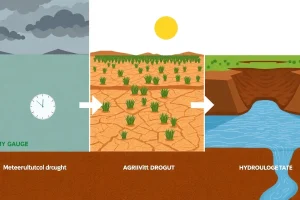
- Drought
- Attribution of drought is more complex due to multiple factors, but climate change has increased drought risk in some areas.
- Tropical cyclones
- While the overall number of tropical cyclones may not increase, climate change is expected to increase the intensity and rainfall of the strongest storms.
- Fraction of Attributable Risk (FAR)
- FAR is the proportion of the risk of an event that can be attributed to human influence.
- Uncertainty
- Attribution statements always include a level of confidence, reflecting the robustness of the evidence and model agreement.
Key Takeaways
- Extreme event attribution is a scientific method that quantifies how human-induced climate change affects the probability and severity of specific weather events.
- It relies on comparing the actual world with a hypothetical world without human greenhouse gas emissions, using climate models and historical data.
- Attribution studies can now be conducted rapidly, sometimes within days of an event, providing near-real-time insights into climate change’s role.
- Understanding attribution helps communities, policymakers, and industries make informed decisions about adaptation and risk management.
What Is How Scientists Attribute Extreme Weather to Climate Change?
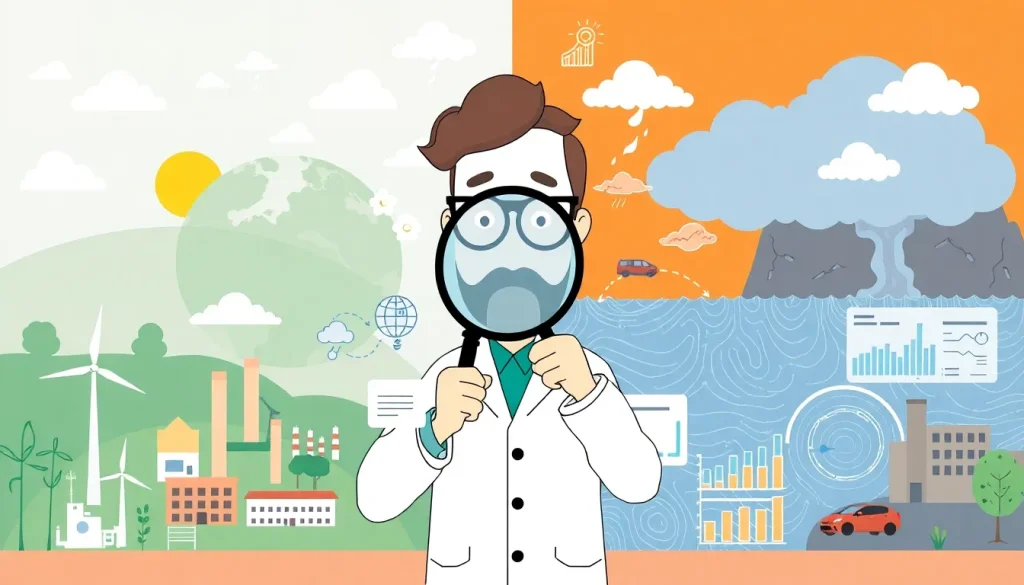
Extreme weather attribution is the science of determining the extent to which human-caused climate change altered the likelihood or intensity of a specific extreme weather event. It answers the question: “Did climate change make this event more likely or more severe?” This field emerged from the need to move beyond general statements that climate change “loads the dice” toward more extreme weather, to providing quantitative assessments for individual events. By isolating the human fingerprint on extreme weather, attribution science bridges the gap between long-term climate projections and the immediate impacts people experience.
The process uses a framework of detection and attribution. Detection demonstrates that an observed change in climate or weather extremes is statistically unusual and cannot be explained by natural variability alone. Attribution then identifies the most likely causes of that change, including greenhouse gas emissions, aerosols, land-use change, and natural factors. For single extreme events, scientists typically apply one of two complementary approaches: the probabilistic approach, which calculates how the probability of an event has changed under human influence, and the storyline approach, which examines how specific physical drivers (such as higher sea surface temperatures) contributed to the event’s magnitude. The result is a statement like “climate change made this heatwave at least twice as likely” or “human influence increased the rainfall intensity by 15%.”
How It Works
Attribution studies follow a structured methodology that combines observations, models, and statistical analysis. The core idea is to compare the world as it is today with a counterfactual world—a “world that might have been” without human emissions of greenhouse gases and aerosols. This is achieved through climate model simulations. The steps typically include:
- Event definition: Scientists first define the extreme event in terms of its key meteorological characteristics, such as maximum temperature, duration, or rainfall amount over a specific region and time period.
- Observational analysis: Historical weather data are used to determine how rare the event was in the current climate, often expressed as a return period (e.g., a 1-in-100-year event).
- Model simulations: Two sets of climate model experiments are run: one representing the actual world with all human and natural forcings, and another representing a world without human influence (only natural forcings like solar variability and volcanic eruptions). Large ensembles of simulations are used to capture the range of possible weather outcomes.
- Probability comparison: The frequency of the defined event in the two sets of simulations is compared. The change in probability is often expressed as a risk ratio (e.g., the event is three times more likely in the current climate).
- Intensity analysis: In some cases, scientists also assess how much more intense the event was due to climate change, by comparing the magnitude of the event in the two worlds.
- Confidence assessment: Results are evaluated against multiple lines of evidence, including physical understanding and the robustness of model results, to assign a confidence level to the attribution statement.
A key metric is the Fraction of Attributable Risk (FAR), which represents the proportion of the risk of an event that can be attributed to human influence. For example, a FAR of 0.8 means that 80% of the risk of that event occurring is due to human-caused climate change. Rapid attribution studies use pre-computed model ensembles to deliver results within days, while more comprehensive analyses may take months.
History
The field of extreme event attribution began in the early 2000s, driven by the question of whether individual extreme events could be linked to human-induced climate change. The landmark study was published in 2004 by Peter Stott, Dáithí Stone, and Myles Allen, analyzing the 2003 European heatwave that caused tens of thousands of deaths. They concluded that human influence had at least doubled the risk of such a heatwave. This study demonstrated that attribution was scientifically feasible and opened a new research frontier.
In the following years, methodologies matured and the number of attribution studies grew. Early efforts often took months or years to complete, limiting their relevance for public discourse. The development of pre-computed climate model ensembles and standardized protocols enabled faster analysis. In 2014, the World Weather Attribution (WWA) initiative was founded to provide rapid, scientifically rigorous attribution assessments of extreme events around the world. By the late 2010s, attribution science had become an established part of climate services, with results regularly cited in media and policy discussions. The Intergovernmental Panel on Climate Change (IPCC) now includes attribution of extreme events as a key component of its assessments, reflecting the growing confidence in the science.
What the Evidence Shows
Attribution studies have been conducted for a wide range of extreme weather events, and the evidence reveals clear patterns. The most robust findings are for heatwaves, where human influence is often the dominant factor. For example, the 2010 Russian heatwave and the 2019–2020 Australian bushfire season were both made significantly more likely by climate change. Heavy rainfall events are also increasingly attributed, as a warmer atmosphere holds more moisture, leading to more intense downpours. Studies of Hurricane Harvey (2017) found that climate change increased the total rainfall by about 15–20%.
Drought attribution is more complex because it involves not only precipitation deficits but also temperature-driven evaporation and human water management. Nevertheless, climate change has been found to increase drought risk in regions such as the Mediterranean and southwestern North America. For tropical cyclones, the overall number of storms may not change, but the proportion of intense storms (Category 4 and 5) is expected to increase, and storm surge impacts are worsened by sea-level rise. Attribution of cold extremes, by contrast, often shows that climate change has made such events less likely. The evidence base continues to expand, with hundreds of events now studied, and a growing number of rapid attribution analyses providing near-real-time insights.
Importance and Impact
Extreme weather attribution has profound implications for society. It transforms the abstract concept of climate change into concrete, local impacts, helping people understand that global warming is not a distant threat but a present reality affecting their lives. This can increase public engagement and support for climate action. For policymakers, attribution provides evidence to justify investments in adaptation and resilience, such as upgrading infrastructure to withstand more intense floods or heatwaves.
Attribution also plays a role in legal and financial contexts. It is increasingly used in climate litigation to establish causal links between emissions and damages, and in discussions of loss and damage under the United Nations Framework Convention on Climate Change. Insurance and reinsurance industries use attribution science to better assess changing risks and set premiums. By quantifying the human contribution to extreme events, attribution helps allocate responsibility and resources for recovery and prevention, making it a critical tool for managing climate risk.
Common Misconceptions
Several misconceptions surround extreme event attribution. One is that attribution means climate change “caused” the event. In reality, attribution quantifies how climate change altered the probability or intensity; the event would still be possible in a natural climate, but often much less likely. Another misconception is that every extreme event can be attributed to climate change. Some events are within the range of natural variability, and for others, data or models may be insufficient to make a confident statement. Attribution is not a binary yes/no answer but a probabilistic assessment.
Some people confuse attribution with weather forecasting. Attribution is a post-event analysis, not a prediction. It uses models to simulate the climate, not to forecast a specific day’s weather. Additionally, there is a misconception that models are too uncertain to be trusted. While models have limitations, they are based on well-understood physics and have been extensively validated. For large-scale thermodynamic changes, such as warming temperatures and increased atmospheric moisture, model results are highly robust. Attribution studies always communicate the level of uncertainty, and confidence is higher for some event types than others.
Data Limitations and Uncertainties
Attribution science faces several challenges. Observational data are sparse or of short duration in many parts of the world, particularly in developing countries, making it difficult to establish the rarity of an event or to validate models. Climate models, while powerful, have limitations in representing small-scale processes like convection, which are critical for thunderstorms and local flash floods. The chaotic nature of the atmosphere also introduces inherent uncertainty, especially for rare and unprecedented events.
Uncertainties arise from the choice of event definition, the models used, and the statistical methods applied. For compound events—where multiple hazards occur simultaneously, such as a heatwave and drought—attribution is particularly challenging. Despite these limitations, scientists quantify and communicate uncertainties transparently, often using multiple models and methods to test the robustness of results. The field continues to advance with improved models, higher-resolution data, and better statistical techniques, steadily increasing the reliability and scope of attribution statements.
FAQ
What is extreme weather attribution?
Extreme weather attribution is the science of determining how human-caused climate change influenced the likelihood or severity of a specific extreme weather event, such as a heatwave, flood, or drought.
How do scientists determine if climate change made an event worse?
They use climate models to simulate the event in the current climate and in a hypothetical climate without human greenhouse gas emissions. By comparing the frequency and intensity of the event in both worlds, they can estimate the change in risk.
Can all extreme weather events be linked to climate change?
No. Some events are within the range of natural variability, and for others, data or models may be insufficient to make a confident attribution. Attribution is a probabilistic assessment, not a simple yes/no answer.
References
- National Academies of Sciences, Engineering, and Medicine. 2016. Attribution of Extreme Weather Events in the Context of Climate Change. Washington, DC: The National Academies Press.
- Intergovernmental Panel on Climate Change (IPCC). 2021. Climate Change 2021: The Physical Science Basis. Contribution of Working Group I to the Sixth Assessment Report.
- World Weather Attribution (WWA) initiative. https://www.worldweatherattribution.org/