In brief
At a glance
Quick Facts
- Meteorological drought definition
- A period of substantially below-average precipitation for a region and season.
- Agricultural drought definition
- A deficit in soil moisture that affects crop growth and yield.
- Hydrological drought definition
- Below-normal levels of streamflow, reservoir storage, and groundwater.
- Typical onset lag
- Agricultural drought can follow meteorological drought within weeks; hydrological drought often lags by months.
- Key monitoring indices
- Standardized Precipitation Index (SPI), Palmer Drought Severity Index (PDSI), Standardized Soil Moisture Index (SSI).
- Flash drought
- Rapid intensification of agricultural drought due to high temperatures and low humidity, sometimes in days to weeks.
- Recovery time
- Hydrological drought can persist for years after rainfall returns to normal, especially for groundwater.
- Human influence
- Excessive water extraction and land-use change can induce or worsen agricultural and hydrological drought.
Key Takeaways
- Meteorological drought is defined by a prolonged period of below-average precipitation and is the first stage of drought.
- Agricultural drought occurs when soil moisture is insufficient to meet crop water demands, linking climate to food production.
- Hydrological drought manifests as reduced streamflow, reservoir levels, and groundwater, often lagging behind meteorological drought by months or years.
- The interconnected nature of these droughts means that early meteorological deficits can cascade into severe agricultural and hydrological droughts with long-lasting socioeconomic consequences.
What Is Meteorological, Agricultural and Hydrological Drought?
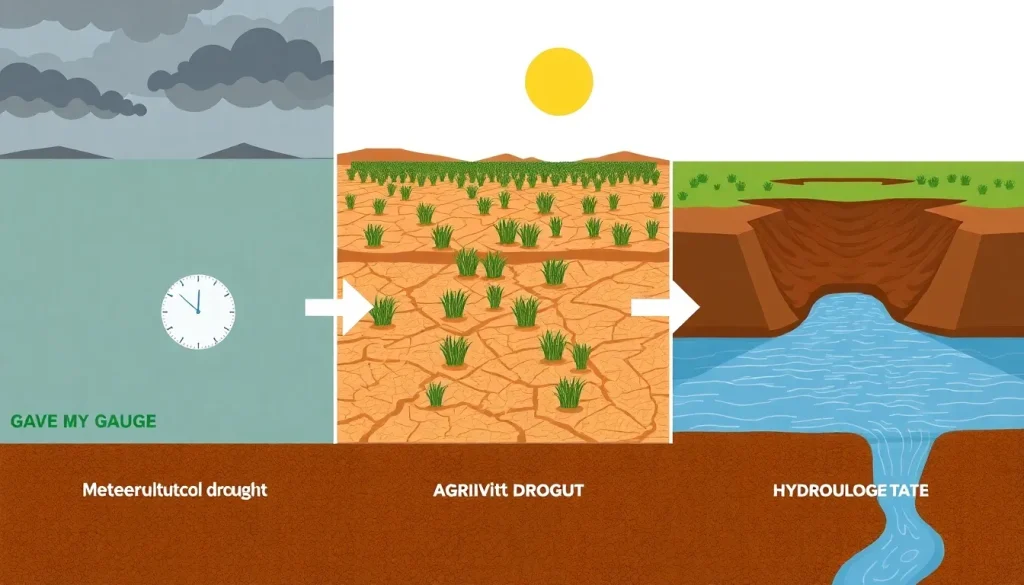
Meteorological, agricultural, and hydrological drought are three distinct but interconnected categories of drought, each defined by the part of the water cycle where the deficit occurs. Meteorological drought is the simplest: it is a period of substantially below-average precipitation for a given region and time of year. Agricultural drought, on the other hand, focuses on the soil moisture available to plants and crops, linking the precipitation deficit to its impact on agriculture. Hydrological drought refers to deficiencies in surface and subsurface water supplies, such as streamflow, reservoir levels, and groundwater, and typically develops more slowly as the deficit propagates through the hydrological system.
These categories are not merely academic; they reflect a sequence of drought impacts that unfold over time. A region may first experience a meteorological drought due to lack of rain, which, if it persists, reduces soil moisture and triggers an agricultural drought. Continued dryness then depletes rivers, lakes, and aquifers, leading to a hydrological drought. Understanding these types helps water managers, farmers, and policymakers anticipate and mitigate the cascading effects of water scarcity.
How It Works
The progression from meteorological to agricultural to hydrological drought follows the movement of water through the environment. Meteorological drought begins with a significant negative anomaly in precipitation—often defined as a period with rainfall below a certain threshold (e.g., the driest 10% of years). This deficit can be measured over various timescales (weeks, months, or years) using indices like the Standardized Precipitation Index (SPI).
When the precipitation deficit persists, soil moisture declines. This is the onset of agricultural drought. The rate of soil moisture loss depends on factors such as temperature, wind, humidity, and vegetation type. High temperatures increase evapotranspiration, accelerating the drying of soils. Agricultural drought is often assessed using indices that combine precipitation, temperature, and soil moisture, such as the Palmer Drought Severity Index (PDSI) or the Standardized Soil Moisture Index (SSI).
If the dry conditions continue, the deficit propagates into the hydrological system. Streamflow decreases, reservoir and lake levels drop, and groundwater recharge slows. This is hydrological drought. Because it takes time for surface and subsurface water stores to be depleted, hydrological drought typically lags behind meteorological drought by weeks to months, and recovery can be even slower. Groundwater drought, a subset of hydrological drought, may persist for years after rainfall returns to normal.
Importance and Impact
Distinguishing between these drought types is critical because each affects different sectors and requires different responses. Meteorological drought is an early warning signal. Agricultural drought directly threatens food security, livelihoods, and rural economies. Hydrological drought impacts water supply for cities, industry, energy production (hydropower and cooling), navigation, and ecosystems.
The socioeconomic impacts can be severe. Agricultural drought can lead to crop failure, livestock losses, and higher food prices. Hydrological drought can force water restrictions, reduce hydroelectric output, and disrupt supply chains that depend on river transport. Environmental impacts include loss of wetlands, fish kills, and increased wildfire risk. The cascading nature means that a prolonged meteorological drought can evolve into a multi-sector crisis, as seen in major drought events worldwide.
Regional Differences
The onset, severity, and impacts of each drought type vary widely by region due to climate, soil characteristics, vegetation, and water management infrastructure. Arid and semi-arid regions are accustomed to low rainfall and often have water storage and irrigation systems that buffer against meteorological drought, but they remain highly vulnerable to hydrological drought if reservoirs are not replenished. In contrast, humid regions may experience agricultural drought more quickly because crops are not adapted to dry spells, and soil moisture can deplete rapidly during heatwaves.
In monsoon-dependent areas, a delayed or weak monsoon can trigger meteorological drought that quickly becomes agricultural, while hydrological drought may not occur if groundwater is sufficient. In snow-dominated regions, a lack of winter snowfall can cause hydrological drought in spring and summer when meltwater is needed. Human factors, such as groundwater pumping and land-use change, can exacerbate regional differences, making some areas more susceptible to agricultural or hydrological drought even when precipitation deficits are modest.
Common Misconceptions
What the Evidence Shows
Observational data and climate models indicate that drought frequency and intensity are increasing in many parts of the world due to climate change. Warmer temperatures enhance evaporation, drying soils and reducing streamflow even where precipitation patterns remain unchanged. Paleoclimate records, such as tree rings and lake sediments, reveal that megadroughts lasting decades have occurred in the past, and some current droughts are among the most severe in centuries.
Satellite remote sensing has revolutionized drought monitoring by providing global measurements of soil moisture, groundwater storage (via GRACE satellites), and vegetation health. These data show that agricultural drought can develop rapidly—sometimes within weeks—in a phenomenon known as “flash drought,” particularly in regions with high temperatures and low humidity. Evidence also confirms that hydrological drought recovery times are lengthening in many basins, raising concerns about long-term water security.
Data Limitations and Uncertainties
Despite advances, significant challenges remain in monitoring and predicting all three drought types. Precipitation data are sparse in many developing regions and over oceans, limiting the accuracy of meteorological drought assessments. Soil moisture measurements are even scarcer, and satellite estimates, while valuable, have coarse resolution and can be affected by vegetation cover. Groundwater data are particularly limited, as monitoring wells are unevenly distributed and often declining in number.
Drought indices and models involve assumptions that introduce uncertainty. The choice of index, timescale, and threshold can yield different drought classifications for the same event. Additionally, separating natural variability from human-caused trends is difficult, especially for hydrological drought, where water management decisions can mask or amplify climatic signals. These uncertainties underscore the need for multiple lines of evidence and cautious interpretation when declaring drought stages.
FAQ
What is the difference between meteorological, agricultural, and hydrological drought?
Meteorological drought is a lack of precipitation; agricultural drought is a lack of soil moisture for crops; hydrological drought is a shortage of water in streams, reservoirs, and groundwater. They often occur in sequence as a dry period lengthens.
How does agricultural drought affect food supply?
Agricultural drought reduces crop yields and pasture growth, leading to lower food production, higher prices, and potential food shortages. It can also force farmers to use more irrigation, depleting water resources.
Why does hydrological drought last longer than meteorological drought?
Hydrological drought involves the slow depletion of large water stores like reservoirs and aquifers. Even after rainfall returns to normal, it takes time for these stores to recharge, so streamflow and groundwater levels may remain low for months or years.
References
- World Meteorological Organization (WMO). “Drought.” WMO, https://public.wmo.int/en/resources/drought.
- American Meteorological Society. “Drought.” Glossary of Meteorology, https://glossary.ametsoc.org/wiki/Drought.
- National Drought Mitigation Center. “Types of Drought.” University of Nebraska-Lincoln, https://drought.unl.edu/Education/DroughtIn-depth/TypesofDrought.aspx.