In brief
At a glance
Quick Facts
- Ice volume
- About 2.2 million cubic kilometers, equivalent to 3.3 meters of global sea level rise.
- Grounding line depth
- Up to 2,500 meters below sea level in some areas.
- Primary glaciers
- Pine Island and Thwaites Glaciers, often called the 'weak underbelly' of the WAIS.
- Current mass loss
- Approximately 100–150 gigatons per year (as of early 21st century).
- Tipping point
- May have already been crossed in the Amundsen Sea sector, according to some studies.
- Timescale of collapse
- Centuries to millennia for full collapse, but significant sea level rise possible within this century.
- Key mechanism
- Marine ice sheet instability (MISI) driven by retrograde bed slope.
- Ice shelf thinning
- Primarily caused by warm ocean water, not surface melt.
- Global impact
- Would reshape coastlines worldwide, affecting major cities and low-lying nations.
- Paleo evidence
- Past interglacials suggest the WAIS has collapsed before, contributing to higher sea levels.
Key Takeaways
- The West Antarctic Ice Sheet is vulnerable to rapid, irreversible retreat because much of its base lies on bedrock below sea level, a configuration that enables marine ice sheet instability.
- Ocean-driven melting of floating ice shelves is the primary trigger, as it removes the buttressing effect that holds back the inland ice.
- Complete collapse would raise global sea levels by about 3.3 meters (11 feet), though the timescale ranges from centuries to millennia, with significant near-term contributions possible.
- Satellite observations show accelerating ice loss and grounding line retreat in key sectors, indicating that instability may already be underway.
What Is West Antarctic Ice Sheet Instability Explained?
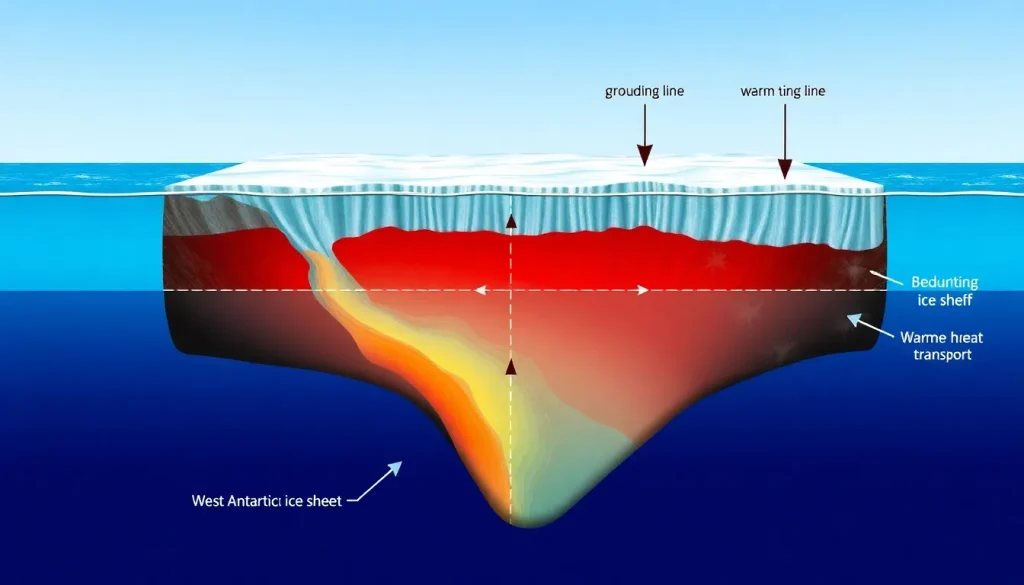
West Antarctic Ice Sheet instability describes the inherent susceptibility of the West Antarctic Ice Sheet (WAIS) to rapid, self-sustaining mass loss due to its physical setting. Unlike the East Antarctic Ice Sheet, which rests largely on bedrock above sea level, the WAIS is a marine-based ice sheet, meaning its base lies on bedrock that is below sea level and slopes downward toward the interior. This retrograde bed slope creates a condition known as marine ice sheet instability (MISI): as the grounding line—the boundary where ice transitions from resting on bedrock to floating as an ice shelf—retreats inland, it encounters deeper water, which allows thicker ice to float, increasing ice discharge and causing further retreat. This feedback can lead to runaway ice loss that continues even if the initial forcing is removed.
The WAIS contains approximately 2.2 million cubic kilometers of ice, equivalent to about 3.3 meters of global sea level rise. Its instability is a critical concern because it represents a potential tipping point in the climate system. Once initiated, the retreat may be irreversible on human timescales, committing future generations to substantial sea level rise regardless of subsequent climate action. The process is primarily driven by ocean warming that melts the ice shelves fringing the ice sheet, reducing their buttressing effect. Understanding this instability is essential for projecting future sea level rise and informing coastal adaptation strategies.
How It Works
The instability of the West Antarctic Ice Sheet arises from two main mechanisms: marine ice sheet instability (MISI) and marine ice cliff instability (MICI). MISI is the foundational concept. In a stable ice sheet, the grounding line sits on a bed that slopes upward inland, so any retreat moves the grounding line into shallower water, reducing ice thickness and discharge, which tends to stabilize the system. However, in West Antarctica, the bed deepens inland, so retreat leads to thicker ice at the grounding line, increasing the outward ice flux. This creates a positive feedback: retreat → thicker ice → faster flow → more retreat. The process can be triggered by sustained melting at the ice-ocean interface beneath ice shelves, which thins the shelves and reduces the back-stress they exert on the inland ice.
Marine ice cliff instability (MICI) is a more recently proposed mechanism that could accelerate collapse. If ice shelves disintegrate and the grounding line retreats past a certain point, tall ice cliffs may be exposed at the ocean edge. Ice cliffs exceeding about 100 meters in height are structurally unstable and can collapse under their own weight, leading to rapid calving. This process could cause retreat rates far faster than MISI alone. However, MICI remains an area of active research, with significant uncertainties about its real-world applicability and the timescales involved.
The key elements of the system include:
- Ice shelves: Floating extensions of the ice sheet that buttress the inland ice. Their loss is the primary trigger for instability.
- Grounding line: The transition from grounded to floating ice. Its position is controlled by ice thickness, sea level, and bed topography.
- Retrograde bed slope: The inland-deepening bedrock that makes the ice sheet inherently unstable.
- Ocean heat delivery: Warm circumpolar deep water that intrudes onto the continental shelf and melts ice shelves from below.
Main Causes or Drivers
The primary driver of West Antarctic Ice Sheet instability is ocean warming. The Southern Ocean has absorbed a large fraction of the excess heat from anthropogenic climate change, and changes in wind patterns have altered ocean circulation, allowing warm circumpolar deep water to access the continental shelf more frequently. This warm water, typically a few degrees above freezing, intrudes into ice shelf cavities and melts the ice from below at rates of tens of meters per year. The thinning of ice shelves reduces their buttressing capacity, leading to acceleration of the glaciers feeding them.
Atmospheric warming plays a secondary role. While surface melt is less significant in Antarctica than in Greenland, it can contribute to ice shelf weakening through hydrofracture—where meltwater fills crevasses and forces them open. This process was implicated in the sudden collapse of the Larsen B Ice Shelf on the Antarctic Peninsula in 2002. However, for the main Amundsen Sea sector of West Antarctica, ocean-driven melting is the dominant forcing. Other contributing factors include changes in sea ice extent, which can influence ocean heat transport, and isostatic rebound of the bedrock, which may slow retreat over long timescales but is too slow to counteract rapid ice loss.
What the Evidence Shows
Multiple lines of evidence indicate that the West Antarctic Ice Sheet is losing mass at an accelerating rate and that instability may already be underway. Satellite observations since the 1990s show that the Pine Island and Thwaites Glaciers—the two largest ice streams draining the WAIS—have thinned, accelerated, and experienced grounding line retreat of tens of kilometers. The Amundsen Sea sector as a whole is losing about 100–150 gigatons of ice per year, making it one of the largest contributors to global sea level rise.
Radar interferometry and altimetry reveal that the grounding lines of these glaciers are retreating along retrograde slopes, consistent with MISI theory. Oceanographic measurements confirm the presence of warm water on the continental shelf and high melt rates beneath ice shelves. Paleoclimate records from past interglacials, such as the Last Interglacial about 125,000 years ago, show that global sea levels were 6–9 meters higher than today, with a substantial contribution likely from West Antarctica. Some modeling studies suggest that the retreat in the Amundsen Sea sector has already passed a tipping point and is now irreversible, though the timescale of collapse remains uncertain—ranging from a few centuries to over a millennium.
Environmental and Human Impacts
The most direct impact of West Antarctic Ice Sheet instability is global sea level rise. A complete collapse would add about 3.3 meters to mean sea level, but even partial loss over the coming centuries could contribute significantly. Because the ice sheet is so large, its gravitational pull on the ocean causes regional variations: sea level fall near Antarctica and enhanced rise in the Northern Hemisphere, particularly along the Atlantic coast of North America. This means that many densely populated coastal regions would experience sea level rise well above the global average.
Rising seas threaten coastal communities with increased flooding, erosion, and saltwater intrusion into freshwater aquifers and agricultural land. Low-lying island nations and deltaic regions face existential risks. Major cities such as New York, Shanghai, and London would require massive investments in coastal defenses or face abandonment of some areas. Ecosystems, including coastal wetlands and mangroves, would be inundated and lost if they cannot migrate inland. The economic costs of displacement, infrastructure damage, and adaptation are projected to be enormous, and the long-term commitment of multi-meter sea level rise would reshape coastlines for millennia.
Data Limitations and Uncertainties
Despite advances in observations and modeling, significant uncertainties remain in projecting the timing and magnitude of West Antarctic Ice Sheet instability. Key challenges include:
- Ice-ocean interactions: The processes by which warm water reaches ice shelf cavities and melts ice are complex and occur at small scales that are difficult to capture in global climate models.
- Bed topography: Accurate maps of the bedrock beneath the ice sheet are incomplete, especially near the grounding line, where the most critical dynamics occur.
- Marine ice cliff instability: The physics of ice cliff failure is not well understood, and its inclusion in models leads to much higher sea level projections, but the mechanism remains debated.
- Model resolution and physics: Ice sheet models are improving but still struggle to represent all relevant processes, such as calving, basal sliding, and ice shelf rheology.
- Natural variability: Decadal-scale ocean and atmosphere variability can mask or amplify long-term trends, making it difficult to attribute observed changes solely to anthropogenic forcing.
These uncertainties translate into a wide range of future sea level projections. The Intergovernmental Panel on Climate Change (IPCC) has historically provided conservative estimates for Antarctic contributions, but more recent expert elicitations and structured model intercomparisons suggest that under high-emission scenarios, the WAIS could contribute tens of centimeters to sea level rise by 2100, with the potential for much larger contributions beyond that. Reducing these uncertainties is a priority for climate science.
Common Misconceptions
Misconception: The West Antarctic Ice Sheet will suddenly collapse and cause catastrophic sea level rise overnight.
Reality: While the ice sheet is unstable, its collapse is a gradual process that unfolds over centuries to millennia. The concern is the long-term commitment to multi-meter sea level rise, not an instantaneous event.
Misconception: The ice sheet has already collapsed.
Reality: The WAIS is losing mass at an accelerating rate, but it is still largely intact. The term “collapse” refers to a potential future state, not the present condition.
Misconception: West Antarctica is the only source of future sea level rise.
Reality: Sea level rise is driven by multiple factors, including thermal expansion of seawater, melting of the Greenland Ice Sheet, and glacier mass loss. The WAIS is a major but not exclusive contributor.
Misconception: We can easily stop the instability once it starts.
Reality: Because of the self-sustaining nature of marine ice sheet instability, retreat may continue even if ocean temperatures stabilize. Reducing greenhouse gas emissions can slow the rate of ice loss and limit the ultimate sea level commitment, but some degree of continued retreat may be unavoidable if tipping points have been crossed.
FAQ
What is West Antarctic Ice Sheet instability?
It is the tendency of the West Antarctic Ice Sheet to undergo rapid, irreversible mass loss because much of its base rests on bedrock below sea level that deepens inland. This configuration triggers a self-sustaining retreat when the grounding line is pushed back by ocean-driven melting of ice shelves.
How does marine ice sheet instability work?
When the grounding line retreats down a retrograde bed slope, the ice at the new grounding line is thicker, leading to faster ice flow and greater discharge. This causes further retreat, creating a positive feedback loop that can continue even if the initial forcing stops.
Why does West Antarctic Ice Sheet instability matter?
The WAIS holds enough ice to raise global sea level by about 3.3 meters. Its collapse, even over centuries, would permanently reshape coastlines, displace millions of people, and cause trillions of dollars in economic damage. Understanding and projecting this instability is crucial for climate adaptation and mitigation planning.
References
- IPCC, 2021: Climate Change 2021: The Physical Science Basis. Contribution of Working Group I to the Sixth Assessment Report of the Intergovernmental Panel on Climate Change. Cambridge University Press.
- Joughin, I., Smith, B. E., & Medley, B. (2014). Marine ice sheet collapse potentially under way for the Thwaites Glacier Basin, West Antarctica. Science, 344(6185), 735–738.
- Rignot, E., Mouginot, J., Scheuchl, B., van den Broeke, M., van Wessem, M. J., & Morlighem, M. (2019). Four decades of Antarctic Ice Sheet mass balance from 1979–2017. Proceedings of the National Academy of Sciences, 116(4), 1095–1103.