In brief
At a glance
Quick Facts
- Direct effect on sea level
- None; floating ice melt does not change ocean volume.
- Governing principle
- Archimedes' principle: a floating object displaces its own weight in fluid.
- Arctic sea ice extent trend
- Declining at about 13% per decade since 1979 (September minimum).
- Primary sea level rise drivers
- Thermal expansion of seawater and melting of land-based ice (glaciers, ice sheets).
- Albedo effect
- Sea ice reflects ~50-70% of sunlight; open ocean reflects only ~6%, amplifying warming.
- Arctic amplification
- The Arctic warms roughly twice as fast as the global average, largely due to sea ice loss.
- Greenland ice sheet
- If fully melted, would raise global sea level by about 7.4 meters (24 feet).
- Negligible direct contribution
- Melting sea ice causes a steric sea level change of less than 1 mm per century.
Key Takeaways
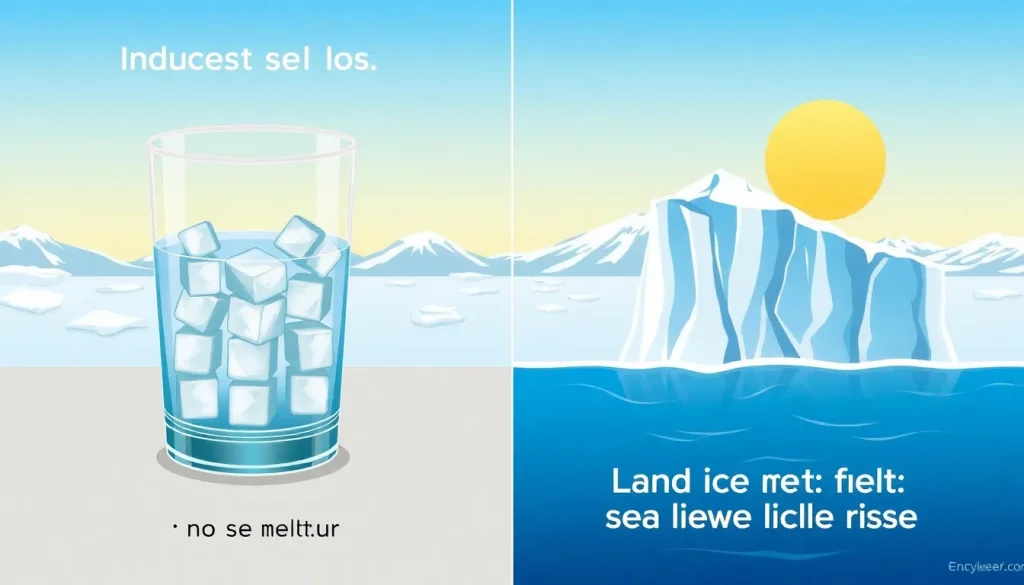
- Arctic sea ice is already floating on the ocean, so its melting does not directly add volume to the sea—just as melting ice cubes in a glass of water does not cause the glass to overflow.
- The physics of buoyancy (Archimedes’ principle) explains that floating ice displaces a volume of water equal to its own weight; when it melts, the resulting water exactly fills that displaced volume.
- While sea ice loss itself does not raise sea level, it triggers powerful indirect effects: reduced reflection of sunlight (albedo), warmer oceans, and accelerated melting of land-based ice sheets and glaciers, all of which do contribute to sea level rise.
- Understanding this distinction is essential for accurate climate communication and for focusing mitigation efforts on the true drivers of sea level rise: thermal expansion and the loss of ice stored on land.
What Is Why Arctic Sea Ice Loss Does Not Directly Raise Sea Level?
“Why Arctic Sea Ice Loss Does Not Directly Raise Sea Level” is a scientific explanation rooted in fundamental physics. It addresses a common point of confusion in public discussions of climate change: the difference between floating ice and land ice. Arctic sea ice is frozen seawater that forms, floats, and melts within the Arctic Ocean. Because it is already displacing its own weight in water, its melting does not change the total volume of the ocean. This is a direct consequence of Archimedes’ principle, which states that a floating object displaces a volume of fluid equal to its weight. When the ice melts, the resulting liquid water occupies exactly the same volume as the displaced seawater, so the water level remains unchanged.
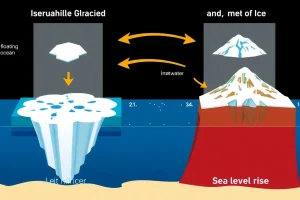
This concept is often demonstrated with a simple experiment: placing an ice cube in a glass of water and marking the water level before and after the ice melts. The level stays the same. However, if the ice cube were resting on a solid surface above the water (like a land-based glacier), its meltwater would flow into the glass and raise the level. The Arctic sea ice is the floating cube; the Greenland and Antarctic ice sheets are the ice on the solid surface. While Arctic sea ice melt does not directly raise sea level, its disappearance has far-reaching indirect consequences that accelerate the melting of land ice and the warming of the ocean, both of which are major contributors to global sea level rise.
Overview
The Arctic Ocean is largely covered by a layer of sea ice that grows and shrinks with the seasons. This ice is formed from freezing seawater and ranges from thin, first-year ice to thick, multi-year ice that persists through summers. Satellite observations since the late 1970s have documented a long-term decline in both the extent and thickness of Arctic sea ice, a trend attributed to rising global temperatures. The loss of sea ice is one of the most visible signs of climate change, but its direct effect on global sea level is often misunderstood.
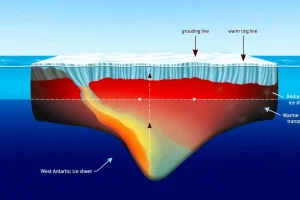
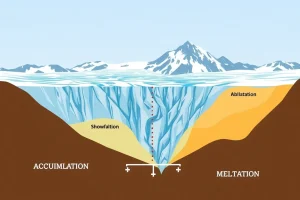
Sea ice is fundamentally different from the ice that covers Greenland and Antarctica. Those ice sheets rest on bedrock and contain vast amounts of frozen fresh water. When they melt, the water flows into the ocean, adding mass and raising sea level. Arctic sea ice, by contrast, is already part of the ocean system. Its melting does not add new water to the ocean; it merely changes the phase of water that is already there. This distinction is critical for understanding the drivers of sea level rise and for setting policy priorities.
How It Works
The physics behind this phenomenon is straightforward. According to Archimedes’ principle, any floating object displaces a weight of fluid equal to its own weight. Sea ice is less dense than seawater, which is why it floats, with about 90% of its volume submerged. The submerged portion displaces a volume of seawater that weighs exactly as much as the entire ice floe. When the ice melts, the fresh water produced has a mass equal to the original ice. That meltwater fills the volume previously occupied by the submerged part of the ice, so the water level does not change.
A classic demonstration uses a glass of water with an ice cube. Mark the water level, let the ice melt, and observe that the level remains the same. The same principle applies to the Arctic Ocean. There is a minor nuance: sea ice is fresher than the surrounding seawater, and the mixing of meltwater slightly changes the density of the surface layer. This can cause a minuscule steric (density-related) sea level change, but the effect is negligible—on the order of millimeters over centuries—and is not considered a direct sea level rise. For all practical purposes, melting sea ice does not raise sea level.
Common Misconceptions
One of the most widespread misconceptions is that the melting of Arctic sea ice will directly flood coastal cities. This confusion often arises because people conflate sea ice with the massive ice sheets on Greenland and Antarctica. While both are forms of ice affected by global warming, only the latter add water to the ocean when they melt. Another common error is to assume that the Arctic is a continent like Antarctica. In reality, the Arctic is an ocean surrounded by land, and its ice is predominantly floating. Antarctica is a landmass covered by ice, with floating ice shelves at its margins.
Some also believe that because sea ice melt does not raise sea level, it is not a concern. This is dangerously misleading. The loss of Arctic sea ice has profound indirect effects on the climate system, including the acceleration of land ice melt and thermal expansion of seawater, both of which are major contributors to sea level rise. Additionally, the misconception can lead to public apathy or misdirected policy efforts. Clear communication of the science is essential to ensure that attention remains on the true drivers of sea level rise while not ignoring the broader impacts of sea ice loss.
Importance and Impact
Although Arctic sea ice loss does not directly raise sea level, its importance for the global climate cannot be overstated. The bright white surface of sea ice reflects a large portion of incoming solar radiation back into space—a property known as albedo. As sea ice melts, it exposes darker ocean water, which absorbs more heat. This ice-albedo feedback amplifies warming in the Arctic, a phenomenon called Arctic amplification. The additional heat absorbed by the ocean contributes to thermal expansion of seawater, which is a significant driver of sea level rise.
Furthermore, the warming Arctic influences weather patterns across the Northern Hemisphere, potentially leading to more extreme events. The loss of sea ice also accelerates the melting of the Greenland ice sheet by warming the surrounding ocean and air. This land ice melt directly adds water to the ocean. In addition, the thawing of permafrost—ground that had been frozen for millennia—releases greenhouse gases, further intensifying global warming. Thus, while sea ice melt itself does not raise sea level, it acts as a critical amplifier of the processes that do.
Connections to Other Systems
Arctic sea ice is deeply interconnected with other components of the Earth system. Its decline affects ocean circulation patterns, particularly the thermohaline circulation, which relies on differences in temperature and salinity. The influx of fresh water from melting sea ice can disrupt the formation of dense, salty water that drives deep ocean currents. Changes in these currents can alter regional climates and influence sea level through changes in ocean heat storage and distribution.
The loss of sea ice also has ecological consequences, disrupting the habitat of species such as polar bears, seals, and walruses, and affecting the livelihoods of Indigenous communities. On a global scale, the reduced albedo and increased heat absorption contribute to the melting of glaciers and ice sheets far beyond the Arctic. The interconnected nature of these systems means that the indirect effects of sea ice loss ripple through the climate system, ultimately contributing to sea level rise in ways that are not immediately obvious but are scientifically well established.
What the Evidence Shows
Satellite data from instruments such as the Special Sensor Microwave Imager (SSMI) and the Advanced Microwave Scanning Radiometer (AMSR) have provided a continuous record of Arctic sea ice extent since 1979. This record shows a clear downward trend, with the minimum extent in September declining by about 13% per decade. The ice has also become thinner, with multi-year ice being replaced by more fragile first-year ice. These observations are consistent with climate model projections and are attributed primarily to human-induced warming.
At the same time, global sea level has been rising at an accelerating rate, measured by tide gauges and satellite altimetry. The Intergovernmental Panel on Climate Change (IPCC) attributes this rise mainly to two factors: the thermal expansion of seawater as it warms, and the addition of water from melting land ice (glaciers and ice sheets). Direct measurements of the mass balance of the Greenland and Antarctic ice sheets confirm that they are losing ice at an increasing rate. No significant contribution to sea level rise is attributed to the melting of Arctic sea ice, confirming the theoretical expectation. The evidence thus clearly separates the direct effects of sea ice loss from the indirect processes that link it to sea level rise.
FAQ
Does melting Arctic sea ice raise sea level?
No, melting Arctic sea ice does not directly raise sea level because the ice is already floating on the ocean and displacing its own weight in water. When it melts, the water level remains the same.
What is the main cause of sea level rise?
The two main causes are thermal expansion of seawater as it warms, and the addition of water from melting land-based ice, such as glaciers and the Greenland and Antarctic ice sheets.
Why is Arctic sea ice loss still a concern if it doesn't raise sea level?
Arctic sea ice loss amplifies global warming through the ice-albedo feedback, accelerates the melting of land ice, disrupts ocean circulation, and contributes to extreme weather. These indirect effects significantly influence sea level rise and the global climate system.
References
- IPCC, 2021: Climate Change 2021: The Physical Science Basis. Contribution of Working Group I to the Sixth Assessment Report of the Intergovernmental Panel on Climate Change.
- National Snow and Ice Data Center (NSIDC). 'All About Sea Ice.' https://nsidc.org/learn/parts-cryosphere/sea-ice
- NASA Global Climate Change. 'Arctic Sea Ice Minimum.' https://climate.nasa.gov/vital-signs/arctic-sea-ice/