In brief
At a glance
Quick Facts
- Definition
- Blue carbon is the carbon captured and stored in coastal and marine ecosystems, primarily mangroves, salt marshes, and seagrasses.
- Carbon Sequestration Rate
- These ecosystems can sequester carbon up to 10 times faster per unit area than mature tropical forests.
- Soil Carbon Storage
- Blue carbon soils can store carbon for thousands of years, with stocks often exceeding 1,000 metric tons per hectare.
- Global Area
- Blue carbon ecosystems cover less than 0.5% of the ocean floor but account for over 50% of carbon burial in ocean sediments.
- Emissions from Degradation
- Destruction of these ecosystems releases 0.15–1.02 billion tons of CO₂ annually, comparable to 3–19% of emissions from deforestation.
- Co-benefits
- They provide coastal protection, support fisheries, improve water quality, and enhance biodiversity.
- Restoration Potential
- Restoring blue carbon ecosystems could offset a small but significant fraction of global emissions, but cannot replace fossil fuel reductions.
- Key Ecosystems
- Mangroves, tidal salt marshes, and seagrass meadows are the three recognized blue carbon ecosystems.
Key Takeaways
- Blue carbon refers to carbon captured and stored by coastal and marine ecosystems, mainly mangroves, salt marshes, and seagrasses, which are exceptionally efficient carbon sinks.
- These ecosystems can sequester carbon up to 10 times faster than terrestrial forests and store it in their soils for centuries to millennia, making them a powerful natural climate solution.
- Despite covering less than 0.5% of the seabed, blue carbon ecosystems account for more than 50% of carbon burial in ocean sediments and offer critical co-benefits like coastal protection and biodiversity support.
- Blue carbon alone cannot solve climate change; its mitigation potential is limited by the small global area of these habitats, and their degradation releases stored carbon, turning them into emission sources.
What Is Can Blue Carbon Help Mitigate Climate Change?
Blue carbon is the term for carbon dioxide (CO₂) captured by the world’s ocean and coastal ecosystems, stored in the biomass and sediments of mangroves, tidal salt marshes, and seagrass meadows. These vegetated coastal habitats are highly productive and have a unique ability to continuously sequester carbon in their waterlogged soils, where it can remain for thousands of years if undisturbed. The question of whether blue carbon can help mitigate climate change is answered by science: yes, these ecosystems can play a meaningful role in reducing atmospheric greenhouse gases, but their contribution is limited by their relatively small global extent and the urgent need to drastically cut fossil fuel emissions.
Blue carbon ecosystems are not a substitute for decarbonizing energy and industry, but they are a critical nature-based solution that offers immediate and cost-effective climate benefits. Protecting existing blue carbon habitats prevents the release of vast stores of carbon that have accumulated over millennia, while restoration can re-establish active carbon sinks. Moreover, these ecosystems provide essential co-benefits such as buffering coastlines from storms, supporting fisheries, and improving water quality, making their conservation a high-priority strategy in integrated climate action plans.
How It Works
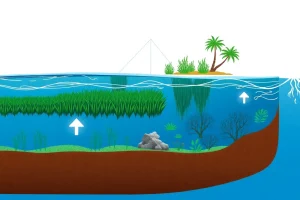
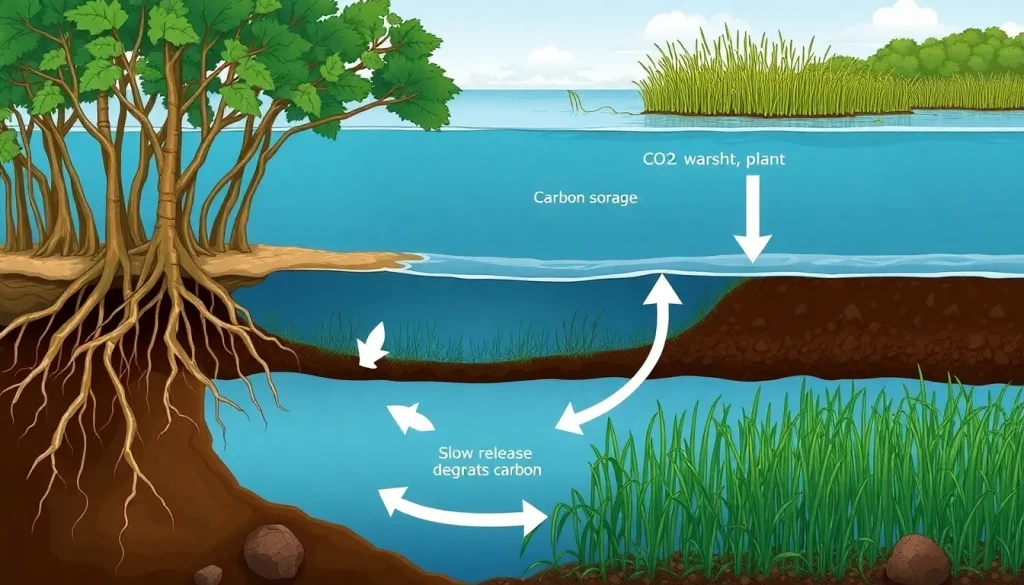
Blue carbon ecosystems capture CO₂ from the atmosphere through photosynthesis and store it in their living biomass (leaves, stems, roots) and, more importantly, in the soil. Unlike terrestrial forests, where most carbon is held in vegetation and can be released by fires or logging, coastal wetlands deposit carbon in waterlogged, oxygen-poor sediments. This anoxic environment drastically slows decomposition, allowing organic matter to accumulate vertically over millennia. As sea levels rise, healthy blue carbon ecosystems can continue to build soil upward, trapping more carbon and maintaining their sequestration function.
The key processes include:
- Photosynthesis: Plants convert CO₂ into organic carbon, which is stored in their tissues.
- Sedimentation: Roots and stems trap particles from the water, adding to the soil carbon pool.
- Low decomposition: Saturated, saline soils lack oxygen, so microbial breakdown of organic matter is extremely slow, preserving carbon for centuries to millennia.
- Vertical accretion: As sea levels rise, these ecosystems can build up their soil elevation, continuing to sequester carbon and providing resilience against climate impacts.
Importance and Impact
Blue carbon ecosystems punch far above their weight in climate mitigation. Although they cover less than 0.5% of the global ocean area, they contribute approximately 50% of carbon burial in ocean sediments. Mangroves alone can store three to five times more carbon per unit area than tropical forests. Globally, the destruction of these ecosystems releases 0.15–1.02 billion tons of CO₂ annually, equivalent to 3–19% of emissions from deforestation, despite their much smaller area. Protecting them is therefore a highly efficient way to avoid emissions.
Beyond carbon, these ecosystems provide critical ecosystem services. Mangroves protect coastlines from storm surges and erosion, saving billions in property damage. Seagrass beds and salt marshes support commercial fisheries by providing nursery habitats. They also filter pollutants and improve water quality. The loss of blue carbon ecosystems thus not only exacerbates climate change but also undermines food security, coastal resilience, and biodiversity. Their conservation is a cost-effective strategy that addresses multiple Sustainable Development Goals simultaneously.
Benefits, Limitations and Trade-offs
The benefits of blue carbon as a climate solution are substantial. Conservation and restoration are often less expensive than technological carbon capture and storage, and they deliver immediate co-benefits. Projects can generate carbon credits, providing financial incentives for local communities. However, blue carbon has clear limitations. The total global area of restorable blue carbon ecosystems is small—estimated at tens of millions of hectares—so even full restoration could only offset a fraction of annual global emissions. It is not a replacement for rapid decarbonization of energy, transport, and industry.
Trade-offs also exist. Restoration projects can compete with other land uses, such as aquaculture or coastal development. In some regions, planting mangroves in non-native areas can disrupt local ecology. Additionally, the permanence of blue carbon storage is vulnerable to climate change itself: sea-level rise, warming, and extreme weather can damage these ecosystems, potentially releasing stored carbon. Effective management requires long-term monitoring, strong governance, and integration with broader climate adaptation strategies to ensure that blue carbon remains a reliable mitigation tool.
What the Evidence Shows
Scientific consensus, reflected in reports from the Intergovernmental Panel on Climate Change (IPCC) and numerous peer-reviewed studies, confirms that blue carbon ecosystems are among the most efficient natural carbon sinks on Earth. Research demonstrates that undisturbed mangroves, salt marshes, and seagrasses sequester carbon at rates up to 10 times higher than mature tropical forests per unit area. Soil carbon stocks in these ecosystems can exceed 1,000 metric tons per hectare, with the majority stored below ground.
Evidence also shows that degradation reverses this function. When drained or converted, blue carbon ecosystems become significant emission sources, releasing carbon that had been locked away for centuries. Restoration has been proven to re-establish carbon sequestration, though recovery of full soil carbon stocks can take decades. Long-term studies indicate that protecting existing ecosystems is far more effective and immediate than restoring degraded ones, as avoided emissions are instantaneous and prevent the loss of irrecoverable carbon stores.
Common Misconceptions
One common misconception is that blue carbon can solve climate change on its own. While these ecosystems are powerful, their limited global extent means they can only contribute a small percentage of the needed emissions reductions. Another misconception is that all coastal vegetation qualifies as blue carbon; in reality, only mangroves, salt marshes, and seagrasses have the unique combination of high productivity and anoxic soil storage that defines blue carbon. Kelp forests and other macroalgae, for example, are not considered blue carbon because most of their carbon is not stored in sediments long-term.
Some also believe that planting mangroves anywhere is beneficial. However, planting in areas that were not historically mangrove habitat—such as mudflats or seagrass beds—can harm existing ecosystems and release stored carbon. Effective blue carbon projects must be site-appropriate and science-based. Finally, there is a misconception that blue carbon credits are always high-quality; the market is still developing, and robust verification standards are essential to ensure real, additional, and permanent carbon sequestration.
What Individuals Can Do
Individuals can support blue carbon climate mitigation in several ways. Reducing personal carbon footprints remains the most important action, as it lessens the overall pressure on all natural carbon sinks. Beyond that, people can donate to or volunteer with organizations that protect and restore coastal wetlands. Choosing sustainable seafood helps reduce the conversion of mangroves to shrimp farms, a major driver of blue carbon loss. When traveling, eco-tourism that supports mangrove conservation can provide economic alternatives to destructive practices.
Advocacy also plays a role: supporting policies that include blue carbon in national climate commitments (NDCs) and local coastal management plans can scale up protection. Educating others about the value of these ecosystems builds public support. Finally, individuals can participate in citizen science projects that monitor coastal habitats, providing data to guide conservation. While individual actions alone are insufficient, collective efforts can drive the systemic changes needed to safeguard blue carbon ecosystems for climate mitigation and the many other benefits they provide.
FAQ
What is blue carbon?
Blue carbon is the carbon stored in coastal and marine ecosystems, specifically mangroves, salt marshes, and seagrasses. These habitats capture carbon dioxide from the atmosphere and store it in their biomass and, more importantly, in their soils for long periods.
How do blue carbon ecosystems store carbon?
They absorb CO₂ through photosynthesis and convert it into plant tissue. When plants die, organic matter accumulates in waterlogged, oxygen-poor soils, where decomposition is extremely slow. This allows carbon to build up in sediments over centuries to millennia.
Why are blue carbon ecosystems threatened?
They are threatened by coastal development, aquaculture (especially shrimp farming), pollution, drainage for agriculture, and climate change impacts such as sea-level rise and storms. An estimated 20–50% of these ecosystems have already been lost.
References
- IPCC Special Report on the Ocean and Cryosphere in a Changing Climate (2019), Chapter 5: Changing Ocean, Marine Ecosystems, and Dependent Communities.
- The Blue Carbon Initiative, a global program working to mitigate climate change through the restoration and sustainable use of coastal and marine ecosystems.
- Mcleod, E., Chmura, G. L., Bouillon, S., et al. (2011). A blueprint for blue carbon: toward an improved understanding of the role of vegetated coastal habitats in sequestering CO₂. Frontiers in Ecology and the Environment, 9(10), 552-560.