In brief
At a glance
Quick Facts
- Definition
- Glacier mass balance is the net change in ice mass over a year, calculated as accumulation minus ablation.
- Measurement unit
- Expressed in meters of water equivalent (m w.e.) to standardize volume change.
- Key zones
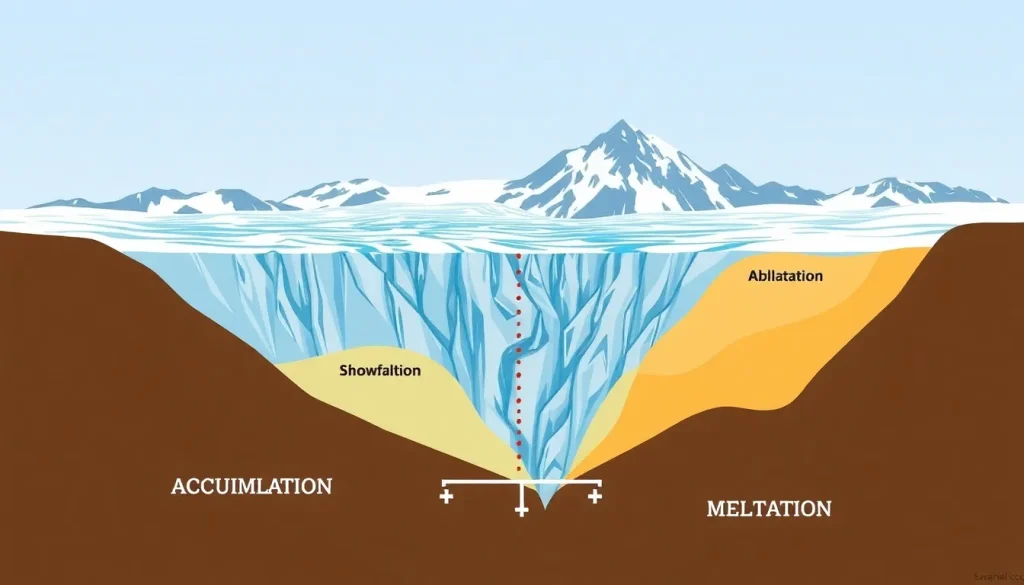
- Accumulation zone (net gain) and ablation zone (net loss), separated by the equilibrium line.
- Climate indicator
- Mass balance directly reflects local climate conditions, especially temperature and snowfall.
- Global trend
- Most glaciers worldwide have been losing mass since the mid-20th century, contributing to sea level rise.
- Water resources
- Glacier meltwater is a critical freshwater source for millions of people in mountain regions.
- Measurement methods
- Includes field stakes, geodetic surveys, remote sensing, and hydrological modeling.
- Equilibrium line altitude (ELA)
- The elevation where annual accumulation equals ablation; a rising ELA indicates negative mass balance.
Key Takeaways
- Glacier mass balance is the net change in ice mass over a specific period, usually a year, resulting from the difference between accumulation (gain) and ablation (loss).
- It is a direct and unfiltered indicator of climate change, as glaciers respond primarily to temperature and precipitation variations.
- Negative mass balance leads to glacier retreat and contributes to global sea level rise, while positive mass balance can cause glacier advance.
- Monitoring mass balance is crucial for understanding water resource availability, assessing natural hazards, and reconstructing past climates.
What Is Glacier Mass Balance Explained?
Glacier mass balance is the quantitative expression of a glacier’s net change in mass over a defined time period, typically a year. It is the difference between the amount of snow and ice accumulated on the glacier and the amount lost through processes like melting, sublimation, and calving. In simple terms, it is the glacier’s “budget” of ice: if accumulation exceeds ablation, the mass balance is positive and the glacier grows; if ablation exceeds accumulation, the mass balance is negative and the glacier shrinks. This concept is fundamental to glaciology because it directly links glacier health to climatic conditions.
Mass balance is measured in meters of water equivalent (m w.e.), which standardizes the volume of ice gained or lost across the entire glacier surface. A glacier’s mass balance is not uniform; typically, the upper reaches (accumulation zone) gain mass through snowfall, while the lower reaches (ablation zone) lose mass through melting. The boundary between these zones is the equilibrium line, where annual accumulation equals ablation. The altitude of this line, the equilibrium line altitude (ELA), is a key indicator of a glacier’s health: a rising ELA signals a shrinking accumulation zone and a negative mass balance.
Overview
Glaciers are dynamic systems that constantly exchange mass with their environment. The concept of mass balance provides a framework for quantifying this exchange. It is analogous to a bank account: deposits (accumulation) and withdrawals (ablation) determine the net balance. Over time, a sustained negative mass balance leads to glacier retreat, while a sustained positive mass balance causes glacier advance. Because glaciers integrate climate signals over years to decades, their mass balance is considered one of the most reliable natural indicators of climate change, free from the short-term noise that can affect other measures.
Glaciologists distinguish between two types of mass balance: climatic mass balance, which focuses on surface processes (snowfall, melting, sublimation), and total mass balance, which also includes internal and basal processes (such as refreezing of meltwater, basal melting, and calving). For most glaciers, surface mass balance dominates the annual signal. The study of mass balance is essential for understanding glacier dynamics, predicting future changes, and assessing the impacts on water resources and sea level.
How It Works
Glacier mass balance is determined by measuring or modeling the inputs and outputs of ice mass. The primary input is accumulation, which includes snowfall, avalanches, wind-blown snow, and freezing of rain. The primary output is ablation, which includes melting, sublimation (direct conversion of ice to water vapor), and calving (breaking off of icebergs at the terminus). The net mass balance (B) is calculated as B = accumulation – ablation, typically over a hydrological year.
There are several methods to measure mass balance:
- Glaciological method: Direct field measurements using stakes and snow pits. Stakes inserted into the ice measure surface melt, while snow pits or cores measure winter accumulation. These point measurements are extrapolated across the glacier surface using maps of elevation and ice flow.
- Geodetic method: Repeated surveys of glacier surface elevation over time, often using aerial photography, satellite altimetry, or ground-based GPS. The change in volume is converted to mass using ice density. This method provides a cumulative mass balance over several years.
- Hydrological method: Calculates mass balance as the difference between precipitation input and runoff output for a glacierized basin, but it is less direct and requires extensive hydrological data.
- Remote sensing and modeling: Satellite observations of glacier extent, surface elevation, and gravity changes are increasingly used to estimate mass balance on regional and global scales, often combined with climate models.
Main Causes or Drivers
The primary drivers of glacier mass balance are climatic variables, particularly temperature and precipitation. Temperature influences both accumulation (whether precipitation falls as snow or rain) and ablation (melting rate). Higher temperatures increase melt and can shift precipitation from snow to rain, reducing accumulation. Precipitation amount, especially snowfall, directly affects accumulation. Other factors include solar radiation, humidity, wind speed, and cloud cover, which affect surface energy balance and thus melt rates. On a longer timescale, changes in atmospheric circulation patterns can alter the delivery of moisture and heat to glacierized regions.
Non-climatic factors also play a role. For example, debris cover on a glacier surface can either insulate the ice and reduce melt (if thick) or enhance melt by absorbing more solar radiation (if thin). Calving of icebergs into lakes or oceans is a major ablation process for tidewater and lake-terminating glaciers, often driven by water depth and glacier dynamics rather than directly by climate. Volcanic eruptions can deposit ash on glaciers, darkening the surface and increasing melt. However, on a global scale, the dominant driver of the widespread glacier retreat observed over the past century is the increase in global mean temperature due to anthropogenic greenhouse gas emissions.
Importance and Impact
Glacier mass balance has far-reaching implications. First, glaciers are major contributors to sea level rise. When land-based glaciers lose mass, the meltwater eventually reaches the ocean, raising global sea levels. Since the mid-20th century, glacier mass loss (excluding the Greenland and Antarctic ice sheets) has been a significant component of observed sea level rise, and it is projected to continue. This contributes to coastal erosion, increased flooding, and saltwater intrusion into freshwater aquifers.
Second, glaciers act as natural water reservoirs, storing water as ice in winter and releasing it as meltwater in summer. Many regions, particularly in the Himalayas, Andes, and Central Asia, rely on glacier meltwater for drinking water, irrigation, and hydropower. Changes in glacier mass balance directly affect the timing and volume of this water supply, with potential for both increased meltwater in the short term (as glaciers shrink) and severe water shortages in the long term (as glaciers disappear). Third, glacier retreat can increase the risk of natural hazards such as glacial lake outburst floods (GLOFs) and landslides, threatening downstream communities. Finally, glacier mass balance is a key indicator for climate models, helping scientists validate and improve projections of future climate change.
Regional Differences
Glacier mass balance varies significantly across different regions due to local climate conditions, glacier geometry, and topography. Maritime glaciers in regions like coastal Alaska, Patagonia, and New Zealand experience high snowfall and high melt rates, making them sensitive to small temperature changes. Continental glaciers in dry, cold regions like the interior of Antarctica or the high Arctic have low accumulation and ablation rates, so their mass balance responds more slowly. Tropical glaciers, such as those in the Andes and East Africa, are particularly vulnerable because they exist only at very high altitudes and are subject to year-round ablation; many are shrinking rapidly.
In general, glaciers in most mountain ranges worldwide have been losing mass since the mid-20th century, with the rate of loss accelerating in many areas. However, some regions have shown periods of positive mass balance, such as parts of Scandinavia and the Karakoram, due to increased winter snowfall or local cooling trends. These regional anomalies highlight the complexity of glacier-climate interactions and the importance of local-scale monitoring.
Data Limitations and Uncertainties
Despite advances in measurement techniques, glacier mass balance data have limitations. Direct field measurements are labor-intensive and cover only a small fraction of the world’s glaciers—typically those that are easily accessible and have long-term monitoring programs. The World Glacier Monitoring Service collects data from reference glaciers, but these are not evenly distributed globally; many regions, especially in the Southern Hemisphere and high Asia, are underrepresented.
Geodetic and remote sensing methods provide broader coverage but have their own uncertainties. Satellite altimetry can be affected by slope and surface roughness, and converting volume change to mass requires assumptions about ice density and firn compaction. Gravity measurements from satellites like GRACE can detect mass changes but have coarse spatial resolution, making it difficult to isolate individual glaciers. Additionally, internal and basal processes, such as refreezing and basal melt, are hard to measure directly and introduce uncertainty in total mass balance estimates. These limitations mean that global glacier mass balance estimates have error margins, and continuous improvement in monitoring is essential for accurate assessments.
FAQ
What is glacier mass balance?
Glacier mass balance is the net gain or loss of ice on a glacier over a specific period, usually a year. It is the difference between accumulation (snowfall, avalanches) and ablation (melting, sublimation, calving).
How is glacier mass balance measured?
It is measured using field methods like stakes and snow pits, geodetic surveys of surface elevation changes, remote sensing from satellites, and hydrological models. Each method has its strengths and limitations.
Why does glacier mass balance matter?
It matters because it is a direct indicator of climate change, contributes to sea level rise, affects freshwater availability for millions of people, and influences natural hazards like glacial lake outburst floods.
References
- World Glacier Monitoring Service (WGMS) – Global Glacier Change Bulletin
- Intergovernmental Panel on Climate Change (IPCC) – Special Report on the Ocean and Cryosphere in a Changing Climate
- United States Geological Survey (USGS) – Glacier Mass Balance Measurement Techniques