In brief
At a glance
Quick Facts
- Definition of dLUC
- Direct land-use change is the on-site conversion of land from one use to another, such as forest to cropland.
- Definition of iLUC
- Indirect land-use change is the displacement of land use to another location due to market-mediated effects.
- Primary driver
- Increased demand for agricultural commodities, especially for biofuels, is a major driver of iLUC.
- Carbon debt
- iLUC can create a 'carbon debt' that may take decades to repay through reduced fossil fuel use.
- Modeling challenge
- iLUC is estimated using complex economic models with significant uncertainties.
- Policy relevance
- iLUC factors are incorporated into some biofuel sustainability standards, such as the EU Renewable Energy Directive.
- Global scale
- iLUC effects can cross national borders, linking consumption in one country to deforestation in another.
- Key commodities
- Crops like corn, soy, palm oil, and sugarcane are frequently associated with iLUC due to their use in both food and fuel.
Key Takeaways
- Direct land-use change (dLUC) is the on-site conversion of land from one use to another, such as clearing forest for cropland.
- Indirect land-use change (iLUC) occurs when land-use changes in one location displace existing activities, causing land conversion elsewhere, often through market mechanisms.
- iLUC is a critical concept in biofuel policy because it can negate the greenhouse gas savings from replacing fossil fuels if it leads to deforestation.
- Quantifying iLUC is challenging due to data limitations and complex economic modeling, but ignoring it can lead to misleading assessments of environmental impacts.
What Is Direct vs Indirect Land-Use Change?
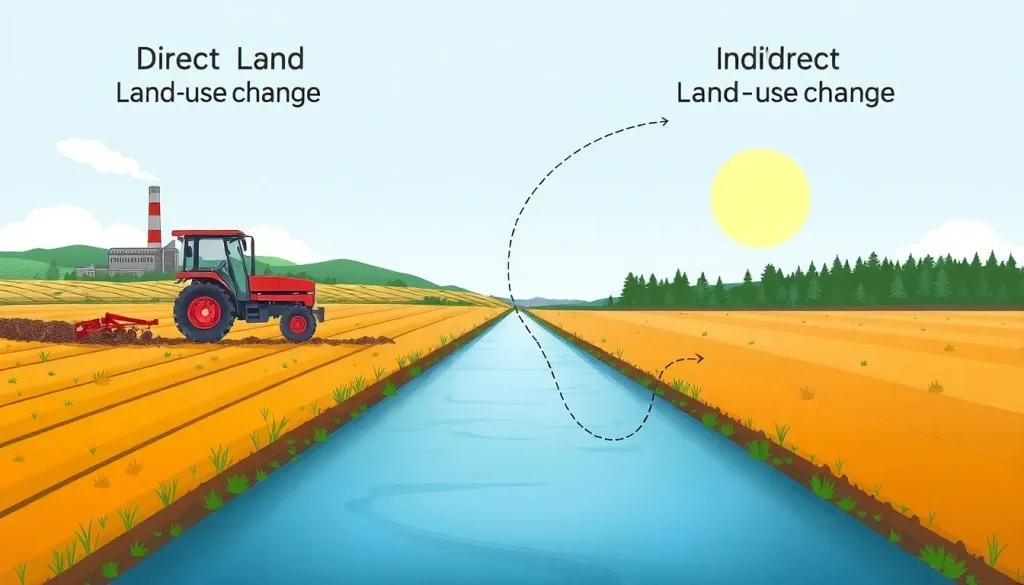
Direct land-use change (dLUC) refers to the conversion of land from one use to another on a specific, identifiable piece of land. This is the most straightforward form of land-use change: a forest is cleared to create a soybean field, a pasture is plowed to plant a corn crop, or a wetland is drained for urban development. The environmental consequences—such as carbon emissions from soil and biomass, loss of biodiversity, and changes in water cycles—are directly attributable to that particular land conversion event.
Indirect land-use change (iLUC), by contrast, is a displacement effect. When land is converted for a new purpose (e.g., growing biofuel feedstocks), the previous land use (e.g., food production) does not simply disappear. Instead, it may shift to another location, often triggering land conversion elsewhere. For example, if a farmer in the United States switches from growing wheat to corn for ethanol, the global demand for wheat does not decrease. That wheat production may move to Brazil, where new land is cleared to grow it. The resulting deforestation in Brazil is an indirect effect of the original land-use change in the United States. iLUC is thus a market-mediated phenomenon, driven by changes in supply, demand, and prices across interconnected global commodity markets.
Overview
Land-use change is a major driver of global environmental change, contributing significantly to greenhouse gas emissions, biodiversity loss, and ecosystem degradation. Historically, assessments of land-use impacts focused only on direct changes—the immediate conversion of land for a specific purpose. However, as global supply chains have become more integrated, it has become clear that local land-use decisions can have far-reaching consequences. The concept of indirect land-use change emerged in the early 2000s, particularly in the context of biofuel policies, to capture these displacement effects. Today, iLUC is a central consideration in life-cycle assessments (LCAs) of agricultural products, renewable energy policies, and land-use planning strategies.
How It Works
Direct land-use change is relatively simple to measure: it involves observing a specific area of land and documenting the change in its use over time. Satellite imagery, ground surveys, and land registries can all provide data on dLUC. The environmental impact is then calculated based on the difference between the original and new land uses—for example, the carbon stored in a forest versus the carbon stored in a cornfield.
Indirect land-use change, however, operates through economic mechanisms. When a crop is diverted to a new use (e.g., corn for ethanol), the supply of that crop for other uses (e.g., animal feed) decreases, causing prices to rise. Higher prices incentivize farmers elsewhere to expand production, often by converting natural ecosystems into cropland. This chain of events can cross national borders and involve multiple commodities. For instance, increased demand for corn ethanol in the U.S. can lead to soybean price increases (as farmers switch from soy to corn), which in turn drives deforestation for soy in South America. Modeling iLUC requires complex economic models that simulate global agricultural markets, land use, and trade flows.
Importance and Impact
Understanding both dLUC and iLUC is essential for accurately assessing the environmental footprint of land-based products and policies. If only direct land-use change is considered, the full carbon debt of a biofuel or agricultural commodity may be underestimated. For example, a biofuel made from crops grown on existing cropland might appear to have low direct emissions, but if that crop displaces food production and causes deforestation elsewhere, the total emissions can be substantial—sometimes even exceeding those of the fossil fuel it replaces. This has profound implications for climate policy, as it can undermine the intended greenhouse gas reductions of biofuel mandates and subsidies.
Moreover, iLUC can have significant social and ecological consequences. Deforestation driven by iLUC can lead to loss of biodiversity, disruption of water cycles, and displacement of indigenous communities. It also complicates efforts to attribute responsibility for environmental damage, as the ultimate driver of land conversion may be far removed from the location of the impact. This makes governance and regulation challenging, requiring international cooperation and comprehensive accounting frameworks.
Main Causes or Drivers
The primary driver of direct land-use change is the demand for land to produce food, feed, fiber, and fuel. Population growth, dietary changes (especially increased meat consumption), and the expansion of bioenergy are key factors. Urbanization and infrastructure development also contribute directly to land conversion.
Indirect land-use change is driven by the same underlying demands but operates through market-mediated displacement. Policies that promote biofuels, such as blending mandates and subsidies, are significant drivers of iLUC because they increase demand for crops that can be used for both food and fuel. Other drivers include changes in agricultural productivity, trade policies, and land governance. When yields improve in one region, it can reduce pressure on land elsewhere, but it can also make agriculture more profitable and lead to expansion. The net effect depends on the interplay of these factors.
Environmental and Human Impacts
The environmental impacts of direct land-use change are immediate and local: deforestation leads to loss of carbon stocks, habitat destruction, soil degradation, and altered water cycles. These changes contribute to climate change, biodiversity loss, and reduced ecosystem services. Indirect land-use change amplifies these impacts by displacing them to other regions, often to areas with high conservation value, such as tropical rainforests. The carbon emissions from iLUC can be substantial, sometimes creating a “carbon debt” that takes decades or even centuries to repay through the greenhouse gas savings of the new land use.
Human impacts include the displacement of local communities, loss of livelihoods, and food insecurity. When land is converted for export-oriented agriculture, local populations may lose access to land and resources. iLUC can exacerbate these issues by increasing pressure on land in developing countries, where land governance is often weak and smallholders are vulnerable. Additionally, the global nature of iLUC means that consumers and policymakers in one country can unknowingly contribute to negative social and environmental outcomes in another.
Data Limitations and Uncertainties
Quantifying indirect land-use change is fraught with challenges. Unlike dLUC, which can be directly observed, iLUC must be inferred from economic models that simulate global land use, trade, and agricultural production. These models rely on numerous assumptions about future yields, market responses, policy scenarios, and land availability. Small changes in model parameters can lead to significantly different estimates of iLUC emissions. As a result, iLUC factors are highly uncertain and often contested.
Data limitations further compound the problem. Reliable data on land use, land cover, and carbon stocks are lacking in many parts of the world, particularly in developing countries. Attribution of land-use change to specific drivers is also difficult, as multiple factors often interact. Despite these challenges, many researchers and policymakers argue that ignoring iLUC is not a solution, as it would lead to an underestimation of the true environmental costs. Instead, efforts are ongoing to improve models, increase transparency, and incorporate iLUC into sustainability standards and certification schemes.
FAQ
What is direct vs indirect land-use change?
Direct land-use change is the conversion of land from one use to another on a specific site, such as clearing forest for agriculture. Indirect land-use change occurs when that conversion displaces existing land uses, causing land conversion elsewhere through market forces.
How does indirect land-use change work?
When land is used for a new purpose (e.g., biofuel crops), the previous use (e.g., food production) is displaced. This reduces supply and raises prices, incentivizing farmers elsewhere to convert natural land to agriculture to meet demand.
Why does indirect land-use change matter?
It matters because ignoring iLUC can lead to underestimating the true environmental impact of products and policies. For biofuels, iLUC emissions can negate the climate benefits of replacing fossil fuels, sometimes making them worse than gasoline.
References
- Searchinger, T., et al. (2008). Use of U.S. Croplands for Biofuels Increases Greenhouse Gases Through Emissions from Land-Use Change. Science, 319(5867), 1238-1240.
- IPCC (2019). Climate Change and Land: an IPCC special report on climate change, desertification, land degradation, sustainable land management, food security, and greenhouse gas fluxes in terrestrial ecosystems.
- European Commission (2015). Directive (EU) 2015/1513 (ILUC Directive) amending the Renewable Energy Directive and the Fuel Quality Directive.
- FAO (2020). The State of the World's Forests 2020. Food and Agriculture Organization of the United Nations.