In brief
At a glance
Quick Facts
- Definition
- A farming system based on minimal soil disturbance, permanent soil cover, and crop diversification.
- Core Principles
- No-till or reduced tillage, permanent organic soil cover, and crop rotation or intercropping.
- Primary Goal
- To achieve sustainable and profitable agriculture by conserving and enhancing natural resources.
- Global Adoption
- Practiced on over 180 million hectares worldwide, with significant areas in North and South America, Australia, and growing adoption in Africa and Asia.
- Key Benefits
- Improved soil health, reduced erosion, increased water retention, carbon sequestration, and lower input costs.
- Main Challenges
- Initial yield reduction, weed management, need for new equipment and knowledge, and reliance on herbicides in some systems.
- Related Concepts
- Agroecology, regenerative agriculture, climate-smart agriculture, and integrated pest management.
Key Takeaways
- Conservation agriculture is a sustainable farming system based on three core principles: minimal soil disturbance, permanent soil cover, and crop diversification.
- It enhances soil health, reduces erosion, improves water retention, and sequesters carbon, contributing to climate change mitigation.
- Adoption requires a shift in management practices and may involve initial trade-offs, but long-term benefits include stable yields and lower input costs.
- Conservation agriculture is practiced globally across diverse agro-ecological zones and is supported by organizations like the FAO as a pathway to food security.
What Is Conservation Agriculture Explained?
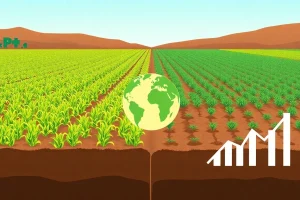
Conservation agriculture (CA) is a farming system that promotes the sustainable use of natural resources by integrating three core principles: minimal soil disturbance (often through no-till or reduced tillage), permanent soil cover (using crop residues or cover crops), and crop diversification (via rotation, intercropping, or relay cropping). Unlike conventional agriculture, which often relies on intensive plowing, monocropping, and removal of crop residues, CA seeks to maintain and enhance soil health, biodiversity, and ecosystem services. It is not a rigid set of practices but a flexible approach that can be adapted to local conditions, crops, and farmer circumstances.
The fundamental goal of conservation agriculture is to mimic the natural processes of undisturbed ecosystems, such as forests or grasslands, where soil is continuously protected by organic matter, roots anchor the soil, and diverse plant species support a complex web of life. By reducing mechanical soil disturbance, CA preserves soil structure and organic matter, which in turn improves water infiltration, reduces erosion, and enhances nutrient cycling. This approach not only sustains agricultural productivity but also builds resilience against climate variability, making it a key strategy for long-term food security and environmental stewardship.
History
The origins of conservation agriculture can be traced back to the environmental crises of the early 20th century, particularly the Dust Bowl in the United States during the 1930s. Severe drought and wind erosion on intensively tilled soils led to massive crop failures and ecological disaster, prompting researchers and farmers to explore reduced tillage methods. The development of herbicides and specialized no-till planters in the mid-20th century enabled the practical application of no-till farming, which became the foundation of conservation agriculture. Pioneering work in the US, Brazil, and Australia demonstrated that leaving crop residues on the soil surface and minimizing plowing could drastically reduce erosion and improve soil moisture.

In the 1970s and 1980s, the concept evolved beyond no-till to include permanent soil cover and crop rotation, forming the three-pillar system now known as conservation agriculture. The Food and Agriculture Organization (FAO) of the United Nations began promoting CA in the 1990s as a response to soil degradation and declining productivity in many parts of the world. Since then, adoption has grown globally, with significant uptake in North and South America, Australia, and increasingly in Africa and Asia. The FAO now recognizes CA as a key component of climate-smart agriculture and sustainable intensification.
How It Works
Conservation agriculture operates through the simultaneous application of three interlinked principles. The first principle, minimal soil disturbance, involves eliminating or significantly reducing tillage. Instead of plowing, farmers use no-till or reduced-till methods that disturb only the narrow strip of soil where seeds are placed. This preserves soil structure, reduces erosion, and protects soil organisms. Specialized equipment, such as no-till seed drills, is often used to plant seeds directly into untilled soil and through the residue of previous crops.
The second principle, permanent soil cover, requires that the soil surface be protected by crop residues (such as stalks, leaves, and stubble) or by living cover crops throughout the year. This cover shields the soil from wind and water erosion, suppresses weeds, moderates soil temperature, and reduces evaporation. Over time, the organic matter from the cover decomposes, enriching the soil with nutrients and improving its structure. Cover crops, such as legumes or grasses, can also fix nitrogen or break pest cycles.
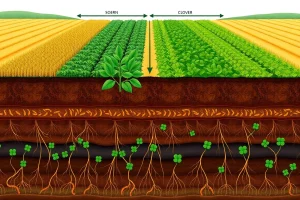
The third principle, crop diversification, involves rotating or intercropping different plant species to break pest and disease cycles, improve soil fertility, and enhance biodiversity. Monocropping depletes specific nutrients and encourages pest buildup; rotating crops with different root structures and nutrient needs helps maintain a balanced soil ecosystem. For example, alternating cereals with legumes can naturally replenish nitrogen levels. Together, these three principles create a self-reinforcing system that improves soil health, water efficiency, and overall farm resilience.
Benefits, Limitations and Trade-offs
Conservation agriculture offers numerous benefits. Improved soil structure and organic matter increase water infiltration and retention, making farms more drought-resistant. Reduced tillage lowers fuel and labor costs, while permanent soil cover suppresses weeds and reduces the need for herbicides over time. Enhanced soil biodiversity and nutrient cycling can lead to stable or even increased yields in the long term. Additionally, CA practices sequester carbon in the soil, helping mitigate climate change, and reduce sediment runoff, protecting water quality.
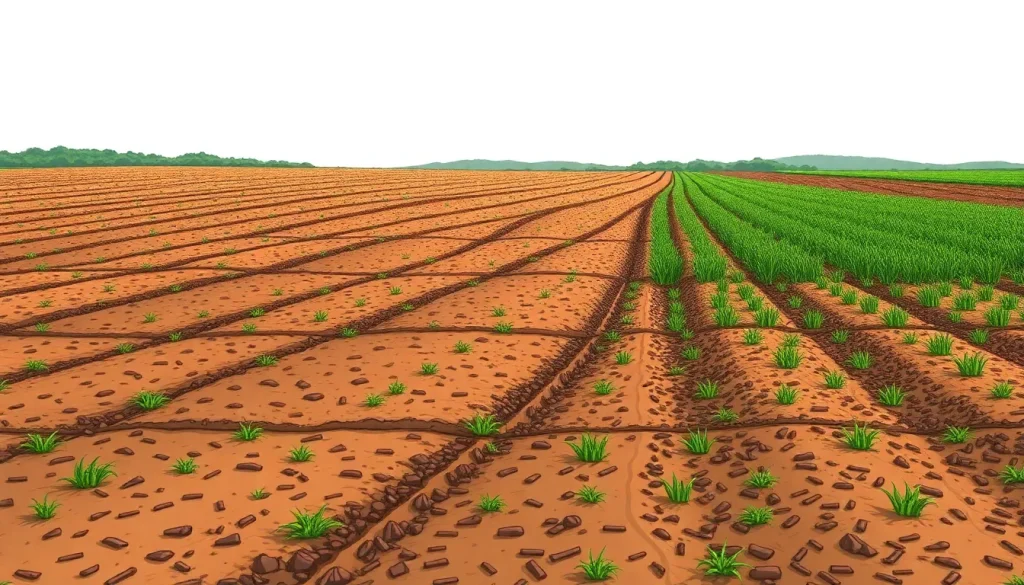
However, CA also presents limitations and trade-offs. The transition period can be challenging: yields may initially decline as the soil ecosystem adjusts, and farmers may face increased weed pressure before the benefits of cover crops and rotations take effect. No-till systems often rely on herbicides for weed control, raising concerns about chemical use and resistance. The approach requires new knowledge, management skills, and sometimes expensive equipment, which can be a barrier for smallholder farmers. Furthermore, in certain climates or soil types, such as waterlogged or compacted soils, no-till may not be immediately suitable without complementary practices like drainage or controlled traffic.
Common Misconceptions
One common misconception is that conservation agriculture simply means stopping all plowing. In reality, minimal soil disturbance is a principle that can include occasional strategic tillage to address specific problems like compaction or weed outbreaks, though the goal is to minimize it. Another myth is that CA is only suitable for large-scale, mechanized farms. While large farms in the Americas and Australia have widely adopted it, smallholder farmers in Africa and Asia are increasingly using manual or animal-drawn no-till methods and cover crops, demonstrating its adaptability.
Some believe that conservation agriculture always reduces yields. While short-term yield dips can occur during the transition, long-term data often show yields comparable to or higher than conventional systems, especially under drought conditions. Finally, CA is sometimes confused with organic farming. Although both share sustainability goals, CA does not prohibit synthetic inputs; it often integrates herbicides and fertilizers judiciously, whereas organic farming excludes most synthetic chemicals. CA is a set of principles that can be applied within various farming systems, including organic, conventional, or integrated.
Importance and Impact
Conservation agriculture is critically important for addressing global challenges of soil degradation, food insecurity, and climate change. An estimated one-third of the world’s soils are moderately to highly degraded due to erosion, nutrient depletion, and loss of organic matter. By halting and reversing these trends, CA helps maintain the productive capacity of land for future generations. It also contributes to climate change mitigation: soils under CA can sequester significant amounts of atmospheric carbon dioxide, turning agricultural lands from carbon sources into carbon sinks.
The impact of CA extends beyond the farm. Reduced erosion and runoff improve water quality in rivers and lakes, while enhanced biodiversity supports pollinators and natural pest control. For farmers, the economic benefits of lower input costs and stable yields can improve livelihoods and reduce vulnerability to price shocks. At a global scale, the FAO and other organizations promote CA as a cornerstone of sustainable intensification—producing more food with fewer environmental impacts. Its adoption is seen as essential for achieving the United Nations Sustainable Development Goals, particularly those related to zero hunger, clean water, and climate action.
Connections to Other Systems
Conservation agriculture shares principles with several other sustainable farming approaches. Agroecology, for instance, emphasizes ecological processes and biodiversity, and CA can be a key practice within agroecological systems. Regenerative agriculture, a broader movement focused on restoring soil health and ecosystem function, often incorporates CA principles alongside holistic grazing and composting. Climate-smart agriculture, as defined by the FAO, aims to increase productivity, enhance resilience, and reduce emissions; CA directly addresses all three pillars.
CA is also compatible with integrated pest management, precision agriculture, and organic farming, though the latter may require adaptations to avoid synthetic herbicides. The flexibility of CA allows it to be combined with agroforestry, where trees are integrated into fields, further enhancing soil cover and diversification. These connections highlight that conservation agriculture is not an isolated technique but part of a larger shift toward more resilient and sustainable food systems. Its principles can be tailored to fit a wide range of contexts, from smallholder plots in sub-Saharan Africa to large mechanized farms in North America.
FAQ
What is conservation agriculture?
Conservation agriculture is a sustainable farming approach that combines minimal soil disturbance, permanent soil cover, and crop diversification to improve soil health, increase productivity, and protect the environment.
How does conservation agriculture work?
It works by eliminating or reducing tillage to preserve soil structure, keeping the soil covered with crop residues or cover crops to prevent erosion and retain moisture, and rotating crops to break pest cycles and enhance soil fertility. These practices together create a resilient farming system.
Why does conservation agriculture matter?
It matters because it addresses critical issues like soil degradation, water scarcity, and climate change. By improving soil health and sequestering carbon, it helps ensure long-term food security and environmental sustainability.
References
- Food and Agriculture Organization of the United Nations (FAO). Conservation Agriculture. http://www.fao.org/conservation-agriculture/en/
- Hobbs, P.R., Sayre, K., & Gupta, R. (2008). The role of conservation agriculture in sustainable agriculture. Philosophical Transactions of the Royal Society B, 363(1491), 543-555.
- Kassam, A., Friedrich, T., & Derpsch, R. (2019). Global spread of conservation agriculture. International Journal of Environmental Studies, 76(1), 29-51.