In brief
At a glance
Quick Facts
- Primary agricultural sources
- Livestock manure and synthetic fertilizers account for over 80% of global anthropogenic ammonia emissions.
- Chemical formula
- NH₃
- Atmospheric lifetime
- Ammonia typically remains in the atmosphere for a few hours to a few days before depositing.
- Health impact
- Ammonia is a precursor to fine particulate matter (PM2.5), which is linked to respiratory and cardiovascular diseases.
- Ecosystem impact
- Ammonia deposition contributes to soil acidification and eutrophication of water bodies.
- Global emissions
- Agriculture is responsible for about 80-90% of anthropogenic ammonia emissions worldwide.
- Key chemical reaction
- Ammonia reacts with sulfuric and nitric acids in the atmosphere to form ammonium sulfate and ammonium nitrate aerosols.
- Regulation
- Ammonia emissions are regulated under the Gothenburg Protocol and national clean air policies in many countries.
Key Takeaways
- Ammonia (NH₃) from agriculture is a primary precursor to fine particulate matter (PM2.5), a major air pollutant linked to respiratory and cardiovascular diseases.
- Livestock manure and synthetic nitrogen fertilizers are the dominant sources, accounting for over 80% of global anthropogenic ammonia emissions.
- Once airborne, ammonia reacts with acids to form ammonium aerosols, which can travel hundreds of kilometers and deposit in sensitive ecosystems.
- Ammonia deposition causes soil acidification, water eutrophication, and loss of biodiversity, making it a key driver of nitrogen pollution beyond the farm.
What Is Ammonia Pollution From Agriculture?
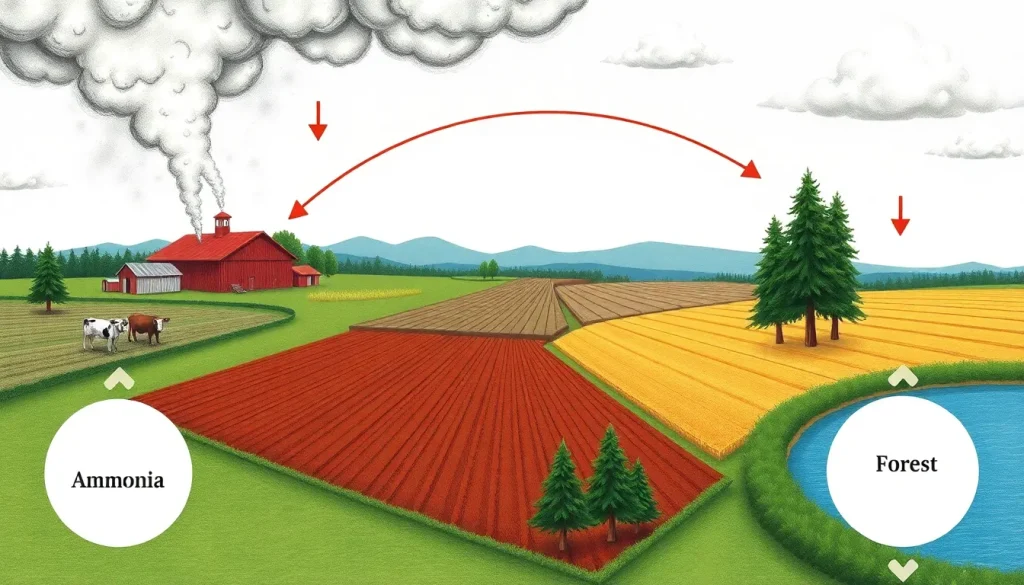
Ammonia pollution from agriculture refers to the emission of gaseous ammonia (NH₃) into the atmosphere as a result of farming activities. Ammonia is a colorless, pungent gas composed of nitrogen and hydrogen. In agriculture, it is released primarily from the breakdown of urea in livestock urine and from the application of nitrogen-based fertilizers to soils. Once in the air, ammonia reacts with other compounds to form fine particulate matter and can be transported over long distances before depositing onto land and water surfaces.
This form of pollution is a central part of the nitrogen cycle disruption caused by modern agriculture. While nitrogen is essential for plant growth, only a fraction of the nitrogen applied to fields or excreted by animals is taken up by crops. The excess volatilizes as ammonia, contributing to a cascade of environmental problems. Ammonia emissions are considered a major driver of air quality degradation, ecosystem acidification, and nutrient overload in natural habitats, making them a priority for environmental regulation worldwide.
Overview
Ammonia is a key component of the global nitrogen cycle, but human activities—especially agriculture—have dramatically increased its atmospheric concentrations. Globally, agriculture is responsible for an estimated 80–90% of anthropogenic ammonia emissions, with the remainder coming from sources such as vehicles, industry, and waste treatment. Livestock production, particularly from cattle, pigs, and poultry, is the single largest contributor, due to the high nitrogen content in manure and urine. Synthetic fertilizer application is the second major source, especially when urea or ammonium-based fertilizers are applied to warm, moist soils.
Once emitted, ammonia has a relatively short atmospheric lifetime—typically a few hours to a few days—but it can travel hundreds of kilometers before being deposited. This means that ammonia pollution is not just a local problem; it can affect ecosystems and air quality far downwind from the original source. In many regions, ammonia is now the dominant source of nitrogen deposition, surpassing nitrogen oxides from combustion. The resulting environmental and health impacts have led to ammonia being included in international agreements such as the Gothenburg Protocol and national emission reduction commitments.
How It Works
Ammonia volatilization begins when urea or ammonium-based compounds in manure or fertilizer come into contact with air and moisture. In livestock operations, urea in urine is rapidly converted to ammonia by the enzyme urease, which is present in feces. This process is accelerated by warm temperatures, high pH, and air movement. Similarly, when urea-based fertilizers are applied to soil, the urease enzyme naturally present in soil breaks down the urea, releasing ammonia gas. The rate of emission depends on soil properties, weather conditions, and application method.
Once in the atmosphere, ammonia (NH₃) reacts with acidic gases—primarily sulfuric acid (H₂SO₄) and nitric acid (HNO₃)—to form ammonium sulfate ((NH₄)₂SO₄) and ammonium nitrate (NH₄NO₃) aerosols. These fine particles are a major component of PM2.5 (particulate matter with a diameter of 2.5 micrometers or less). The aerosols can be transported over long distances before being removed from the atmosphere by dry deposition (direct settling) or wet deposition (rain, snow, fog). When deposited, the ammonium ion (NH₄⁺) can acidify soils, contribute to nutrient imbalances, and cause eutrophication in water bodies, leading to harmful algal blooms and oxygen depletion.
Main Causes or Drivers
The primary driver of agricultural ammonia emissions is the intensification of livestock and crop production to meet global food demand. Key factors include:
- Manure management: Inefficient handling, storage, and spreading of animal manure allow large amounts of ammonia to escape. Open-air lagoons, uncovered manure piles, and surface application of slurry are major sources.
- Fertilizer use: Application of urea and ammonium-based fertilizers without incorporation into the soil leads to significant volatilization, especially in warm, windy, or alkaline conditions.
- Livestock density: High concentrations of animals in confined feeding operations produce large quantities of urine and manure, overwhelming the capacity of local land to absorb the nitrogen.
- Soil and climate conditions: High soil pH, temperature, and wind speed increase ammonia loss. Dry, calcareous soils and hot climates exacerbate emissions.
- Crop and animal type: Different crops and livestock have varying nitrogen use efficiencies. For example, beef and dairy cattle produce more ammonia per unit of protein than poultry or pigs.
Environmental and Human Impacts
Ammonia emissions have far-reaching consequences for both ecosystems and public health. In the atmosphere, ammonia is a precursor to fine particulate matter (PM2.5), which is associated with increased mortality from respiratory and cardiovascular diseases. Long-term exposure to ammonium aerosols can also reduce lung function and aggravate asthma. Because ammonia is often emitted in rural areas but forms particles that travel to urban centers, it contributes to regional air pollution that affects millions of people.
When deposited, ammonia and ammonium cause soil acidification, which leaches essential nutrients like calcium and magnesium and mobilizes toxic aluminum, harming plant roots and soil organisms. In nitrogen-limited ecosystems such as heathlands, grasslands, and forests, excess nitrogen favors fast-growing species over specialized native plants, leading to biodiversity loss. In aquatic systems, ammonia deposition fuels eutrophication—an over-enrichment of nutrients that triggers algal blooms, oxygen depletion, and fish kills. These impacts can cascade through food webs, reducing ecosystem resilience and services.
Solutions
Reducing ammonia emissions from agriculture requires a combination of technological, management, and policy measures. Key strategies include:
- Improved manure management: Covering manure storage facilities, using anaerobic digestion, and injecting or incorporating slurry into the soil rather than surface spreading can cut emissions by 30–90%.
- Fertilizer best practices: Switching from urea to ammonium nitrate, using urease inhibitors, and applying fertilizers during cool, moist conditions or immediately incorporating them into the soil reduces volatilization.
- Precision agriculture: Matching nitrogen application rates to crop needs through soil testing, variable-rate technology, and split applications minimizes excess nitrogen.
- Dietary changes: Reducing livestock protein intake to better match animal requirements lowers nitrogen excretion and subsequent ammonia loss.
- Policy and regulation: Emission ceilings, mandatory emission reduction plans, and subsidies for low-emission practices can drive adoption. The Gothenburg Protocol and EU National Emission Ceilings Directive set binding ammonia reduction targets.
- Integrated nitrogen management: Considering the whole nitrogen cycle—including nitrate leaching and nitrous oxide emissions—ensures that ammonia reductions do not inadvertently increase other pollution forms.
Benefits, Limitations and Trade-offs
Reducing ammonia emissions yields clear benefits: improved air quality and public health, reduced acidification and eutrophication, and protection of biodiversity. Economic benefits include lower healthcare costs and avoided damage to crops and forests. However, implementing mitigation measures can be costly for farmers, particularly in regions with small-scale operations or limited access to technology. The effectiveness of some techniques depends on local climate and soil conditions, and there may be trade-offs with other environmental goals.
For example, injecting slurry into soil reduces ammonia loss but can increase nitrate leaching into groundwater and emissions of the potent greenhouse gas nitrous oxide (N₂O) under certain conditions. Covering manure storage reduces ammonia but may require additional energy for ventilation or treatment. Urease inhibitors are effective but add to input costs. Therefore, a balanced approach that considers the entire nitrogen cascade is essential. Policy frameworks that provide financial incentives, technical support, and flexible, region-specific solutions can help overcome these limitations and maximize net environmental benefits.
FAQ
What is ammonia pollution from agriculture?
It is the release of gaseous ammonia (NH₃) into the air from livestock manure and nitrogen-based fertilizers. This ammonia contributes to air pollution and environmental damage when it deposits onto land and water.
How does ammonia from farming affect air quality?
Ammonia reacts with acidic gases in the atmosphere to form fine particulate matter (PM2.5), which can be inhaled deep into the lungs and cause respiratory and cardiovascular problems. These particles can travel long distances, affecting air quality far from the source.
Why does ammonia pollution matter for ecosystems?
Ammonia deposition adds excess nitrogen to soils and water, leading to soil acidification, loss of plant biodiversity, and eutrophication of lakes and coastal zones. This disrupts natural habitats and can cause fish kills and harmful algal blooms.
References
- IPCC Guidelines for National Greenhouse Gas Inventories, Chapter on Ammonia Emissions from Agriculture.
- European Environment Agency, 'Ammonia (NH3) emissions' indicator.
- Sutton, M.A. et al. (2013) 'Towards a climate-dependent paradigm of ammonia emission and deposition', Philosophical Transactions of the Royal Society B.