In brief
At a glance
Quick Facts
- Definition
- Reactive nitrogen includes all nitrogen compounds except inert N₂ gas, such as ammonia, nitrogen oxides, and nitrates.
- Human vs. Natural Production
- Human activities now produce more reactive nitrogen than all natural terrestrial sources combined.
- Haber-Bosch Process
- The industrial process converts atmospheric N₂ to ammonia, enabling synthetic fertilizer production and supporting about half of global food production.
- Fertilizer Efficiency
- Only about 20% of nitrogen applied as fertilizer ends up in food; the rest is lost to the environment.
- Greenhouse Gas
- Nitrous oxide (N₂O) is a potent greenhouse gas with a global warming potential 300 times that of CO₂ over 100 years.
- Eutrophication
- Excess nitrogen in water causes algal blooms and dead zones, harming aquatic life.
- Air Quality
- Nitrogen oxides and ammonia contribute to particulate matter and ground-level ozone, affecting respiratory health.
- Nitrogen Cascade
- A single reactive nitrogen atom can cause multiple environmental impacts as it moves through ecosystems.
Key Takeaways
- Reactive nitrogen includes all nitrogen compounds except inert N₂ gas, and its global cycle has been profoundly altered by human activities.
- The main sources of excess reactive nitrogen are synthetic fertilizer production, fossil fuel combustion, and agricultural intensification.
- Excess reactive nitrogen triggers a cascade of environmental problems, including air pollution, water eutrophication, climate change, and biodiversity loss.
- Integrated management strategies that address the entire nitrogen cycle are essential to mitigate these impacts while ensuring food security.
What Is Reactive Nitrogen?
Reactive nitrogen is a term used to describe all nitrogen compounds that are chemically, biologically, or radiatively active in the environment. Unlike the inert dinitrogen gas (N₂) that makes up 78% of Earth’s atmosphere, reactive nitrogen forms include ammonia (NH₃), ammonium (NH₄⁺), nitrogen oxides (NOₓ), nitric acid (HNO₃), nitrous oxide (N₂O), nitrate (NO₃⁻), and organic nitrogen compounds such as urea and proteins. These compounds are essential for life—they are the building blocks of DNA, proteins, and enzymes—but when present in excess, they can cause severe environmental and health problems.
The concept of reactive nitrogen gained prominence as scientists recognized that human activities have dramatically increased the amount of nitrogen circulating in the biosphere. The Haber-Bosch process, developed in the early 20th century, allows the industrial conversion of inert N₂ into ammonia for fertilizers. This invention, along with the cultivation of nitrogen-fixing crops and the burning of fossil fuels, has doubled the global rate of reactive nitrogen creation compared to pre-industrial levels. The resulting imbalance has led to a cascade of environmental issues, from air and water pollution to climate change and biodiversity loss.
Overview
Nitrogen is a fundamental element for life, but most of it exists in a form that organisms cannot use. The conversion of inert atmospheric nitrogen (N₂) into reactive forms is a critical step in the nitrogen cycle. Historically, this conversion was carried out by specialized bacteria and lightning, maintaining a natural balance. However, human activities have drastically increased the production of reactive nitrogen, primarily through the Haber-Bosch process for synthetic fertilizer, the combustion of fossil fuels, and the cultivation of nitrogen-fixing crops. Today, human sources contribute more reactive nitrogen to the environment than all natural terrestrial sources combined.
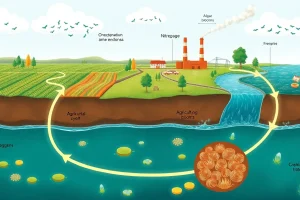
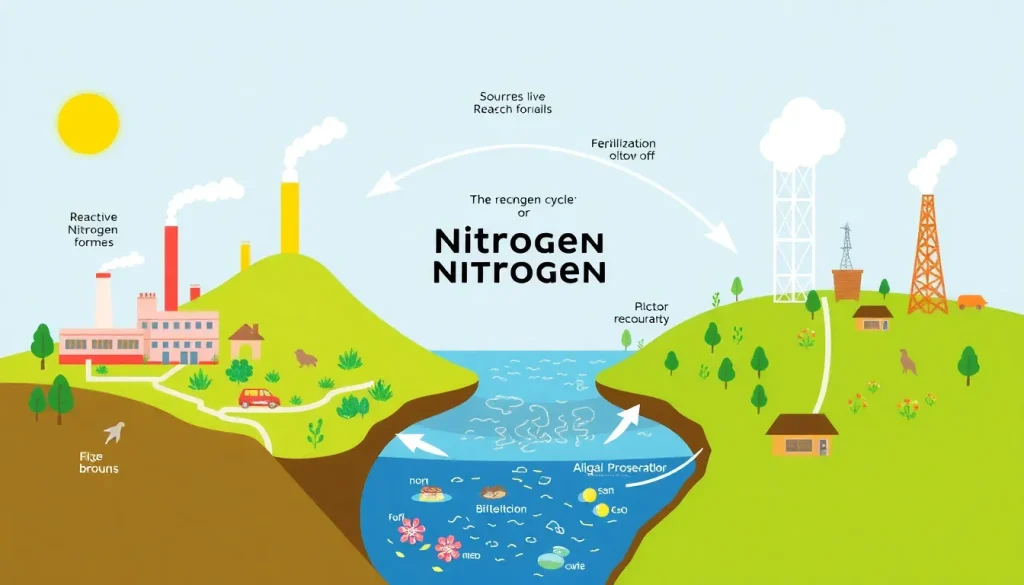
The increase in reactive nitrogen has been described as a “cascade” because a single nitrogen atom can cause a sequence of environmental effects as it moves through different forms. For example, ammonia released from fertilizer can contribute to particulate matter in the air, then deposit onto land and water, causing eutrophication, and eventually be converted to nitrous oxide, a potent greenhouse gas. This cascade makes nitrogen pollution a complex, multi-faceted problem that requires a holistic approach to management.
How It Works
The nitrogen cycle involves several key processes that convert nitrogen between its inert and reactive forms. The primary natural process is nitrogen fixation, where N₂ is converted into ammonia (NH₃) by bacteria or lightning. Once in reactive form, nitrogen undergoes nitrification (conversion of ammonia to nitrite and then nitrate), assimilation (uptake by plants and animals), ammonification (decomposition of organic matter back to ammonia), and denitrification (conversion of nitrate back to N₂ gas, with some release of N₂O). Human activities have intensified these processes, particularly through industrial nitrogen fixation and fossil fuel combustion, which directly emit nitrogen oxides (NOₓ).
In the environment, reactive nitrogen moves through air, water, and soil. Ammonia volatilizes from fertilizers and livestock waste, contributing to particulate matter formation. Nitrate leaches into groundwater and runs off into surface waters, causing eutrophication. Nitrous oxide, a byproduct of nitrification and denitrification, is a long-lived greenhouse gas that also depletes stratospheric ozone. The mobility of reactive nitrogen means that a single molecule can contribute to multiple environmental problems as it travels through the ecosystem, a phenomenon known as the nitrogen cascade.
Environmental and Human Impacts
The environmental impacts of excess reactive nitrogen are diverse and interconnected. In the atmosphere, nitrogen oxides (NOₓ) and ammonia (NH₃) contribute to the formation of ground-level ozone and fine particulate matter (PM2.5), which harm human respiratory health and reduce visibility. NOₓ and sulfur dioxide also lead to acid rain, which damages forests, soils, and aquatic ecosystems. Nitrous oxide (N₂O) is a powerful greenhouse gas with a global warming potential approximately 300 times that of carbon dioxide over a 100-year period, and it is the dominant ozone-depleting substance emitted today.
In aquatic systems, nitrogen runoff from agricultural fields and urban areas causes eutrophication—an over-enrichment of nutrients that leads to explosive algae growth. When these algae die and decompose, they consume oxygen, creating “dead zones” where most marine life cannot survive. Excess nitrogen also contributes to biodiversity loss on land, as nitrogen-loving species outcompete those adapted to low-nitrogen conditions. Human health is affected through contaminated drinking water (nitrate can cause methemoglobinemia, or “blue baby syndrome”) and through the respiratory effects of air pollutants derived from reactive nitrogen.
Main Causes or Drivers
The primary driver of increased reactive nitrogen in the environment is the production and use of synthetic nitrogen fertilizers. The Haber-Bosch process, which converts atmospheric N₂ and hydrogen from natural gas into ammonia, is the foundation of modern agriculture and supports roughly half of the world’s food production. However, only a fraction of the nitrogen applied to crops is actually taken up by plants; the rest is lost to the environment through volatilization, leaching, and runoff. Livestock farming is another major source, as animal manure releases ammonia and nitrous oxide.
Fossil fuel combustion in power plants, vehicles, and industrial processes releases nitrogen oxides (NOₓ) into the atmosphere. These emissions contribute to smog, acid rain, and particulate matter. Additionally, the cultivation of leguminous crops like soybeans and alfalfa, which host nitrogen-fixing bacteria, adds reactive nitrogen to soils. While this is a natural process, the scale of legume agriculture has increased the overall input. Urban and industrial wastewater also discharge nitrogen compounds into waterways, further exacerbating the problem.
Solutions
Addressing the challenges of excess reactive nitrogen requires a multi-pronged approach that improves nitrogen use efficiency across all sectors. In agriculture, precision farming techniques—such as using sensors to apply fertilizer only where and when needed—can significantly reduce nitrogen losses. Enhanced efficiency fertilizers, including controlled-release formulations and nitrification inhibitors, help keep nitrogen in the soil longer. Crop rotation and cover cropping can also improve soil nitrogen retention and reduce the need for synthetic inputs.
On the energy and transportation front, transitioning to cleaner fuels and adopting emission control technologies like catalytic converters and selective catalytic reduction can lower NOₓ emissions. Dietary shifts toward plant-based foods can reduce the demand for nitrogen-intensive livestock production. At the policy level, integrated nitrogen management strategies that consider the entire nitrogen cycle—rather than addressing air, water, and climate issues separately—are essential. International cooperation, such as through the United Nations Environment Programme’s efforts on nitrogen, can help coordinate action and set targets for reducing nitrogen pollution.
Common Misconceptions
A common misconception is that all nitrogen is harmful or that nitrogen itself is a pollutant. In reality, nitrogen is essential for life, and the problem is the excess of reactive forms in the wrong places. Another misunderstanding is that nitrogen pollution is solely a fertilizer issue; in fact, fossil fuel combustion and livestock waste are equally significant sources. Some people also believe that organic farming eliminates nitrogen pollution, but organic systems can still lose nitrogen through leaching and volatilization, though they often rely on slower-release sources.
There is also confusion about the difference between nitrogen gas (N₂) and nitrous oxide (N₂O). While N₂ is inert and harmless, N₂O is a potent greenhouse gas. Finally, many assume that nitrogen’s effects are local, but reactive nitrogen can travel long distances in the atmosphere and water, making it a transboundary and global issue. Understanding these nuances is critical for effective communication and policy-making.
FAQ
What is reactive nitrogen?
Reactive nitrogen refers to all nitrogen compounds that are chemically, biologically, or radiatively active, including ammonia, nitrogen oxides, nitrates, and organic nitrogen. It excludes inert dinitrogen gas (N₂) that makes up most of the atmosphere.
How does reactive nitrogen affect the environment?
Excess reactive nitrogen causes a cascade of environmental problems: air pollution (smog, particulate matter), acid rain, water eutrophication and dead zones, climate change (via nitrous oxide), and stratospheric ozone depletion.
Why is reactive nitrogen important?
Reactive nitrogen is essential for life as a nutrient, but its overabundance due to human activities is a major global environmental challenge. Managing it is crucial for food security, human health, and ecosystem integrity.
References
- Galloway, J.N., et al. (2003). 'The Nitrogen Cascade.' BioScience, 53(4), 341–356.
- United Nations Environment Programme (UNEP). (2019). 'Frontiers 2018/19: Emerging Issues of Environmental Concern.' Chapter on Nitrogen.
- Intergovernmental Panel on Climate Change (IPCC). (2021). 'Climate Change 2021: The Physical Science Basis.' Contribution of Working Group I to the Sixth Assessment Report.