In brief
At a glance
Quick Facts
- Definition
- Engineered systems that mimic natural wetlands to treat wastewater by removing nutrients like nitrogen and phosphorus.
- Main types
- Surface flow (SF) and subsurface flow (SSF), including horizontal and vertical flow designs.
- Key removal processes
- Nitrification-denitrification for nitrogen; sorption, precipitation, and plant uptake for phosphorus.
- Typical applications
- Municipal wastewater, agricultural runoff, stormwater, industrial effluents, and landfill leachate.
- Land requirement
- Generally larger than conventional treatment plants; area depends on flow and nutrient load.
- Energy use
- Low to none; relies on gravity flow and natural processes, reducing operational costs.
- Climate sensitivity
- Performance can decrease in cold weather due to reduced microbial activity and plant dormancy.
- Co-benefits
- Habitat creation, flood control, carbon sequestration, and recreational/aesthetic value.
Key Takeaways
- Constructed wetlands are engineered systems that use natural processes to remove nutrients like nitrogen and phosphorus from wastewater, stormwater, and agricultural runoff.
- They rely on a combination of physical, chemical, and biological mechanisms, including sedimentation, filtration, adsorption, plant uptake, and microbial transformations.
- Nutrient removal in constructed wetlands is highly effective but depends on design, climate, vegetation, and maintenance; they are particularly valuable for reducing eutrophication in downstream water bodies.
- While offering low-cost, low-energy treatment and additional ecosystem services, constructed wetlands require careful design and management to avoid issues like clogging, greenhouse gas emissions, and seasonal performance variability.
What Is Constructed Wetlands for Nutrient Removal?
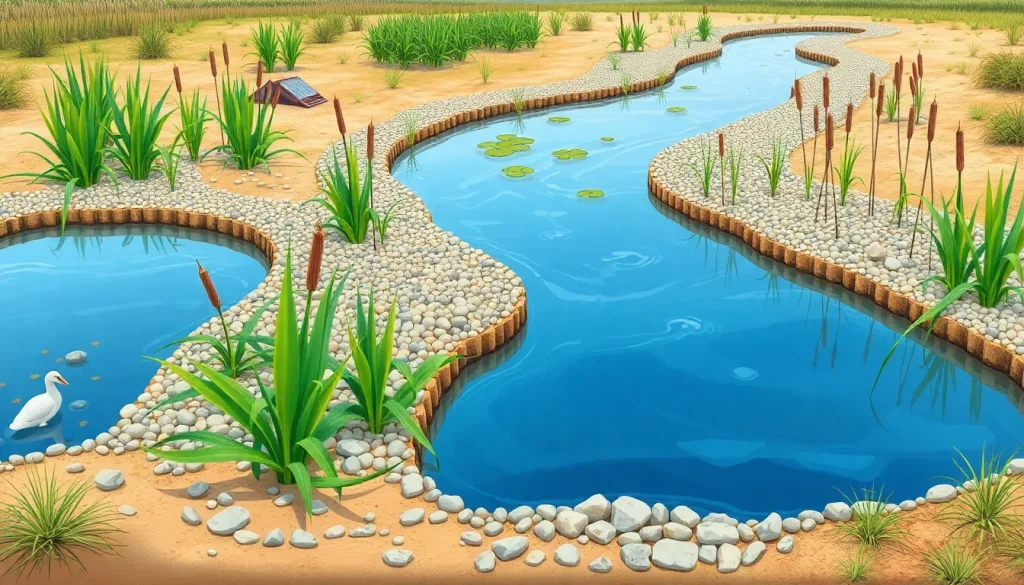
Constructed wetlands for nutrient removal are human-made systems designed to mimic the functions of natural wetlands in treating wastewater, stormwater, or agricultural runoff by removing excess nutrients—primarily nitrogen and phosphorus. These systems consist of shallow basins or channels filled with porous media (such as gravel, sand, or soil) and planted with emergent aquatic vegetation. As water flows through the wetland, a combination of physical, chemical, and biological processes reduces nutrient concentrations, improving water quality before it is discharged into the environment or reused.
Unlike conventional wastewater treatment plants that rely heavily on mechanical and chemical processes, constructed wetlands harness the natural abilities of plants, microorganisms, and substrates to break down and assimilate pollutants. They are considered a sustainable, low-energy, and cost-effective treatment technology, particularly suitable for small communities, decentralized systems, and agricultural settings. The primary goal of nutrient removal is to prevent eutrophication—the excessive enrichment of water bodies with nutrients that leads to algal blooms, oxygen depletion, and degradation of aquatic ecosystems.
How It Works
Constructed wetlands remove nutrients through a series of interconnected physical, chemical, and biological processes that occur as water moves through the system. The design of the wetland—whether it is a surface flow (SF) or subsurface flow (SSF) system—influences which mechanisms dominate. In surface flow wetlands, water flows above the substrate, exposing it to the atmosphere and allowing for processes like volatilization and direct plant uptake. In subsurface flow wetlands, water moves horizontally or vertically through a porous medium, promoting filtration, adsorption, and microbial activity in the root zone.
Nitrogen removal primarily occurs through microbial nitrification and denitrification. Ammonium (NH₄⁺) in the wastewater is first oxidized to nitrate (NO₃⁻) by nitrifying bacteria under aerobic conditions, typically in the root zone or near the water surface. The nitrate is then converted to nitrogen gas (N₂) by denitrifying bacteria under anoxic conditions, which are common in the saturated substrate. This gas escapes to the atmosphere, permanently removing nitrogen from the water. Plant uptake also contributes, but harvested biomass typically accounts for only a small fraction of total nitrogen removal unless plants are regularly harvested. Phosphorus removal relies on sorption to the substrate, precipitation with minerals like iron, aluminum, or calcium, and uptake by plants and microorganisms. However, the capacity for phosphorus sorption is finite and can diminish over time as binding sites become saturated.
Key processes include:
- Sedimentation and filtration: Particulate nutrients settle out or are trapped in the media.
- Microbial transformations: Nitrification, denitrification, and mineralization convert nutrients into gaseous forms or biomass.
- Plant uptake: Wetland vegetation assimilates nutrients into tissue, though this is often a minor removal pathway unless plants are harvested.
- Adsorption and precipitation: Phosphorus binds to substrate particles or forms insoluble compounds.
- Volatilization: Ammonia can be lost to the atmosphere under high pH conditions.
Importance and Impact
Constructed wetlands play a critical role in mitigating nutrient pollution, which is one of the most widespread water quality problems globally. Excess nitrogen and phosphorus from agricultural runoff, sewage, and industrial discharges fuel eutrophication in lakes, rivers, and coastal waters, leading to harmful algal blooms, hypoxia (low oxygen), and loss of aquatic biodiversity. By intercepting and treating nutrient-rich water before it reaches sensitive ecosystems, constructed wetlands help protect drinking water sources, recreational waters, and fisheries. They are particularly valuable in rural and peri-urban areas where centralized wastewater treatment is not feasible or cost-effective.
Beyond nutrient removal, these systems provide multiple co-benefits. They create wildlife habitat, support biodiversity, and can be integrated into green spaces for public recreation and education. They also contribute to flood control and groundwater recharge. In agricultural settings, constructed wetlands can treat non-point source pollution from tile drainage or livestock operations, reducing the nutrient load entering streams and rivers. Their low energy requirements and minimal use of chemicals make them an environmentally friendly alternative to conventional treatment, aligning with principles of green infrastructure and sustainable water management.
Benefits, Limitations and Trade-offs
Constructed wetlands offer numerous advantages over traditional treatment technologies. They have lower construction and operational costs, require no external energy inputs (relying on gravity and solar energy), and need less skilled labor for operation and maintenance. They are robust and can handle variable flow rates and pollutant loads, making them suitable for decentralized applications. Additionally, they provide aesthetic and ecological benefits, such as wildlife habitat and recreational opportunities, which are not typically associated with conventional treatment plants.
However, constructed wetlands also have limitations. They require relatively large land areas compared to mechanical treatment systems, which can be a constraint in densely populated regions. Performance can vary seasonally, with reduced nutrient removal in cold climates due to slower microbial activity and plant dormancy. Phosphorus removal efficiency may decline over time as the substrate becomes saturated, necessitating media replacement or additional treatment steps. There is also a risk of greenhouse gas emissions, particularly nitrous oxide (N₂O) and methane (CH₄), from microbial processes. Proper design, including sizing, substrate selection, and vegetation management, is essential to maximize benefits and minimize drawbacks. Maintenance requirements, such as sediment removal and plant harvesting, must be considered for long-term performance.
What the Evidence Shows
Extensive research and practical applications have demonstrated the effectiveness of constructed wetlands for nutrient removal. Studies consistently show that well-designed systems can achieve high removal rates for nitrogen (often 40–80%) and phosphorus (30–90%), depending on the wetland type, loading rates, and environmental conditions. Subsurface flow wetlands tend to be more efficient for nitrogen removal due to the close contact between wastewater and microbial biofilms on the media, while surface flow wetlands can effectively remove phosphorus through sedimentation and plant uptake. Long-term monitoring data from operational systems in North America, Europe, and Australia confirm that constructed wetlands can reliably meet stringent discharge standards when properly maintained.
Research also highlights the importance of design parameters such as hydraulic retention time, water depth, and plant species selection. For example, wetlands planted with fast-growing, high-nutrient-uptake species like cattails (Typha spp.) or reeds (Phragmites spp.) can enhance nutrient removal, but regular harvesting may be needed to prevent nutrient release during senescence. Hybrid systems that combine different wetland types or integrate pre-treatment steps (e.g., settling ponds) often achieve better overall performance. Despite the wealth of positive data, uncertainties remain regarding long-term phosphorus removal sustainability and the quantification of greenhouse gas emissions, prompting ongoing research into improved substrates and operational strategies.
Common Misconceptions
One common misconception is that constructed wetlands are simply natural swamps or ponds that can treat any type of wastewater without design or maintenance. In reality, they are carefully engineered systems that require specific hydraulic and organic loading rates, substrate selection, and vegetation management to function effectively. Another misunderstanding is that plants are the primary nutrient removal mechanism; while plants play a role, microbial processes and substrate interactions are often more significant. Additionally, some believe that constructed wetlands are maintenance-free, but they require periodic sediment removal, plant harvesting, and monitoring to sustain performance. Finally, there is a perception that constructed wetlands can completely replace conventional treatment, but they are often best suited as a component of a treatment train, particularly for polishing or tertiary treatment.
FAQ
What is a constructed wetland for nutrient removal?
It is an engineered system that uses natural processes involving plants, soils, and microbes to remove nitrogen and phosphorus from wastewater, stormwater, or agricultural runoff.
How does a constructed wetland remove nutrients?
Nutrients are removed through sedimentation, filtration, microbial transformations (like nitrification-denitrification), plant uptake, and chemical adsorption/precipitation.
Why is nutrient removal important?
Excess nutrients cause eutrophication, leading to harmful algal blooms, oxygen depletion, and degradation of aquatic ecosystems. Removing them protects water quality and public health.
References
- U.S. Environmental Protection Agency. (2000). Constructed Wetlands Treatment of Municipal Wastewaters. EPA/625/R-99/010.
- Kadlec, R.H. and Wallace, S.D. (2009). Treatment Wetlands. 2nd ed. CRC Press.
- Vymazal, J. (2007). Removal of nutrients in various types of constructed wetlands. Science of the Total Environment, 380(1-3), 48-65.