In brief
At a glance
Quick Facts
- Verdict
- Complementary
- Problem addressed
- Transportation greenhouse gas emissions and urban congestion
- Evidence strength
- Moderate
- Potential scale
- Global
- Relative cost
- Moderate to High
- Time to impact
- Years to Decades
Quick verdict
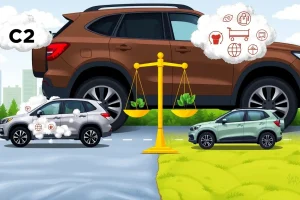
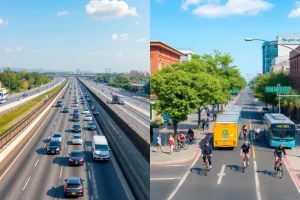
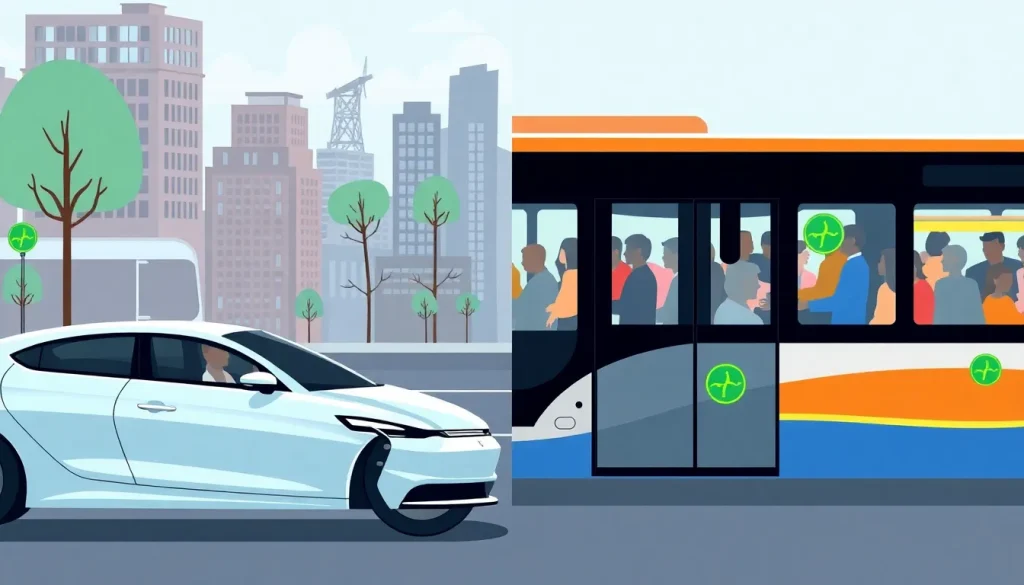
Electric cars and public transport are not mutually exclusive solutions; they are complementary components of a sustainable transport system. Public transport offers greater potential for reducing energy use, emissions, and congestion per passenger-kilometer, particularly in dense urban areas, but requires substantial infrastructure investment and behavioral shifts. Electric cars can decarbonize private mobility more rapidly in car-dependent regions, yet they do not address congestion, land use, or lifecycle environmental impacts. The most effective approach integrates both, prioritizing public and active transport where feasible while electrifying remaining private vehicles.
Problem addressed
Transportation accounts for approximately 15–20% of global CO₂ emissions, with road vehicles responsible for the majority. Beyond climate change, the sector contributes to urban air pollution, noise, traffic congestion, and land consumption. The problem is acute in rapidly urbanizing regions where private car ownership is rising. Both electric cars and public transport aim to reduce the environmental footprint of mobility, but they tackle different aspects: electric cars address tailpipe emissions, while public transport addresses vehicle volume and per-capita energy use.
How the solution works
Electric cars replace internal combustion engines with battery-electric powertrains, eliminating tailpipe emissions. When charged with low-carbon electricity, they can significantly reduce lifecycle greenhouse gas emissions compared to conventional vehicles. Public transport—buses, trains, trams, and metros—moves many people in shared vehicles, achieving high occupancy rates that slash per-passenger energy use and emissions. Both solutions can be powered by renewable electricity, but public transport inherently requires fewer vehicles and less infrastructure per traveler, reducing material throughput and land use.
Evidence strength
A large body of lifecycle assessment (LCA) research consistently shows that public transport emits less CO₂ per passenger-kilometer than private cars, including electric ones, especially when occupancy is high. For example, a typical diesel bus with 20 passengers can have lower per-capita emissions than a single-occupancy electric car. However, the advantage narrows if public transport runs empty or if the electric car is charged with very clean electricity. Evidence on electric cars is robust regarding tailpipe emissions, but LCAs vary widely depending on grid mix, battery manufacturing, and vehicle lifetime. Studies generally agree that electric cars have lower lifecycle emissions than conventional cars, but they still carry a significant manufacturing footprint. The evidence base is moderate to strong, but context-specific.
Potential scale
Public transport can scale to serve millions of daily trips in dense cities, but its viability depends on population density, urban form, and network quality. In low-density suburbs or rural areas, fixed-route public transport often struggles to attract sufficient ridership. Electric cars can theoretically replace the global fleet of over 1 billion vehicles, but scaling faces constraints from battery material supply (lithium, cobalt), charging infrastructure, and grid capacity. Both solutions have global potential, but public transport is inherently limited by geography, while electric cars face resource and infrastructure bottlenecks.
Cost considerations
Electric cars currently have higher upfront purchase prices than conventional cars, though operating costs (fuel, maintenance) are lower. Total cost of ownership is approaching parity in some markets, aided by subsidies. Public transport requires large capital investments in vehicles, tracks, stations, and ongoing operational subsidies. However, per-trip costs to users are typically lower, and societal costs (congestion, pollution, accidents) are reduced. Cost-effectiveness analyses often favor public transport in dense corridors, while electric cars may be more cost-effective in dispersed settings where fixed-route services are inefficient.
Implementation time
Electric cars can be adopted as quickly as the vehicle fleet turns over—typically 10–20 years for a full transition, assuming supportive policies and charging infrastructure. Public transport projects, especially rail, can take decades from planning to operation. Bus rapid transit (BRT) systems can be implemented in a few years. Thus, electric cars offer a faster path to reducing tailpipe emissions from existing car-dependent populations, while public transport requires longer lead times but yields deeper systemic changes.
Environmental benefits
Both solutions reduce tailpipe emissions of CO₂, nitrogen oxides, and particulate matter. Public transport additionally reduces the total number of vehicles on the road, cutting congestion, road wear, and the need for parking spaces. Lifecycle analyses indicate that a full bus or train has a carbon footprint per passenger-kilometer that is often 50–80% lower than a single-occupancy electric car, even when accounting for vehicle manufacturing and infrastructure. However, if public transport runs at low occupancy, its advantage diminishes. Electric cars eliminate direct emissions but still require energy for manufacturing and electricity generation, and they perpetuate car-dependent land use patterns.
Social and economic co-benefits
Public transport enhances social equity by providing affordable mobility to non-drivers, reduces traffic fatalities, and fosters more compact, walkable urban development. It can also stimulate local economies through improved access to jobs and services. Electric cars reduce local air and noise pollution, which benefits public health, but they may exacerbate social inequity if only higher-income households can afford them. They also do not alleviate traffic congestion, which has economic costs. Both solutions can create jobs in manufacturing, infrastructure, and services.
Risks and unintended consequences
A rapid shift to electric cars without complementary policies could reinforce car dependency, urban sprawl, and road infrastructure expansion, locking in high energy use and land consumption. Battery production raises concerns about mining impacts, resource depletion, and labor practices. Increased electricity demand may strain grids and, if not matched with renewables, could shift emissions upstream. Public transport risks include high upfront costs, potential underutilization, and political opposition. Both solutions require careful integration with land-use planning and clean energy policies to avoid unintended negative outcomes.
Where it works best
Electric cars are most effective in suburban and rural areas with low population density, where public transport is uneconomical and car ownership is entrenched. They also suit regions with clean electricity grids. Public transport excels in dense urban corridors, central business districts, and along high-demand routes where ridership can justify frequent service. Cities with existing transit culture and supportive land-use policies see the greatest benefits.
Where it may not work
Electric cars may offer limited emissions reductions in regions with coal-dominated electricity grids, though they still improve local air quality. In very dense cities, they do not solve congestion and parking scarcity. Public transport is often a poor fit for low-density, dispersed settlements where fixed routes cannot efficiently serve scattered populations. In such contexts, demand-responsive services or electric car-sharing might be more appropriate.
Comparison with alternatives
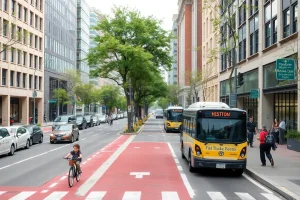
Walking, cycling, and micromobility (e-bikes, scooters) are even more energy-efficient and space-efficient for short trips, with near-zero emissions. Car-sharing and ride-hailing can reduce private car ownership but may increase vehicle miles traveled if not regulated. The optimal strategy is a hierarchy: prioritize active transport and public transit for most trips, electrify remaining private vehicles, and integrate modes through seamless payment and transfer systems. Compared to these, electric cars alone are an incremental improvement, while public transport offers transformative change in urban mobility.
Case studies
Oslo, Norway, has achieved high electric car adoption (over 80% of new car sales) through incentives and a renewable-based grid, significantly cutting transport emissions. However, the city also invests heavily in public transport and cycling infrastructure. Curitiba, Brazil, pioneered bus rapid transit (BRT) in the 1970s, creating a high-capacity, low-cost system that serves over 2 million passengers daily and has been replicated globally. Shenzhen, China, electrified its entire bus fleet (over 16,000 buses) by 2017, demonstrating that public transport can be zero-emission at scale. London’s congestion charge and investment in buses and cycling have reduced car traffic and improved air quality, showing the power of integrated policies.
Final assessment
The evidence strongly supports a combined approach: public transport and active mobility should be prioritized in urban areas to maximize efficiency, equity, and environmental gains, while electric cars can decarbonize the remaining private vehicle fleet, especially in lower-density regions. Neither solution alone is sufficient. Policymakers should tailor strategies to local density, grid cleanliness, and existing infrastructure, ensuring that electric car adoption does not undermine investments in public and active transport. The transition to sustainable mobility requires both technological shift and behavioral change, with public transport forming the backbone of efficient urban systems.
FAQ
Are electric cars always better for the climate than public transport?
No. While electric cars produce zero tailpipe emissions, their lifecycle carbon footprint depends on the electricity source and battery manufacturing. A full bus or train often has lower per-passenger emissions than a single-occupancy electric car, especially when occupancy is high. In areas with very clean grids and low public transport ridership, the difference narrows.
Can public transport replace all car trips?
Not entirely. Public transport is most efficient in dense urban corridors. In low-density suburbs or rural areas, fixed-route services may be impractical. A combination of public transport, walking, cycling, and electric cars (or car-sharing) is needed to cover all trip types.
What is the biggest barrier to scaling up public transport?
High upfront capital costs and long planning timelines are major barriers. Political will, land acquisition, and integration with existing urban fabric also pose challenges. Operational subsidies may be needed to keep fares affordable, which can strain public budgets.
References
- International Energy Agency (IEA), Global EV Outlook 2023
- IPCC Sixth Assessment Report, Working Group III, Chapter 10: Transport
- Chester, M. V., & Horvath, A. (2009). Environmental assessment of passenger transportation should include infrastructure and supply chains. Environmental Research Letters.
- UITP (International Association of Public Transport), The Impact of Public Transport on Climate Change, 2021
- European Environment Agency, Transport and Environment Report 2022