In brief
At a glance
Quick Facts
- Definition
- Carbon captured and stored by coastal and marine ecosystems, mainly mangroves, seagrasses, and salt marshes.
- Carbon Storage Rate
- Up to 10 times higher per unit area than terrestrial forests.
- Global Coverage
- Less than 0.5% of the ocean surface but account for over 50% of carbon burial in ocean sediments.
- Mangrove Carbon Stocks
- Average total ecosystem carbon stock is about 1,000 tonnes of carbon per hectare.
- Seagrass Carbon Stocks
- Seagrass meadows store up to 1,400 tonnes of carbon per hectare in their sediments.
- Salt Marsh Carbon Stocks
- Salt marshes can store carbon at rates of 210 grams per square meter per year.
- Annual Loss Rates
- Mangroves are lost at 1–2% per year; seagrasses at 1.5% per year; salt marshes at 1–2% per year.
- Emission from Degradation
- Degradation of blue carbon ecosystems releases up to 1 billion tonnes of CO₂ annually.
- Co-benefits
- Provide habitat for fisheries, protect coastlines from storms, and improve water quality.
- Carbon Market Potential
- Blue carbon credits are emerging as a tool for climate finance and conservation.
Key Takeaways
- Blue carbon is the carbon stored in coastal and marine ecosystems, primarily mangroves, seagrasses, and salt marshes.
- These ecosystems sequester carbon up to 10 times faster per unit area than terrestrial forests and can store it for millennia.
- Despite covering less than 2% of the ocean area, blue carbon habitats account for approximately 50% of carbon burial in ocean sediments.
- Destruction of these ecosystems releases vast amounts of stored carbon, contributing significantly to global greenhouse gas emissions.
- Conserving and restoring blue carbon ecosystems is a cost-effective climate mitigation strategy with co-benefits for biodiversity, fisheries, and coastal protection.
What Is Blue Carbon Explained: Mangroves, Seagrasses and Salt Marshes?
Blue carbon is the term used to describe the carbon dioxide captured from the atmosphere and stored in coastal and marine ecosystems. The primary ecosystems responsible for blue carbon sequestration are mangroves, seagrasses, and salt marshes. These vegetated coastal habitats have a remarkable ability to absorb and store carbon in their biomass and, more importantly, in the underlying sediments for centuries to millennia. Unlike terrestrial forests, which store carbon mainly in woody biomass and release it when they die or burn, blue carbon ecosystems accumulate carbon in waterlogged, oxygen-poor soils, where decomposition is extremely slow, leading to long-term storage.
The concept of blue carbon emerged from the recognition that coastal ecosystems play a disproportionately large role in the global carbon cycle. While they occupy only a fraction of the ocean surface, their carbon burial rates per unit area are orders of magnitude higher than those of terrestrial forests. This makes them a critical component of nature-based solutions to climate change, alongside their well-documented roles in supporting fisheries, protecting coastlines from storms, and maintaining water quality.
Overview
Blue carbon ecosystems are found along the coastlines of every continent except Antarctica. Mangroves are salt-tolerant trees and shrubs that grow in tropical and subtropical intertidal zones, forming dense forests that trap sediment and organic matter. Seagrasses are flowering plants that form extensive underwater meadows in shallow coastal waters, while salt marshes are grassy wetlands in temperate and high-latitude intertidal areas. Together, these ecosystems cover an estimated 49 million hectares globally, yet they are being lost at rates of 1–7% per year due to coastal development, aquaculture, pollution, and climate change.
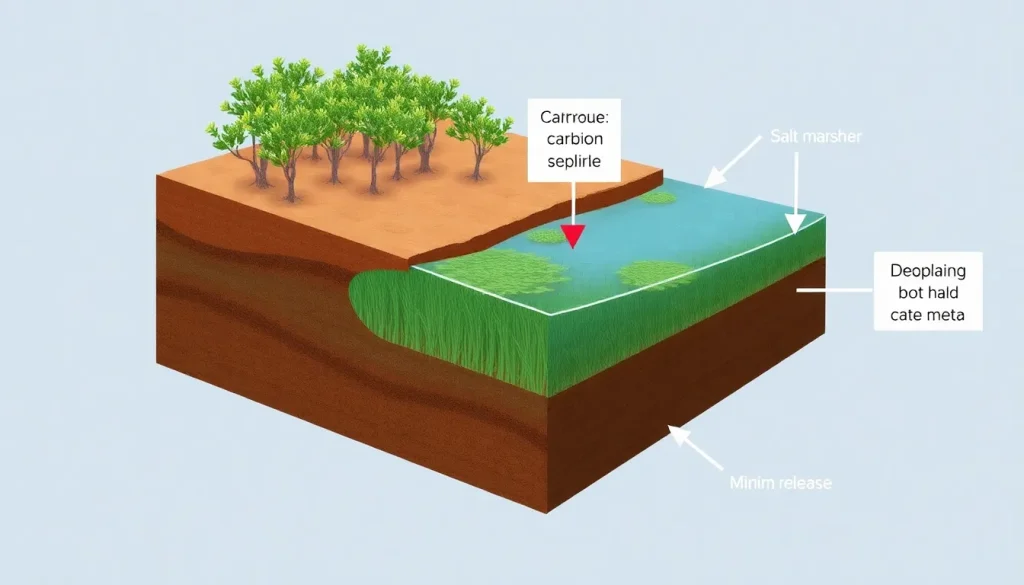
The carbon stored in these systems is partitioned between living biomass (aboveground and belowground) and the much larger sediment carbon pool. In mangroves, for example, over 70% of the total carbon stock may be held in the soil. When these habitats are degraded or destroyed, the stored carbon is exposed to oxygen, leading to rapid decomposition and release of carbon dioxide back into the atmosphere. This process can continue for decades, turning these ecosystems from carbon sinks into significant carbon sources.
How It Works
Blue carbon ecosystems capture carbon dioxide through photosynthesis, converting it into plant biomass. Mangroves, seagrasses, and salt marsh plants are highly productive, but the key to their long-term carbon storage lies in their waterlogged, anaerobic soils. In these oxygen-poor conditions, organic matter decomposes very slowly, allowing carbon-rich sediments to accumulate vertically over thousands of years. In some cases, these sediments can be several meters thick, storing carbon that was captured centuries ago.
The continuous trapping of sediment particles by the vegetation also contributes to carbon burial. Mangroves and salt marshes, with their complex root systems, are particularly effective at trapping and stabilizing sediments brought in by tides and rivers. Seagrasses, while not emergent, reduce water flow and wave energy, promoting the settlement of organic particles. This combination of high primary productivity and slow decomposition makes blue carbon ecosystems among the most efficient natural carbon sinks on Earth.
Importance and Impact
The significance of blue carbon extends beyond climate regulation. These ecosystems provide essential habitat for countless marine and terrestrial species, including commercially important fish and shellfish. They act as natural buffers against storm surges and coastal erosion, protecting communities and infrastructure. Mangroves, for instance, can reduce wave energy by up to 66%, while salt marshes and seagrasses stabilize shorelines and improve water quality by filtering pollutants.
Economically, the value of blue carbon ecosystems is immense. The carbon stored in their soils and biomass represents a potential source of carbon credits in voluntary and compliance carbon markets. Additionally, the fisheries, tourism, and coastal protection services they provide are estimated to be worth trillions of dollars globally. However, these values are often overlooked in coastal development decisions, leading to continued degradation and loss.
Common Misconceptions
One common misconception is that blue carbon ecosystems are only important for their carbon storage. While their carbon sequestration capacity is extraordinary, their role in supporting biodiversity, protecting coastlines, and sustaining local livelihoods is equally vital. Another misunderstanding is that all coastal wetlands are blue carbon ecosystems; in reality, only mangroves, seagrasses, and salt marshes have the unique combination of high productivity and long-term carbon burial in sediments.
Some also assume that blue carbon projects are a simple substitute for reducing fossil fuel emissions. While these ecosystems are powerful carbon sinks, their capacity is finite and cannot offset unlimited emissions. Additionally, there is a misconception that blue carbon habitats are pristine and untouched; in fact, they are among the most threatened ecosystems globally, with significant historical and ongoing losses. Restoration is possible but often challenging and expensive.
What Individuals Can Do
Individuals can support blue carbon conservation by reducing their personal carbon footprint, which lessens the overall pressure on all carbon sinks. Participating in local coastal cleanups and avoiding products that contribute to habitat destruction—such as unsustainably farmed shrimp that may be linked to mangrove deforestation—can make a direct difference. Supporting organizations that work to protect and restore coastal ecosystems through donations or volunteer efforts is another tangible action.
On a broader scale, individuals can advocate for policies that prioritize blue carbon conservation, such as the inclusion of coastal wetlands in national climate commitments and marine protected areas. Educating others about the value of these ecosystems helps build public support. When visiting coastal areas, practicing responsible tourism—like not disturbing seagrass beds or salt marshes—also contributes to their preservation.
Data Limitations and Uncertainties
Despite growing recognition, significant gaps remain in the scientific understanding of blue carbon. Global estimates of the extent and carbon stocks of these ecosystems vary widely due to inconsistent mapping methods and limited data in many regions, particularly for seagrasses and salt marshes. The rates of carbon sequestration and the long-term fate of stored carbon under different environmental conditions are also areas of active research.
Additionally, the permanence of blue carbon storage is not absolute. Disturbances such as storms, sea-level rise, and human activities can remobilize stored carbon, potentially releasing it back into the atmosphere. Quantifying these emissions accurately is challenging, and there is ongoing debate about how to account for them in carbon markets and national greenhouse gas inventories. Improved monitoring, reporting, and verification methods are needed to build confidence in blue carbon as a reliable climate mitigation tool.
Examples
One of the most well-documented blue carbon projects is the Mikoko Pamoja initiative in Kenya, which is the world’s first community-led mangrove conservation project to sell carbon credits. By protecting and restoring mangroves, the project generates revenue for local communities while sequestering carbon. In Indonesia, the Katingan Mentaya Project protects and restores peat swamp forests and mangroves, preventing the release of millions of tons of carbon dioxide equivalent.
In the United States, the restoration of salt marshes in the Gulf of Mexico following the Deepwater Horizon oil spill has incorporated blue carbon accounting. Australia’s seagrass restoration projects, such as those in Shark Bay, aim to recover carbon sinks damaged by extreme weather events. These examples demonstrate the feasibility of blue carbon projects across different ecosystem types and socioeconomic contexts, though scaling up remains a challenge.
FAQ
What is blue carbon?
Blue carbon is the carbon dioxide captured and stored by coastal and marine ecosystems, primarily mangroves, seagrasses, and salt marshes. These habitats sequester carbon in their biomass and, more importantly, in their sediments for long periods.
How do blue carbon ecosystems work?
They absorb CO₂ through photosynthesis and store it in plant tissues and oxygen-poor soils, where decomposition is slow. This allows carbon to accumulate over centuries, making them highly efficient carbon sinks.
Why does blue carbon matter?
Blue carbon ecosystems help mitigate climate change by removing CO₂ from the atmosphere. They also protect coastlines, support fisheries, and provide habitat for biodiversity, making their conservation crucial for both environmental and human well-being.
References
- Intergovernmental Panel on Climate Change (IPCC) Special Report on the Ocean and Cryosphere in a Changing Climate (2019)
- The Blue Carbon Initiative (Conservation International, IUCN, and IOC-UNESCO)
- National Oceanic and Atmospheric Administration (NOAA) – Coastal Blue Carbon