In brief
At a glance
Quick Facts
- Recyclable definition
- A product or package that can be collected, processed, and manufactured into a new product through established recycling programs.
- Recycled content
- Material that has been recovered or diverted from the waste stream, either during manufacturing (pre-consumer) or after consumer use (post-consumer).
- Reusable definition
- An item designed to be used multiple times for its original purpose without significant reprocessing.
- Green Guides (US)
- The FTC's Green Guides provide guidance on environmental marketing claims, including recyclable, recycled, and reusable, to prevent deception.
- ISO 14021
- An international standard specifying requirements for self-declared environmental claims, including recyclable, recycled content, and reusable.
- Chasing arrows symbol
- The Mobius loop or chasing arrows symbol does not automatically mean an item is recyclable; it often indicates resin type.
- Waste hierarchy
- The preferred order of waste management is reduce, reuse, recycle, with reuse generally having a lower environmental impact than recycling.
- Greenwashing risk
- Vague or unsubstantiated claims can mislead consumers and undermine trust in legitimate environmental labeling.
Key Takeaways
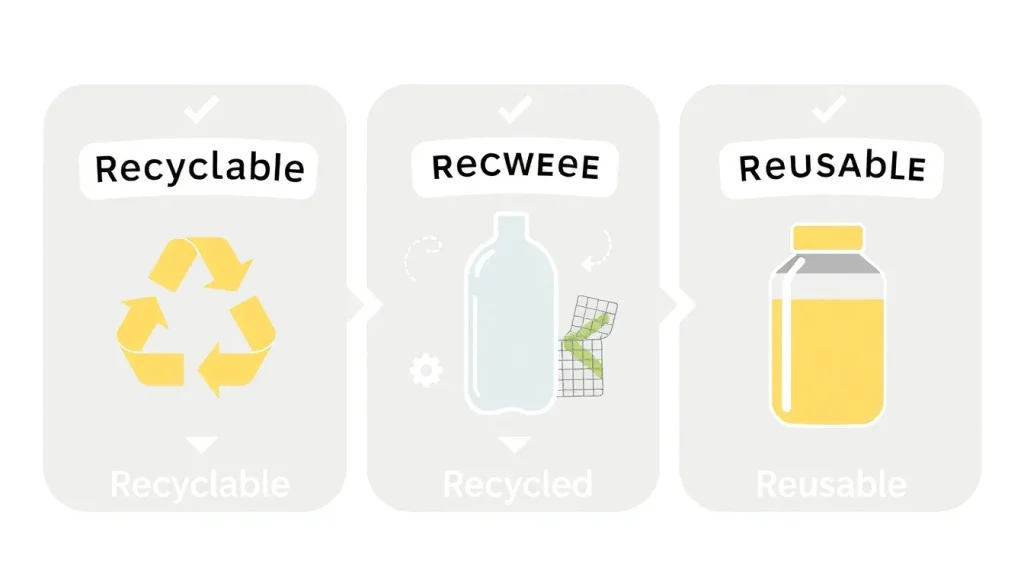
- Recyclable, recycled, and reusable are distinct environmental claims with specific meanings: recyclable means an item can be collected and reprocessed; recycled means it contains material recovered from waste; reusable means it is designed for multiple uses.
- The accuracy of these claims depends on local infrastructure, material properties, and consumer behavior, not just the label itself.
- Misleading or vague claims can constitute greenwashing, undermining trust and hindering genuine environmental progress.
- Understanding these terms empowers consumers to make better purchasing and disposal decisions, supporting a circular economy.
What Is Recyclable, Recycled and Reusable Claims Explained?
Recyclable, recycled, and reusable claims are environmental marketing terms used on products and packaging to communicate their end-of-life options or material content. A recyclable claim indicates that an item can be collected, separated, and reprocessed into a new product or material through established recovery systems. A recycled claim means the product or packaging contains material that has been recovered or diverted from the waste stream, either during manufacturing (pre-consumer) or after consumer use (post-consumer). A reusable claim signifies that the item is designed to be used multiple times for its original purpose without significant reprocessing, often through refilling, returning, or durable design.
These claims are part of a broader set of environmental labels and declarations that aim to guide consumers toward more sustainable choices. They are regulated to varying degrees around the world by standards and guidelines, such as those from the International Organization for Standardization (ISO) and national consumer protection agencies. The terms are often used on packaging, but their meaning depends heavily on context: a product labeled recyclable may not be recycled in practice if local facilities do not accept it, while a reusable claim may be undermined if the item is not actually reused. Understanding the precise definitions and limitations of these claims is essential for evaluating their credibility.
Overview
Environmental claims on products serve as a communication bridge between manufacturers and consumers, signaling a product’s potential environmental benefits. The three claims—recyclable, recycled, and reusable—address different stages of a product’s life cycle. Recyclable focuses on the end-of-life stage, indicating that the material can re-enter the manufacturing cycle. Recycled focuses on the material content, highlighting the use of recovered resources. Reusable focuses on the use phase, promoting extended product life and waste prevention. Together, they form a hierarchy of waste management strategies, with reuse generally considered more environmentally preferable than recycling, which in turn is preferable to disposal.
However, the effectiveness of these claims depends on a functioning system. A recyclable claim is only meaningful if collection, sorting, and reprocessing infrastructure exists and is accessible to consumers. A recycled content claim requires robust markets for recovered materials. A reusable claim relies on consumer participation and a system that enables multiple uses, such as returnable packaging or durable product design. Without these supporting systems, the claims can be misleading, leading to accusations of greenwashing—where companies overstate environmental benefits to appeal to eco-conscious consumers.
How It Works
The practical meaning of each claim is shaped by technical standards, regulations, and real-world systems. For a product to be labeled recyclable, it must be made of materials that are technically capable of being reprocessed, and a significant majority of consumers must have access to collection and processing facilities. In the United States, the Federal Trade Commission’s Green Guides advise that a recyclable claim should be qualified if recycling facilities are not available to at least 60% of consumers or communities where the item is sold. Similar guidance exists in other regions, such as the UK’s Competition and Markets Authority’s Green Claims Code.
Recycled content claims are typically verified through chain-of-custody certifications or mass-balance accounting. Products may be labeled as containing pre-consumer or post-consumer recycled material, with post-consumer content often viewed as more environmentally beneficial because it directly diverts waste from landfills. Reusable claims require that the product be designed for multiple trips or uses, and often involve a system for return, cleaning, and refilling. For example, a reusable shopping bag must be durable enough to withstand many uses, and a refillable container requires a collection and refilling infrastructure. Without these systems, the claim may be considered deceptive.
Importance and Impact
These claims play a critical role in the transition to a circular economy, where materials are kept in use for as long as possible. Accurate claims help consumers identify products that reduce waste, conserve resources, and lower environmental footprints. When claims are trustworthy, they can drive market demand for more sustainable products, encouraging manufacturers to design for recyclability, incorporate recycled materials, and develop reusable systems. This, in turn, can reduce pressure on virgin resources, decrease pollution, and mitigate climate change.
Conversely, misleading claims can have negative consequences. If consumers believe a product is recyclable when it is not accepted in local programs, it may contaminate recycling streams or end up in landfills, undermining trust in environmental labeling. Similarly, exaggerated recycled content claims can distort markets and disadvantage companies making genuine efforts. The integrity of these claims is therefore essential for the credibility of environmental marketing and the effectiveness of waste management policies.
Common Misconceptions
One widespread misconception is that the chasing-arrows symbol (♻) on a product automatically means it is recyclable. In reality, the symbol is often used merely to indicate the type of plastic resin, not that the item will be accepted by local recycling programs. Many plastics labeled with the symbol are not economically recyclable in most communities. Another misunderstanding is that “biodegradable” or “compostable” claims are equivalent to recyclable or recycled claims, when they refer to entirely different end-of-life pathways.
Consumers also frequently assume that a product labeled as recycled contains 100% post-consumer material, when in fact it may contain only a small percentage or be made from pre-consumer scrap that never left the manufacturing facility. Similarly, a reusable claim does not guarantee that the product will be reused; it only indicates that the design and intended use support multiple uses. Without proper consumer behavior and supporting systems, even well-designed reusable items can become single-use waste.
Benefits, Limitations and Trade-offs
The primary benefit of these claims is that they can guide consumers toward more sustainable choices, reducing waste and resource consumption. Recycled content claims support markets for recovered materials, creating economic incentives for collection and reprocessing. Reusable systems can significantly cut down on single-use waste and often have lower long-term environmental impacts if used enough times. Recyclable claims encourage design for recycling and can increase the supply of secondary raw materials.
However, each claim has limitations. Recyclable does not guarantee that an item will be recycled; it depends on local infrastructure and consumer participation. Recycled content may involve trade-offs, such as higher energy use in reprocessing or limitations on the number of times a material can be recycled without degradation. Reusable products often require more resources to manufacture initially and depend on consumer behavior to achieve environmental benefits; if a reusable bag is used only once, its impact may be higher than a single-use alternative. Additionally, the proliferation of environmental claims can lead to consumer confusion and skepticism, reducing their overall effectiveness.
What Individuals Can Do
Individuals can make more informed decisions by understanding the nuances behind these claims. When purchasing products, look for specific, qualified claims rather than vague terms like “eco-friendly” or “green.” Check local recycling guidelines to confirm whether a product labeled recyclable is actually accepted in your community’s program. Prioritize products with high post-consumer recycled content, as this directly supports recycling markets. For reusable items, commit to using them consistently and for their full intended lifespan to realize environmental benefits.
Beyond purchasing, individuals can reduce waste by practicing the waste hierarchy: first reduce consumption, then reuse items whenever possible, and finally recycle correctly. Avoid “wishcycling”—placing non-recyclable items in recycling bins in the hope they will be recycled—as this contaminates recycling streams. Support policies and companies that provide transparent, verified environmental claims, and provide feedback to brands that make vague or misleading claims. Small, consistent actions collectively drive demand for more sustainable products and systems.
FAQ
What is the difference between recyclable and recycled?
Recyclable means an item can be collected and reprocessed into new material, while recycled means the item already contains material that was recovered from the waste stream. A product can be recyclable without containing recycled content, and vice versa.
How can I tell if a product is truly recyclable?
Check local recycling guidelines, as recyclability depends on your area's facilities. Look for specific, qualified claims (e.g., 'recyclable where facilities exist') rather than just the chasing arrows symbol. The FTC Green Guides suggest that a claim should be qualified if recycling is not available to at least 60% of consumers.
Why does reusable matter if I can just recycle?
Reuse generally has a lower environmental impact than recycling because it avoids the energy and resources needed for reprocessing. It also prevents waste generation in the first place, aligning with the waste hierarchy of reduce, reuse, recycle.
References
- U.S. Federal Trade Commission, 'Green Guides' (16 CFR Part 260), guidance on environmental marketing claims.
- ISO 14021:2016, 'Environmental labels and declarations — Self-declared environmental claims (Type II environmental labelling)'.
- UK Competition and Markets Authority, 'Green Claims Code: making environmental claims', guidance for businesses.