In brief
At a glance
Quick Facts
- Fast removal
- About 50% of emitted CO₂ is absorbed by land and ocean sinks within 30 years.
- Long tail
- 20–35% of emitted CO₂ remains in the atmosphere after 1,000 years.
- Ultimate removal
- Complete removal via rock weathering takes over 100,000 years.
- Airborne fraction
- Approximately 45% of annual CO₂ emissions stay in the atmosphere.
- Ocean sink
- The ocean absorbs about 25% of human CO₂ emissions each year, causing acidification.
- Cumulative pollutant
- Warming is proportional to total cumulative CO₂ emissions, not annual rates.
- Irreversibility
- Even if emissions stop, elevated CO₂ and temperatures persist for centuries.
- Pre-industrial levels
- CO₂ varied between 180–300 ppm over the past 800,000 years; now exceeds 420 ppm.
Key Takeaways
- Carbon dioxide does not have a single atmospheric lifetime; it is removed through multiple processes operating on timescales from years to hundreds of thousands of years.
- About half of emitted CO₂ is absorbed by land and ocean sinks within a few decades, but the remaining fraction can linger for centuries to millennia.
- The long persistence of CO₂ means that climate impacts from today’s emissions are effectively irreversible on human timescales.
- Even if all emissions stopped, elevated atmospheric CO₂ and associated warming would persist for many centuries due to slow deep-ocean and geological removal.
What Is the Atmospheric Lifetime of Carbon Dioxide?
The atmospheric lifetime of carbon dioxide refers to the length of time that a molecule of CO₂, once emitted, remains in the atmosphere before being removed by natural processes. Unlike many other greenhouse gases, CO₂ does not have a single, well-defined lifetime. Instead, it is removed through a series of mechanisms that operate on vastly different timescales, from rapid uptake by plants and the ocean surface to extremely slow geological weathering. This complexity means that a pulse of CO₂ emitted today will not simply decay exponentially; rather, a fraction is removed relatively quickly, while the rest is distributed among various reservoirs and can persist for thousands of years.
In climate science, the concept of CO₂ lifetime is often described in terms of an “adjustment time” or “perturbation lifetime.” This is the time it takes for the atmosphere to return to equilibrium after a disturbance, such as a large emission of CO₂. Because the carbon cycle involves multiple interconnected sinks with different response times, the adjustment time is not a single number. The Intergovernmental Panel on Climate Change (IPCC) notes that a significant fraction of emitted CO₂ remains in the atmosphere for centuries to millennia, making it a long-lived greenhouse gas with enduring climate consequences.
Overview
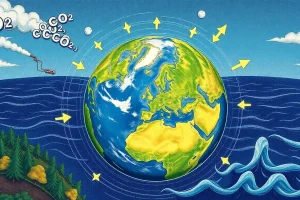
The fate of CO₂ in the atmosphere is governed by the global carbon cycle, which exchanges carbon among the atmosphere, land biosphere, oceans, and geological reservoirs. When CO₂ is released from burning fossil fuels or deforestation, it enters the atmosphere and is gradually redistributed. The fast components of the carbon cycle—photosynthesis by plants and absorption by the ocean surface—remove a substantial portion within years to decades. However, these sinks do not permanently sequester the carbon; they merely transfer it to other parts of the system where it can eventually return to the atmosphere.
On longer timescales, CO₂ is mixed into the deep ocean and ultimately neutralized by reactions with carbonate sediments and silicate rocks. These processes take thousands to hundreds of thousands of years. As a result, the atmospheric concentration of CO₂ does not simply decay to pre-industrial levels after emissions cease. Instead, it stabilizes at a level that is higher than the original, and the excess persists for millennia. This behavior is fundamentally different from gases like methane, which has a well-defined atmospheric lifetime of about 12 years due to chemical destruction in the atmosphere.
How It Works
The removal of CO₂ from the atmosphere involves several interconnected mechanisms, each with its own characteristic timescale:
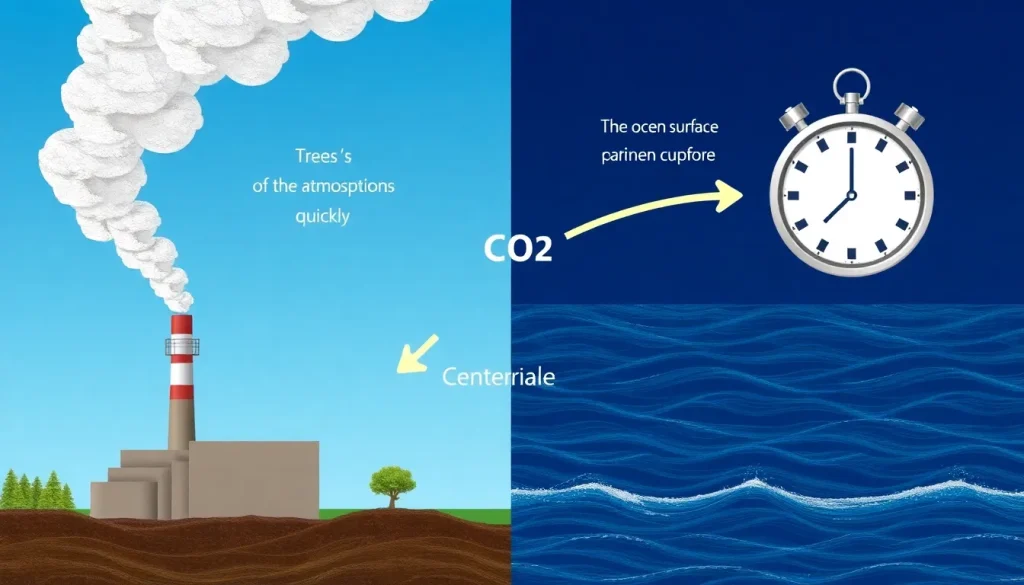
- Fast terrestrial uptake (years to decades): Plants absorb CO₂ through photosynthesis, storing carbon in biomass and soils. This sink is highly responsive but can saturate or even reverse if forests are cleared or soils degrade.
- Ocean surface exchange (months to decades): CO₂ dissolves in seawater, where it forms carbonic acid. The surface ocean equilibrates with the atmosphere relatively quickly, but the total amount it can absorb is limited by the Revelle factor—a chemical buffering effect that reduces the ocean’s capacity to take up additional CO₂.
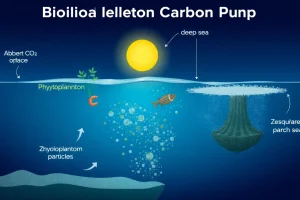
- Deep ocean mixing (centuries to millennia): Carbon-enriched surface waters are transported to the deep ocean through currents and mixing. This slow process sequesters CO₂ for hundreds to thousands of years, but the deep ocean eventually circulates back to the surface, potentially releasing some of the stored carbon.
- Carbonate compensation (thousands of years): Over millennia, the increased acidity from dissolved CO₂ dissolves carbonate sediments on the seafloor, which neutralizes the acid and allows the ocean to absorb more CO₂ from the atmosphere.
- Silicate weathering (tens to hundreds of thousands of years): The ultimate removal mechanism is the chemical weathering of silicate rocks on land, which consumes atmospheric CO₂ and delivers bicarbonate to the ocean, where it eventually forms carbonate sediments. This process restores atmospheric CO₂ to pre-industrial levels but operates on geological timescales.
Because these processes act in parallel and at different rates, the decay of a CO₂ perturbation is not a simple exponential. Models and observations show that after a pulse emission, the atmospheric concentration declines rapidly at first, then much more slowly, leaving a long tail that persists for millennia.
What the Evidence Shows
Ice core records provide direct evidence of the long-term behavior of CO₂. Air bubbles trapped in Antarctic ice show that atmospheric CO₂ concentrations varied between about 180 and 300 parts per million (ppm) over the past 800,000 years, never exceeding 300 ppm until the industrial era. The rapid rise to over 420 ppm today is unprecedented in this record. These data also reveal that natural changes in CO₂ were driven by orbital cycles and feedbacks, and that the removal of excess CO₂ after natural emissions took thousands of years.
Modern measurements and modeling confirm the multi-timescale removal. The “airborne fraction”—the proportion of emitted CO₂ that remains in the atmosphere—has been about 45% over recent decades, indicating that natural sinks absorb the rest. However, model simulations of a sudden cessation of emissions show that atmospheric CO₂ would decline only slowly: after 1,000 years, about 20–35% of the emitted CO₂ would still be in the atmosphere. After 10,000 years, roughly 10–15% would remain. These findings underscore that CO₂ emissions are essentially irreversible on human timescales.
Importance and Impact
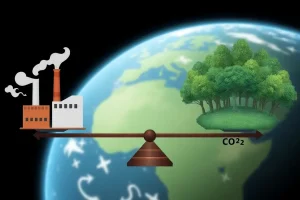
The long atmospheric lifetime of CO₂ has profound implications for climate policy and the future of the planet. Because CO₂ persists for so long, the warming effect of emissions is cumulative. The total amount of CO₂ emitted over time, rather than the rate of emission in any given year, determines the peak warming. This is why the concept of a “carbon budget”—the total amount of CO₂ that can be emitted while limiting warming to a specific target—is central to climate mitigation.
Moreover, the long tail of CO₂ means that even if all anthropogenic emissions were to stop immediately, global temperatures would not drop quickly. The elevated CO₂ levels would continue to trap heat for centuries, and the slow response of the climate system (including ocean thermal inertia) would keep temperatures near peak levels for a millennium or more. Sea level rise, ocean acidification, and other impacts would also persist, locking in changes that affect countless generations.
Common Misconceptions
Misconception: CO₂ has a short atmospheric lifetime, like methane. Methane is chemically reactive and has a lifetime of about 12 years, but CO₂ is removed by physical and biological processes that operate much more slowly. Comparing the two directly is misleading.
Misconception: All emitted CO₂ is absorbed by plants and oceans within a few decades. While fast sinks do absorb about half of emissions within 30 years, the remaining fraction stays in the atmosphere for centuries to millennia. The sinks cannot keep pace with the rate of emissions, and some of the absorbed carbon can be re-released.
Misconception: If we stop emitting, CO₂ levels will quickly return to pre-industrial levels. In reality, atmospheric CO₂ would decline only gradually over thousands of years. The climate impacts we are experiencing now are largely irreversible on human timescales.
Misconception: The carbon cycle will naturally restore balance within a human lifetime. The carbon cycle operates on geological timescales for complete removal. While natural sinks provide a valuable service, they cannot quickly undo the massive perturbation caused by fossil fuel burning.
Connections to Other Systems
The long residence of CO₂ in the atmosphere is tightly linked to other Earth systems. The ocean absorbs about a quarter of annual CO₂ emissions, leading to ocean acidification, which harms marine life and reduces the ocean’s capacity to absorb further CO₂. This chemical change will persist as long as atmospheric CO₂ remains elevated, with effects lasting for tens of thousands of years.
Additionally, the long lifetime of CO₂ interacts with climate feedbacks. For example, warming caused by persistent CO₂ can thaw permafrost, releasing more CO₂ and methane, or increase the frequency of wildfires, which release stored carbon. These feedbacks can amplify warming and further extend the time required for the climate system to stabilize. The long-term commitment to sea level rise from thermal expansion and ice sheet melt is also directly tied to the cumulative CO₂ emissions and their millennial-scale persistence.
FAQ
How long does CO₂ stay in the atmosphere?
CO₂ does not have a single lifetime. About half is removed within 30 years, but a significant fraction remains for centuries to millennia. Complete removal takes over 100,000 years.
Why does some CO₂ persist for so long?
The deep ocean and geological processes that permanently remove CO₂ operate very slowly. Fast sinks like plants and the ocean surface can only absorb a portion, leaving the rest to be mixed into the deep ocean and neutralized by rock weathering over thousands of years.
What happens if we stop emitting CO₂?
Atmospheric CO₂ levels would gradually decline, but temperatures would remain elevated for centuries due to the long-lived fraction. Sea level rise and ocean acidification would also continue for millennia.
References
- Intergovernmental Panel on Climate Change (IPCC) Assessment Reports, especially the Working Group I contributions on the carbon cycle and climate change.
- National Oceanic and Atmospheric Administration (NOAA) Carbon Cycle Science, providing data and explanations on CO₂ sinks and lifetimes.
- NASA Earth Observatory: The Carbon Cycle, an educational resource detailing the processes and timescales of carbon exchange.