In brief
At a glance
Quick Facts
- Definition
- A discrete period of anomalously high sea surface temperature
- Threshold
- 90th percentile of a 30-year historical baseline
- Minimum Duration
- At least 5 consecutive days
- Typical Size
- Can range from a few km² to millions of km²
- Primary Natural Driver
- Atmospheric blocking high-pressure systems
- Key Ecological Impact
- Mass coral bleaching and mortality
- Economic Impact
- Fisheries collapse and aquaculture losses
- Climate Change Link
- Global warming has doubled MHW frequency since the 1980s
Key Takeaways
- A marine heatwave is a prolonged period of unusually warm sea surface temperatures, defined relative to a historical baseline for that location and time of year.
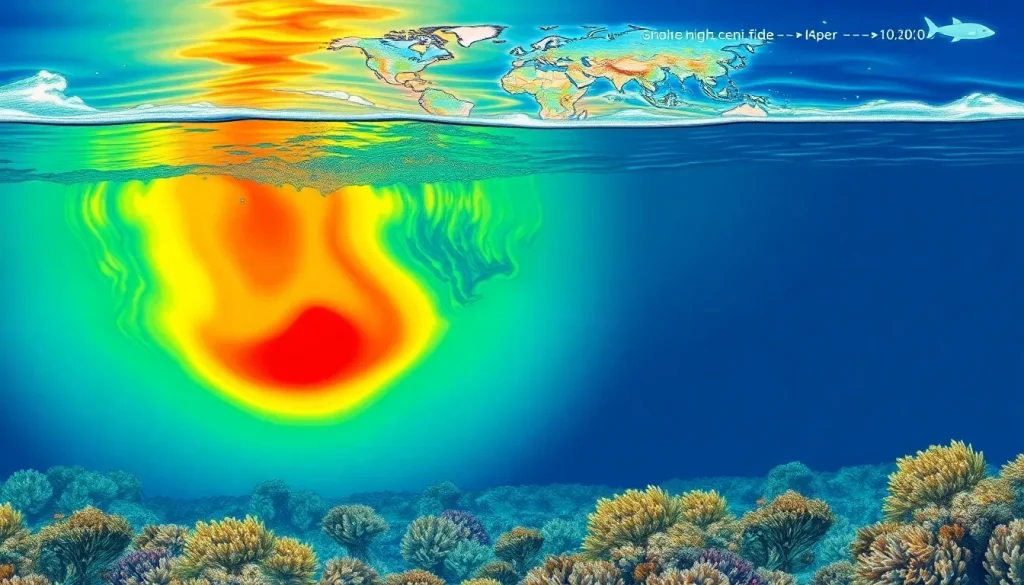
- They can persist for weeks to years, cover areas from a few square kilometers to entire ocean basins, and penetrate depths of hundreds of meters.
- Marine heatwaves are driven by a combination of atmospheric forcing, ocean circulation changes, and long-term climate warming, with El Niño being a major natural contributor.
- These events cause mass coral bleaching, harmful algal blooms, shifts in species distribution, and significant economic losses in fisheries and aquaculture.
- Climate change has doubled the frequency of marine heatwaves since the 1980s, and they are projected to become more intense and widespread in the future.
What Is a Marine Heatwave?
A marine heatwave (MHW) is a discrete, prolonged anomalously warm water event in the ocean. It is defined as a period when daily sea surface temperatures exceed a locally and seasonally varying threshold—typically the 90th percentile of a 30-year historical baseline—for at least five consecutive days. This definition, widely adopted by the scientific community, allows for the consistent identification and comparison of MHWs across different regions and time periods. Marine heatwaves can range in size from a few square kilometers to millions of square kilometers, and they can last from days to years, with the most extreme events causing devastating ecological and economic consequences.
Unlike gradual ocean warming, which is a long-term trend, marine heatwaves are discrete extreme events. They are characterized by their intensity (how much warmer than normal), duration, and spatial extent. The concept is analogous to atmospheric heatwaves, but the ocean’s high heat capacity means that marine heatwaves often develop more slowly, last longer, and have more persistent effects. The term gained prominence after the 2011 Western Australia marine heatwave and the 2013–2015 “Blob” in the Northeast Pacific, which led to widespread ecosystem disruptions. Since then, research has shown that marine heatwaves are occurring in all ocean basins and are becoming more frequent due to climate change.
Overview
Marine heatwaves are not a new phenomenon, but their scientific study has intensified in recent years due to their increasing frequency and severity. They can occur in any season and in any ocean region, from the tropics to the poles. While some marine heatwaves are driven primarily by local atmospheric conditions—such as persistent high-pressure systems that reduce cloud cover and wind mixing, allowing the sun to heat the sea surface—others are linked to large-scale climate patterns like El Niño–Southern Oscillation (ENSO) or shifts in major ocean currents. The most extreme events often result from a combination of these factors, amplified by the background warming of the ocean due to anthropogenic climate change.
Marine heatwaves have been documented for decades, but the term itself was formalized in the scientific literature in the early 2010s. Since then, researchers have developed standardized metrics to detect and categorize these events, similar to how atmospheric heatwaves are classified. The Hobday et al. (2016) definition, which uses a 30-year climatological baseline and a 90th percentile threshold, has become the standard. This framework allows scientists to compare events across time and space, and to attribute their causes and consequences.
How It Works
Marine heatwaves are identified by comparing daily sea surface temperature (SST) data to a long-term climatology. The process involves several steps: first, a baseline period (e.g., 1982–2011) is used to calculate the mean SST and the 90th percentile threshold for each day of the year at each location. Then, for any given day, if the observed SST exceeds the 90th percentile threshold for that day and remains above the threshold for at least five consecutive days, a marine heatwave is declared. The event ends when temperatures drop below the threshold. The intensity of the event can be categorized based on how much the SST exceeds the threshold, with categories ranging from moderate to extreme.
The physical mechanisms behind marine heatwaves are diverse. They often begin with a high-pressure weather system that stalls over a region, leading to clear skies, low winds, and reduced evaporative cooling. This allows the sun to heat the ocean surface more than usual. Additionally, reduced wind mixing prevents cooler subsurface water from reaching the surface, further warming the upper layer. Ocean currents can also play a role by transporting warm water into a region or by shifting the position of a warm current. In some cases, a combination of these factors, along with the background warming trend, can produce record-breaking events that persist for months or even years.
Main Causes or Drivers
The primary drivers of marine heatwaves can be grouped into three categories: atmospheric forcing, ocean circulation changes, and long-term climate trends. Atmospheric forcing is the most common trigger. Persistent high-pressure systems, known as blocking highs, can sit over a region for weeks, reducing cloud cover and wind speed. This leads to increased solar radiation reaching the sea surface and decreased evaporative cooling, causing the upper ocean to warm rapidly. For example, the 2011 Western Australia marine heatwave was largely driven by a strong La Niña event that shifted warm, low-wind conditions over the region.
Ocean circulation changes can also cause or amplify marine heatwaves. Anomalous currents can transport warm water into a region, as seen during the 2013–2015 Northeast Pacific marine heatwave, where a weakened Aleutian Low reduced heat loss from the ocean to the atmosphere and allowed warm water to accumulate. Additionally, changes in the depth of the mixed layer—the upper layer of the ocean that is well-mixed by wind and waves—can influence MHW development. A shallower mixed layer heats up more quickly under the same solar radiation. Finally, long-term climate change is a critical driver: the global ocean has absorbed more than 90% of the excess heat from greenhouse gas emissions, raising the baseline temperature and making it easier for natural variability to push temperatures above the extreme threshold. This means that marine heatwaves that would have been rare in the past are now more likely to occur.
Environmental and Human Impacts
Marine heatwaves have profound and often devastating effects on marine ecosystems. The most visible impact is coral bleaching, where corals expel their symbiotic algae under heat stress, turning white and often dying if the heat persists. The 2016–2017 Great Barrier Reef marine heatwave caused back-to-back mass bleaching events, leading to significant coral mortality. Beyond corals, marine heatwaves can trigger harmful algal blooms that produce toxins, leading to shellfish poisoning and marine mammal deaths. They can also cause mass die-offs of fish, seabirds, and marine mammals by disrupting food webs. For instance, the Northeast Pacific “Blob” led to a massive decline in zooplankton, which cascaded up the food chain, causing starvation and reproductive failure in sea lions, puffins, and whales.
Human communities are also heavily impacted. Fisheries and aquaculture suffer when target species move to cooler waters, experience reduced growth, or die. The 2012 Northwest Atlantic marine heatwave caused a shift in lobster distribution, leading to market gluts and price collapses. The 2015–2016 Tasman Sea marine heatwave caused farmed salmon deaths and an outbreak of Pacific Oyster Mortality Syndrome. Coastal economies that depend on tourism, such as those near coral reefs, face losses when reefs bleach and lose their appeal. Additionally, marine heatwaves can intensify tropical cyclones by providing extra heat energy, and they can alter weather patterns on land, contributing to droughts or heavy rainfall events.
Regional Differences
Marine heatwaves are not uniform across the globe; their characteristics and drivers vary by region. In the tropics, marine heatwaves are often associated with El Niño events and can cause widespread coral bleaching, as seen in the central and eastern Pacific. The Indian Ocean experiences marine heatwaves linked to the Indian Ocean Dipole, affecting monsoon patterns and fisheries. In mid-latitude regions, such as the Northeast Pacific and the Tasman Sea, marine heatwaves are frequently driven by persistent high-pressure systems and shifts in ocean currents. The Mediterranean Sea, a semi-enclosed basin, is particularly vulnerable to marine heatwaves due to its limited exchange with cooler Atlantic waters, and events there have caused mass mortality of benthic organisms.
Polar regions are also experiencing marine heatwaves, with dramatic consequences for sea ice and ice-dependent ecosystems. In the Arctic, marine heatwaves can accelerate sea ice melt and alter the timing of phytoplankton blooms, affecting the entire food web. The Southern Ocean has seen marine heatwaves that impact krill populations, with cascading effects on penguins, seals, and whales. Each region’s unique oceanography and ecology mean that the impacts of marine heatwaves are highly context-dependent, requiring localized monitoring and adaptation strategies.
Data Limitations and Uncertainties
While the study of marine heatwaves has advanced rapidly, significant data limitations and uncertainties remain. The primary source of sea surface temperature data is satellite observations, which provide global coverage but only measure the skin temperature of the ocean (the top millimeter). This can differ from the temperature just below the surface, especially under calm conditions. In situ measurements from buoys, ships, and Argo floats provide more depth-resolved data but are sparse in many regions, particularly the Southern Ocean and parts of the tropics. The historical baseline period used to define thresholds is also a challenge: the commonly used 1982–2011 period already includes a warming trend, which may underestimate the true anomaly relative to a pre-industrial baseline.
Another uncertainty lies in the attribution of individual events to climate change. While it is clear that global warming has increased the probability of marine heatwaves, quantifying the exact contribution to a specific event requires sophisticated climate models and statistical methods. There is also uncertainty in how marine heatwaves will evolve in the future, as projections depend on greenhouse gas emission scenarios and model representations of ocean processes. Furthermore, the ecological impacts of marine heatwaves are complex and can vary depending on the timing, depth, and species involved, making it difficult to predict outcomes with high confidence. Ongoing research aims to improve monitoring, forecasting, and understanding of these events.
FAQ
What is a marine heatwave?
A marine heatwave is a period of unusually warm sea surface temperatures that lasts for at least five days and exceeds a historical threshold.
How does a marine heatwave form?
They form when atmospheric conditions like high-pressure systems reduce wind and cloud cover, allowing the sun to heat the ocean surface, or when ocean currents bring warm water into a region.
Why do marine heatwaves matter?
They matter because they cause coral bleaching, disrupt fisheries, harm marine life, and can intensify storms, with significant economic and ecological consequences.
References
- Hobday, A. J., et al. (2016). A hierarchical approach to defining marine heatwaves. Progress in Oceanography.
- IPCC (2021). Climate Change 2021: The Physical Science Basis. Contribution of Working Group I.
- NOAA Marine Heatwave Tracker (https://www.ncdc.noaa.gov/marine-heatwave-tracker)