In brief
At a glance
Quick Facts
- Typical short-duration discharge time
- Seconds to 4–10 hours
- Typical long-duration discharge time
- 10+ hours to days, weeks, or seasons
- Most deployed long-duration technology
- Pumped-storage hydropower (over 90% of global storage capacity)
- Fastest-growing short-duration technology
- Lithium-ion batteries
- Key short-duration services
- Frequency regulation, voltage support, peak shaving
- Key long-duration services
- Energy shifting, capacity firming, seasonal balancing
- Round-trip efficiency of lithium-ion
- Typically 85–95%
- Round-trip efficiency of pumped hydro
- Typically 70–85%
- Emerging long-duration technology
- Green hydrogen storage for seasonal use
- Main driver for long-duration storage
- High penetration of variable renewable energy sources
Key Takeaways
- Short-duration energy storage typically discharges for seconds to a few hours, while long-duration storage provides energy for many hours, days, or even seasons.
- Short-duration systems like lithium-ion batteries excel at frequency regulation and rapid response, whereas long-duration storage addresses extended supply-demand mismatches.
- The need for long-duration storage grows as grids rely more on variable renewable energy sources like wind and solar.
- No single technology is optimal for all durations; a mix of storage types is required for a resilient, decarbonized energy system.
What Is Short-Duration vs Long-Duration Energy Storage?
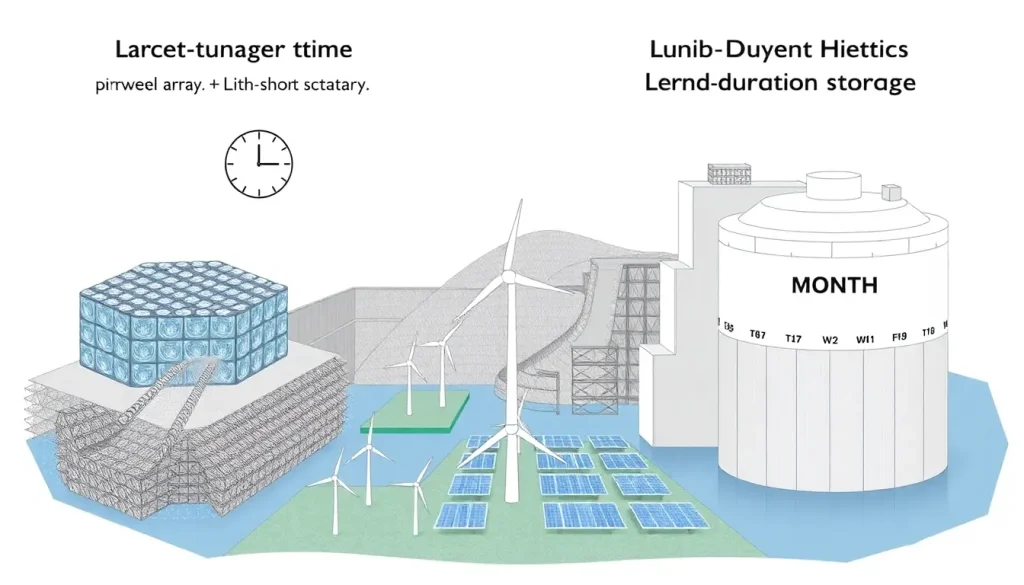
Short-duration energy storage refers to systems that can store and discharge energy over periods ranging from seconds to a few hours, typically up to 4–10 hours. These systems are designed to respond quickly to fluctuations in electricity supply and demand, providing services such as frequency regulation, voltage support, and short-term balancing. Common examples include lithium-ion batteries, flywheels, and supercapacitors. In contrast, long-duration energy storage (LDES) encompasses technologies that can store energy for extended periods—from several hours to days, weeks, or even months—and discharge it when needed. LDES is essential for managing the variability of renewable energy sources over longer timescales, such as overnight, during multi-day weather events, or across seasons.
The distinction between short-duration and long-duration storage is not rigidly defined by a specific number of hours but rather by the role each plays in the energy system. Short-duration storage is primarily used for power quality, frequency regulation, and peak shaving, where rapid response is critical. Long-duration storage, on the other hand, is geared toward energy shifting and capacity firming, ensuring that electricity generated during periods of high renewable output can be stored and used when generation is low. As the share of intermittent renewables like solar and wind increases, the need for both types of storage becomes more pronounced, with long-duration storage playing a crucial role in achieving deep decarbonization.
How It Works
Energy storage systems operate by converting electricity into a storable form and then converting it back when needed. The underlying physics and chemistry vary widely across technologies, but the fundamental principle is the same: absorb energy during periods of low demand or high generation, and release it during periods of high demand or low generation. Short-duration storage technologies are optimized for high power density and rapid response. For example, lithium-ion batteries store energy in chemical form within electrodes and release it through electrochemical reactions, achieving response times in milliseconds. Flywheels store kinetic energy in a rotating mass and can inject or absorb power almost instantaneously. Supercapacitors store energy in an electric field and are used for very short bursts of power.
Long-duration storage technologies, by contrast, are designed for high energy capacity and lower self-discharge rates over extended periods. Pumped-storage hydropower, the most widely deployed LDES technology, uses excess electricity to pump water to an upper reservoir, then releases it through turbines to generate electricity when needed. Compressed air energy storage (CAES) compresses air into underground caverns and expands it through a turbine to generate power. Emerging technologies include flow batteries, which store energy in liquid electrolytes and can scale energy capacity independently of power, and thermal storage, which stores heat or cold in materials like molten salt or ice. Green hydrogen, produced via electrolysis using renewable energy, can be stored for months and used in fuel cells or turbines, offering seasonal storage potential.
Importance and Impact
Energy storage is a cornerstone of modern electricity grids, enabling the integration of higher shares of variable renewable energy sources. Short-duration storage provides essential grid services that maintain power quality and stability, preventing blackouts and reducing the need for fossil fuel-based peaker plants. It also enables time-shifting of solar energy from midday to evening peaks, a function that has become increasingly valuable as solar penetration grows. Long-duration storage addresses the intermittency challenge of renewables over longer periods, such as cloudy or windless days, and can replace the role of baseload power plants traditionally fueled by coal or natural gas. Without adequate LDES, grids with high renewable penetration risk supply shortages during extended periods of low generation, potentially requiring backup from carbon-intensive sources.
The economic and environmental impacts are substantial. By reducing curtailment of renewable energy—when excess generation is wasted—storage increases the utilization of clean energy assets. It also enhances grid resilience against extreme weather events and reduces reliance on fossil fuel peaker plants, which are often expensive and polluting. Long-duration storage, in particular, can provide firm, dispatchable power that supports grid reliability over days or weeks, making it a key enabler of deep decarbonization targets. The deployment of both short- and long-duration storage is expected to grow significantly as costs decline and renewable penetration increases.
Benefits, Limitations and Trade-offs
Short-duration storage offers high efficiency, rapid response, and a mature supply chain, particularly for lithium-ion batteries. These systems are modular, scalable, and have seen dramatic cost reductions. However, they are not well-suited for storing energy beyond a few hours due to self-discharge and economic constraints. Lithium-ion batteries also face challenges related to raw material sourcing, thermal runaway risks, and limited cycle life under deep discharge conditions. Flywheels and supercapacitors have very high cycle life but low energy density, making them unsuitable for bulk energy storage.
Long-duration storage technologies provide the ability to shift energy over days or seasons, but they often come with lower round-trip efficiency, higher upfront capital costs, and geographic or resource constraints. Pumped-storage hydropower, for instance, requires suitable topography and large water resources, and can have environmental impacts. Compressed air energy storage depends on underground caverns. Flow batteries and hydrogen-based storage are still maturing and face cost and infrastructure challenges. The trade-off between duration, efficiency, cost, and scalability means that no single technology can meet all grid needs; a portfolio approach is necessary.
Examples
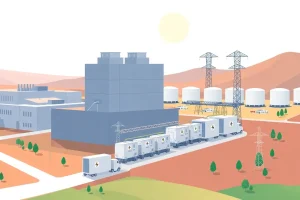
Short-duration storage is exemplified by the widespread deployment of lithium-ion battery systems, such as the Hornsdale Power Reserve in South Australia (150 MW/193.5 MWh), which provides frequency control and short-term energy shifting. Flywheel storage plants, like the Beacon Power facility in New York, offer fast frequency regulation. Supercapacitors are used in niche applications requiring very high power for seconds to minutes, such as voltage sag mitigation in industrial facilities.
For long-duration storage, pumped-storage hydropower is the most established, with facilities like the Bath County Pumped Storage Station in Virginia, USA (3,003 MW, 24,000 MWh), capable of generating for over 10 hours. Compressed air energy storage plants, such as the Huntorf plant in Germany (290 MW, 580 MWh), have operated for decades. Emerging LDES technologies include vanadium redox flow batteries, like the 200 MW/800 MWh system planned in Dalian, China, and green hydrogen projects that store renewable energy as hydrogen for seasonal use, such as the Advanced Clean Energy Storage project in Utah, USA, which aims to store hydrogen in underground salt caverns.
Connections to Other Systems
Energy storage is deeply interconnected with the broader electricity grid, renewable generation, and demand-side management. Short-duration storage works in tandem with smart grids and advanced inverters to provide real-time balancing and ancillary services. It also complements demand response programs, where consumers adjust their usage based on grid conditions, by absorbing excess generation or supplying power during short-term deficits. Long-duration storage integrates with bulk power systems and can enable higher penetration of variable renewables by acting as a buffer against seasonal variations. It also links the power sector with other energy sectors, such as through power-to-gas (hydrogen) that can be used for industrial processes, heating, or transportation, creating cross-sectoral flexibility.
Additionally, energy storage is a critical component of microgrids and off-grid systems, where both short- and long-duration storage may be combined to ensure reliability. For example, a remote community might use lithium-ion batteries for daily solar shifting and hydrogen storage for seasonal backup. The interplay between different storage durations and other grid assets is essential for optimizing overall system cost, reliability, and environmental performance.
Common Misconceptions
One common misconception is that lithium-ion batteries can serve all grid storage needs, including long-duration applications. While lithium-ion is versatile and cost-effective for short-duration storage, its economics and technical characteristics make it less suitable for discharges beyond 4–8 hours. Another misunderstanding is that long-duration storage must mean seasonal storage; in practice, many grid needs fall in the 10–100 hour range, which can be met by technologies like pumped hydro, flow batteries, or compressed air. Additionally, some believe that energy storage is inherently clean, but the environmental footprint depends on the technology and its lifecycle—mining for battery materials, land use for pumped hydro, and energy losses during conversion all have impacts that must be managed.
Finally, there is a misconception that short-duration and long-duration storage are competing solutions. In reality, they are complementary: short-duration storage handles rapid, frequent fluctuations, while long-duration storage addresses sustained imbalances. A reliable, decarbonized grid requires both, along with other flexibility resources like demand response and grid interconnections.
FAQ
What is the difference between short-duration and long-duration energy storage?
Short-duration storage discharges energy for seconds to a few hours and is used for rapid grid services like frequency regulation. Long-duration storage provides energy for many hours, days, or seasons, addressing extended supply-demand imbalances.
Why is long-duration energy storage important for renewable energy?
Renewable sources like wind and solar are variable; long-duration storage can store excess energy when generation is high and release it during prolonged periods of low generation, ensuring a reliable electricity supply without fossil fuel backup.
Can lithium-ion batteries be used for long-duration storage?
Lithium-ion batteries are generally not cost-effective for discharges beyond 4–8 hours due to high per-unit energy costs and self-discharge. Other technologies like pumped hydro, flow batteries, or hydrogen are better suited for long-duration applications.
References
- U.S. Department of Energy, 'Energy Storage Grand Challenge: Energy Storage Market Report'
- International Energy Agency (IEA), 'Energy Storage'
- National Renewable Energy Laboratory (NREL), 'Long-Duration Energy Storage: A Review of Technologies and Applications'