In brief
At a glance
Quick Facts
- Verdict
- Promising
- Problem addressed
- Decarbonizing residential heating
- Evidence strength
- Strong
- Potential scale
- Global
- Relative cost
- Moderate to High
- Time to impact
- Years
Quick verdict
Heat pumps are a proven, highly efficient technology that can significantly reduce carbon emissions from residential heating when powered by low-carbon electricity. However, their suitability depends on climate, building insulation, and the carbon intensity of the local electricity grid. Gas boilers offer lower upfront costs and reliable performance even in very cold weather, but they lock in continued fossil fuel use and direct CO2 emissions. The choice is context-dependent: in well-insulated homes with access to clean electricity, heat pumps are the more sustainable and often more economical long-term option. In poorly insulated buildings or regions with carbon-intensive grids, a hybrid approach or phased transition may be more practical.
Problem addressed
Residential heating accounts for a substantial share of global energy consumption and direct greenhouse gas emissions. In many temperate and cold regions, natural gas boilers are the dominant heating technology, burning fossil fuels and releasing carbon dioxide, nitrogen oxides, and particulate matter. Decarbonizing this sector is essential for meeting climate targets, as heating can represent 10–15% of a country’s total emissions. The core challenge is to provide affordable, reliable warmth while drastically reducing the carbon footprint of the building stock.
How the solution works
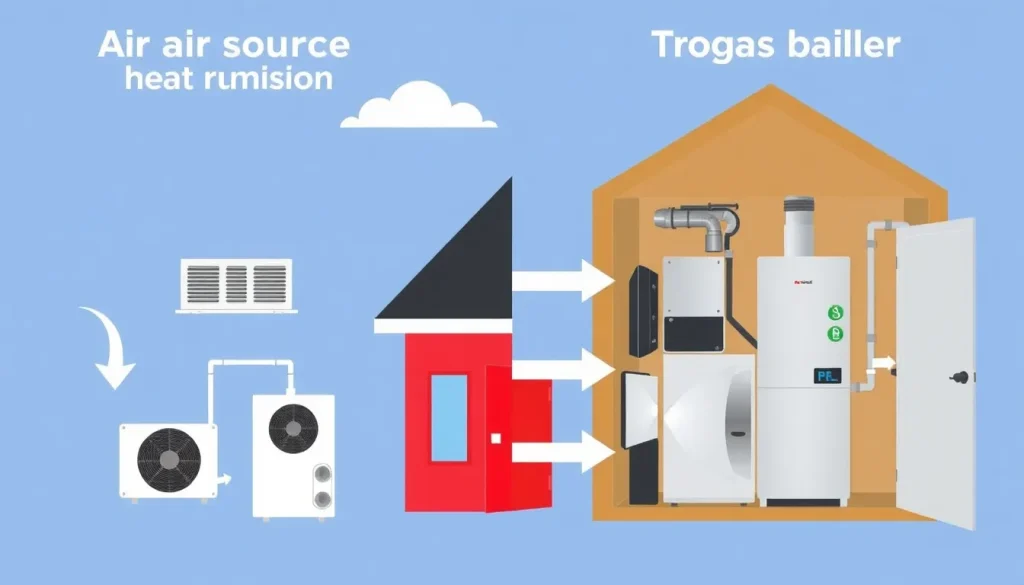
A heat pump is an electrically powered device that transfers heat from a low-temperature source (outdoor air, ground, or water) to a higher-temperature indoor space. It operates on a vapor-compression cycle similar to a refrigerator, but in reverse. The key performance metric is the Coefficient of Performance (COP), which measures the ratio of heat output to electrical energy input. Under typical conditions, air-source heat pumps achieve a COP of 2.5–4.5, meaning they deliver 2.5 to 4.5 units of heat for every unit of electricity consumed. Ground-source (geothermal) heat pumps can achieve even higher efficiencies due to more stable ground temperatures.
In contrast, a gas boiler burns natural gas to heat water, which is then circulated through radiators or underfloor pipes. Modern condensing boilers achieve efficiencies of around 90–95%, meaning 90–95% of the energy in the gas is converted into usable heat. However, because the primary energy source is a fossil fuel, the carbon emissions per unit of heat are inherently higher than those of a heat pump running on low-carbon electricity.
Heat pumps can also provide cooling in summer by reversing the cycle, a feature gas boilers lack. They are most efficient when supplying low-temperature heat (e.g., 35–45°C) to large surface-area emitters like underfloor heating or oversized radiators, whereas gas boilers typically operate at higher flow temperatures (60–80°C).
Evidence strength
The evidence base for heat pump performance is robust and growing. Numerous field trials, laboratory tests, and meta-analyses have been conducted by government agencies, research institutes, and industry bodies. Key sources include:
- The International Energy Agency’s (IEA) special report The Future of Heat Pumps (2022), which synthesizes global data on deployment, efficiency, and policy.
- The UK’s Electrification of Heat demonstration project (Energy Systems Catapult, 2019–2021), which monitored 750 heat pump installations across diverse housing types and found seasonal performance factors (SPF) averaging 2.5–3.0 for air-source units.
- Fraunhofer ISE’s field monitoring in Germany, showing real-world SPFs of 3.0–4.0 for ground-source and 2.5–3.5 for air-source systems in existing buildings.
- Studies from cold climates, such as the U.S. Department of Energy’s research on cold-climate heat pumps, demonstrating reliable operation down to -25°C with COPs above 1.5.
While laboratory ratings often exceed real-world performance due to idealised conditions, the gap is well-documented and narrowing as installation practices improve. Evidence on long-term reliability and maintenance costs is still accumulating, but early data suggest heat pump lifespans of 15–20 years, comparable to gas boilers. The evidence for gas boiler efficiency and emissions is long-established and uncontested.
Potential scale
Heat pumps have the technical potential to serve the vast majority of global heating demand. The IEA estimates that in a net-zero by 2050 scenario, heat pumps could meet over 50% of global heating needs, with installed capacity growing from around 180 million units in 2020 to over 1.5 billion by 2050. In some countries, such as Norway and Sweden, heat pumps already dominate new installations. However, scaling up faces constraints: manufacturing capacity, installer training, electricity grid capacity, and the rate of building retrofit. The transition will likely take decades, and in many regions gas boilers will remain a significant part of the stock for years.
Cost considerations
Upfront costs for heat pumps are generally higher than for gas boilers. A typical air-source heat pump system (including installation) may cost between $3,500 and $15,000, depending on capacity, type, and local market conditions. Ground-source systems are more expensive, often $10,000–$25,000. In comparison, a new condensing gas boiler typically costs $2,000–$5,000 installed. However, operating costs can be lower for heat pumps, especially where electricity prices are low relative to gas. For example, in many European countries, a heat pump with a COP of 3.5 and an electricity price of €0.20/kWh delivers heat at €0.057/kWh, while a gas boiler with 90% efficiency and a gas price of €0.08/kWh delivers heat at €0.089/kWh. Government incentives, such as grants, tax credits, or low-interest loans, can significantly reduce the upfront cost barrier. Maintenance costs are broadly similar, though heat pumps may require less frequent servicing than combustion-based systems. The cost-effectiveness of heat pumps improves with higher COPs, lower electricity prices, and carbon taxes on gas.
Implementation time
Installing a heat pump in an existing home typically takes a few days to a week, but preparatory work—such as upgrading radiators, improving insulation, or installing underfloor heating—can extend the timeline to several weeks. In new builds, integration is seamless. At a societal level, replacing the entire stock of gas boilers with heat pumps will take decades, constrained by the rate of building renovation, installer training, and manufacturing scale-up. Policy targets in many countries aim for a phase-out of new gas boiler sales by 2025–2035, but the existing stock will persist well beyond that.
Environmental benefits
Heat pumps produce zero direct emissions at the point of use. Their indirect emissions depend entirely on the carbon intensity of the electricity grid. On a grid with an average intensity of 200 gCO2/kWh, a heat pump with a COP of 3.0 emits approximately 67 gCO2 per kWh of heat delivered. A gas boiler emitting 220 gCO2/kWh of heat (direct combustion) would produce over three times as much. As grids decarbonize, heat pump emissions fall further. In addition, heat pumps eliminate local air pollutants such as nitrogen oxides (NOx) and particulate matter associated with gas combustion, improving urban air quality. The lifecycle environmental impact of heat pumps includes refrigerant leakage; modern units increasingly use low-global-warming-potential (GWP) refrigerants, mitigating this risk.
Social and economic co-benefits
- Improved air quality: Reduced NOx and particulate emissions benefit public health, particularly in dense urban areas.
- Energy security: Shifting from imported natural gas to domestically produced electricity reduces exposure to volatile fossil fuel markets.
- Job creation: Manufacturing, installation, and maintenance of heat pumps create local employment opportunities.
- Reduced energy poverty: In regions where heat pumps lower heating bills, households may experience improved affordability, though this depends on electricity pricing and building efficiency.
- Summer cooling: Heat pumps can provide efficient cooling, reducing heat stress and potentially lowering mortality during heatwaves.
Risks and unintended consequences
- Grid strain: Widespread electrification of heating could increase peak electricity demand, requiring costly grid upgrades and additional generation capacity.
- Refrigerant leakage: Some heat pumps use hydrofluorocarbons (HFCs) with high GWP; if leaked, they can offset climate benefits. Regulations are phasing down HFCs, but proper handling is essential.
- Noise: Outdoor units produce fan and compressor noise, which can be a nuisance in dense housing if not properly sited.
- Cold-weather performance: Air-source heat pump efficiency and capacity decline at very low temperatures, potentially requiring backup heating (often electric resistance or a gas boiler), which can increase costs and emissions.
- Regressive impacts: High upfront costs may exclude lower-income households unless supported by subsidies, and renters may have no control over heating system choice.
- Rebound effect: Lower operating costs could lead to higher indoor temperatures or more extensive heated areas, partially offsetting energy savings.
- Embodied carbon: Manufacturing heat pumps involves materials and energy, though lifecycle analyses generally show net carbon savings within a few years of operation compared to gas boilers.
Where it works best
Heat pumps are most effective in:
- Moderate climates: Regions where winter temperatures rarely drop below -15°C, allowing high COPs year-round.
- Well-insulated buildings: Homes with low heat loss enable lower flow temperatures and higher efficiency.
- Low-temperature heating systems: Underfloor heating or large radiators designed for 35–45°C operation.
- New construction: Integration from the design stage optimizes performance and reduces costs.
- Grids with low carbon intensity: Areas with high shares of renewables or nuclear power maximize emission reductions.
- Regions with high gas prices or carbon taxes: Where the operating cost advantage is greatest.
Where it may not work
Heat pumps may be a poor fit in:
- Extremely cold climates: While cold-climate heat pumps can operate down to -25°C or lower, efficiency drops and backup heating is often needed, reducing economic and environmental benefits.
- Poorly insulated, leaky buildings: High heat demand requires higher flow temperatures, lowering COP and potentially necessitating expensive envelope upgrades first.
- Homes with limited outdoor space: Air-source units require adequate airflow and distance from property boundaries; ground-source systems need land area or borehole access.
- Historic or listed buildings: Constraints on insulation and radiator upgrades can make low-temperature heat distribution difficult.
- Regions with very cheap natural gas and carbon-intensive electricity: In such contexts, a heat pump may increase both running costs and emissions relative to a gas boiler.
Comparison with alternatives
| Technology | Efficiency | Direct Emissions | Upfront Cost | Operating Cost | Scalability | Notes |
|---|---|---|---|---|---|---|
| Air-source heat pump | 250–450% (COP 2.5–4.5) | Zero direct; indirect depend on grid | Moderate–High | Low–Moderate (with clean electricity) | High | Also provides cooling; performance drops in extreme cold |
| Ground-source heat pump | 300–500% (COP 3.0–5.0) | Zero direct; indirect depend on grid | High | Low | Moderate (space constraints) | Highest efficiency; stable year-round; high installation cost |
| Gas boiler (condensing) | 90–95% | ~200–250 gCO2/kWh heat | Low–Moderate | Moderate (depends on gas price) | Very high (existing infrastructure) | Reliable, well-understood; locks in fossil fuel use |
| Hydrogen-ready boiler | ~90% (expected) | Zero if using green hydrogen; otherwise similar to gas | Moderate (projected) | Uncertain (hydrogen cost) | Unproven at scale | Requires hydrogen supply infrastructure; still in development |
| Biomass boiler | 85–95% | Near-zero net CO2 (biogenic); particulate emissions | Moderate–High | Moderate (fuel cost) | Limited by sustainable biomass supply | Requires fuel storage; air quality concerns |
| District heating | Varies (70–95% distribution) | Depends on heat source | High (infrastructure) | Low–Moderate | Urban areas | Efficient at scale; requires dense demand |
Case studies
Sweden: Sweden has one of the highest heat pump penetration rates in the world, driven by carbon taxes on heating fuels and government subsidies. Over 2 million heat pumps are installed, serving both single-family homes and multi-residential buildings. The shift has contributed to a significant decline in residential heating emissions, with heat pumps now providing over 40% of heating energy in the sector. The success is attributed to high building standards, widespread district heating in urban areas, and a low-carbon electricity grid (mostly hydro and nuclear).
United Kingdom: The UK’s Boiler Upgrade Scheme offers grants of £5,000–£7,500 for heat pump installations. Early data from the Electrification of Heat project showed that heat pumps can work in a variety of UK housing types, but performance varied with insulation levels and system design. The UK’s relatively high electricity-to-gas price ratio has been a barrier, and the government is exploring rebalancing levies to make heat pumps more cost-competitive. As of 2024, annual installations are around 40,000, far below the government’s target of 600,000 per year by 2028.
Maine, USA: Maine has promoted cold-climate heat pumps as a strategy to reduce reliance on expensive heating oil. Over 100,000 units have been installed since 2013, with strong consumer satisfaction. Field studies show that modern cold-climate units maintain COPs above 2.0 at -15°C and can deliver heat at -25°C, though backup resistance heating is sometimes used. The program has been praised for reducing heating costs and emissions in a rural, cold state.
Final assessment
Heat pumps are a mature, efficient technology that can play a central role in decarbonizing residential heating. The evidence strongly supports their environmental benefits when paired with a low-carbon electricity supply, and their economic case improves as carbon pricing and energy market reforms take hold. However, they are not a universal solution. Their effectiveness is highly dependent on building fabric, climate, and the local energy system. A successful transition requires parallel investments in energy efficiency, grid infrastructure, and installer training. Gas boilers will remain a practical necessity in some contexts for years, but their long-term role is incompatible with net-zero targets. Policymakers and homeowners should evaluate heat pumps on a case-by-case basis, considering whole-system costs and benefits over the lifetime of the equipment.
FAQ
Are heat pumps more efficient than gas boilers?
Yes, heat pumps are significantly more efficient in terms of useful heat delivered per unit of energy input. A typical air-source heat pump has a Coefficient of Performance (COP) of 2.5–4.5, meaning it delivers 2.5 to 4.5 times more heat energy than the electrical energy it consumes. A modern condensing gas boiler is about 90–95% efficient, so it converts nearly all the gas energy into heat, but the primary energy is fossil fuel. However, the overall environmental benefit depends on the carbon intensity of the electricity used to power the heat pump.
Do heat pumps work in cold climates?
Yes, modern cold-climate heat pumps can operate effectively at temperatures as low as -25°C, though their efficiency and heat output decline as outdoor temperatures drop. At very low temperatures, a backup heating source (such as electric resistance or a gas boiler) may be needed. In regions with prolonged extreme cold, ground-source heat pumps offer more stable performance because ground temperatures remain relatively constant year-round.
What are the main barriers to heat pump adoption?
The primary barriers are higher upfront costs compared to gas boilers, the need for adequate building insulation and sometimes larger radiators or underfloor heating, limited installer expertise in some markets, and electricity grid constraints. In some regions, the ratio of electricity to gas prices makes heat pumps more expensive to run, though this can be offset by efficiency gains and policy support.
References
- International Energy Agency (IEA), 'The Future of Heat Pumps', 2022
- IPCC Sixth Assessment Report, Working Group III, 2022
- UK Energy Systems Catapult, 'Electrification of Heat' project, 2019
- Fraunhofer ISE, 'Heat Pumps in Existing Buildings', 2020
- U.S. Department of Energy, 'Heat Pump Systems'