In brief
At a glance
Quick Facts
- Definition
- BECCS combines biomass energy production with carbon capture and permanent geological storage to achieve net removal of CO2 from the atmosphere.
- Net negativity
- The process can be net-negative if the biomass is sustainably sourced and the captured CO2 is permanently stored, as the carbon was originally absorbed from the air during plant growth.
- Role in climate models
- Many IPCC scenarios that limit warming to 1.5°C or 2°C rely on BECCS to remove billions of tonnes of CO2 annually by mid-century.
- Biomass sources
- Feedstocks include dedicated energy crops (e.g., switchgrass, willow), agricultural residues, forestry residues, and organic waste.
- Capture methods
- Common CO2 capture techniques include post-combustion chemical absorption, pre-combustion capture, and oxy-fuel combustion.
- Storage
- Captured CO2 is injected into deep geological formations such as saline aquifers, depleted oil and gas fields, or unmineable coal seams.
- Land requirement
- Large-scale BECCS could require hundreds of millions of hectares of land, raising concerns about competition with food production and natural ecosystems.
- Energy penalty
- The capture and compression of CO2 can consume 20–30% of the energy generated by the plant, reducing net output.
Key Takeaways
- Bioenergy with carbon capture and storage (BECCS) is a negative emissions technology that combines biomass energy production with CO2 capture and permanent geological storage.
- BECCS can remove CO2 from the atmosphere because the carbon in biomass was originally absorbed from the air during plant growth, and capturing and storing it prevents its return.
- Many climate stabilization scenarios rely heavily on BECCS to offset residual emissions and achieve net-zero or net-negative targets, but its feasibility at scale remains uncertain.
- Large-scale deployment of BECCS faces significant trade-offs, including land and water use, biodiversity impacts, high costs, and energy penalties.
What Is Bioenergy With Carbon Capture and Storage?
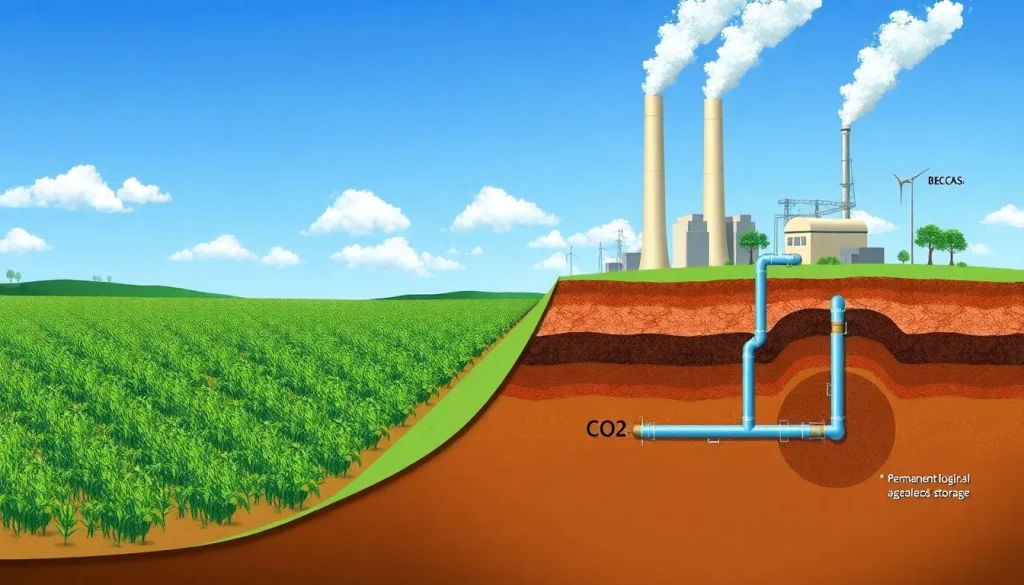
Bioenergy with carbon capture and storage (BECCS) is a carbon dioxide removal (CDR) technology that integrates the production of energy from biomass with the capture and permanent geological storage of the resulting CO2. In a BECCS system, organic matter—such as dedicated energy crops, agricultural residues, forestry waste, or organic municipal waste—is used as fuel to generate electricity, heat, or biofuels. The CO2 released during combustion or conversion is then captured before it can enter the atmosphere and is injected into deep underground rock formations for long-term isolation. Because the biomass feedstock absorbed CO2 from the atmosphere during its growth, the overall process can result in net removal of CO2 from the air, a concept known as negative emissions.
BECCS is one of several carbon dioxide removal (CDR) approaches considered in climate change mitigation pathways. Unlike technologies that only reduce emissions, BECCS can actively draw down atmospheric CO2 concentrations. This makes it particularly relevant in scenarios where simply reducing emissions is insufficient to meet temperature targets, such as those outlined in the Paris Agreement. However, BECCS is not a single, off-the-shelf technology; it encompasses a range of possible configurations depending on the type of biomass, conversion process, capture method, and storage option. Its net carbon balance depends on the entire lifecycle, including cultivation, harvesting, transport, conversion, and any land-use changes.
How It Works
A BECCS system can be broken down into several interconnected stages, each with its own technical options and environmental implications.
- Biomass production and sourcing: The process begins with the growth of biomass, which absorbs CO2 from the atmosphere through photosynthesis. Feedstocks can include dedicated energy crops (such as switchgrass, miscanthus, or fast-growing trees like willow and poplar), agricultural residues (corn stover, wheat straw), forestry residues (sawdust, bark, thinnings), or organic waste streams. The sustainability of this stage is critical, as land-use changes, fertilizer application, and water consumption can generate significant greenhouse gas emissions that partially or fully offset the carbon removed.
- Energy conversion: The biomass is converted into usable energy through combustion, gasification, anaerobic digestion, or fermentation. In a power plant, biomass is burned to produce steam that drives a turbine, generating electricity. Alternatively, biomass can be gasified to produce syngas, which can be burned for power or upgraded to biofuels. The conversion process releases CO2 that would otherwise have been re-emitted through natural decomposition.
- CO2 capture: The CO2 is separated from the flue gas or process stream using technologies similar to those in fossil fuel CCS. Common methods include post-combustion capture (using chemical solvents like amines), pre-combustion capture (removing CO2 before combustion), and oxy-fuel combustion (burning biomass in pure oxygen to produce a concentrated CO2 stream). The captured CO2 is compressed to a dense fluid for transport.
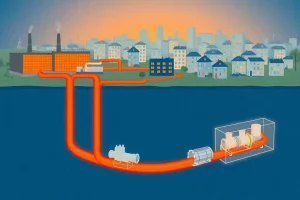
- Transport and storage: The compressed CO2 is transported via pipeline, ship, or truck to a suitable storage site. It is then injected into deep geological formations, typically at depths greater than 800 meters, where it is trapped in porous rock layers capped by impermeable seal rocks. Suitable storage reservoirs include saline aquifers, depleted oil and gas fields, and unmineable coal seams. Over time, the CO2 mineralizes or dissolves, becoming permanently locked away.
The net negativity of a BECCS system is calculated by subtracting all lifecycle emissions (from cultivation, harvesting, transport, conversion, capture, and storage) from the amount of CO2 originally absorbed by the biomass. If the system is carefully managed, the result can be a net removal of CO2 from the atmosphere.
Importance and Impact
BECCS occupies a central role in many climate change mitigation scenarios because it offers a way to generate low-carbon energy while simultaneously removing CO2 from the atmosphere. The Intergovernmental Panel on Climate Change (IPCC) has highlighted that limiting global warming to 1.5°C or 2°C above pre-industrial levels will likely require not only drastic emissions reductions but also the deployment of negative emissions technologies. In numerous integrated assessment models, BECCS is the most widely deployed CDR method, often removing several billion tonnes of CO2 per year by the second half of the century.
The importance of BECCS stems from its dual function. First, it can provide dispatchable, renewable electricity or heat, complementing intermittent sources like wind and solar. Second, it can offset emissions from sectors that are difficult to decarbonize, such as aviation, heavy industry, and agriculture. By achieving net-negative emissions at a system level, BECCS could help compensate for any overshoot of carbon budgets and contribute to a gradual drawdown of atmospheric CO2 concentrations. This potential has made BECCS a cornerstone of many national and corporate net-zero strategies.
Benefits, Limitations and Trade-offs
BECCS offers several potential benefits, but these must be weighed against significant limitations and trade-offs.
Benefits:
- Negative emissions: When sustainably managed, BECCS can remove CO2 from the atmosphere, helping to reverse the accumulation of greenhouse gases.
- Renewable energy production: It generates electricity, heat, or fuels that can replace fossil-based energy, contributing to energy security and decarbonization.
- Scalability potential: Biomass is a widely available resource, and CCS infrastructure can be built upon existing knowledge from the oil and gas industry.
- Dispatchable power: Unlike some renewables, BECCS plants can operate continuously, providing baseload or flexible power to the grid.
Limitations and trade-offs:
- Land and resource competition: Large-scale BECCS would require vast areas of land to grow biomass, potentially competing with food production, natural ecosystems, and water resources. This could drive up food prices, exacerbate deforestation, and threaten biodiversity.
- High costs: The capital and operating costs of BECCS are currently higher than those of conventional bioenergy or fossil fuel power with CCS, due to the added complexity of biomass handling and the energy penalty of CO2 capture.
- Energy penalty: Capturing and compressing CO2 consumes a significant portion of the energy generated by the plant, reducing net energy output and overall efficiency.
- Sustainability concerns: If biomass is not sourced sustainably—for example, from monoculture plantations that displace native forests or require heavy fertilizer use—the net carbon benefit can be greatly diminished or even reversed.
- Storage capacity and permanence: Suitable geological storage sites are not evenly distributed globally, and long-term monitoring is required to ensure that stored CO2 does not leak.
Environmental and Human Impacts
The environmental and human impacts of BECCS are highly context-dependent and can range from beneficial to harmful depending on how the system is implemented.
On the positive side, BECCS can contribute to climate change mitigation, which has broad environmental and societal benefits. If biomass is sourced from agricultural residues or waste, it can provide an additional revenue stream for farmers and reduce waste disposal problems. In some cases, planting deep-rooted energy crops on degraded land can improve soil carbon and reduce erosion.
However, large-scale deployment raises serious concerns. Converting natural ecosystems to energy crop plantations can lead to biodiversity loss, soil degradation, and increased water stress. The use of nitrogen fertilizers can cause nitrous oxide emissions, a potent greenhouse gas, and contribute to water pollution. There are also social risks, including land grabbing, displacement of local communities, and competition with food production that could affect food security, particularly in developing regions. Air pollution from biomass combustion, such as particulate matter and nitrogen oxides, can have local health impacts if not properly controlled. These risks underscore the need for robust sustainability governance and careful lifecycle assessment.
Common Misconceptions
Several misconceptions surround BECCS, often leading to overestimation of its potential or misunderstanding of its requirements.
- “BECCS is automatically carbon-negative.” The net carbon balance depends on the entire lifecycle. If forests are cleared to plant energy crops, the carbon debt from land-use change can take decades to repay. Unsustainable practices can result in net positive emissions.
- “BECCS is a proven technology at scale.” While individual components (biomass power, CO2 capture, geological storage) are commercially demonstrated, integrated BECCS facilities operating at large scale are rare. Most experience comes from pilot and demonstration projects.
- “BECCS can solve climate change on its own.” No single technology can. BECCS is one tool among many, and its deployment must be accompanied by deep emissions cuts across all sectors. Overreliance on BECCS in models has been criticized as a “moral hazard” that could delay near-term mitigation action.
- “The captured CO2 is used to make products.” In BECCS, the CO2 is intended for permanent storage, not utilization. While some CO2 could be used in industrial processes, the climate benefit of BECCS relies on long-term sequestration, not temporary use.
- “Any biomass is suitable for BECCS.” The type and source of biomass matter greatly. Waste and residues generally have lower lifecycle emissions than dedicated energy crops, and the sustainability of the supply chain is critical to achieving negative emissions.
FAQ
What is bioenergy with carbon capture and storage (BECCS)?
BECCS is a technology that generates energy from biomass and captures the resulting CO2 for permanent underground storage. Because the biomass absorbed CO2 during growth, the overall process can remove more CO2 from the atmosphere than it emits, achieving negative emissions.
How does BECCS work?
Biomass is grown and harvested, then burned or converted to produce electricity, heat, or fuels. The CO2 released is captured using chemical or physical separation methods, compressed, and transported to a geological storage site where it is injected deep underground for permanent isolation.
Why does BECCS matter for climate change?
BECCS is one of the few technologies that can actively remove CO2 from the atmosphere while generating energy. It is included in many climate stabilization pathways to offset emissions from hard-to-abate sectors and to help achieve net-zero or net-negative global emissions.
References
- IPCC, 2018: Global Warming of 1.5°C. An IPCC Special Report on the impacts of global warming of 1.5°C above pre-industrial levels and related global greenhouse gas emission pathways.
- IEA Bioenergy, 'Bioenergy with Carbon Capture and Storage (BECCS)' – Technology Collaboration Programme.
- Global CCS Institute, 'BECCS: Bioenergy with Carbon Capture and Storage' – Fact Sheet and Reports.