In brief
At a glance
Quick Facts
- Verdict
- Proven in specific contexts
- Problem addressed
- Inefficient individual heating/cooling and high carbon emissions from buildings
- Evidence strength
- Strong from existing systems
- Potential scale
- Regional/Urban
- Relative cost
- High upfront, moderate operational
- Time to impact
- Years to decades for full deployment
Quick verdict
District heating and cooling (DHC) is a mature, proven technology for efficiently supplying thermal energy to buildings in dense urban areas. When powered by low-carbon sources such as waste heat, geothermal, or large-scale heat pumps, it can significantly reduce greenhouse gas emissions and primary energy use compared to individual heating and cooling systems. However, its high upfront infrastructure costs, long implementation timelines, and dependence on local conditions mean it is not a universal solution. DHC is most promising in cities with high heat demand density and access to sustainable heat sources, where it can play a key role in decarbonizing the building sector.
Problem addressed
Buildings account for a substantial share of global energy consumption and carbon emissions, primarily due to space heating, cooling, and hot water production. In many regions, these needs are met by inefficient individual boilers or electric heaters, often relying on fossil fuels. This decentralized approach leads to higher primary energy use, local air pollution, and missed opportunities to utilize waste heat from power generation or industrial processes. District heating and cooling addresses this by aggregating demand, enabling the use of more efficient, cleaner, and diverse energy sources that would be impractical for individual buildings.
How the solution works
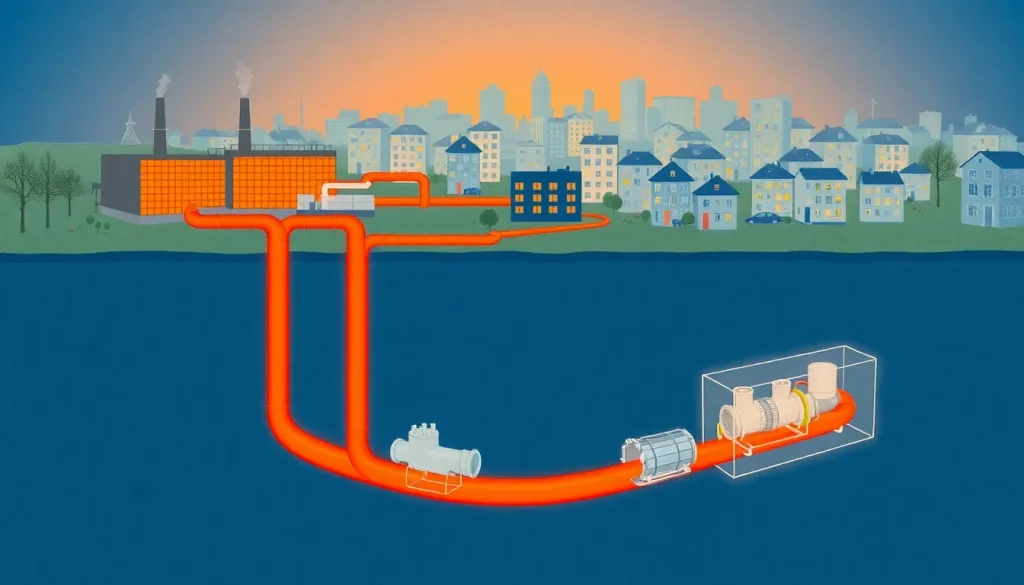
A district heating system consists of three main components: a central heat source, a distribution network of insulated pipes, and building-level heat exchangers. Heat is generated at one or more central plants—these can be combined heat and power (CHP) plants, which produce both electricity and useful heat; dedicated heat-only boilers; or renewable sources such as geothermal wells, solar thermal arrays, or large-scale heat pumps. The heat is transferred to a fluid (typically hot water or steam) and circulated through underground pipes to connected buildings. At each building, a heat exchanger transfers the thermal energy to the building’s internal heating system, and the cooled fluid returns to the plant for reheating. District cooling operates similarly, using central chillers or natural cold sources (e.g., deep lake water) to circulate chilled water for air conditioning. Modern systems often incorporate thermal storage, allowing heat or cold to be produced when electricity is cheap or renewable generation is abundant, and used later.
Evidence strength
The evidence base for district heating is robust, drawing on over a century of operation in many countries. Numerous peer-reviewed studies and technical reports document the performance of existing networks. For example, comprehensive reviews by Werner (2017) and Lund et al. (2014) provide international comparisons of system efficiencies, carbon savings, and economic viability. Data from Euroheat & Power and national energy agencies show that well-designed systems can achieve primary energy savings of 20–40% compared to individual gas boilers, and even higher when using waste heat or renewables. However, the evidence is context-dependent: most successful cases are in regions with cold climates, high urban density, and supportive policies. Evidence for district cooling is less extensive but growing, particularly in hot climates like the Middle East. The main limitation is that many studies rely on modeled projections rather than long-term empirical data for newer, low-temperature networks.
Potential scale
District heating currently supplies about 10% of global heat demand, with significant variation by region. In countries like Denmark, it covers over 60% of residential heating, while in many other parts of the world it is negligible. The technical potential is large: the International Energy Agency estimates that by 2050, district heating could provide up to 50% of heat demand in urban areas worldwide, provided there is strong policy support and investment. However, scaling is constrained by the need for high heat demand density (typically above 50–100 TJ/km² per year) to justify the cost of pipe networks. Retrofitting existing urban areas is challenging and expensive, while new developments can integrate DHC more easily. District cooling has similar density requirements and is most viable in commercial districts with high cooling loads.
Cost considerations
District heating systems involve high upfront capital costs, primarily for the pipe network, which can account for 50–70% of total investment. Costs vary widely depending on local conditions: in urban areas, installation can range from $1 million to $5 million per kilometer of pipe. Operational costs depend on the heat source; waste heat and geothermal have low marginal costs, while electric heat pumps or gas boilers are subject to fuel price volatility. For consumers, district heating can offer stable and competitive prices, but this is not guaranteed. In some markets, lack of competition has led to higher prices than individual alternatives. Cost-effectiveness improves with scale and density, and when existing infrastructure (e.g., CHP plants) can be leveraged. Government subsidies or low-interest financing are often critical to make projects financially viable.
Implementation time
Planning and constructing a district heating network is a long-term endeavor. From initial feasibility studies to full operation, a new system can take 5–15 years, depending on scale and regulatory processes. Retrofitting existing urban areas is particularly time-consuming due to the need to dig up streets and coordinate with other utilities. However, once the network is in place, connecting new buildings can be relatively quick. The benefits in terms of emission reductions and efficiency gains accrue gradually as more buildings are connected and the heat source mix is decarbonized. In some cases, early phases can deliver quick wins by connecting large anchor loads like hospitals or industrial facilities.
Environmental benefits
The primary environmental benefit of district heating is the potential to reduce greenhouse gas emissions and primary energy use. By utilizing waste heat from power plants or industrial processes, DHC can achieve emission reductions of 50–90% compared to individual fossil fuel boilers. When integrated with renewable sources like geothermal or biomass, it can be nearly carbon-neutral. District cooling can reduce electricity consumption for air conditioning by 30–50% compared to individual units, lowering peak power demand and associated emissions. Additionally, centralizing heat production enables better control of air pollutants like NOx and SOx. However, the actual environmental performance depends heavily on the energy source: systems relying on coal or natural gas CHP may offer only modest improvements over individual gas boilers, and if the electricity grid is carbon-intensive, large heat pumps may not deliver significant net savings.
Social and economic co-benefits
Beyond environmental gains, district heating can enhance energy security by diversifying heat sources and reducing dependence on imported fuels. It can create local jobs in construction, operation, and maintenance. In some regions, it provides stable and predictable heating costs, protecting consumers from fuel price spikes. District cooling can reduce urban heat island effects by centralizing heat rejection. Moreover, DHC can facilitate the integration of intermittent renewable electricity by using power-to-heat technologies and thermal storage, thus supporting grid stability. However, these benefits are not automatic; they require careful planning and regulation to ensure equitable access and fair pricing.
Risks and unintended consequences
One major risk is the potential for “lock-in” to fossil fuel-based heat sources if a network is built around a gas CHP plant and later decarbonization proves costly. The high upfront investment creates a natural monopoly, which can lead to higher prices for consumers if not properly regulated. Heat losses from pipes, typically 5–15% of energy transported, can reduce overall efficiency, especially in low-density areas. There is also a risk of stranded assets if building efficiency improvements reduce heat demand significantly, making the network less economical. Construction can disrupt traffic and local communities. Finally, if biomass is used as a fuel, sustainability concerns about feedstock sourcing and air quality impacts must be addressed.
Where it works best
District heating is most effective in areas with high heat demand density, such as city centers, dense residential neighborhoods, and industrial zones. Cold climates with long heating seasons improve economics. Access to low-cost, low-carbon heat sources—such as waste heat from power plants or industry, geothermal resources, or large-scale solar thermal—is a critical success factor. New urban developments can be planned with DHC from the start, reducing installation costs. District cooling works best in hot climates with high cooling loads, especially in commercial districts, and where natural cold sources like deep lake water are available. Supportive policy frameworks, including mandates for connection, zoning, and financial incentives, greatly enhance viability.
Where it may not work
Low-density suburban or rural areas are generally unsuitable for district heating due to high pipe costs per customer and excessive heat losses. Regions with mild climates and low heating demand may not justify the investment. Areas with a highly competitive and low-cost natural gas network may find it difficult to switch. Retrofitting existing buildings with individual heating systems can be challenging if building owners are reluctant to connect. In places where the electricity grid is already decarbonized and individual heat pumps are cost-effective, district heating may offer little additional benefit. Finally, political and regulatory barriers, such as lack of local government support or complex permitting, can prevent implementation even where technical conditions are favorable.
Comparison with alternatives
The main alternatives to district heating are individual heating systems: gas boilers, electric heat pumps, and biomass stoves. Compared to gas boilers, DHC can be more efficient and lower-carbon if the heat source is clean, but it requires a network. Heat pumps offer high efficiency and can be decarbonized with a clean grid, but they may strain electricity infrastructure and are less effective in very cold climates without backup. District cooling competes with individual air conditioners; it is often more efficient at scale but requires a network. In dense urban areas, DHC can be the most cost-effective and environmentally friendly option, while in low-density areas, individual solutions are usually better. Hybrid approaches, such as micro-district networks or shared ground loops, can bridge the gap.
Case studies
Copenhagen, Denmark: One of the world’s most extensive district heating systems, serving 98% of the city. It has transitioned from coal and oil to primarily biomass, waste incineration, and increasingly large heat pumps and geothermal. The system has reduced CO2 emissions by over 60% since 1990 and aims for carbon neutrality by 2025. Key success factors include strong municipal ownership, long-term planning, and a legal mandate for connection.
Helsinki, Finland: A large network using CHP and waste heat, with plans to phase out coal by 2029. The system provides over 90% of the city’s heat. It has achieved high reliability and competitive pricing, though recent debates have emerged over biomass sustainability.
Paris, France: The city has several district heating networks, including one using geothermal energy from the Dogger aquifer, supplying heat to thousands of homes. The system has operated since the 1970s and demonstrates the long-term viability of geothermal DHC.
Toronto, Canada: A deep lake water cooling system uses cold water from Lake Ontario to provide air conditioning to downtown buildings, reducing electricity use by 90% compared to conventional chillers. It has been operating since 2004 and has expanded to serve over 100 buildings.
These cases illustrate that success depends on local resources, political commitment, and integration with urban planning.
Final assessment
District heating and cooling is a proven, scalable solution for decarbonizing the building sector in appropriate contexts. It offers substantial environmental and economic benefits when implemented in dense urban areas with access to low-carbon heat sources. However, it is not a one-size-fits-all solution; its high upfront costs, long deployment times, and risk of fossil fuel lock-in require careful planning and strong governance. For cities committed to deep decarbonization, DHC can be a cornerstone strategy, especially when combined with building efficiency improvements and renewable energy integration. Policymakers should prioritize feasibility studies, regulatory frameworks, and financial mechanisms to unlock its potential where it makes sense, while avoiding forced deployment in unsuitable areas.
FAQ
What is district heating and cooling?
District heating and cooling (DHC) is a system that distributes thermal energy from a central source through a network of insulated pipes to multiple buildings for space heating, hot water, and cooling. It can use a variety of heat sources, including combined heat and power plants, waste heat from industry, geothermal energy, and large-scale heat pumps.
Is district heating more efficient than individual heating systems?
In many cases, yes. Centralized production can achieve higher efficiencies, especially when using combined heat and power or waste heat. However, distribution losses and the need for high heat density mean it is not always more efficient than modern individual systems like heat pumps in low-density areas.
What are the main challenges to expanding district heating?
The main challenges include high upfront capital costs for pipe networks, the need for high building density to be economical, potential monopoly issues, and the risk of locking in fossil fuel-based heat sources if not paired with decarbonization strategies.
References
- International Energy Agency (IEA), District Heating and Cooling in Buildings, 2021.
- Lund, H., et al. (2014). 4th Generation District Heating (4GDH). Energy.
- Werner, S. (2017). International review of district heating and cooling. Energy.
- Euroheat & Power, District Heating and Cooling Statistics, 2020.
- Danish Energy Agency, District Heating in Denmark, 2019.