In brief
At a glance
Quick Facts
- Definition of LCOE
- The average cost per unit of electricity generated by a plant over its lifetime, accounting for capital, fuel, O&M, and financing.
- Definition of Total System Cost
- The sum of all costs to reliably deliver electricity to consumers, including generation, transmission, distribution, storage, and grid balancing.
- Key Limitation of LCOE
- It does not capture integration costs, time-varying value of electricity, or system stability requirements.
- Typical LCOE Range for Utility Solar PV
- $30–$50 per MWh, depending on location and assumptions, but system integration costs can add $5–$20 per MWh.
- Components of Total System Cost
- Generation costs, transmission and distribution infrastructure, balancing services, reserve margins, storage, and externalities.
- Why Total System Cost Matters
- It reveals the true economic impact of high shares of variable renewables and guides cost-effective decarbonization.
- Common Misconception
- That the technology with the lowest LCOE is always the cheapest option for the system.
Key Takeaways
- Levelized cost of energy (LCOE) measures the average cost per unit of electricity generated by a specific power plant over its lifetime, while total system cost accounts for all expenses required to deliver reliable electricity to consumers, including grid integration, backup, and balancing.
- LCOE is a plant-level metric that ignores system-wide costs, making it insufficient for comparing the true economic impact of different generation technologies, especially variable renewables like wind and solar.
- Total system cost provides a more complete picture by incorporating transmission, distribution, storage, and the costs of maintaining grid stability, which become significant as the share of intermittent sources increases.
- Policymakers and planners must consider both metrics to design cost-effective and reliable electricity systems, as focusing solely on LCOE can lead to underinvestment in necessary grid infrastructure and flexibility resources.
What Is Levelized Cost vs Total System Cost?
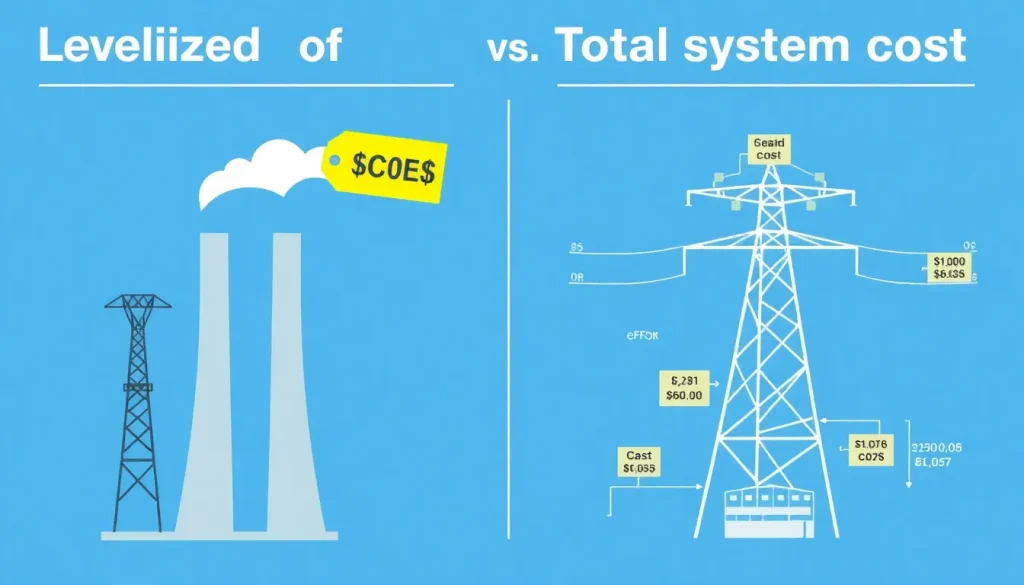
Levelized cost of energy (LCOE) is a metric that represents the average cost per unit of electricity generated by a specific power plant over its entire lifetime, expressed in currency per megawatt-hour (e.g., $/MWh). It accounts for all capital expenditures, fuel costs, operation and maintenance, and financing, discounted to a present value, and divides that total by the discounted energy output. In contrast, total system cost is a broader concept that encompasses all costs necessary to deliver electricity reliably to end users, including generation, transmission, distribution, grid balancing, storage, and the costs of maintaining system stability and security. While LCOE focuses on the supply side at the plant level, total system cost reflects the full economic burden of the entire electricity system.
These two metrics serve different purposes in energy economics and policy. LCOE is a straightforward tool for comparing the generation costs of different technologies at a single point of connection to the grid, assuming that each unit of electricity is equally valuable and dispatchable. However, it does not account for the fact that electricity must be supplied exactly when demanded, and that the value of a megawatt-hour varies with time and location. Total system cost addresses these shortcomings by including the costs of matching supply with demand, integrating variable renewable sources, and maintaining grid reliability. As the share of intermittent renewables grows, the divergence between LCOE and total system cost becomes more pronounced, making it essential to consider both metrics in energy planning.
Overview
The comparison between levelized cost and total system cost is central to modern energy economics and policy. LCOE has long been used as a benchmark to assess the competitiveness of different generation technologies, such as coal, natural gas, nuclear, wind, and solar. It provides a simple, standardized number that allows for direct comparison. However, as electricity systems evolve to incorporate higher shares of variable renewable energy (VRE) sources, the limitations of LCOE have become increasingly apparent. VRE sources like wind and solar have near-zero marginal costs but are intermittent and location-dependent, requiring additional system-level investments to ensure reliability.
Total system cost, sometimes referred to as system-levelized cost or full system cost, captures the economic implications of integrating these variable sources. It includes not only the generation costs but also the costs of transmission expansion, distribution upgrades, storage, backup capacity, and ancillary services needed to maintain grid frequency and voltage. The concept is crucial for understanding the true cost of decarbonizing the electricity sector and for designing market mechanisms that incentivize an optimal mix of generation, storage, and demand-side resources. While LCOE remains a useful metric for comparing individual plants, total system cost provides a more holistic view for long-term planning and policy decisions.
How It Works
LCOE is calculated by summing all discounted costs over a plant’s lifetime and dividing by the discounted energy output. The formula is: LCOE = (sum of (Cost_t / (1 + r)^t)) / (sum of (Electricity_t / (1 + r)^t)), where Cost_t includes capital, fuel, operation and maintenance, and decommissioning costs in year t, and r is the discount rate. This yields a single cost per unit of electricity, allowing straightforward comparison between technologies. For example, a natural gas combined-cycle plant might have an LCOE of $40–$60/MWh, while a utility-scale solar PV plant might have an LCOE of $30–$50/MWh, depending on location and assumptions.
Total system cost, on the other hand, is not a single formula but a framework that aggregates multiple cost components. These include: (1) generation costs (the LCOE of all plants in the system); (2) transmission and distribution infrastructure costs; (3) balancing costs to match supply and demand in real time; (4) costs of maintaining reserve margins and frequency control; (5) costs of storage or backup capacity to compensate for variability; and (6) externalities such as environmental impacts or grid stability risks. Because total system cost depends on the specific mix of technologies, geographic factors, and policy goals, it is typically estimated using sophisticated energy system models that simulate hourly operations over many years. These models optimize the generation and transmission expansion to meet demand at the lowest total cost, subject to reliability and environmental constraints.
Importance and Impact
The distinction between LCOE and total system cost has profound implications for energy policy and investment decisions. Relying solely on LCOE can lead to a misallocation of resources, as it may favor technologies that appear cheap on a per-MWh basis but impose high integration costs on the system. For instance, while wind and solar have low LCOEs, their variability requires additional investments in flexible generation, storage, and grid infrastructure to maintain reliability. If these system costs are not accounted for, the apparent cost advantage of renewables may be overstated, potentially leading to underinvestment in necessary backup or grid upgrades.
Conversely, total system cost analysis can reveal that a mix of technologies—including those with higher LCOEs, such as nuclear or natural gas with carbon capture—may be more cost-effective at the system level when reliability and environmental constraints are considered. This metric is particularly important for long-term planning and for designing electricity markets that ensure resource adequacy. Policymakers and regulators increasingly use total system cost assessments to evaluate the economic efficiency of different decarbonization pathways and to set appropriate incentives for both renewable and conventional generation, storage, and demand-side resources.
Benefits
LCOE offers several benefits as a metric. It is simple to calculate and easy to understand, providing a quick, standardized comparison of generation costs across technologies. This simplicity has made it a widely used benchmark in the energy industry and policy circles. LCOE is particularly useful for comparing dispatchable technologies with similar operational characteristics, such as different types of thermal power plants, where the value of electricity produced is relatively uniform.
Total system cost, on the other hand, provides a more comprehensive and realistic assessment of the economic implications of different generation portfolios. Its main benefit is that it captures the full cost of delivering reliable electricity, including the often-overlooked expenses of grid integration and system balancing. This holistic view helps avoid the pitfalls of optimizing for a single metric and supports the design of more resilient and cost-effective energy systems. By accounting for the value of flexibility, location, and reliability, total system cost analysis can guide investments that minimize overall societal costs while meeting environmental and security objectives.
Limitations and Trade-offs
Despite its widespread use, LCOE has significant limitations. It does not account for the time-varying value of electricity, the cost of integrating intermittent sources, or the system services required to maintain grid stability. LCOE comparisons can be misleading when applied across different technology types, especially between dispatchable and variable renewable generators. For example, a solar plant with a low LCOE may produce electricity only during sunny hours, requiring backup or storage that adds to the total system cost. LCOE also ignores locational factors, such as transmission constraints and losses, which can substantially affect the delivered cost of electricity.
Total system cost analysis, while more comprehensive, is not without its own challenges. It is highly complex and model-dependent, requiring detailed assumptions about future technology costs, fuel prices, demand patterns, and policy frameworks. The results can vary significantly based on the chosen system boundaries, discount rates, and reliability standards. Additionally, total system cost estimates are often less transparent and harder to communicate to non-experts than LCOE. There is also a trade-off between accuracy and simplicity: while total system cost provides a fuller picture, it may be too cumbersome for quick comparisons or for use in simple policy instruments like feed-in tariffs.
Common Misconceptions
A common misconception is that the technology with the lowest LCOE is always the most cost-effective choice for the electricity system. In reality, a low LCOE does not guarantee low total system cost, because it ignores integration and balancing expenses. For instance, adding large amounts of solar PV with a very low LCOE can increase total system cost if it requires significant investment in storage and grid upgrades to manage its variability. Another misconception is that total system cost is simply LCOE plus transmission and distribution costs. In fact, total system cost includes a much wider range of factors, such as the cost of maintaining frequency and voltage stability, the expense of holding reserve capacity, and the economic impact of curtailment.
Some also mistakenly believe that LCOE and total system cost are competing metrics, when they are actually complementary. LCOE is a useful starting point for technology comparison, while total system cost provides the context needed for system-level planning. Finally, there is a misconception that total system cost is a fixed number; it is highly dependent on the specific system configuration, geographic context, and policy objectives, and can change over time as technology and demand evolve.
FAQ
What is levelized cost vs total system cost?
Levelized cost of energy (LCOE) is the average cost per unit of electricity from a specific power plant over its lifetime. Total system cost includes all expenses to reliably deliver electricity to consumers, such as generation, grid infrastructure, storage, and balancing services.
How does LCOE differ from total system cost?
LCOE is a plant-level metric that ignores system integration costs, while total system cost captures the full economic burden of the entire electricity system, including the costs of managing variability and maintaining reliability.
Why does total system cost matter?
It matters because focusing only on LCOE can lead to underestimating the true cost of integrating variable renewable energy sources, potentially resulting in underinvestment in grid infrastructure and backup capacity, and higher overall costs for consumers.
References
- International Energy Agency (IEA), "Projected Costs of Generating Electricity," annual report.
- U.S. Energy Information Administration (EIA), "Levelized Cost of New Generation Resources," Annual Energy Outlook.
- National Renewable Energy Laboratory (NREL), "System Cost of Energy," technical reports.
- Joskow, P. L. (2011). "Comparing the Costs of Intermittent and Dispatchable Electricity Generating Technologies." American Economic Review.