In brief
At a glance
Quick Facts
- Verdict
- Mixed
- Problem addressed
- Industrial and atmospheric CO₂ emissions
- Evidence strength
- Moderate
- Potential scale
- Global
- Relative cost
- High
- Time to impact
- Years to decades
Quick verdict
Carbon capture, utilization and storage (CCUS) is a set of technologies that capture carbon dioxide (CO₂) from large industrial sources or directly from the air, then either use it in products or inject it into deep geological formations for permanent storage. It is technically feasible and has been demonstrated in multiple projects, but large-scale deployment remains limited by high costs, energy requirements, and infrastructure challenges. CCUS is not a standalone solution to climate change; it is most promising as a complement to rapid emissions reductions, particularly for hard-to-abate sectors like cement and steel, and for achieving negative emissions. Its overall promise is mixed: necessary in many climate scenarios, yet unproven at the gigatonne scale and economically challenging without strong policy support.
Problem addressed
CCUS targets the accumulation of CO₂ in the atmosphere from fossil fuel combustion and industrial processes, which is the primary driver of anthropogenic climate change. While renewable energy and efficiency can decarbonize much of the economy, certain emissions are difficult to eliminate: process emissions from cement production (from calcination of limestone), iron and steelmaking, and some chemical processes. Additionally, existing infrastructure and legacy assets may continue to emit for decades. CCUS aims to capture CO₂ before it enters the atmosphere or to remove it directly, thereby reducing net emissions and, in some configurations, achieving negative emissions when paired with bioenergy or direct air capture.
How the solution works
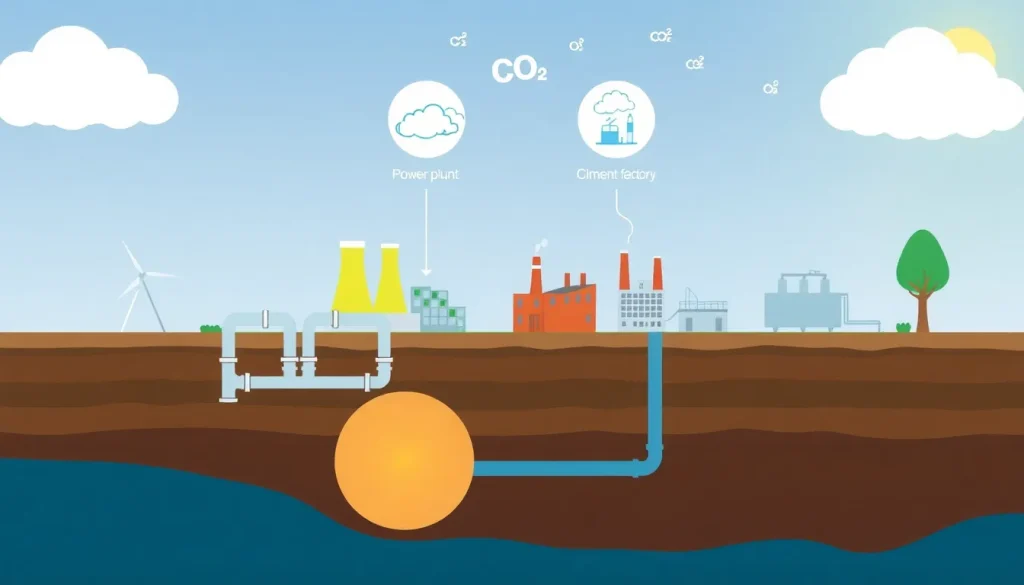
CCUS involves three main stages: capture, transport, and either utilization or storage. Capture technologies include post-combustion (scrubbing flue gases with chemical solvents like amines), pre-combustion (gasifying fuel and separating CO₂ before combustion), oxy-fuel combustion (burning fuel in pure oxygen to produce a concentrated CO₂ stream), and direct air capture (using chemical sorbents or filters to extract CO₂ from ambient air). Once captured, CO₂ is compressed and transported via pipeline, ship, or truck to a utilization or storage site. Utilization converts CO₂ into products such as chemicals, fuels, plastics, or building materials, though many of these re-release CO₂ upon use or decomposition. Enhanced oil recovery (EOR) injects CO₂ into oil fields to increase production; this can result in net storage if the CO₂ remains underground. Storage involves injecting CO₂ into deep geological formations, including saline aquifers, depleted oil and gas reservoirs, and unmineable coal seams, where it is trapped by impermeable caprock and gradually mineralizes. Monitoring, reporting, and verification (MRV) are essential to ensure permanence and detect any leakage.
Evidence strength
The evidence base for CCUS is moderate. Numerous pilot and demonstration projects have operated for decades, providing valuable operational data. The Sleipner project in Norway has stored approximately 1 million tonnes of CO₂ per year in a saline aquifer since 1996, with no detected leakage. The Boundary Dam project in Canada, the world’s first commercial-scale CCS on a coal power plant, captured around 1 million tonnes per year but faced technical issues and lower-than-expected capture rates. The Petra Nova project in the United States captured 1.4 million tonnes per year for EOR but was shut down in 2020 due to low oil prices; it restarted in 2023. Direct air capture remains at an early stage: Climeworks’ Orca plant in Iceland captures 4,000 tonnes per year. Globally, CCUS facilities capture about 40 million tonnes of CO₂ annually (as of 2023), a tiny fraction of the gigatonne scale needed to meet climate targets. Integrated assessment models used by the IPCC consistently include CCUS in pathways limiting warming to 1.5°C or 2°C, but these are scenarios, not predictions. Long-term storage security is supported by natural analogues and decades of monitoring, but large-scale, long-term performance data are still limited. The evidence is strongest for capture from high-purity sources and storage in well-characterized geological formations; it is weakest for direct air capture and for the net climate benefit of utilization pathways.
Potential scale
CCUS has global potential. Geological storage capacity is vast, with estimates ranging from 8,000 to 55,000 gigatonnes of CO₂, far exceeding cumulative emissions to date. In climate mitigation scenarios, CCUS could capture between 1 and 10 gigatonnes of CO₂ per year by 2050, and up to 20 gigatonnes per year by 2100. However, current global capture capacity is around 0.04 gigatonnes per year, highlighting an enormous scaling challenge. Achieving gigatonne-scale deployment would require a massive build-out of capture facilities, CO₂ transport networks, and storage infrastructure, along with supportive policies, public acceptance, and substantial cost reductions. Utilization potential is more limited: the global market for CO₂-derived products is unlikely to exceed a few hundred million tonnes per year, and many products do not provide permanent storage. EOR is the largest current use of captured CO₂, but its climate benefit depends on the net carbon balance of the entire oil production cycle. Scaling CCUS is constrained by the availability of suitable storage sites, the energy and water requirements of capture processes, and the need for extensive pipeline networks. In regions without favorable geology or existing infrastructure, CCUS may be impractical.
Cost considerations
CCUS is currently a high-cost mitigation option. Capture is the most expensive step, accounting for 70–80% of total costs. For power generation, capture costs range from $50 to $100 per tonne of CO₂, increasing the levelized cost of electricity by 30–50%. For industrial processes like cement and steel, costs are typically $40–120 per tonne. Direct air capture is far more expensive, with current costs estimated at $200–600 per tonne, though developers aim to reach $100 per tonne with technological learning. Transport and storage add $10–30 per tonne, depending on distance and geology. These costs are generally higher than those of many alternatives: onshore wind and solar PV are now cheaper than fossil fuels in most regions, and energy efficiency measures often have negative costs. However, for sectors where no low-cost alternatives exist, CCUS may be economically justified if carbon prices or subsidies are sufficient. The US 45Q tax credit provides up to $85 per tonne for permanent storage, making some projects viable. Costs are expected to decline with deployment and innovation, but learning rates are uncertain and likely slower than for modular technologies like solar panels. Without robust carbon pricing or equivalent policies, CCUS will struggle to compete.
Implementation time
Individual CCUS facilities can be built within 3–5 years once planning, permitting, and financing are secured. However, the lead time for storage site characterization, regulatory approval, and pipeline construction can extend this to a decade or more. Once operational, emissions reductions are immediate. Scaling to gigatonne levels will take decades, requiring sustained investment, policy stability, and the development of CO₂ transport and storage networks. Direct air capture is still in the early demonstration phase; large-scale plants are unlikely before the 2030s. The overall timeline for CCUS to make a meaningful dent in global emissions is measured in decades, not years, and is highly dependent on the pace of policy and infrastructure development.
Environmental benefits
The primary environmental benefit of CCUS is the reduction of CO₂ emissions to the atmosphere. When applied to industrial point sources, it can cut emissions by 90% or more, enabling near-zero-emission production of cement, steel, and chemicals. When combined with bioenergy (BECCS) or direct air capture (DACCS), it can achieve negative emissions, actively removing CO₂ from the atmosphere. This is considered essential in many climate scenarios to offset residual emissions from agriculture and aviation. However, the capture process itself consumes energy, which may increase local air pollutants and water use if the energy source is fossil-based. The net environmental benefit depends on the full life cycle, including upstream methane leakage and the carbon intensity of the energy used for capture. Properly sited and monitored geological storage poses minimal risk to groundwater or ecosystems, and the risk of catastrophic leakage is considered very low based on current understanding.
Social and economic co-benefits
CCUS can help preserve jobs in fossil fuel and heavy industries by enabling their continued operation with reduced emissions. It can create new employment in engineering, construction, and monitoring. In regions dependent on such industries, CCUS may ease the transition to a low-carbon economy. Improved local air quality is possible if capture systems also remove sulfur dioxide and particulate matter. However, these co-benefits are contingent on genuine emissions reductions and do not outweigh the risks of delaying the shift to cleaner energy sources. Public opposition to CO₂ storage (the “not in my backyard” effect) and to pipeline construction is a significant social barrier. Economic benefits are largely tied to policy incentives; without carbon pricing or subsidies, CCUS projects are rarely commercially viable. There is also a risk that over-reliance on CCUS could perpetuate fossil fuel use and divert investment from renewables and efficiency, a moral hazard that could increase long-term climate damages.
Risks and unintended consequences
CCUS carries several risks. CO₂ leakage from storage sites could harm local ecosystems, contaminate groundwater, and negate climate benefits. While the probability is low for well-selected and managed sites, long-term liability remains unresolved. Injection can induce seismicity, though most events are small. The energy penalty of capture increases fuel consumption per unit of output, potentially raising upstream emissions and other environmental impacts. Water usage for some capture processes can be significant in water-stressed regions. Utilization pathways often do not provide permanent storage; for example, CO₂-derived fuels release CO₂ when burned. EOR extends the life of oil fields and may lead to net positive emissions if the extracted oil is combusted. The biggest systemic risk is moral hazard: the promise of future CCUS deployment may be used to justify continued fossil fuel extraction and delay the transition to renewable energy. High costs could also divert limited climate finance from more cost-effective mitigation options. Finally, the sheer scale of infrastructure required—pipelines, wells, monitoring networks—poses land-use and safety challenges.
Where it works best
CCUS is most effective and economical when applied to large point sources with high-purity CO₂ streams, such as natural gas processing, ammonia production, and ethanol fermentation, where capture costs can be as low as $15–25 per tonne. It is also well-suited to industrial clusters where shared CO₂ transport and storage infrastructure can reduce costs. Regions with favorable geology—extensive saline aquifers or depleted oil and gas fields—and existing pipeline networks are prime candidates. Strong policy support, such as the 45Q tax credit in the United States or Norway’s carbon tax, is critical. CCUS is particularly valuable for decarbonizing cement and steel production, where process emissions cannot be avoided by fuel switching alone. It is also the leading technological option for delivering negative emissions via BECCS or DACCS, though these remain expensive and early-stage.
Where it may not work
CCUS is poorly suited for dispersed emission sources like vehicles, residential heating, and small industrial facilities, where capture is technically impractical or prohibitively expensive. In the power sector, the rapid cost declines of renewables and battery storage have made CCUS on new coal or gas plants economically uncompetitive in most regions; it may only be viable for retrofitting existing plants in specific circumstances. Regions without suitable storage geology or with high population density and public opposition face significant barriers. In many developing countries, the high upfront costs and lack of infrastructure make CCUS infeasible without substantial international support. Direct air capture, while geographically flexible, is currently too energy-intensive and costly to be a practical large-scale solution without major technological breakthroughs. In general, CCUS should not be pursued where cheaper, more sustainable alternatives can achieve equivalent or greater emission reductions.
Comparison with alternatives
CCUS is often compared to renewable energy, nuclear power, energy efficiency, and natural climate solutions. Renewables (solar, wind) and energy storage are now cheaper and faster to deploy for electricity generation, and they avoid the environmental risks of fossil fuel extraction. Energy efficiency measures reduce demand and often have negative costs. Nuclear power provides firm low-carbon electricity but faces high costs and public acceptance challenges. Afforestation and soil carbon sequestration are low-cost and provide co-benefits but are land-intensive, impermanent, and limited in scale. CCUS is unique in its ability to address industrial process emissions and to deliver permanent negative emissions. However, it is more expensive and energy-intensive than most alternatives for the same emission reduction. A cost-effective climate strategy would prioritize the cheapest and most scalable options first (efficiency, renewables) and reserve CCUS for the hardest-to-abate sectors and for negative emissions. In many integrated assessment models, CCUS becomes essential only after exhausting cheaper mitigation options.
Case studies
Sleipner, Norway: Since 1996, Equinor has captured CO₂ from natural gas processing and injected it into the Utsira saline aquifer. Over 20 million tonnes have been stored, with extensive monitoring showing no leakage. The project was driven by Norway’s carbon tax, making it economically viable. It demonstrates the technical feasibility and long-term security of geological storage.
Boundary Dam, Canada: SaskPower’s coal-fired power plant was retrofitted with post-combustion capture in 2014, aiming to capture 1 million tonnes per year. It faced operational challenges, including corrosion and solvent degradation, and achieved lower capture rates than planned. The project highlighted the technical difficulties and higher-than-expected costs of retrofitting existing power plants.
Petra Nova, United States: This post-combustion capture project on a coal plant in Texas captured 1.4 million tonnes per year for EOR. It operated from 2017 to 2020, when low oil prices made it uneconomical, leading to a shutdown. It restarted in 2023 after oil prices recovered. The case illustrates the dependence of EOR-based CCUS on oil market dynamics.
Climeworks Orca, Iceland: The world’s largest direct air capture plant, Orca captures 4,000 tonnes of CO₂ per year and stores it in basalt formations through mineralization. It is powered by geothermal energy. While a milestone for DAC, its tiny scale and high cost ($600–800 per tonne) underscore the immense challenge of scaling this technology.
Final assessment
Carbon capture, utilization and storage is a technically proven but economically and logistically challenging climate solution. It is not a silver bullet, nor is it a substitute for rapid and deep emissions cuts across all sectors. The strongest case for CCUS lies in decarbonizing hard-to-abate industrial processes and in providing a pathway for negative emissions, both of which are critical for meeting net-zero targets. However, its current high costs, energy penalty, and infrastructure requirements mean it should be deployed judiciously, with a focus on sectors and regions where it is most viable and where alternatives are lacking. Robust policy support, carbon pricing, and sustained public investment in R&D and infrastructure are essential to drive down costs and ensure safe, permanent storage. Public engagement and transparent monitoring are needed to build trust. While CCUS is likely to play a necessary role in the climate mitigation portfolio, it must be pursued alongside, not instead of, aggressive deployment of renewables, efficiency, and other low-carbon technologies.
FAQ
What is the difference between carbon capture and storage (CCS) and carbon capture, utilization and storage (CCUS)?
CCS refers to capturing CO₂ and storing it permanently underground without using it. CCUS includes utilization, where captured CO₂ is used to produce products like chemicals, fuels, or building materials, or for enhanced oil recovery. The climate benefit of utilization varies; only permanent storage or products that lock away CO₂ for long periods contribute to net emission reductions.
Is carbon capture safe?
Geological storage of CO₂ is considered safe when sites are carefully selected, managed, and monitored. Risks include potential leakage, which could contaminate groundwater or harm ecosystems, and induced seismicity. Decades of experience from projects like Sleipner show no significant leakage. However, long-term liability and the need for monitoring over centuries remain challenges.
Can carbon capture solve climate change on its own?
No. CCUS is not a standalone solution. It is one tool among many needed to reduce emissions. Rapid deployment of renewable energy, energy efficiency, and other low-carbon technologies is essential. CCUS is most valuable for hard-to-abate sectors and for achieving negative emissions, but it cannot compensate for a failure to cut emissions deeply across all sectors.
References
- IPCC, 2018: Global Warming of 1.5°C. Special Report.
- IEA, 2023: CCUS in Clean Energy Transitions.
- Global CCS Institute, 2023: Global Status of CCS Report.
- National Academies of Sciences, Engineering, and Medicine, 2019: Negative Emissions Technologies and Reliable Sequestration.
- Rubin, E.S., et al., 2015: The cost of CO₂ capture and storage. International Journal of Greenhouse Gas Control.