In brief
At a glance
Quick Facts
- Most abundant element
- Hydrogen is the most abundant element in the universe, but on Earth it is almost always bound in compounds like water or hydrocarbons.
- Current production
- Over 95% of hydrogen today is produced from fossil fuels, mainly natural gas, releasing about 830 million tonnes of CO2 annually.
- Green hydrogen definition
- Green hydrogen is produced by splitting water using electrolysis powered by renewable electricity, with zero direct carbon emissions.
- Energy density by mass
- Hydrogen has a very high energy density of about 120 MJ/kg, nearly three times that of gasoline.
- Energy density by volume
- At ambient conditions, hydrogen's volumetric energy density is very low, requiring compression to 350–700 bar or liquefaction at -253°C for practical use.
- Efficiency comparison
- A battery electric vehicle uses about 70–80% of the original electricity, while a hydrogen fuel cell vehicle uses only 25–35% due to conversion losses.
- Steelmaking potential
- Hydrogen can replace coal in direct reduced iron (DRI) processes, potentially cutting steel industry emissions by up to 90%.
- Ammonia production
- Around 70% of global hydrogen demand is for ammonia synthesis, mainly for fertilizers, making it a key sector for green hydrogen substitution.
- Pipeline challenges
- Hydrogen can embrittle steel and cause leaks; blending more than 20% hydrogen into existing natural gas pipelines is generally not feasible without major upgrades.
- Leakage climate impact
- Hydrogen leakage indirectly warms the climate by increasing atmospheric methane lifetime and contributing to ozone formation.
Key Takeaways
- Hydrogen is not a universal solution; its value depends on the specific application and the availability of better alternatives.
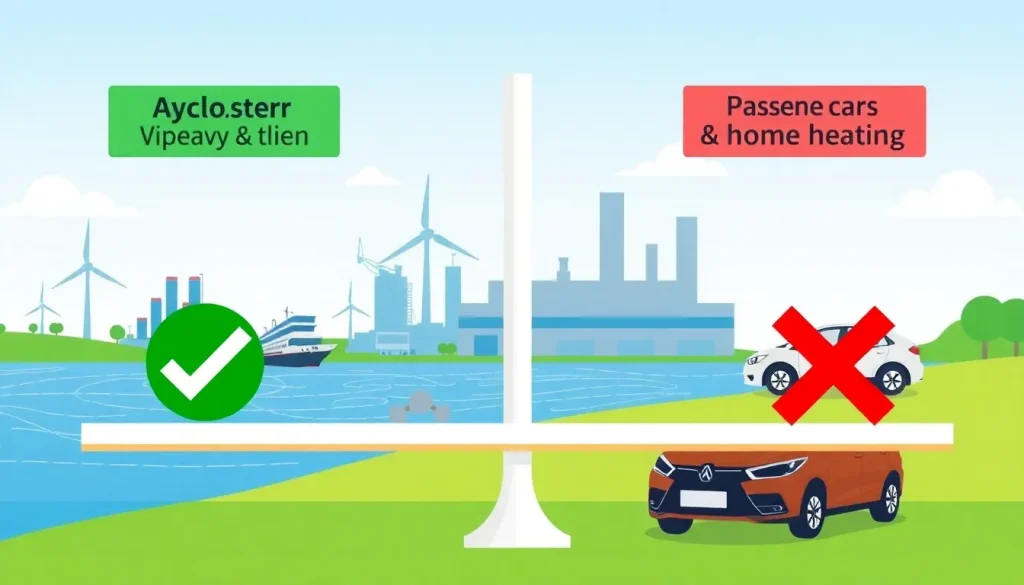
- Direct electrification with batteries is more efficient for most light-duty transport and heating, while hydrogen excels in hard-to-abate sectors like steelmaking, ammonia, and long-distance shipping.
- The environmental benefit of hydrogen hinges on its production method—only green hydrogen (from renewables) offers deep decarbonization.
- Hydrogen’s physical properties, including low volumetric energy density and metal embrittlement, create significant infrastructure challenges that limit its use in existing gas networks.
What Is Where Hydrogen Makes Sense—and Where It Does Not?
“Where Hydrogen Makes Sense—and Where It Does Not” is a framework for evaluating the optimal role of hydrogen as an energy carrier in a decarbonized economy. It recognizes that hydrogen is not a universal solution but rather a specialized tool best applied in sectors where direct electrification is technically or economically impractical. The concept helps policymakers, industries, and investors prioritize hydrogen deployment to maximize climate benefits while avoiding wasteful investments in areas where more efficient alternatives exist.
This framework emerged from the growing understanding that hydrogen’s unique properties—high energy per mass, ability to store energy for long periods, and use as a chemical feedstock—make it indispensable for certain “hard-to-abate” sectors. However, its low round-trip efficiency, high production costs, and infrastructure hurdles mean that in many applications, such as passenger cars or residential heating, battery-electric solutions or heat pumps are far superior. The goal is to direct hydrogen to where it truly adds value, rather than treating it as a panacea.
How It Works
Hydrogen can be produced through several methods, each with different environmental footprints. The most common today is steam methane reforming (SMR), which extracts hydrogen from natural gas but releases carbon dioxide—this is known as “grey” hydrogen. When carbon capture and storage (CCS) is added, it becomes “blue” hydrogen, reducing but not eliminating emissions. The cleanest pathway is electrolysis, where electricity splits water into hydrogen and oxygen; if powered by renewables, it yields “green” hydrogen with zero direct emissions.
Once produced, hydrogen can be converted back into energy through fuel cells, which combine hydrogen and oxygen to generate electricity with water as the only byproduct, or through combustion in turbines or engines. However, each conversion step incurs energy losses. For example, using green hydrogen to power a fuel cell vehicle typically results in only about 25–35% of the original renewable electricity reaching the wheels, compared to 70–80% for a battery electric vehicle. This efficiency gap is a key reason why hydrogen makes sense only where batteries cannot easily be used.
Benefits, Limitations and Trade-offs
Hydrogen offers several compelling benefits. It has a high energy density by mass (about 120 MJ/kg, nearly three times that of gasoline), produces zero greenhouse gas emissions at the point of use, and can be stored for long periods without significant losses. It also serves as a vital chemical feedstock for industries like ammonia production and petroleum refining, where there are few low-carbon alternatives.
However, hydrogen also has significant limitations. Its volumetric energy density is very low, requiring compression to 350–700 bar or liquefaction at -253°C for practical storage and transport—both energy-intensive processes. Hydrogen can embrittle steel and other metals, necessitating special materials for pipelines and tanks. The overall round-trip efficiency of hydrogen systems (electricity → hydrogen → electricity) is often below 40%, compared to 90% for battery storage. Safety concerns include its wide flammability range and the difficulty of detecting leaks, as hydrogen is odorless and burns with an invisible flame.
Examples
Where hydrogen makes sense:
- Heavy industry: Replacing coal and natural gas in steelmaking (direct reduced iron) and providing high-temperature heat for cement and glass production.
- Chemical feedstock: Producing ammonia for fertilizers and methanol for plastics, where hydrogen is already used but currently derived from fossil fuels.
- Long-haul transport: Fueling ships, trains on non-electrified routes, and possibly long-distance trucks, where batteries are too heavy or charging times too long.
- Aviation: Synthetic kerosene made from hydrogen and captured CO2 could decarbonize air travel, though it remains at an early stage.
- Seasonal energy storage: Storing excess renewable electricity as hydrogen for weeks or months to balance grid supply and demand.
Where hydrogen does not make sense:
- Passenger cars: Battery electric vehicles are far more energy-efficient, have a growing charging infrastructure, and are already cost-competitive.
- Residential heating: Heat pumps deliver 3–5 units of heat per unit of electricity, while hydrogen heating would waste most of the input energy.
- Short-haul trucks and buses: Battery-electric models are increasingly available and offer lower total cost of ownership.
- Light-duty commercial vehicles: For urban delivery vans, battery electric options are simpler and cheaper.
Environmental and Human Impacts
The environmental impact of hydrogen depends heavily on its production pathway. Grey hydrogen from unabated fossil fuels has a carbon footprint comparable to direct fossil fuel use. Blue hydrogen reduces emissions but still relies on natural gas and faces methane leakage and CCS efficiency challenges. Green hydrogen, produced via electrolysis using renewable energy, has the lowest lifecycle emissions, though it requires significant water resources—about 9 liters of water per kilogram of hydrogen for electrolysis, which can strain local supplies in arid regions.
Hydrogen leakage poses an indirect climate risk. Although hydrogen itself is not a greenhouse gas, it reacts in the atmosphere to increase the lifetime of methane and contribute to ozone formation, indirectly warming the planet. Studies suggest that if leakage rates exceed a few percent, the climate benefit of hydrogen could be partially offset. Additionally, combustion of hydrogen in air produces nitrogen oxides (NOx), which are air pollutants, though fuel cells avoid this. Safety risks include the potential for explosions in confined spaces, requiring robust handling protocols.
Common Misconceptions
“Hydrogen is a clean fuel.” Hydrogen is only as clean as its production method. Most hydrogen today is grey, made from natural gas, and has a significant carbon footprint. Calling hydrogen “clean” without specifying its source is misleading.
“Hydrogen cars are zero-emission.” While fuel cell vehicles emit only water vapor from the tailpipe, the full lifecycle emissions depend on how the hydrogen was produced. If made from fossil fuels, the overall emissions can be higher than those of a modern internal combustion engine vehicle.
“We can simply use existing natural gas pipelines for hydrogen.” Hydrogen can embrittle steel and cause leaks in standard pipeline materials. Blending small amounts (up to 20%) may be possible, but a full conversion requires expensive retrofitting or new dedicated pipelines.
“Hydrogen is the most efficient energy carrier.” In fact, hydrogen has significant round-trip energy losses. Converting electricity to hydrogen and back to electricity typically wastes over 60% of the input energy, making it far less efficient than direct electrification or battery storage.
What Businesses and Governments Can Do
Businesses and governments should prioritize hydrogen deployment in sectors where it offers the greatest decarbonization potential and where few alternatives exist. This includes creating demand-side policies for green hydrogen in steel, chemicals, and heavy transport, while avoiding subsidies for inefficient uses like hydrogen passenger cars. Investment in research and development can drive down the cost of electrolyzers and improve hydrogen storage and transport technologies.
Governments can establish clear certification schemes for green hydrogen to ensure environmental integrity, set safety standards for handling and infrastructure, and support the build-out of dedicated hydrogen pipelines and import terminals. International cooperation is essential to harmonize regulations and create a global market. At the same time, they should resist the temptation to over-promote hydrogen as a silver bullet, instead focusing on a balanced portfolio that includes direct electrification, energy efficiency, and other clean technologies.
FAQ
What is the main idea behind 'Where Hydrogen Makes Sense'?
It is a framework for identifying the most effective uses of hydrogen in a low-carbon economy, focusing on sectors where direct electrification is difficult, such as heavy industry and long-haul transport, while avoiding applications where batteries or other technologies are more efficient.
Why is hydrogen not suitable for passenger cars?
Battery electric vehicles are about three times more energy-efficient than hydrogen fuel cell vehicles when considering the full energy chain. They also benefit from a rapidly expanding charging infrastructure and lower operating costs, making hydrogen cars a less practical choice for personal transport.
How can hydrogen help fight climate change?
Hydrogen can decarbonize hard-to-abate sectors like steel, chemicals, and shipping by replacing fossil fuels. When produced as green hydrogen from renewable energy, it offers a zero-emission alternative for these industries, significantly reducing global greenhouse gas emissions.
References
- International Energy Agency (IEA), "The Future of Hydrogen," 2019.
- Intergovernmental Panel on Climate Change (IPCC), "Climate Change 2022: Mitigation of Climate Change," Working Group III contribution to the Sixth Assessment Report.
- National Renewable Energy Laboratory (NREL), "Hydrogen and Fuel Cells Research."